If you're comparing insulation options in South Florida, you're probably staring at a few quotes, seeing different R-values, and wondering why one product costs more than another. On paper, the answer looks simple. Higher R-value should mean better insulation.
In Florida, it isn't that simple.
A useful insulation R-value comparison has to look past the label and ask harder questions. Does the material stop humid air from moving into the house? Does it hold its shape in an attic? Does it leave gaps around wiring, ducts, and framing? Does it keep performing after years of heat, moisture, and service work overhead? Those are the questions that separate a decent insulation job from one that improves comfort.
R-value is the standard way to compare insulation because it measures resistance to heat flow. Higher R-values mean better thermal resistance. But even the basic definition comes with an important qualifier. The total performance of the assembly also depends on air sealing and installation quality, not just the insulation layer itself, as noted by InterNACHI in its guide to insulation R-values and installation performance.
That distinction matters more in South Florida than many generic insulation articles admit.
A homeowner here usually isn't fighting deep winter cold. They're fighting attic heat, roof-driven heat gain, outside humidity, duct leakage, and indoor comfort problems that show up as hot rooms, muggy air, and an AC system that never seems to rest. In that environment, a material with a respectable label rating can still underperform if air moves through it or around it.
A lot of people shop insulation the way they shop appliances. They compare the headline number and assume the highest one wins. That works in theory. It doesn't always work in a humid coastal climate where moisture movement can create comfort and durability issues long before the insulation's lab rating becomes the main problem.
If humid air keeps leaking into the building envelope, the house can feel uncomfortable even when the insulation depth looks fine. That's why moisture strategy matters as much as the insulation spec itself. If you're looking at the building as a whole, this guide on moisture barrier insulation gives a good picture of how insulation and moisture control work together.
In South Florida, the best insulation choice often isn't the one with the flashiest label. It's the one that still performs after air leaks, humidity, and real-world installation are factored in.
A good insulation job here does three things at once:
If one of those pieces is missing, the job can look fine from the hatch opening and still disappoint in daily use.
Homeowners often ask for a simple insulation chart first. That's fine as a starting point. In South Florida, though, the number on the label only helps if the material still performs after humidity, air leakage, and jobsite conditions get involved.
| Material | Typical R-value per inch | Practical note |
|---|---|---|
| Closed-cell spray foam | About R-6 to R-6.5 per inch | High R in limited space. Also helps reduce air movement and adds moisture resistance |
| Open-cell spray foam | About R-3.5 to R-3.6 per inch | Lower per inch than closed-cell. Expands well into irregular cavities |
| Fiberglass batts | About R-3 to R-4.3 per inch | Common and affordable. Performance depends heavily on fit and installation quality |
| Blown fiberglass | About R-3.1 to R-3.4 per inch | Often used in attics. Coverage can be good, but it does not air seal |
| Polyisocyanurate board | About R-5.6 to R-8.0 per inch | Strong rigid option where the assembly allows board insulation |
| Standard EPS board | About R-4 per inch | Useful rigid board for the right wall or roof detail |
| Graphite-enhanced EPS | About R-5 per inch | Higher-performing EPS option |
| Polyurethane or phenolic foam | Around R-7 per inch | High thermal performance in board or specialty applications |
| Aerogel | About R-10 to R-30 per inch | Specialty material, usually reserved for unusual constraints |
| Vacuum insulated panels | Around R-45 per inch | Extremely high per inch, but specialized and uncommon in residential work |
These ranges are drawn from material references summarized by Wikipedia's insulation R-value overview) and the broader comparison ranges compiled by EcoStar Insulation's R-value guide.
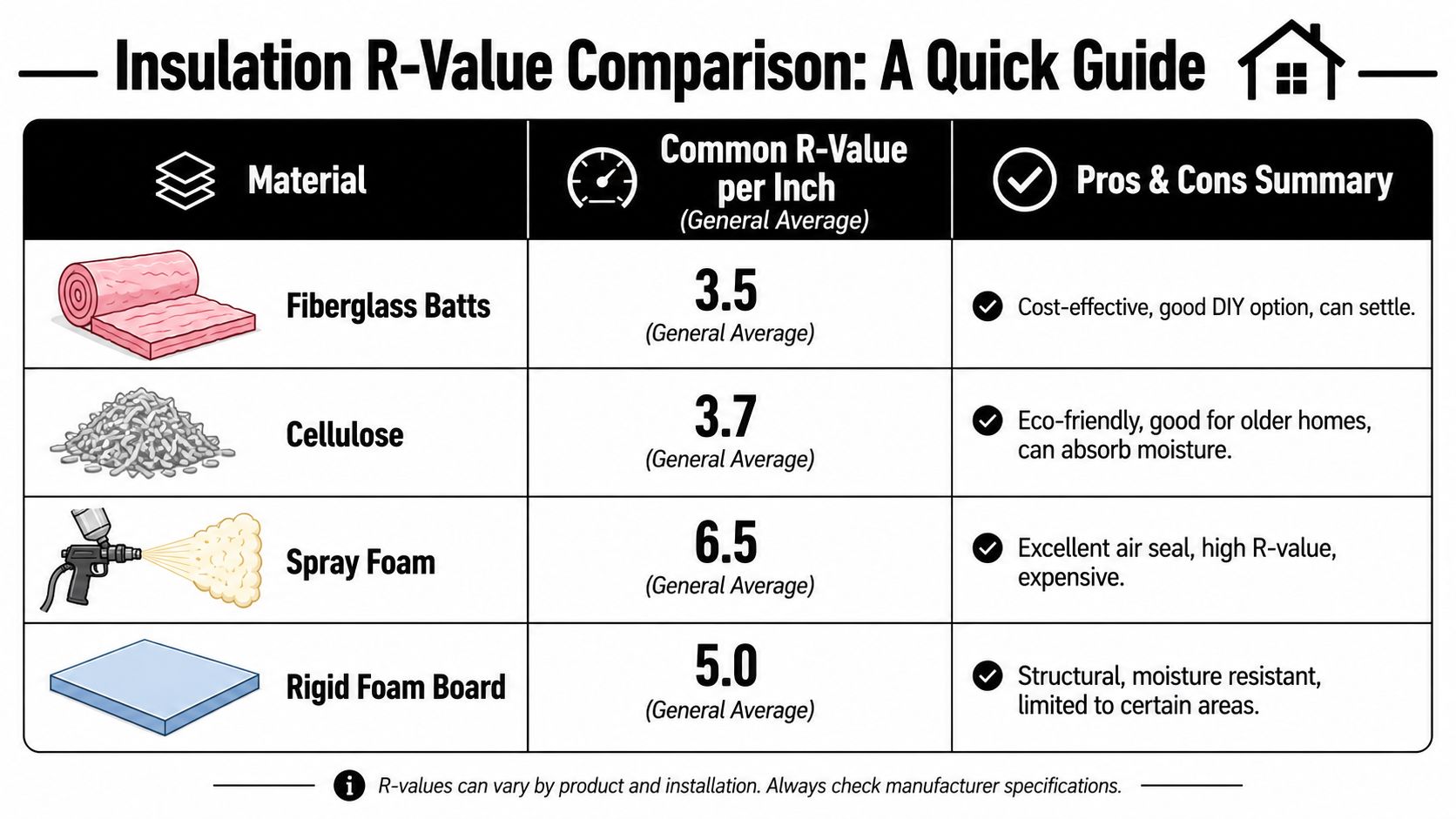
R-value per inch changes with the material's structure. Fibrous products rely on trapped air between fibers, so they usually need more thickness. Foam and rigid board products deliver more resistance in less space, which matters in tight rooflines, block walls with furring, rim joists, and retrofit areas where cavity depth is limited.
That still does not make the highest number the automatic winner.
In South Florida, practical performance depends on where the insulation goes, how well it fits the assembly, and how it handles humid air. A lower labeled R-value material that also controls air movement can outperform a higher labeled product that leaves gaps or allows moisture-laden air to move through the assembly.
Use the table to compare thickness efficiency first. Then look at what the material asks from the installation.
Fiberglass and blown products usually need more depth to reach the same total R-value. Rigid foam and spray foam make more sense where space is tight or where the assembly needs better control over air and moisture. For Florida-specific target ranges by area of the home, this guide on a good R-value for insulation in Florida homes is a useful companion to the raw material chart.
Baseline rule: Compare materials by R-value per inch, but choose them by how they will hold up in a humid, air-leaky building.
A label tells you what the product can do under controlled conditions. The building tells you what it will do after the crew leaves, the electrician cuts in a box, the HVAC contractor runs a new line, and the attic starts cycling through heat and humidity.
That gap between nominal value and field performance is where most insulation decisions should be made.
Fiberglass batts can work well when they're cut accurately, fitted tightly, and protected from compression. The problem is that many attics and wall cavities aren't simple rectangles. They have wiring, plumbing, framing irregularities, can lights, tight corners, and mechanical obstructions. Batts don't automatically solve those details. A crew has to solve them.
Blown fiberglass handles open attic floors better than batts in many cases because it covers broad areas more continuously. But it still doesn't air seal on its own. If the attic floor has penetrations, top plates, chase openings, or dropped soffits, air can still move through the assembly.
Fiberglass is often judged by what it looks like from six feet away. Performance depends on what happens in the small gaps you can't see from the attic hatch.
Spray foam changes the conversation because it conforms to the surface instead of asking the cavity to be perfect. Open-cell foam expands into irregular spaces. Closed-cell foam does the same while also delivering a higher R-value per inch. In assemblies with odd geometry, that matters.
Rigid foam boards can perform very well too, especially where flat, continuous surfaces allow careful installation. But boards are only as good as the cuts, seams, and transitions around them. In clean new construction details, they can be excellent. In irregular retrofit spaces, they can become labor-intensive fast.
For readers weighing those trade-offs directly, this comparison of foam versus fiberglass insulation is a helpful side-by-side look at where each one tends to make sense.
Different materials solve different problems. The mistake is expecting one product to be ideal everywhere.
Field reality: The best insulation on paper can lose to a better-installed material with stronger air control.
A few jobsite realities affect performance more than homeowners expect:
That's why experienced contractors spend more time on transitions, penetrations, and edge conditions than most buyers realize. Those areas don't show up in a brochure, but they drive comfort.
The biggest miss in most insulation R-value comparison articles is treating the insulation number as if it exists in isolation. In South Florida, it doesn't. Humid air is always looking for a path into the building, especially through attics, soffits, wall penetrations, duct chases, and recessed fixtures.
Once air moves, moisture moves with it.
Independent guidance summarized by Stellrr notes that gaps, compression, and voids can reduce insulation performance by 30% or more, and it also cites fiberglass batts dropping from about 3.14 R per inch when new to as low as 1.26 R per inch under poor installation conditions in the field, as explained in this article on real-world insulation R-values and installation quality.
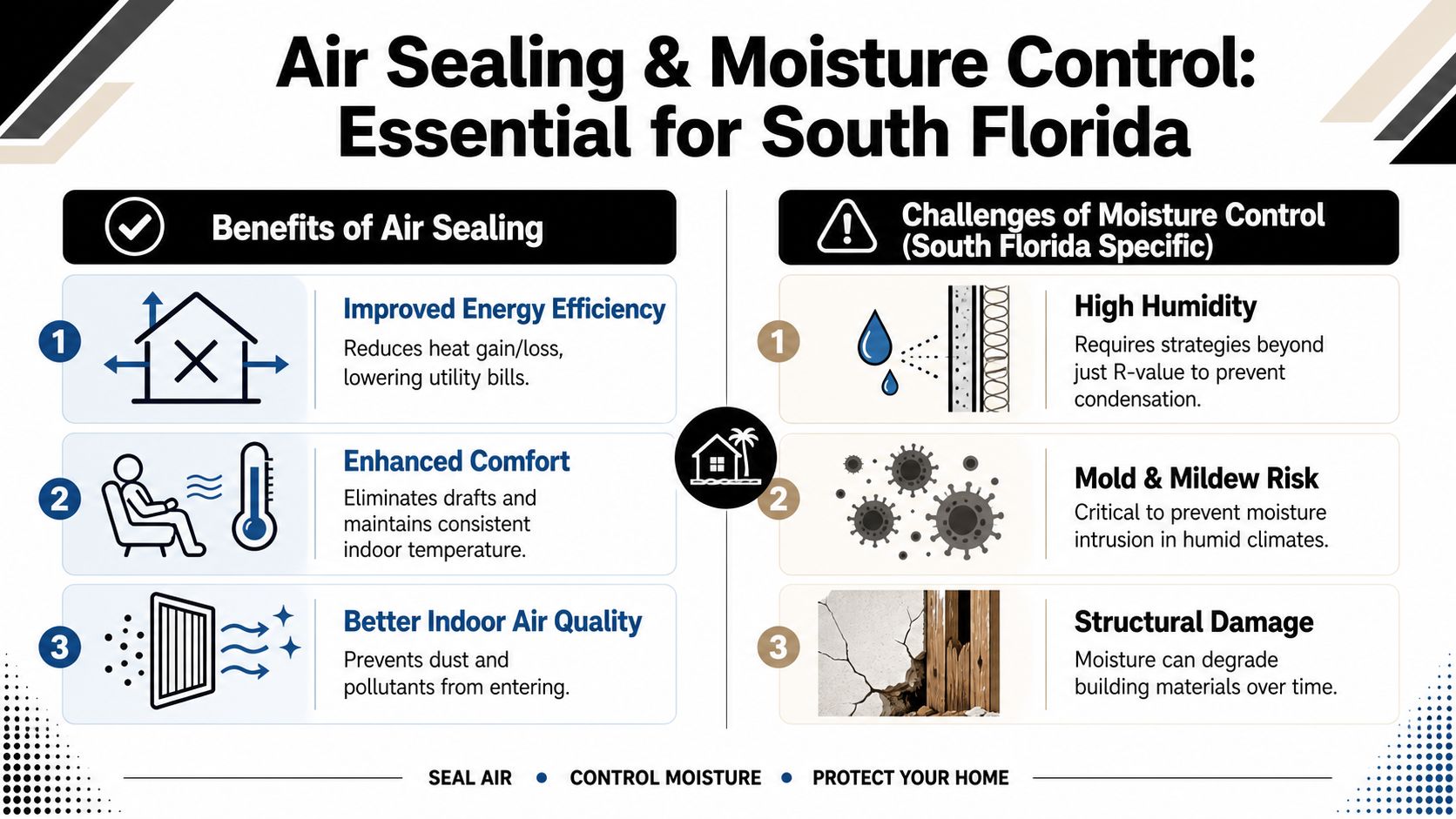
In a dry climate, poor insulation installation can still be costly. In a humid climate, it can also create moisture problems. Air leaks can pull damp outdoor air into cooler building cavities, and that raises the risk of condensation, musty odors, and material degradation.
That's why homeowners here should care about effective R-value, not just labeled R-value. Effective R-value is the performance you get after the assembly deals with real-world airflow, interruptions, and workmanship.
If you want to understand how contractors diagnose that side of the problem, this explanation of understanding blower door test results is worth reading. It helps connect comfort complaints to measurable leakage pathways instead of guessing based on insulation depth alone.
A house can have plenty of insulation and still feel wrong if outside air keeps bypassing it.
Spray foam earns its reputation because it doesn't just insulate; it also addresses air movement at the same time. In Florida assemblies where humidity control matters, that combined function is often more important than chasing the highest nominal R-value in a vacuum.
Closed-cell foam is especially useful when the assembly needs high R-value in limited depth along with better resistance to moisture movement. Open-cell foam can also improve air sealing in the right applications, but product choice should match the assembly and the moisture exposure.
Price matters. Anyone pretending otherwise isn't working with real homeowners, builders, or property managers. But the cheapest line item on the estimate often becomes the most expensive choice if the assembly leaves comfort problems, moisture risk, or recurring service headaches behind.
A smart insulation decision looks at installed value over time, not just first cost.
Fiberglass and other conventional products often win the initial bid because the material cost is lower and the install process is familiar. In the right application, that can be a reasonable decision. The problem starts when buyers compare that quote against a foam quote without accounting for what each system is doing.
One product may be supplying thermal resistance only. Another may be supplying thermal resistance plus air sealing in one installation step. Those aren't identical scopes of work, even if both are being called insulation.
When I look at long-term insulation value in South Florida, I focus on a few practical questions:
Cost lens: Don't compare insulation products as if they all perform the same job. Compare them by what problems they actually solve.
Higher-performance insulation usually makes the most sense when the building has one or more of these conditions:
In those cases, better air control and moisture management can justify a higher upfront investment because the owner isn't just buying R-value. They're buying a stronger building enclosure.
South Florida buildings aren't all built the same, and the insulation strategy shouldn't be either. A concrete block home in West Palm Beach presents different challenges than a wood-framed addition in Jupiter or a metal warehouse in Stuart.
The U.S. Department of Energy notes that insulation targets are climate-zone specific, with attic recommendations ranging from R-30 in the southern U.S. to R-60 in colder zones, and it specifically points out that for South Florida climate zones 1 and 2, controlling air leakage and solar heat gain in attics is often more critical than reaching extremely high R-values, according to the DOE's insulation guidance by climate zone.
Generic national advice often falls short. In colder regions, adding more attic R-value often dominates the discussion. Here, the conversation should also include attic ventilation strategy, roof deck conditions, duct location, and air leakage from the living space below.
For many Florida homes, the attic is the main heat and moisture pressure zone. If ducts and air handlers are up there, attic conditions matter even more. A roof and attic system designed for hot climates has to reduce solar heat loading and control uncontrolled air movement. For a roofing-focused perspective, these expert tips on hot climate roofing pair well with insulation planning.
Concrete block homes are common across South Florida. They behave differently than all-wood framed houses. Interior comfort problems in block homes often show up at the roofline, garage connection, additions, and transition areas where different assemblies meet.
Practical priorities usually include:
A conditioned attic strategy can be effective in the right home, especially where ductwork runs overhead and the attic is driving load into the living space.
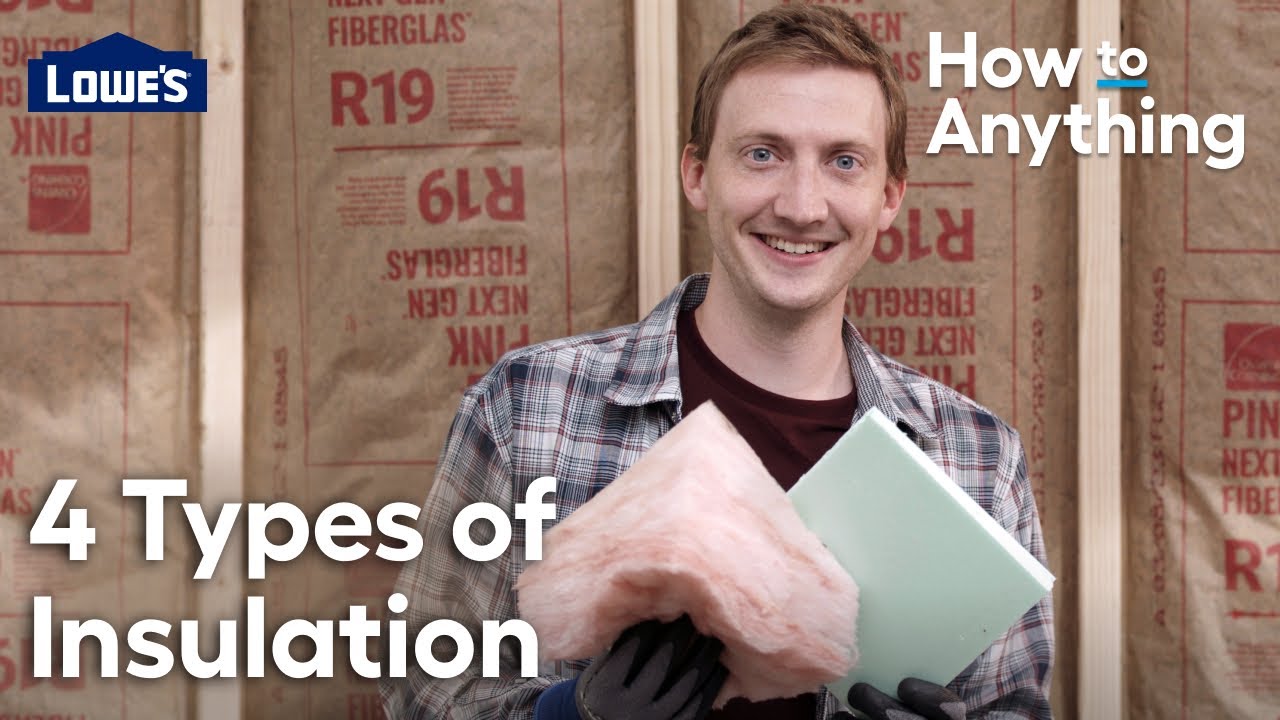
After the roofline discussion, this video gives a useful visual look at how insulation choices affect building performance:
Metal buildings, workshops, and warehouses create another set of challenges. They heat up fast, cool down unevenly, and can struggle with condensation if the insulation system doesn't control both temperature difference and air movement.
In those projects, the right system usually depends on how the building is used. Storage-only space, occupied workspace, and conditioned commercial use each call for different levels of enclosure performance. The key is to match the insulation approach to occupancy, moisture exposure, and the amount of climate control the owner expects.
A homeowner in South Florida usually calls after noticing one of three things. The upstairs stays hot, the AC runs longer than it should, or a room near the garage or roofline always feels damp. At that point, the question is simple. Which insulation choice will stand up in this climate?
The answer starts with the building, not the label.
A low-cost insulation option can still work in a straightforward area with easy access, solid installation, and careful air sealing. But in South Florida, labeled R-value by itself can be misleading. If humid air keeps moving through the assembly, effective performance drops, comfort suffers, and moisture problems follow.
Use the jobsite conditions to narrow the field:
Good insulation choices are project-specific. The best results come from matching the product to the building assembly, moisture exposure, and service conditions over time.
On real projects, three questions usually separate a good choice from an expensive mistake:
Those questions matter more here than they do in drier climates. A material can look fine on paper and still underperform if it allows air movement, traps moisture in the wrong layer, or gets compromised during later work. If you're still comparing room-by-room upgrade options, guides on ways to improve home insulation can help you sort through the practical differences before choosing a system.
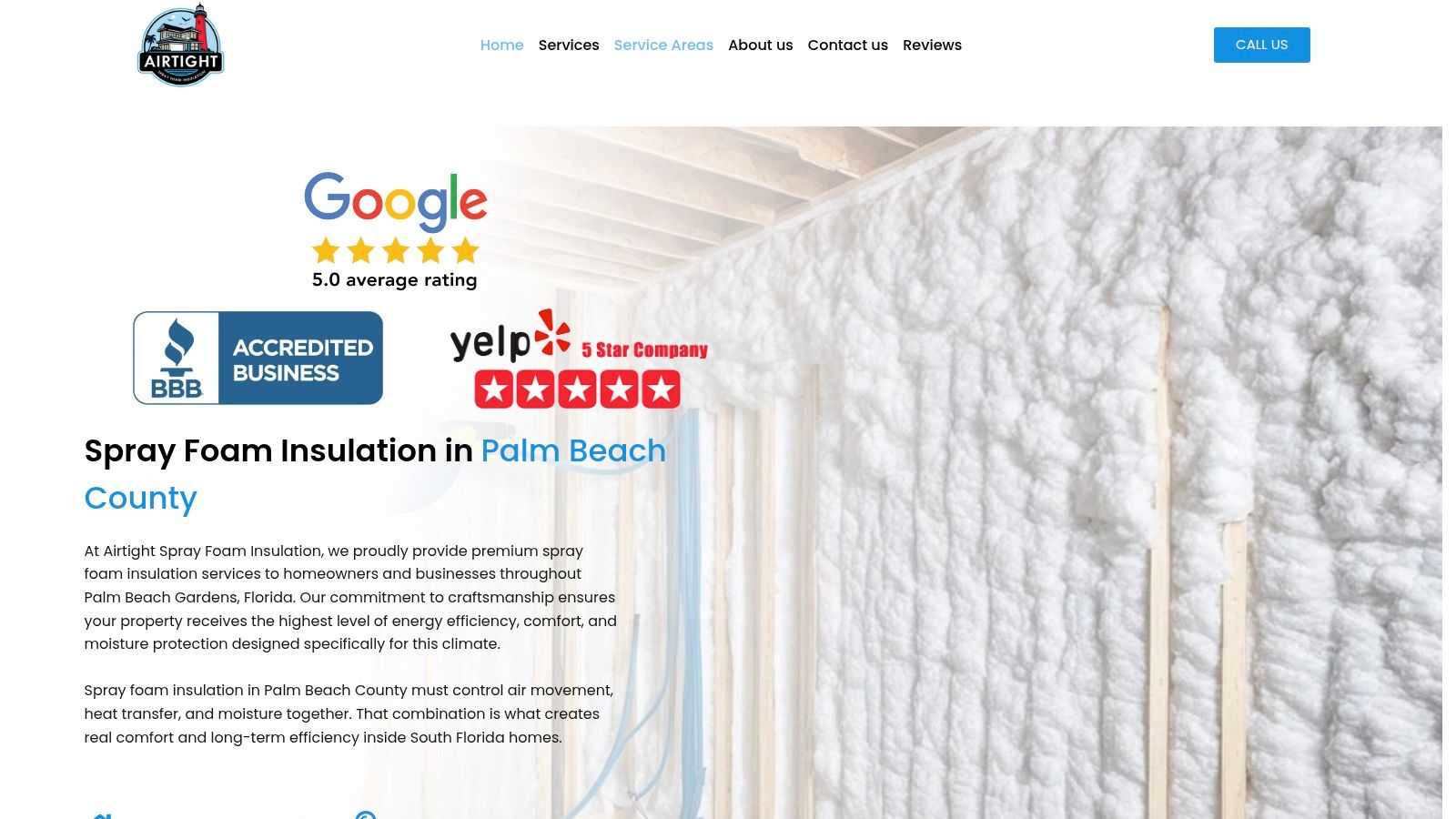
In performance-critical areas such as attics, roof decks, garage transitions, metal buildings, and moisture-sensitive assemblies, spray foam often stands out because it improves two parts of the enclosure at once. It adds insulation and limits uncontrolled air movement.
That does not mean every building needs the same foam product or the same assembly design. It means the best insulation comparison for South Florida usually favors the system that keeps humid air out, maintains its installed performance, and protects the building over time. In this climate, effective R-value often matters more than the number printed on the package.
If you want a recommendation based on your actual attic, walls, roofline, or building type, contact Airtight Spray Foam Insulation. Their team works with South Florida homeowners, builders, and property managers to compare insulation options with a focus on air sealing, moisture control, and long-term performance.