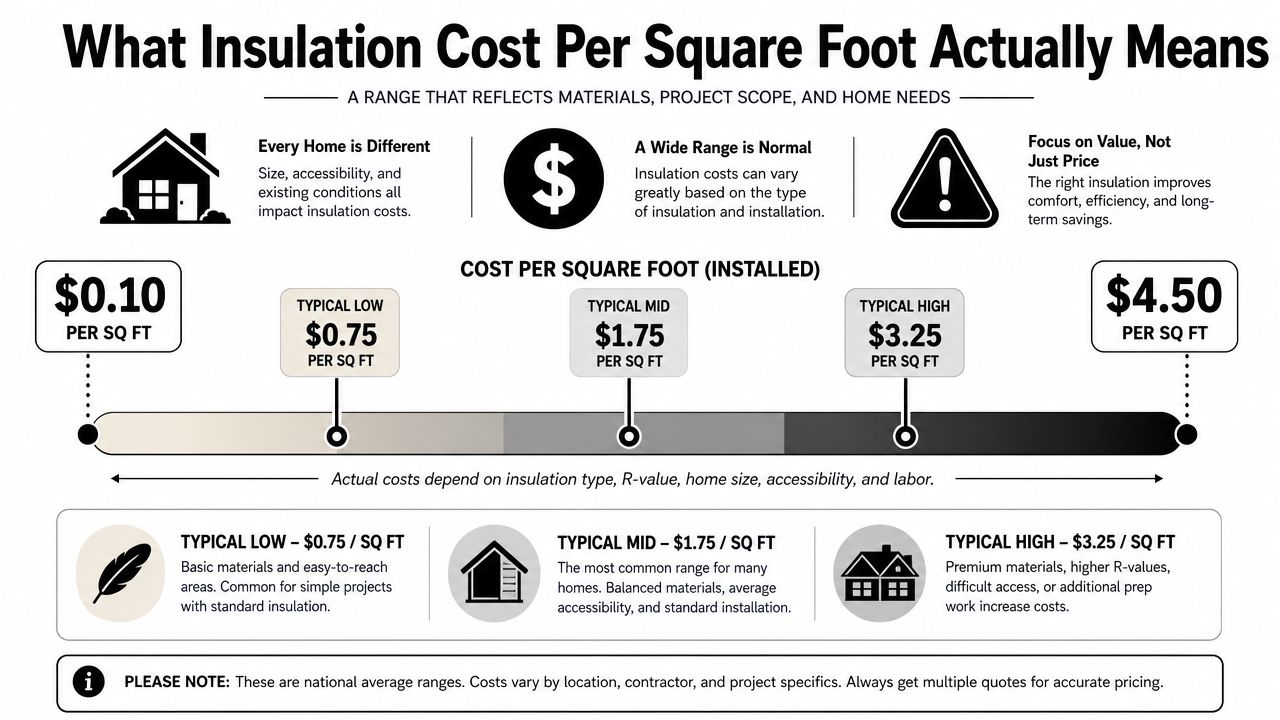
The 2026 installed range is about $0.30 to $6.75 per square foot, with a national average near $0.67 per square foot and typical whole-home projects around $1.26 to $2.78 per square foot depending on material and scope. For a 1,000-square-foot project, that can mean roughly $300 to $6,750 at the extremes, but most homeowners end up closer to $1,000 to $2,500.
That spread is why the answer depends almost entirely on material type and project location. A clean attic, a tight wall cavity, and a roof deck don't price the same, even if the square footage looks similar on paper.
Most homeowners ask for one number and get frustrated when the estimates vary. That's normal, because insulation pricing isn't just about area, it's about how much material is needed, how hard the space is to reach, and whether the job has to seal air and control moisture, not just add thermal resistance.
A quoted insulation cost per square foot is a shorthand, not a full scope. It usually folds materials, labor, prep, thickness, and access into one figure, which is why two homes with the same size can still produce very different bids.
That gap shows up fast in real jobs. A broad installed range can run from about $0.30 to $6.75 per square foot across residential insulation types, while current guides also place the national average near $0.67 per square foot and typical whole-home projects around $1.26 to $2.78 per square foot depending on material and scope (Gordian). The same benchmark explains why a 1,000-square-foot project can swing from roughly $300 to $6,750, while many homeowner budgets land closer to $1,000 to $2,500 for that size (Gordian).
A per-square-foot price usually reflects more than the bag, board, or spray chemical itself. It also covers how many passes the crew has to make, whether the cavity is open or crowded, and whether the installer has to work around existing systems.
Practical rule: if a quote is only expressed as a low per-square-foot figure, ask what thickness, prep, and access assumptions are built into it.
The phrase sounds precise, but it often hides the job. Fiberglass in a wide-open attic is a different animal from closed-cell foam sprayed into a vaulted roof deck, yet both can get quoted under the same headline number.
The better question is simple. What does this square foot need to do, and where is it going? If the answer includes air sealing, moisture control, or limited cavity depth, the price can move quickly even when the area stays the same.
For example, open-cell foam pricing can look reasonable on paper, but the installed number depends on whether the crew is filling a standard cavity or working around tight framing and roof geometry. A practical cost check, like open-cell foam insulation cost, makes more sense when you match it to the part of the home being insulated.
In South Florida, that difference matters even more. A wall cavity, an attic floor, and a roof deck do not ask the same thing from the insulation, so the square-foot quote should be read as a starting point, not the final story.
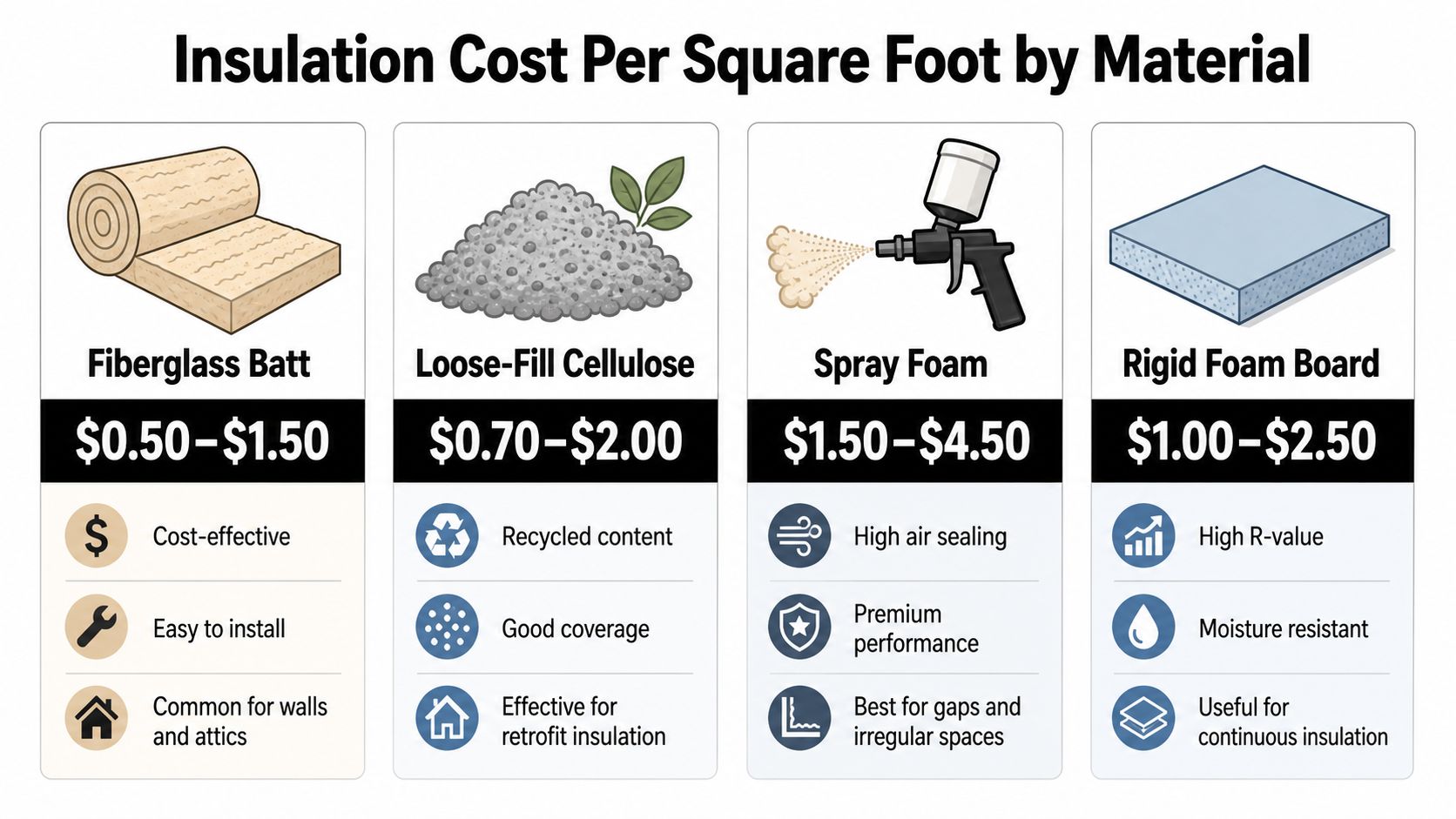
A material quote only makes sense if you know what job the insulation is doing. Fiberglass batts usually sit at the lower end, cellulose often comes in a bit higher, and spray foam sits in the premium tier because it insulates and seals air leaks at the same time. Closed-cell foam also adds more moisture resistance, which is why it gets specified more often in tighter assemblies.
The number on the estimate is only half the story. Spray foam can cost more per square foot, but it also gives you more R-value per inch, which matters when the cavity is shallow, the framing is irregular, or the space needs better control over air and humidity.
Open-cell spray foam is commonly about $1.50 to $3.00 per square foot installed, while closed-cell spray foam is typically about $2.00 to $4.50 per square foot installed (Insulation Calculator). In a new-construction dataset from the Insulation Institute, closed-cell spray foam, 5 inches thick, R-32.5E was listed at $2.76 per square foot for materials plus $0.56 and $0.54 for additional cost components, while fiberglass batt, unfaced, R-13 was listed at $0.33 plus $0.18 per square foot (Insulation Calculator).
| Material | Installed $/sq ft | R-value per inch |
|---|---|---|
| Fiberglass Batt | $0.30 to $1.50 | roughly R-3 to R-4 |
| Loose-Fill Cellulose | about $0.70 to $2.00 | about R-3 to R-3.7 |
| Open-Cell Spray Foam | about $1.50 to $3.00 | about R-3.5 to R-3.9 |
| Closed-Cell Spray Foam | about $2.00 to $4.50 | about R-6 to R-7 |
A contractor should explain the quote in terms of what the material does. Fiberglass is a basic thermal layer. Open-cell foam adds air sealing. Closed-cell foam gives you higher thermal resistance and stronger moisture control, which is why it gets used more often in demanding assemblies and in places where the homeowner wants more than just a thermal blanket.
Open-cell foam pricing also needs to be read in context. A homeowner comparing quotes should look at the installed number alongside the space being insulated, because a roof deck, a wall cavity, and an attic floor do not ask the crew to do the same kind of work. For a closer look at how that pricing shows up in real jobs, see open-cell foam insulation cost.
The labor split is different by material, too. Fiberglass usually installs fastest in open, accessible areas. Cellulose needs more cleanup and containment, while spray foam takes more prep, more equipment, and more care around framing, wiring, and uneven surfaces. That is part of why the installed price can rise even when the square footage does not change. For landlords and contractors comparing material and labor together, pricing roof work for landlords is a useful parallel, because the same site conditions can swing the quote in a hurry.
Two quotes can look wildly different for the same square footage, and that doesn't automatically mean one contractor is overcharging. The primary driver is how many problems the crew has to solve while they're on site.
Material type is the biggest obvious lever. Commodity products cost less because they're simpler to install, while spray foam costs more because it's doing more than one job.
Required thickness and R-value matter just as much. A shallow cavity that needs a stronger thermal layer pushes the price up because the installer needs more material or a denser system to reach the target.
Labor complexity changes the math fast. A batt job in an open attic is not the same as spraying a roof deck around ducts, wiring, and uneven framing.
Surface prep and access can add time before the first layer goes down. Removing old insulation, cleaning dusty framing, masking finished surfaces, and working in cramped spaces all increase the installed cost.
Moisture or code requirements often push homeowners toward higher-performance assemblies. In a humid climate, the job isn't just about temperature. It's about keeping the building dry enough to perform long term.
A clean, open attic costs less per square foot than a vaulted roof deck because the crew can move faster, spray more evenly, and hit thickness with fewer corrections.
The labor split is also different by material. On a basic batt job, material often drives more of the bill. On spray foam, labor, equipment, and time on site become a much bigger slice of the total.
For landlords and property owners who want a broader pricing framework, pricing roof work for landlords is a helpful comparison because roof labor, access, and margin work the same way as insulation pricing in a lot of real-world bids.
A strong quote should tell you what the crew is installing, not just the square footage. If it doesn't mention thickness, access, and the condition of the space, you're not comparing real jobs.
For homeowners looking at spray foam specifically, this cost of spray foam insulation resource helps frame why two jobs with the same area can still land in different price bands.
The easiest way to sanity-check a quote is to tie it to a real space. Square footage matters, but the project type matters just as much, because access and performance targets change from one area of the home to another.
A 1,000-square-foot attic is the most common homeowner comparison point, so it's a good baseline. At the low end, batt or blown-in material lands near the lower part of the installed range. In the middle, open-cell spray foam raises the bill because it adds air sealing. At the premium end, closed-cell foam costs more but delivers stronger thermal performance in less thickness.
A 400- to 600-square-foot garage conversion usually sits somewhere between basic comfort and full envelope control. If it's being turned into living space, the installer often has to think more like a builder than a commodity insulation crew.
A 2,000-square-foot metal building or workshop is a different animal altogether. Condensation control and thermal stability matter as much as heat resistance, so the quote often reflects more than just the area.
| Project | Square Footage | Low, Fiberglass or Cellulose | Mid, Open-Cell Foam | Premium, Closed-Cell Foam |
|---|---|---|---|---|
| Attic | 1,000 sq ft | about $300 to $1,500 | about $1,500 to $3,000 | about $2,000 to $4,500 |
| Garage Conversion | 400 to 600 sq ft | about $120 to $900 | about $600 to $1,800 | about $800 to $2,700 |
| Metal Building or Workshop | 2,000 sq ft | about $600 to $3,000 | about $3,000 to $6,000 | about $4,000 to $9,000 |
These are budgeting ranges, not promises. A real quote can move because of height, obstacle density, tear-out, or whether the space needs a tighter air seal before the insulation goes in.
For attic-specific budgeting, this spray foam attic insulation costs page is a useful reference when you're trying to compare different thicknesses and foam types.
In South Florida, attics often justify closed-cell foam at 3 to 5 inches when the goal is more than basic thermal resistance. Interior walls and sound control jobs are where open-cell usually earns its keep, because the priorities are different.
The best pricing conversations do not stop at installed cost. They ask how much performance you are getting for each dollar, because that is what tells you whether a higher quote is a better buy.
The U.S. Department of Energy's insulation guide puts the trade-off in plain terms. Open-cell spray foam comes in at about $0.17 per square foot per R-value, closed-cell at about $0.25, while fiberglass batt is around $0.02 to $0.03 and loose-fill around $0.03 (U.S. DOE). That gap explains why spray foam can look expensive up front, even when the performance picture is more favorable.
A low-cost batt can be the right answer if you only need basic thermal resistance. It gets you there cheaply, and the DOE guide makes that clear.
If the assembly also needs air sealing or moisture control, the lowest square-foot price may not be the lowest total solution. In that case, the buyer is not shopping for insulation alone, the buyer is paying for enclosure performance.
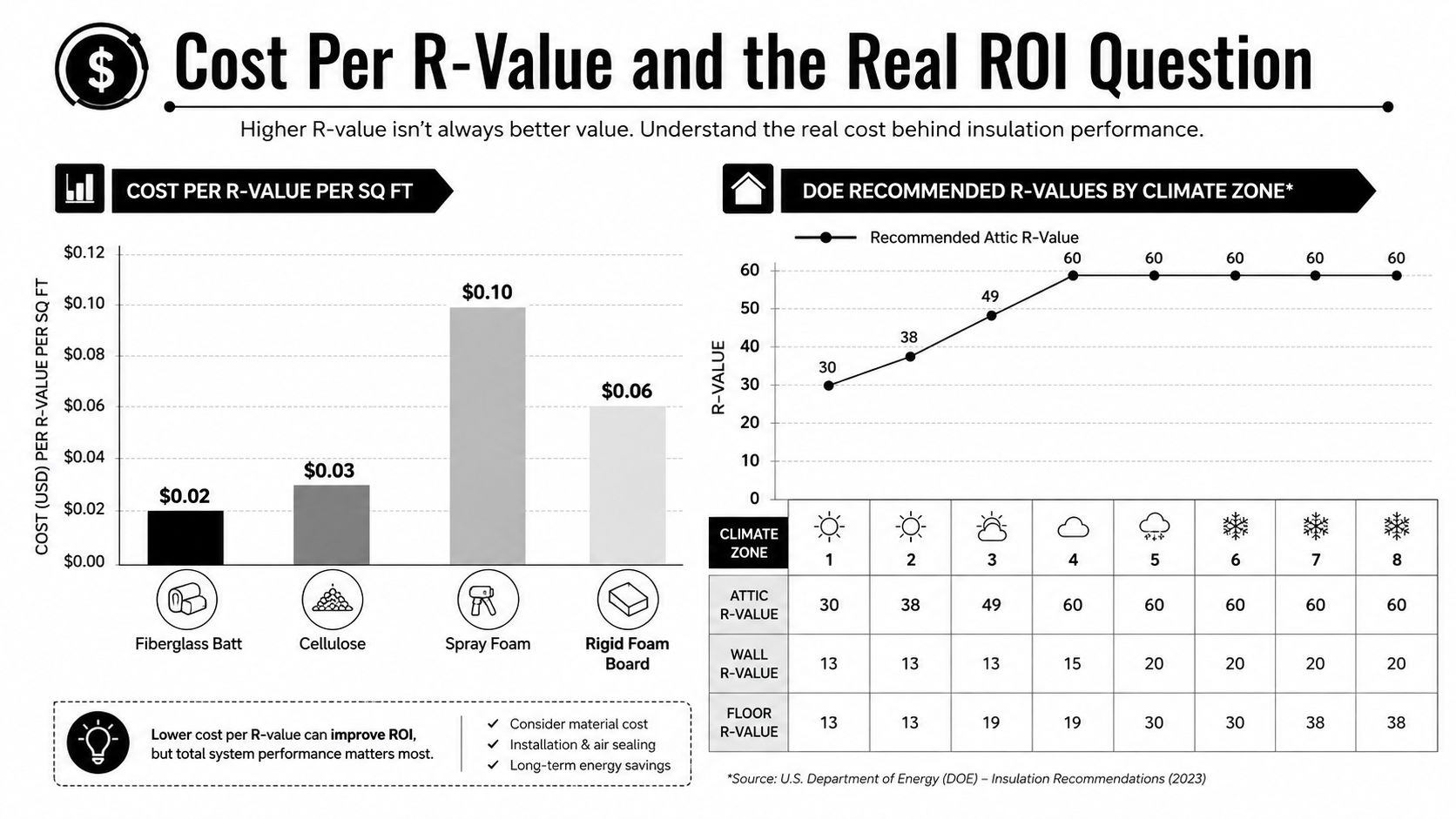
That is why a premium system can still make sense when the sticker price is higher. The value comes from the mix of thermal resistance, air sealing, and, in some assemblies, moisture control, not from the material label by itself.
For homeowners weighing upgrades against other home improvements, best energy saving home improvements is a practical resource for seeing where insulation fits in the broader efficiency picture.
In a hot climate, the payoff often comes from reducing attic heat gain and unwanted air leakage. That does not mean every home needs the same material, but it does mean the cheapest option is not automatically the most cost-effective one.
If the attic leaks air, the comfort problem is usually not just lack of R-value. It is an enclosure problem.
South Florida does not behave like a generic national market. Heat, humidity, wind-driven rain, and a long cooling season all change what a smart insulation quote should look like.
Closed-cell foam gets a lot of attention here because it does more than slow heat flow. At roughly R-6 to R-7 per inch, it delivers strong thermal performance in a limited cavity, and its moisture-resistant behavior matters in attic decks, rooflines, and metal buildings where condensation can turn into a real problem. That is why pricing in Jupiter, Palm Beach Gardens, West Palm Beach, Wellington, and Stuart can look different from pricing in a colder inland market.
In a humid coastal climate, insulation often has to help with air sealing too. If a hot, moist attic keeps leaking into conditioned space, the comfort loss shows up fast, and the HVAC system feels it.
Local crews often recommend closed-cell in roof decks and certain attic assemblies, while open-cell still has a place in sound control and some interior applications. The product choice should match the space, not a generic “good, better, best” chart.
In South Florida, the wrong insulation can still pass the eye test and fail the moisture test.
Metal buildings push the decision harder. Salt air, humidity, and temperature swings make condensation control a budgeting issue, not just a comfort issue. If the building is a workshop, warehouse, or storage space, the quote should reflect that reality.
Airtight Spray Foam Insulation, led by Christian Cates, brings over 25 years of hands-on experience to South Florida projects, which matters because regional pricing and assembly choices are shaped by local humidity and building conditions rather than national averages alone. Contractors also price the job around where the foam goes, not just the square footage. Roof decks, attic floors, wall cavities, and metal structures each carry different labor, prep, and moisture risks, so the headline number only makes sense when it is tied to the assembly. For homeowners comparing bids, that is the trade-off. A lower installed price can be fine in a dry, simple cavity, but in this climate the better quote is the one that accounts for air leakage, condensation risk, and the part of the house the insulation is protecting.
A good quote starts with good measurements. Before you call a contractor, know the square footage, the area you want insulated, and whether you're dealing with an attic, walls, a garage, or a roof deck.
Ask for the material type, thickness, and target R-value in writing. Those three details tell you whether you're comparing the same job or two very different ones.
The quote should also show surface prep, access constraints, ventilation considerations, and warranty terms. If the proposal skips those line items, it's usually incomplete.
A platform like Exayard HVAC estimating software can help contractors organize project details, but homeowners still need a written scope that spells out exactly what they're buying.
Red flags are easy to spot once you know what to look for. Vague “meets code” language without a specific number, an unusually low spray foam price, or no mention of vapor control usually means you need a second opinion.
If you want a straight answer for your home or project, Airtight Spray Foam Insulation can walk the space, compare material options, and price the job by the right scope instead of a generic square-foot guess. Visit Airtight Spray Foam Insulation to request a quote and compare the actual options for your attic, walls, garage, or metal building.