On a South Florida afternoon, the pattern is familiar. The thermostat is set where it should be, the air conditioner has been running for what feels like all day, and the house still feels sticky by mid-afternoon. Upstairs rooms lag behind. The hallway near the attic hatch feels warmer. By evening, the system is still grinding.
In homes across Jupiter, West Palm Beach, Wellington, and nearby communities, that usually points to one place first: the attic. In this climate, the attic isn't a neutral buffer zone. It's a heat-loaded, moisture-sensitive space sitting directly above your ceiling. If it's under-insulated, poorly sealed, or both, your HVAC equipment spends its life trying to overcome a problem that starts above your head.
That's where R-49 attic insulation enters the conversation. Not as a trendy upgrade, and not as a code buzzword, but as a serious target for homeowners who want better control over heat gain, humidity pressure, and day-to-day comfort. In South Florida, getting to R-49 is only part of the job. The harder question is how to get there without creating moisture trouble, blocking ventilation where it matters, or copying advice that makes sense in a dry northern attic but falls apart in a coastal climate.
A lot of homeowners start by blaming the equipment. That's understandable. If the house won't stay comfortable, the air conditioner looks guilty first. Sometimes it is. But plenty of systems are working exactly as they were designed to work, and they're still losing the battle because the attic is feeding heat into the home all day.
That's especially true in South Florida, where long cooling seasons expose every weak point in the building envelope. If you're comparing repair options, replacement timing, or basic system layouts, a primer on central heat AC systems can help you separate an HVAC issue from a house-performance issue. The two are connected more often than homeowners think.
The usual warning signs are consistent:
If the attic floor has thin insulation, gaps around wiring and ceiling penetrations, or compressed material, heat moves down and conditioned air leaks up. Before adding more insulation, it makes sense to deal with the hidden bypasses. Homeowners who want to understand that part of the job should look at how to seal attic air leaks, because insulation alone won't stop moving air.
Practical rule: If the attic is leaky, adding insulation on top of the leaks won't solve the whole problem. It just buries it.
South Florida homes also have another layer of risk. When warm, humid outdoor air finds pathways into the attic and then toward cooler house surfaces, comfort problems can turn into moisture problems. That's why a good attic strategy here has to do two things at once. It has to slow heat flow, and it has to manage air movement.
R-value is the measure of how well insulation resists heat flow. Higher R-value means better resistance. The simple way to think about it is a cooler. A thin cooler wall slows heat a little. A thicker, better-insulated cooler keeps ice longer because it resists heat transfer more effectively.
The same logic applies to your attic. The insulation above your ceiling is there to slow the flow of heat from the attic into the living space below. In South Florida, that matters most during cooling season, when the roof and attic assembly absorb heavy solar load for hours.

R-value works a lot like sunscreen. A low number gives limited protection. A higher number gives stronger protection against exposure. Insulation doesn't “block” heat in an absolute sense, but a higher R-value gives the house more resistance against that constant heat drive from the attic.
That's why R-49 attic insulation is treated as a performance target, not just a random label.
Energy Star's attic guidance lists R49 as the recommended attic level for retrofit projects in climate zones 2 and 3, which includes Florida, when an attic is currently uninsulated. The same guidance notes that reaching that level may require 13–14 inches of blown-in cellulose or 16–20 inches of blown-in fiberglass, which tells you something important right away. R-49 is not a thin layer. It is a substantial installed depth.
That depth is one reason homeowners underestimate the job. They look into the attic, see some existing material, and assume they're close. Often they're not. A quick insulation R-value calculator can help estimate where the attic stands before anyone talks about adding material or changing the assembly.
R-49 became the benchmark because it's high enough to deliver meaningful performance without drifting into “more just because more sounds better.”
In practice, I'd describe R-49 as the point where the attic starts acting like a real thermal control layer instead of a token one. For South Florida homeowners, that matters because your cooling system is dealing with that attic load day after day, month after month.
There's no single material that solves every attic. The right approach depends on whether you're insulating the attic floor or the roofline, whether the attic is vented or unvented, and how much depth you have to work with. In South Florida, those decisions also have to account for air leakage and moisture behavior, not just nominal R-value.
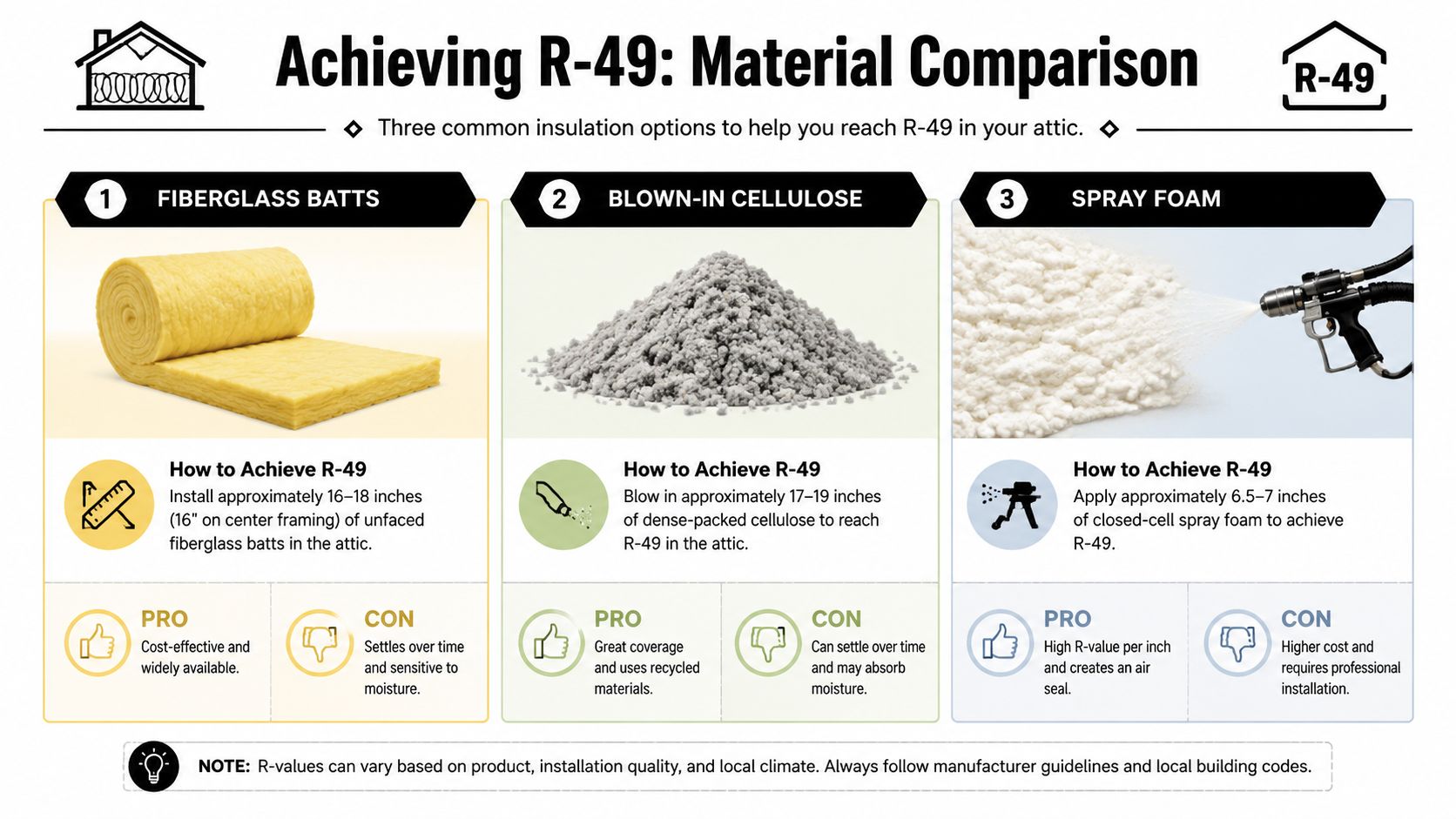
If the attic is a conventional vented attic and the insulation sits on the attic floor, the common choices are fiberglass batts, blown-in fiberglass, and blown-in cellulose.
| Material | What it takes to reach R-49 | What works well | Where it falls short |
|---|---|---|---|
| Fiberglass batts | Multiple layers or deep batt assembly | Straightforward in open attic floors | Easy to leave gaps, voids, and compression |
| Blown-in cellulose | Around the depth commonly associated with R-49 in Energy Star guidance | Good coverage over irregular attic floors | Must stay dry and be installed evenly |
| Blown-in fiberglass | Also requires substantial depth | Fast coverage in large open attics | Lower air control than foam-based systems |
Batts can work when the attic is open, accessible, and carefully detailed around trusses, wiring, and mechanical obstructions. The problem is that many attics are not clean rectangles. They're full of intersections, low edges, duct runs, recessed fixtures, and access limitations. Batts don't forgive sloppy work.
Blown-in materials cover irregular surfaces better. That's one reason they're common for vented attic floors. But they still don't create an air seal. If the ceiling plane below is leaky, the insulation layer is doing only part of the job.
A closer look at spray foam insulation value per inch helps explain why foam gets so much attention in roofline applications and tight assemblies.
Spray foam becomes more attractive when depth is limited or when the goal is to insulate the roof deck instead of the attic floor. That's common in homes where homeowners want a conditioned or semi-conditioned attic, or where ductwork is exposed to harsh attic conditions.
The key issue is thickness. A technical discussion from GreenBuildingAdvisor on reaching R-49 in rafter cavities notes that common “fluffy” insulation performs at about R-4.2 per inch, so R-49 needs roughly 12 inches of insulation plus a 1-inch vent channel. In a typical 2×10 cavity, that usually won't fit without using spray foam, adding rigid foam under the rafters, or building a deeper assembly.
If you're trying to hit R-49 inside a standard rafter space, the problem usually isn't finding insulation. It's finding enough room.
That's why northern advice often misleads South Florida homeowners. People hear “just add more insulation,” but that assumes an attic floor application with plenty of depth. It doesn't help much when the design goal is a roofline assembly with limited cavity space.
A short visual helps show the trade-offs in plain terms:
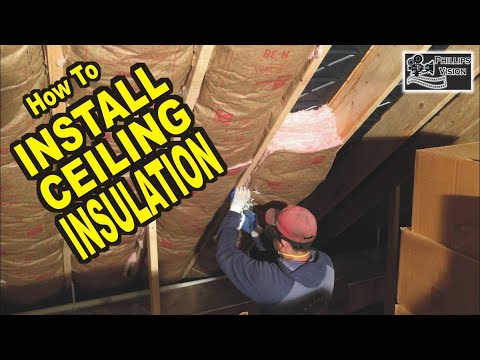
The material matters. The assembly matters more.
South Florida punishes bad attic design. Heat is obvious, but humidity is what turns a mediocre insulation job into a building-science problem. An attic here has to manage solar gain, humid air, wind-driven weather, and long AC seasons. If the insulation plan ignores moisture movement, the house may end up less durable even if the R-value on paper looks impressive.
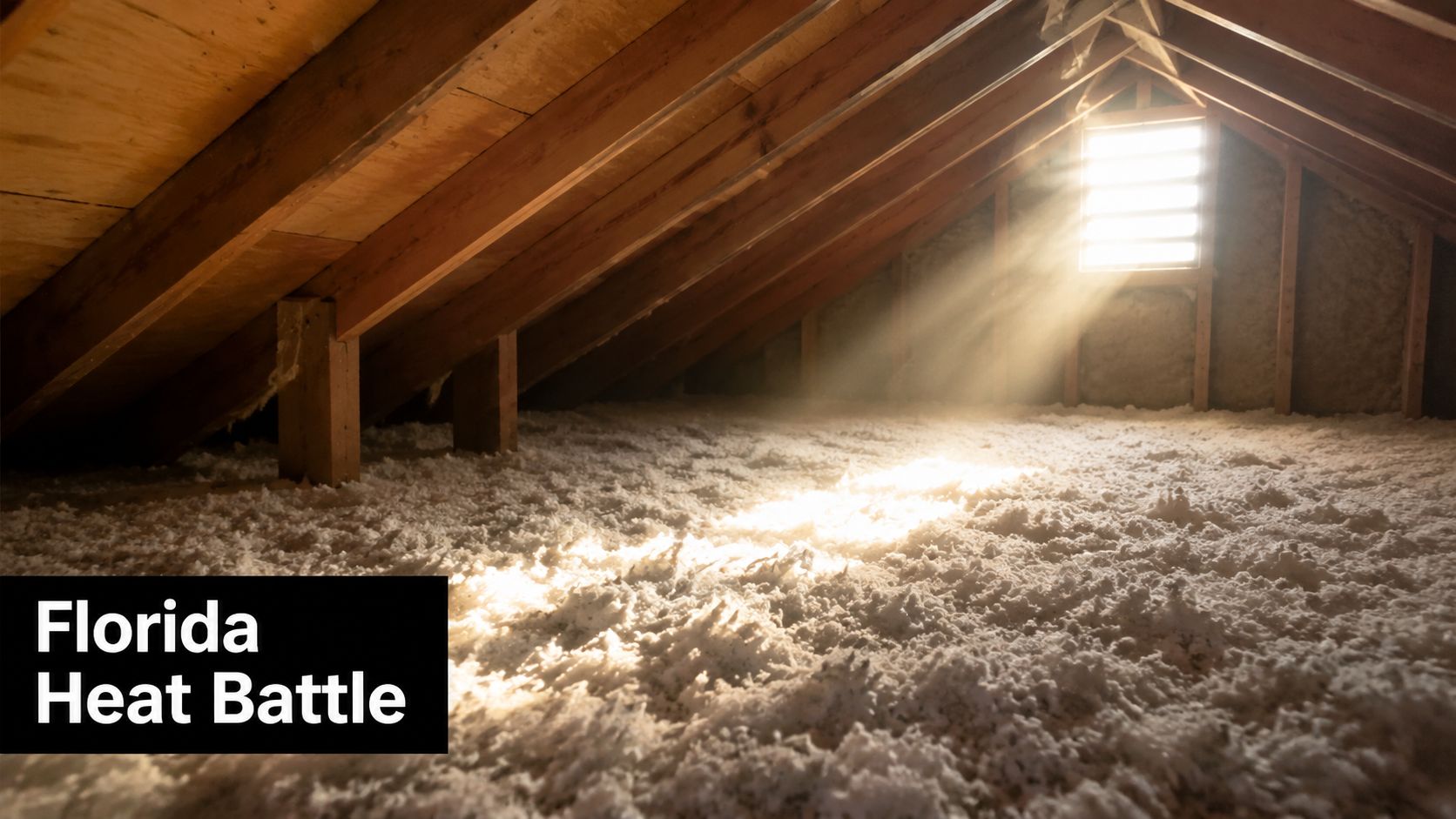
In many markets, homeowners hear that code is enough. In South Florida, that mindset leaves comfort on the table. One industry source notes that minimum attic insulation code is often R-38, while the U.S. Department of Energy recommendation is often R-49 for better performance in regions where attic temperatures can reach 130–140°F (Bird Insulation on R-38 versus R-49 attic performance).
That matters in a vented attic because the attic air itself can become brutally hot. Even if your home technically meets a lower minimum, that doesn't mean the ceiling assembly is doing enough to protect the rooms below from the sustained heat load.
South Florida also adds a moisture challenge that a lot of northern advice barely addresses. High outdoor humidity pushes inward. Conditioned indoor air pulls in replacement air through leaks. If the ceiling plane is leaky, the attic and the house exchange air in all the wrong places.
That creates several real-world problems:
South Florida attic rule: Thermal resistance by itself isn't enough. You need a heat strategy and an air-moisture strategy working together.
A vented attic can work well when the ceiling plane is carefully air sealed and the attic floor insulation is installed correctly. That approach is common and often cost-effective. But it leaves ducts and air handlers in a harsh environment unless those systems are inside conditioned space.
An unvented attic, usually created by applying insulation at the roof deck, changes the whole operating environment. The attic becomes much closer to indoor conditions. In South Florida, that can be a major advantage when HVAC equipment and ductwork are located overhead.
Neither approach is automatically right. What matters is that the assembly is coherent. Problems show up when someone mixes strategies halfway, blocks drying paths, or copies details from a colder climate without considering coastal humidity and storm exposure.
Homeowners usually ask two questions right away. What will this cost, and what does it save? The honest answer is that project cost varies too much by attic layout, material choice, access, prep work, and whether the job includes air sealing or a change in attic design to give one number that means anything. A simple blow-in top-off is one kind of project. A roofline spray foam conversion is another.
What can be said with confidence is why R-49 is such a common target. It tends to sit at the practical balance point between meaningful performance and diminishing returns.
A neutral industry article states that moving from an uninsulated attic to R-49 can reduce heating and cooling costs by 40% to 50%, while going from R-49 to R-60 adds only another 5% to 8% improvement. The same source says a 2,000-square-foot home with R-49 attic insulation could save around $200 annually (USA Insulation on R-49 versus R-60 attic insulation).
That comparison is useful because it explains the logic behind R-49. The jump from very little insulation to a serious attic level changes the performance of the house in a way homeowners can feel. The jump beyond that is smaller.
Here's how I'd frame it for a South Florida homeowner:
The best attic investment is rarely “the most insulation possible.” It's the level where insulation, air control, and moisture management start working as one system.
There's also a resale and durability angle, even though that's harder to put into a clean number. Buyers notice comfort. Inspectors notice attic deficiencies. Owners notice when upstairs rooms stop feeling like a separate climate zone. In that sense, an R-49 upgrade pays back in more than one way, even when the monthly utility effect is only part of the story.
A homeowner can inspect an attic, measure insulation depth, and in some cases handle a simple top-off. That's the upper limit of what I'd call a low-risk DIY path. Once the project involves air sealing details, baffles, moisture concerns, ductwork, recessed lights, bath fan terminations, roofline insulation, or any type of spray foam, the risk profile changes fast.
The reason is simple. R-49 attic insulation isn't just a matter of putting enough material in place. The installation has to preserve ventilation where needed, avoid compression, protect access points, and keep the whole assembly from trapping moisture.
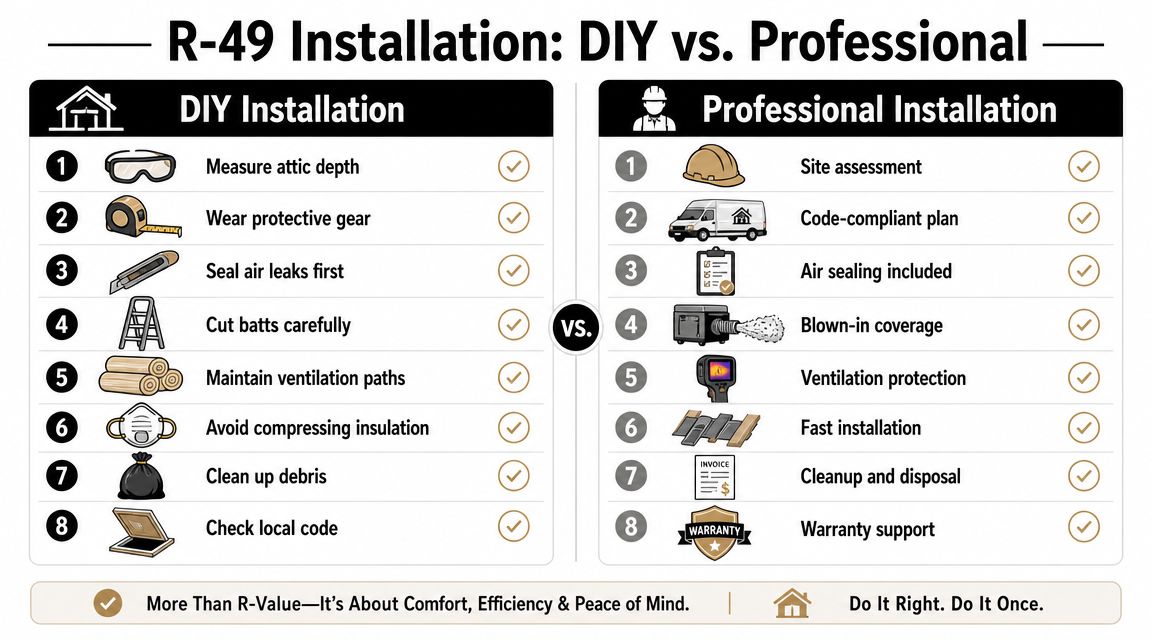
DIY can make sense if all of the following are true:
Even then, homeowners get into trouble by covering can lights incorrectly, burying junction boxes, blocking soffit intake, or skipping air sealing because it's tedious.
Professional installation is the safer route when any of these conditions show up:
| Situation | Why a pro matters |
|---|---|
| Complex rooflines or shallow rafters | Depth and fit become design issues |
| HVAC equipment or ducts in the attic | The insulation strategy affects system performance |
| Signs of moisture or previous roof leaks | The attic needs diagnosis, not just more material |
| Spray foam application | Material handling and installation quality are critical |
| Hurricane-prone exposure concerns | Assembly decisions need to support durability |
If you're hiring a contractor, credentials and risk management matter too. Builders and trades working in Florida already know how much can go wrong when envelope work is done carelessly. For contractors reading this, resources on securing your Florida contracting business are relevant because insulation work sits right at the intersection of liability, workmanship, and building performance.
A bad insulation job can stay hidden for a long time. That's what makes it expensive.
Call a professional if the project involves roof deck insulation, spray foam, visible moisture issues, shallow framing, or a home that never seems to control humidity well. Those aren't cosmetic problems. They're assembly problems.
If the attic is dry, simple, vented, and only needs a careful top-off after proper prep, DIY may be reasonable. But in South Florida, many attics look simple from the hatch and turn complicated once the work starts.
If you want a South Florida-specific evaluation of your attic, Airtight Spray Foam Insulation can help you determine whether your home needs a vented attic upgrade, a roofline spray foam approach, or a more targeted air sealing and insulation plan. The right solution isn't just about hitting R-49 on paper. It's about building an attic system that stands up to heat, humidity, and real Florida conditions.