Your AC runs all afternoon. The thermostat says one thing, but the house feels another way entirely. Rooms near the ceiling stay hot, the air feels sticky, and by late summer in South Florida, the utility bill starts looking like a penalty for living near the coast.
That usually isn't just an air conditioner problem. It's a building envelope problem. If hot, wet outside air keeps slipping into the house through the attic, roofline, walls, or garage connections, the AC has to cool the air and pull moisture out of it at the same time. That's hard work, and most homes never really catch up.
So what is closed cell spray foam? In plain terms, it's a high-density insulation that also helps stop air movement and moisture intrusion. In South Florida, that combination matters more than the insulation label alone. Heat is relentless here. Humidity is constant. Storm exposure is real. A material that only slows heat but doesn't control air leakage usually leaves too much performance on the table.
A common South Florida setup looks like this. The AC is fairly new. The ducts have been checked. The homeowner changes filters on time. But the second floor still feels warmer, the garage-side rooms never seem right, and the attic turns into a heat reservoir by noon.
In that situation, the equipment often gets blamed first. The primary issue is often the shell of the house. If the attic floor has gaps around penetrations, if the roof deck radiates heat into a vented attic, or if humid outside air keeps leaking in, the system is fighting a problem it can't solve by capacity alone.
That's where closed-cell foam changes the conversation. It isn't just insulation packed into a cavity. It's a way to turn a loose, humid building into a tighter, more controlled environment. For homeowners focused on monthly operating costs, this is the same building-envelope thinking behind ways to reduce utility bills.
Instead of trying to overpower heat and humidity with a larger AC system, closed-cell foam helps reduce what gets into the house in the first place.
Practical rule: If your home feels humid even when the AC is running, insulation alone may not be the missing piece. Air leakage usually is.
South Florida homes need more than a thicker blanket in the attic. They need a tighter shell. Closed-cell foam is one of the few materials that addresses heat, air movement, and moisture in the same application.
Closed-cell spray foam is a medium-density, rigid polyurethane insulation. It's made by combining two liquid components during installation, then spraying the material onto the surface being insulated. It expands, bonds to the substrate, and cures into a dense solid layer.
The easiest way to picture it is a rigid honeycomb made of tiny sealed cells. Those cells are packed tightly together. That closed structure is what separates it from softer, more vapor-open insulation materials.
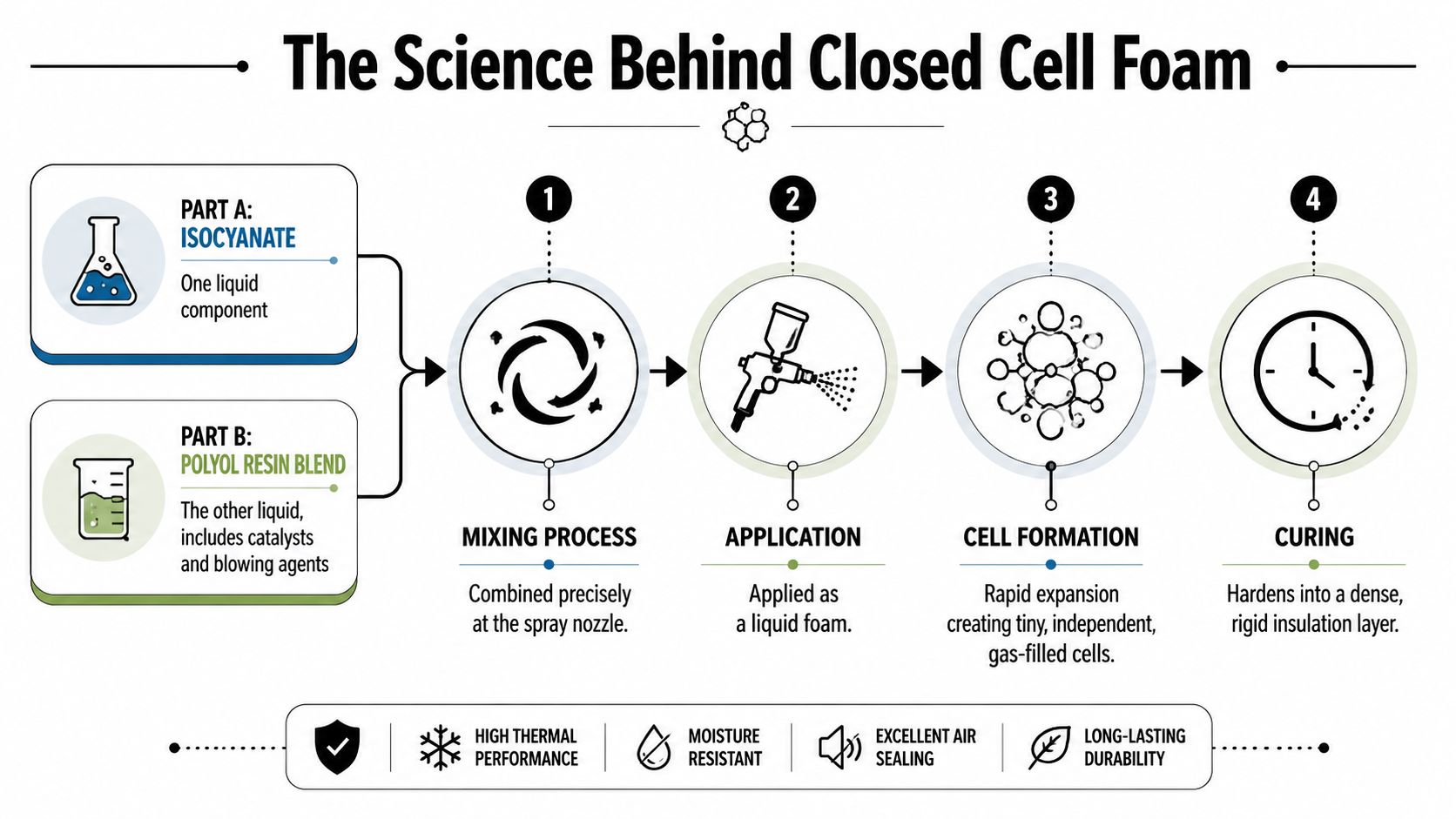
Once the foam cures, it doesn't sit loosely in place like batt insulation. It adheres to wood, masonry, or metal and becomes part of the assembly. That matters in South Florida because humid air doesn't need a large hole to cause trouble. It only needs a path.
According to Johns Manville, closed cell spray foam has a typical density of about 2.0 lb/ft³, functions as an air barrier at about 1 inch, and can act as an air-and-vapor barrier at about 1.5 inches or greater in the right assembly and thickness range, which is especially useful in humid climates like ours (Johns Manville on open-cell vs. closed-cell spray foam).
That's the core answer to what is closed cell spray foam. It's not only a thermal product. It's also a control layer.
South Florida buildings deal with two constant forces. Outdoor heat pushes inward, and moisture tries to move with air and vapor through the envelope. Closed-cell foam works because its dense, sealed structure slows both.
Think about a vented attic in August. The roof deck gets hot, humid air moves through soffits and ridge vents, and every recessed light, top plate gap, and wiring penetration becomes a leakage point into the living space below. Closed-cell foam changes that dynamic when it's installed in the right place and in the right thickness.
For property owners comparing insulation options, understanding closed-cell insulation R-value per inch is useful, but the bigger point is this: the material performs well because its density and closed-cell structure let it insulate while also limiting air and moisture movement.
A lot of insulation products help with heat. Fewer products help with heat, air leakage, and moisture at the same time.
That's why closed-cell foam is often chosen for rooflines, exterior walls, and other areas where South Florida climate conditions punish weak assemblies.
Closed-cell foam earns its place on projects because it solves more than one problem. In South Florida, that matters. A material that only improves insulation value but leaves the house leaky won't fully address comfort or humidity.
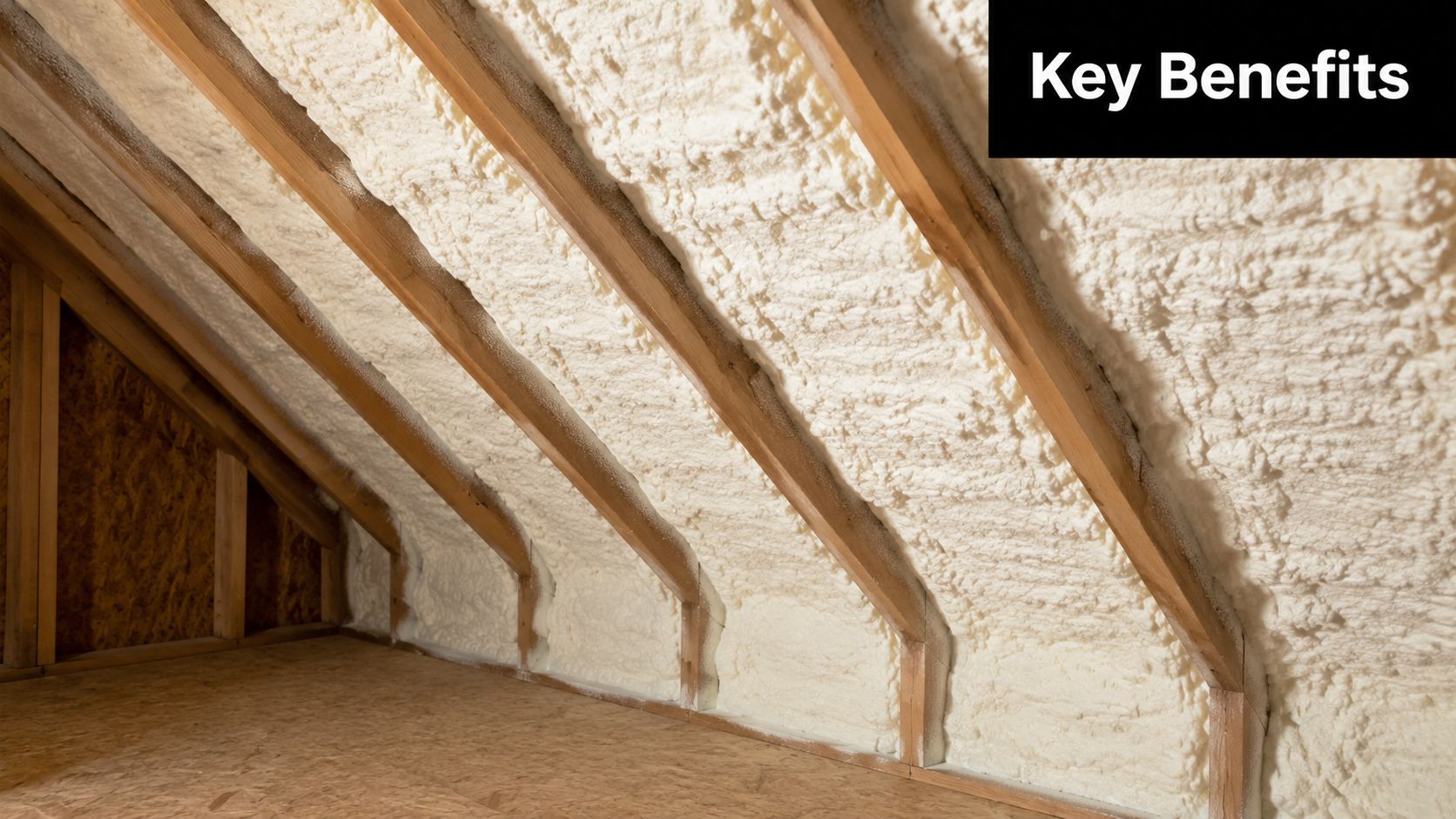
Closed-cell spray foam provides a high R-value, typically between R-5.6 and R-8 per inch, and one industry comparison lists it at R-5.7 per inch. The same source notes that it can function as an air barrier and, in many cases, a Class II vapor retarder under the International Residential Code (Spray Man comparison of open-cell and closed-cell foam).
That high per-inch performance is a real advantage where space is limited.
Open-cell foam is often around R-3.6 to R-4 per inch in that same comparison, so closed-cell can deliver more thermal resistance in less thickness. In South Florida, that helps when builders need performance without overbuilding the wall or roof assembly.
Thermal resistance is only one part of the story. In this climate, air leakage is often what makes a house feel clammy even when the temperature seems acceptable.
Closed-cell foam's dense structure allows one material layer to help control both air movement and moisture migration. That's why it's commonly used in roof decks, exterior walls, and transition zones where humid outdoor air tends to sneak in.
For homes dealing with persistent dampness, condensation risk, or moisture-sensitive assemblies, understanding where closed-cell spray foam insulation helps with waterproof performance can be useful, especially in areas exposed to wind-driven rain and high humidity.
Field takeaway: In South Florida, comfort complaints often start as moisture-control failures, not temperature failures.
A tighter assembly doesn't mean the house can't dry or breathe in a healthy way. It means the designer and installer are controlling where air and moisture move, instead of letting random leakage points decide.
Closed-cell foam is also rigid. Once cured, it adheres tightly to the substrate. That doesn't replace proper framing, connectors, sheathing, or hurricane-rated design. But it does add firmness to the assembly in a way soft insulation does not.
That matters most in roof and wall systems where wind pressure and uplift are part of the design conversation. In South Florida, it's smart to value insulation that contributes more than one benefit.
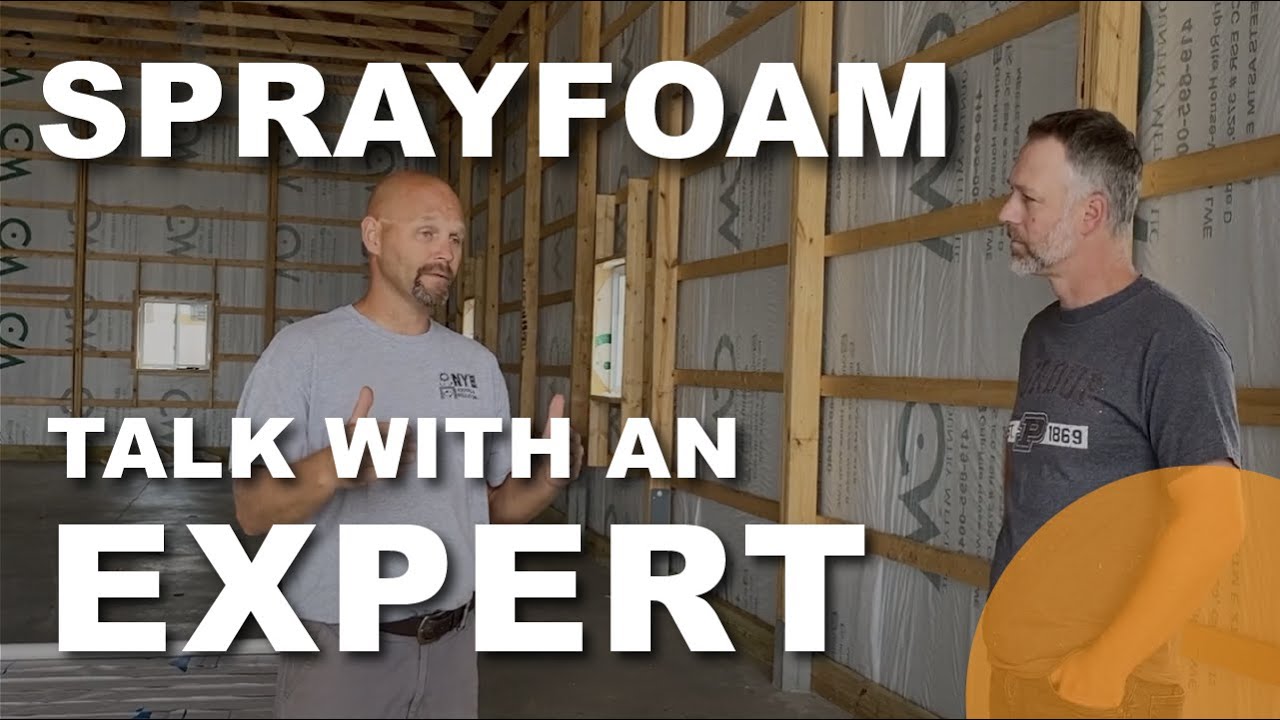
A short walkthrough helps show how these benefits come together in real assemblies:
When you add it up, closed-cell foam is not just an insulation upgrade. It is a performance upgrade to the whole enclosure.
A lot of confusion starts when people ask which foam is better. That's not the right first question. The better question is which foam fits the assembly, climate, and performance goal.
In South Florida, both products have a place. But they do different jobs. Closed-cell foam is usually chosen where moisture exposure, limited space, and assembly control matter most. Open-cell foam can make sense in other areas where vapor openness or sound control is more important.
| Characteristic | Closed-Cell Foam | Open-Cell Foam |
|---|---|---|
| R-value per inch | About R-5.6 to R-8 per inch | Often around R-3.6 to R-4 per inch |
| Density | About 2 lb/ft³ or 2.0 lb/ft³ | Lower density |
| Moisture permeability | Much less permeable to air and moisture | More vapor open |
| Air barrier capability | Can function as an air barrier at about 1 inch | Depends on product and assembly |
| Vapor control | Can act as an air-and-vapor barrier at about 1.5 inches or greater | Not typically used the same way |
| Structural rigidity | Rigid | Softer |
| Best fit uses | Rooflines, exterior walls, metal buildings, moisture-prone areas | Interior applications where sound control is valued |
| Relative cost | Higher upfront cost | Lower upfront cost in many cases |
Closed-cell foam is primarily valued because it combines insulation, air sealing, and moisture resistance in one product. One industry source describes it as roughly four times denser than open-cell foam and far more impermeable, which is why it's often selected where space is limited or moisture exposure is a major concern (Polytech on open-cell vs. closed-cell foam).
That description lines up with what works in South Florida. If you're insulating a roof deck, exterior wall, garage ceiling under conditioned space, or a metal building, density and low permeability matter.
Open-cell foam is not a “bad” version of spray foam. It just solves a different set of problems. In many projects, it's used where a softer material and lower cost matter more than maximum per-inch performance or vapor resistance.
That can include:
If a contractor recommends closed-cell everywhere without discussing the assembly, that's not careful building science. It's oversimplification.
For South Florida homeowners, the practical takeaway is simple. Use open-cell where it fits. Use closed-cell where heat, humidity, tight space, or moisture exposure make the enclosure less forgiving.
South Florida is hard on buildings. Roofs absorb brutal sun, outside humidity stays high for long stretches, and storm season tests every weak point in the envelope. Closed-cell foam makes the most sense where those conditions create the biggest penalty for leaks and poor insulation choices.

This is one of the strongest applications in our region. When closed-cell foam is installed along the underside of the roof deck, the attic becomes far less hostile to the house below. Instead of a vented superheated buffer zone above your ceiling, the roofline becomes part of a tighter building enclosure.
That can help in homes with:
For many South Florida homes, closed-cell foam provides its clearest practical value.
Certain rooms always give away envelope problems first. West-facing bedrooms, additions over garages, rooms beside unconditioned spaces, and block homes with furring strips often suffer from heat gain and humidity swings.
Closed-cell foam works well here because it does two things at once. It adds thermal resistance in a limited cavity, and it reduces the uncontrolled air movement that makes a room feel damp or uneven.
In a humid climate, the room that feels “hot” often also has an air leakage problem you can't see.
Metal structures are notorious for condensation problems. When warm, humid air meets a cooler metal surface, moisture shows up fast. That's why closed-cell foam is often the right call for workshops, warehouses, garages, and other metal enclosures in South Florida.
It's also a practical fit for:
The goal isn't only to make the building cooler. It's to create a more stable interior environment that doesn't swing wildly with outdoor conditions.
Builders often use closed-cell foam where the details of the assembly matter more than broad-brush insulation coverage. Rim areas, transition points, rooflines, and select wall systems are common examples.
Retrofits can be just as effective when the scope is targeted correctly. You don't always need to foam an entire house to solve a major comfort issue. Sometimes the right move is to address the roof deck, a problem wall, a garage ceiling, or another high-impact area.
A closed-cell foam project is not a paint job and not a DIY weekend task. The quality of the result depends heavily on prep, equipment calibration, substrate conditions, spray technique, and jobsite safety.
Most projects follow a straightforward sequence.
Preparation and masking
Crews protect floors, windows, equipment, and finished surfaces. If old insulation needs to come out, that happens first. The goal is to expose the area that needs to be sealed and insulated.
Spraying the foam
The installer applies the two-part material to the target surface in controlled passes. Thickness, adhesion, and uniformity matter. Good installers don't rush this part.
Trimming and cleanup
After the foam cures, excess material may be trimmed flush depending on the assembly. Then the crew cleans the work area and checks coverage.
Homeowners should expect a real safety protocol. That includes proper personal protective equipment, controlled access to the work area, and clear guidance on when the space can be reoccupied. Trained technicians matter because the material has to be mixed and applied correctly to perform as intended.
Questions worth asking any contractor include:
This also applies when you're evaluating contractors online. Home service companies that explain their process clearly usually understand that trust starts before the first truck arrives. If you want a look at how reputable companies present that information, this overview of insulation contractor marketing strategies is useful because it shows what transparent communication and service positioning should look like from a buyer's perspective.
Closed-cell foam usually costs more upfront than conventional insulation. That part is true. The mistake is stopping the analysis there.
One industry source projects the overall spray foam market to reach $4.37 billion by 2030 and attributes adoption to performance benefits. That same source says airtight assemblies using foam can reduce air infiltration by a factor of 24 and deliver energy savings of up to 30% in some applications (spray foam industry statistics and projections).
Those figures don't mean every project will perform exactly the same way. They do explain why owners keep choosing foam where comfort, humidity control, and long-term operating costs matter.
If a home in South Florida is fighting heat gain, moisture intrusion, and air leakage at the same time, paying more for a material that addresses all three can be the practical decision, not the expensive one.
If your main problem is South Florida heat mixed with indoor humidity, closed-cell foam is often a strong answer. If you're insulating a roofline, dealing with limited cavity depth, or trying to tighten a house that never quite feels dry or even, it usually deserves serious consideration.
A quick gut-check helps.
If several of those sound familiar, closed-cell foam is probably not just an upgrade. It may be the right building-envelope fix.
It's not the automatic answer for every cavity and every budget. Good contractors should say that plainly. But for South Florida homes and buildings dealing with extreme heat, heavy humidity, and the conditions of coastal weather, closed-cell foam solves a combination of problems that simpler insulation products often leave behind.
If you want a project-specific recommendation, Airtight Spray Foam Insulation can evaluate your attic, roofline, walls, garage, or metal building and help you determine whether closed-cell foam is the right fit for your property. A local assessment is the fastest way to find out where air leakage and moisture are really costing you comfort.