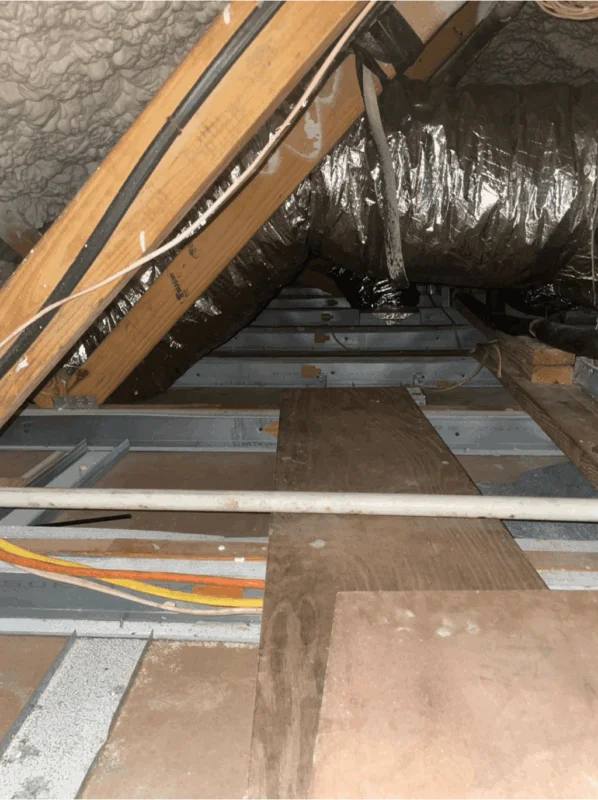
This project involved a home with an existing spray foam attic that was experiencing moisture-related performance issues. The homeowner was concerned about elevated humidity, musty odors, and visible contamination within the attic. During our inspection we observed microbial growth on sections of the spray foam, HVAC ductwork, and portions of the air handler cabinet. We also found areas where HVAC ductwork had been installed tight against the roof deck, limiting the continuity of the spray foam air seal and creating locations that required correction as part of the overall restoration.
• Musty odor
• High indoor humidity
• Sweating HVAC ductwork
• Visible microbial growth
• Poor comfort
• Indoor Air Quality
Inspection photographs documented visible dark microbial staining on portions of the spray foam insulation, HVAC duct insulation, and the exterior of the air handler cabinet. Several duct runs were positioned high against the roof structure, making it difficult to maintain a continuous spray foam seal around the ductwork. These conditions can interfere with the performance of a conditioned attic and contribute to persistent moisture concerns if not addressed.
Based on our observations, the attic was not functioning as a consistently controlled conditioned space. Existing installation conditions and moisture accumulation created an environment where condensation could persist on cooler surfaces, supporting visible microbial growth. Rather than treating only the symptoms, the project focused on correcting the conditions affecting attic performance using our Airtight Comfort System.
Implement a comprehensive building-science approach including cleaning and sanitizing affected surfaces, correcting spray foam deficiencies, improving the continuity of the air barrier around HVAC components, and restoring the attic to a properly controlled environment using the Airtight Comfort System.




Successful spray foam attics depend on more than insulation alone. Proper detailing around HVAC components, continuous air sealing, moisture management, and an integrated building-science approach are essential to long-term performance.
A conditioned attic performs best when insulation, air sealing, moisture control, and the HVAC system work together as one complete system. By correcting the conditions contributing to elevated moisture and restoring the attic to a properly controlled environment, the attic can better resist condensation, reduce the potential for future microbial growth, improve HVAC performance, and provide a healthier, more comfortable home.
Following completion of the project, the attic was transformed from a moisture-affected space into a cleaner, better-controlled conditioned attic. Visible contamination was addressed, spray foam deficiencies were corrected, and the overall attic environment was restored to support improved moisture management and HVAC performance. The homeowner now has greater confidence that the attic is functioning as intended while providing a healthier and more comfortable indoor environment.
If you’re experiencing high attic humidity, sweating HVAC ducts, musty odors, or concerns about spray foam performance, contact Airtight Spray Foam Insulation for a professional building science inspection.
Properly installed spray foam is only one component of a successful conditioned attic. Long-term performance depends on how insulation, HVAC, moisture management, and air sealing function together as a complete building system.
At Airtight Spray Foam Insulation, every project begins with understanding why the problem exists. We believe the most effective solutions come from identifying the root cause rather than simply treating the symptoms.
Our building science approach evaluates how insulation, air sealing, HVAC performance, moisture management, and attic pressure work together as one complete system. This allows us to develop recommendations tailored to the unique conditions of each home instead of relying on one-size-fits-all solutions.
Whether restoring a failed spray foam attic or improving the performance of an existing conditioned attic, our objective is to create a healthier, more comfortable, and better-performing home through sound building science principles.
Properly installed spray foam is only one component of a successful conditioned attic. Long-term performance depends on how insulation, HVAC, moisture management, and air sealing function together as a complete building system.