
If you manage a South Florida commercial property, you already know the same pattern: the cooling bill keeps climbing, the metal roof sweats on humid mornings, and one bad rain event can turn a minor envelope weakness into a real complaint from tenants or staff. Fiberglass might look cheaper on paper, but it doesn't solve air leakage, moisture intrusion, or the condensation issues that show up fast in hot, wet buildings.
Spray foam insulation for commercial buildings works differently because it's part insulation, part air seal, and part moisture control strategy. In commercial roofs, exterior walls, metal buildings, and other hard-working assemblies, that matters more than brochure language. The right foam, installed correctly, changes how the building behaves day after day.
A facility manager can usually tell when the envelope is failing before the utility company does. A warehouse feels fine at sunrise, then turns into a heat sink by midafternoon. A tenant complains that one conference room is cold while the next one feels muggy. In South Florida, those complaints often trace back to air leakage, thermal bridging, and moisture getting where it shouldn't.
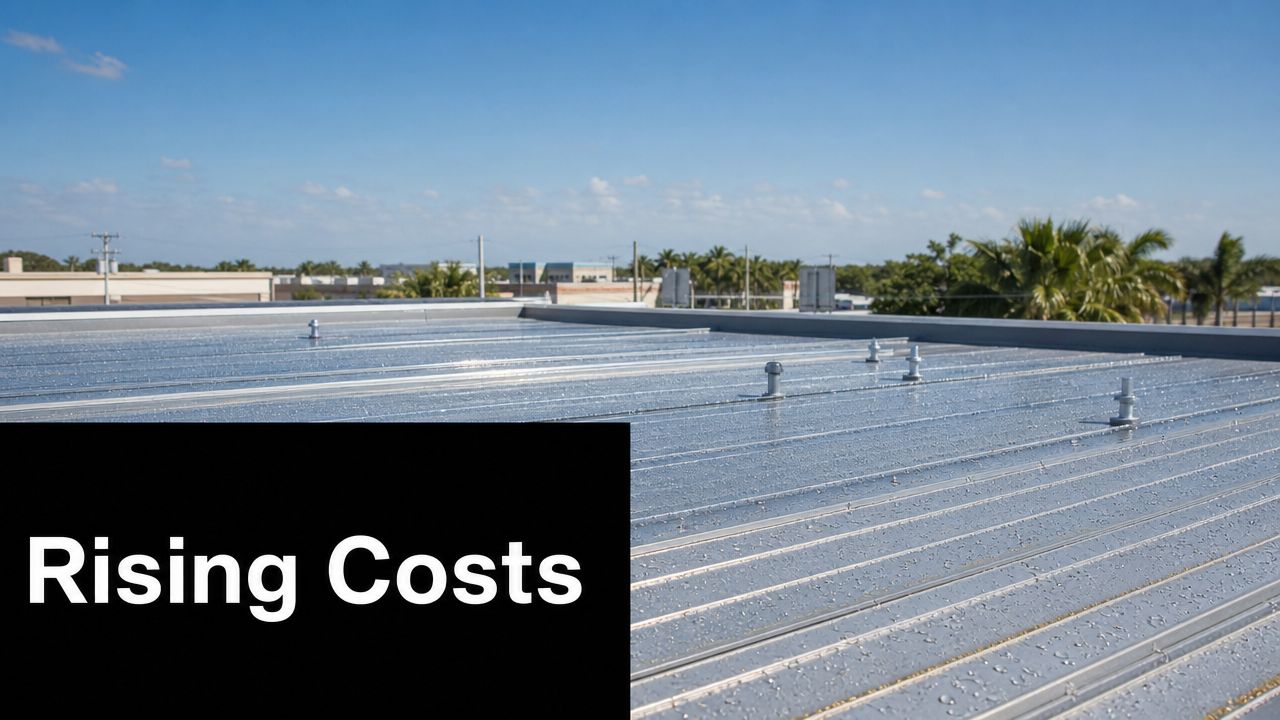
The weak point is usually not the idea of insulation, it's the assembly. Traditional materials can slow heat transfer, but they don't stop the humid outside air from sneaking into cavities and condensing on cooler surfaces. That's why commercial roofs and walls in this climate need a material that does more than just hold still.
Fiberglass batts often leave gaps around fasteners, framing, penetrations, and uneven surfaces. In a metal building, those gaps matter because a thin layer of trapped moisture can lead to dripping, corrosion, and mold pressure over time. Building managers looking for a practical overview can also compare this topic with insights from Facility Management, especially if they're trying to prioritize envelope fixes before HVAC upgrades.
Spray foam changes the math because it adheres to the substrate and helps reduce uncontrolled air movement. That doesn't make every project the same, but it does make the insulation layer part of the solution instead of a loose component sitting inside the assembly.
Practical rule: If the building leaks air, traps moisture, or has metal surfaces that go cold at night, the insulation choice has to address all three problems together.
For owners who want a deeper look at how commercial envelope performance ties into energy use, this commercial building energy efficiency guide is a useful companion reference. The core takeaway is simple, better insulation in commercial space isn't just about staying cool, it's about keeping the building dry, stable, and easier to run.
The foam decision usually comes down to building physics, not brand loyalty. Open-cell and closed-cell both insulate, but they behave differently once they're inside a roof, wall, or metal structure. In South Florida, that difference matters more than it does in dry climates because humidity, wind-driven rain, and condensation are constant design factors.
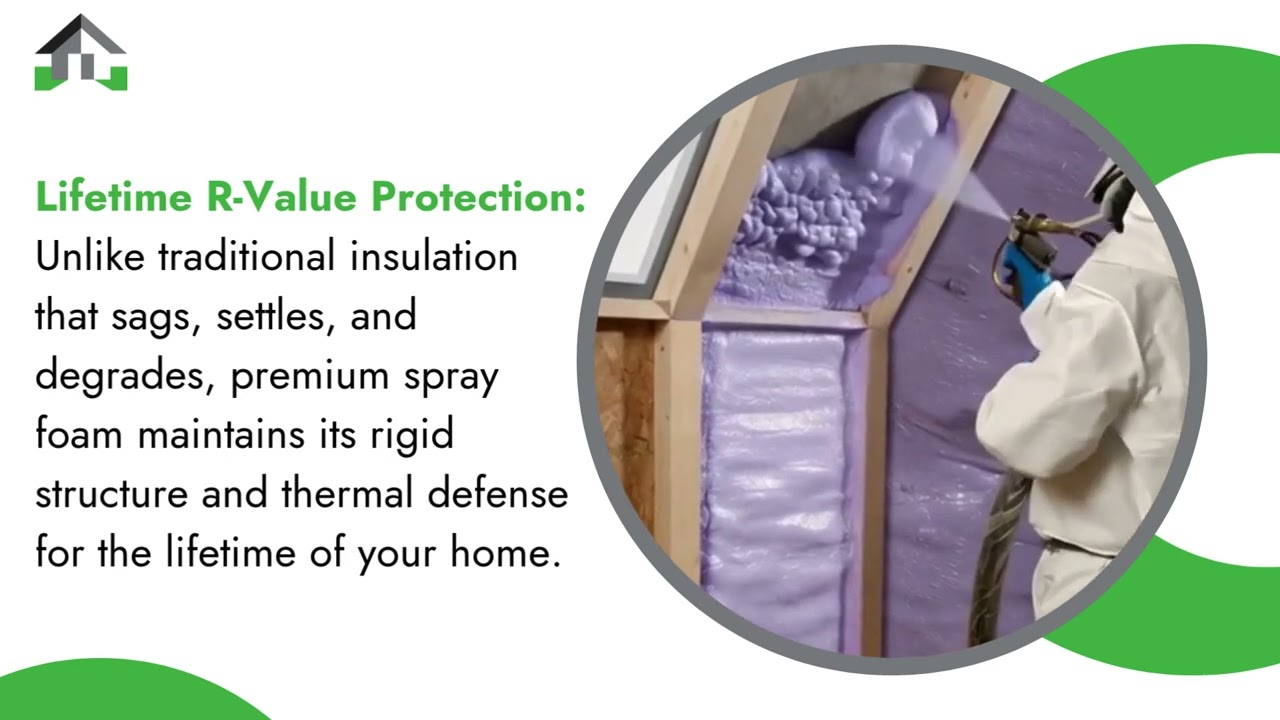
Closed-cell foam is the heavy-duty option. Technical guidance puts its typical R-value at about R-6.0 to R-7.0 per inch, compared with R-3.5 to R-4.2 per inch for open-cell foam, so it delivers more thermal resistance in less space. It also becomes an air barrier at about 1.5 inches, while open-cell reaches that point at about 4.5 inches, which makes a real difference in tight cavities and retrofit work. That guidance also notes closed-cell foam is about 90% more rigid than open-cell, which is why it shows up so often in commercial roofs, exterior walls, and metal buildings. For a deeper technical background, see what is closed-cell spray foam.
Closed-cell is also the better choice when moisture control is essential. U.S. DOE guidance says it is “moisture-vapor impermeable” at typical applied thickness, and that's exactly why it gets specified in humid, flood-prone, and high-risk assemblies.
Open-cell still has a job. It's lighter, softer, and better for sound absorption, so it can fit well in interior office buildouts, conference rooms, or partitions where acoustics matter more than vapor control. It also works where the assembly can dry in at least one direction and where the design doesn't need the rigidity of closed-cell.
| Property | Open-Cell Foam | Closed-Cell Foam |
|---|---|---|
| R-Value per inch | Lower, about R-3.5 to R-4.2 | Higher, about R-6.0 to R-7.0 |
| Air sealing thickness | About 4.5 inches | About 1.5 inches |
| Moisture control | More breathable | Low vapor permeability |
| Rigidity | Softer and less rigid | About 90% more rigid |
| Best fit | Sound control and interior spaces | Roofs, walls, metal buildings, humid environments |
Closed-cell is usually the safer default when the assembly faces wind, moisture, or condensation. Open-cell is a comfort tool, not a moisture-management solution.
The right answer is not “always closed-cell” or “always open-cell.” It's matching the foam to the building's job, then installing it so the assembly can perform under South Florida conditions.
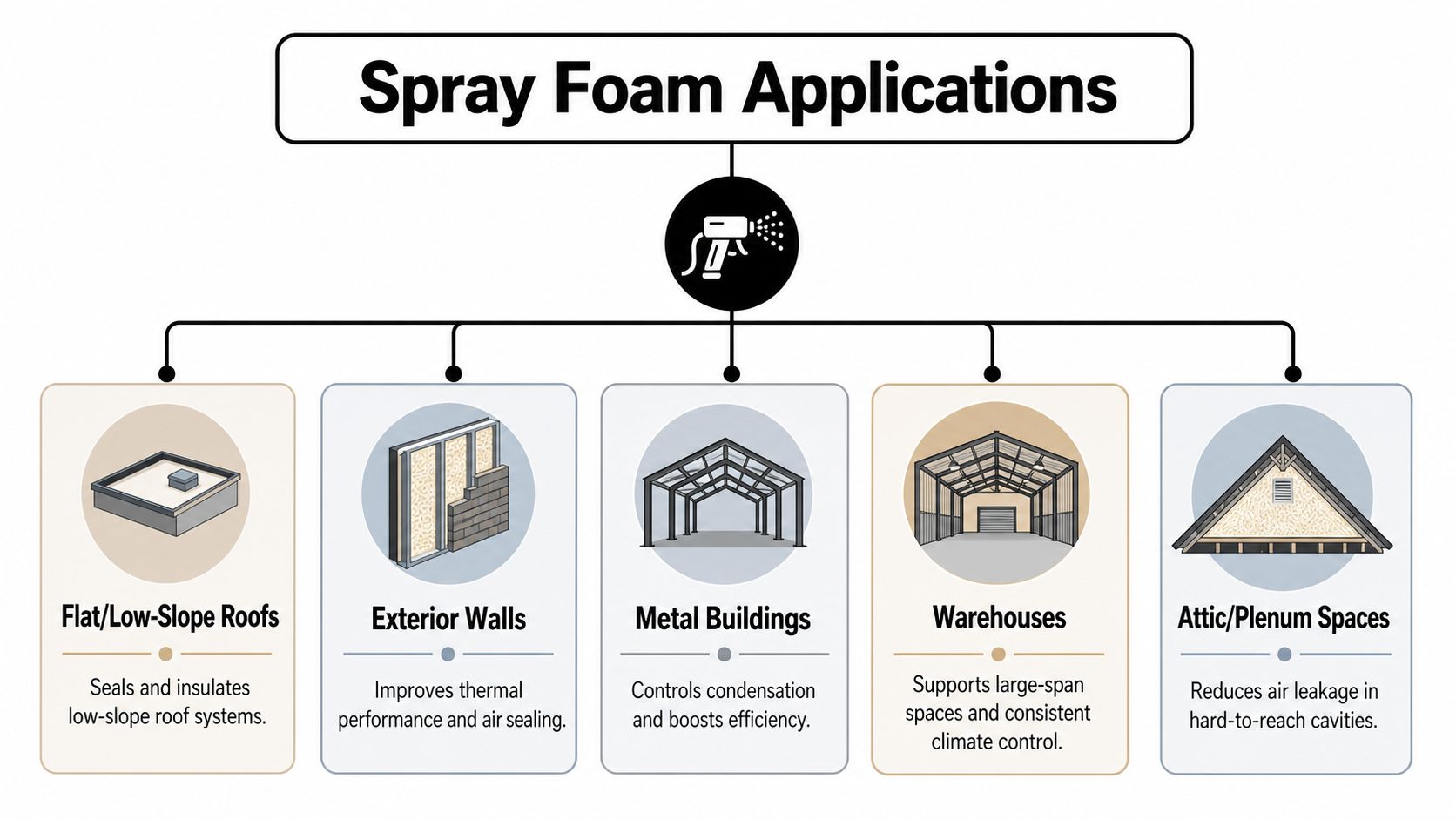
Spray foam pays off fastest where commercial buildings lose the most energy and collect the most moisture. That usually means roofs, walls, metal panels, attic-like voids, and large spaces with exposed structure. The biggest mistakes happen when one foam type gets used everywhere without thinking through the actual exposure.
Low-slope roofs are a natural fit because they take constant sun, ponding risk, and thermal movement. Closed-cell foam is usually the better choice here because it gives you insulation and added rigidity in one layer, which matters under membranes and around penetrations. The roof application is a major share of spray foam use, and the market data shows roofing insulation accounts for nearly 25% of total spray foam use, while more than 53% of warehouses and logistics centers reportedly use spray foam for roof insulation to control internal temperatures. That aligns with what contractors see on the job, roofs are where spray foam often earns its keep first. A helpful companion on roof-specific practice is Commercial Roofers' expert insights.
Exterior walls need careful detailing around framing, sleeves, and service penetrations. In commercial wall assemblies, spray foam is widely used because the application share for wall insulation is about 46%, and roughly 52% of builders reportedly use it in exterior wall assemblies to improve energy efficiency. That doesn't mean every wall should get the same thickness or foam type. It means the wall is one of the best places to stop conditioned air from escaping and humid air from sneaking in.
Metal buildings deserve special attention. Uninsulated metal panels cool down fast after sunset, which invites condensation on the interior face. Closed-cell foam is often the right call because its low vapor permeability and rigidity help manage that problem better than softer materials. If the installer leaves gaps at purlins, fasteners, or seams, the condensation issue usually comes back.
Warehouses are often about temperature stability, not just comfort. Spray foam can reduce hot spots near the roofline and help protect inventory, equipment, and worker conditions. In attic or plenum spaces, the detail work matters even more because HVAC distribution and air leakage are tied together. A sloppy install can trap heat, block access, or interfere with mechanical clearances, so the crew has to plan before spraying.
The common thread is simple. Spray foam performs best where the building is hardest to seal by other means and where moisture, heat, and air movement all collide at once.
Commercial owners usually start with the price tag, which is fair. Spray foam is rarely the cheapest insulation option upfront, and that's especially true when closed-cell is compared with open-cell. The central question is whether the building envelope will cost less to run and maintain over time.
The broader spray foam market is no longer niche. One forecast projects global spray foam insulation revenue rising from $3.2 billion in 2025 to $5.4 billion by 2034, a 6.8% CAGR, while another projects the market at about USD 5,508.5 million by 2035 after standing at USD 3,212.65 million in 2026. In North America, the market was valued at USD 1.24 billion in 2025, and the closed-cell segment alone generated around USD 800 million that year, with growth projected to USD 1.41 billion by 2035. Those figures don't tell you what your project will cost, but they do show that spray foam has become a mainstream specification in mature commercial markets. For a broader cost discussion, this spray foam cost guide is a useful reference.
The hidden savings are where spray foam becomes attractive. Better air sealing eases HVAC demand, which can improve comfort and reduce runtime, and that ties directly into equipment life and service frequency. If you want a practical lens on HVAC impacts, it's worth reviewing guidance to boost your HVAC efficiency alongside the insulation plan.
| Foam Type | Typical Strength | Typical Use Case |
|---|---|---|
| Open-cell | Lower material cost, better acoustics | Interior partitions, sound-sensitive spaces |
| Closed-cell | Higher R-value, stronger moisture control | Roofs, walls, metal buildings, humid environments |
The wrong comparison is spray foam versus nothing. The right comparison is spray foam versus repeated energy waste, moisture repairs, comfort complaints, and shortened mechanical life. In ownership terms, the cheapest insulation rarely stays the cheapest once the building starts working against it.
The best foam in the world can fail if the substrate is dirty, the weather is wrong, or the installer is guessing on thickness. Spray foam is unforgiving that way. Once it's in place, bad prep and bad technique are hard to hide.
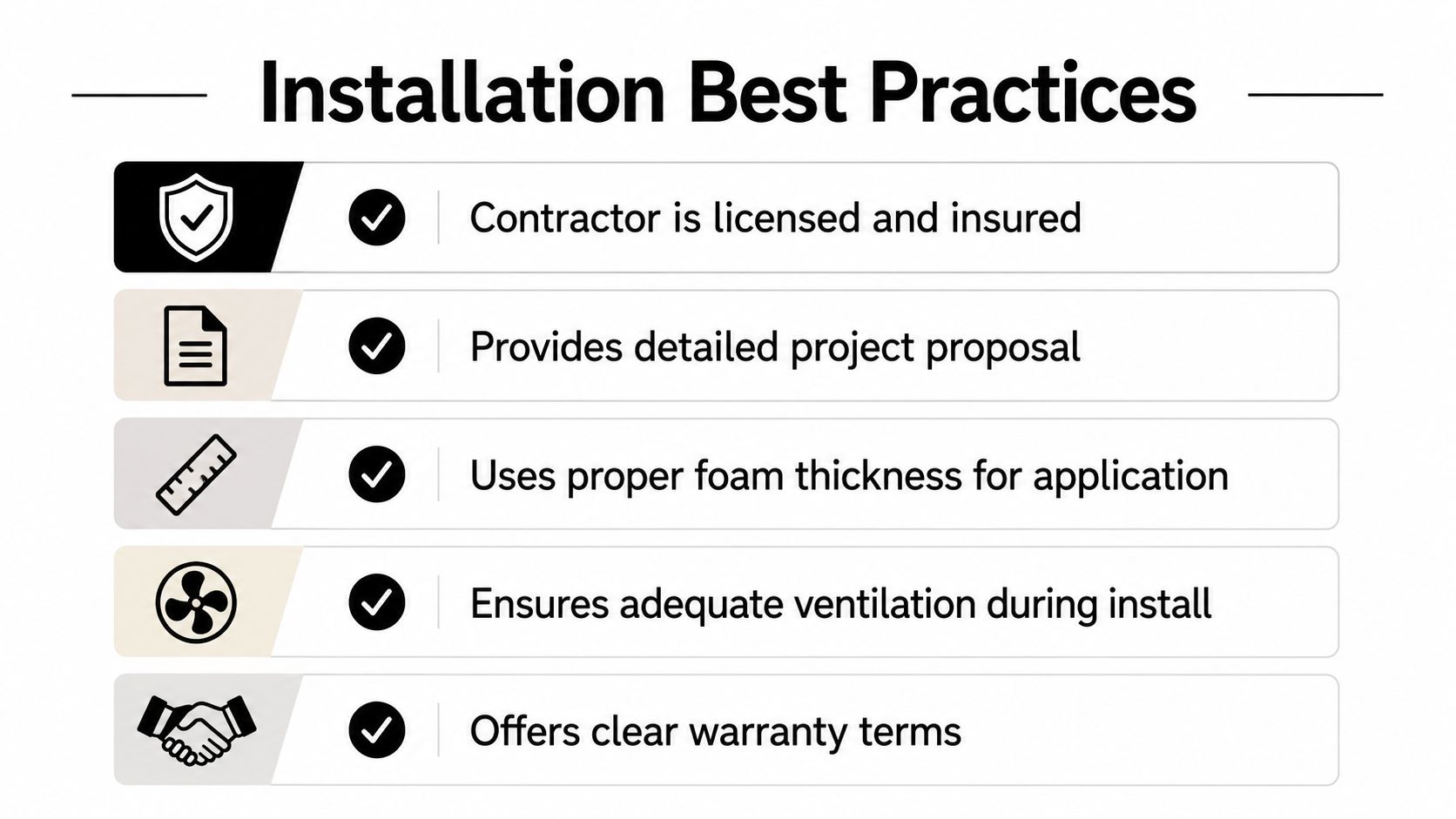
A professional crew starts with substrate inspection, not the spray gun. Metal should be clean, dry, and ready for adhesion. Humidity and temperature need to be considered during application because South Florida weather can change the behavior of the foam and the surface it's bonding to.
If the installer can't explain how they'll verify thickness, protect adjacent surfaces, and document fire and thermal barrier compliance, keep looking.
The other nonnegotiables are code compliance and post-installation inspection. Commercial foam work often needs a thermal barrier or an approved alternative, and that isn't something to figure out after the fact. Thickness should be checked, edges should be inspected, and any problem areas should be corrected before the job is called complete.
The final walkthrough should feel like a handoff, not a surprise. If the crew leaves you with no paperwork, no thickness verification, and no explanation of what was sprayed where, the job isn't finished in any meaningful sense.
Generic insulation advice breaks down fast in South Florida. The climate here pushes building assemblies in multiple directions at once. Humidity drives condensation into wall cavities, hurricane-driven rain punishes weak envelope details, and the cooling season never really ends.
Closed-cell foam is the better fit in many of these commercial conditions because it brings low vapor permeability and added stiffness to the assembly. U.S. DOE guidance describes it as “essentially moisture-vapor impermeable” at typical applied thickness, and that matters when the exterior air is hot, wet, and relentless. In metal buildings especially, that combination helps reduce the chance that interior-side condensation turns into a recurring maintenance problem.
South Florida projects usually need tighter installation discipline than a generic climate-zone guide suggests. Roofs need special attention at penetrations and transitions. Walls need careful continuity at framing and service runs. Metal structures need condensation control, not just thermal resistance.
The biggest mistake is assuming the foam choice alone solves the problem. The climate response has to include product selection, thickness, and installation detail.
In places like Jupiter, Palm Beach Gardens, West Palm Beach, Wellington, and Stuart, commercial clients tend to face the same core demands, stable interior temperatures, moisture control, and reliable performance under intense sun and driving rain. That's why properly specified spray foam systems are such a practical fit for local warehouses, retail spaces, and light industrial buildings. The material works best when the installer respects the climate instead of treating the project like it's in a dry inland market.
The strongest results come from matching the foam to the exposure, then treating the building envelope as a system. That approach is what keeps South Florida commercial spaces from fighting humidity, heat, and mechanical strain every single day.
Commercial spray foam is not a commodity purchase. It's a building-performance decision that affects comfort, moisture control, HVAC load, and how well the structure handles South Florida weather over time. The right choice comes down to foam type, the areas you prioritize first, and the quality of the contractor standing behind the work.
If you're comparing options for a roof, metal building, wall assembly, or retrofit project, start with a full assessment of where the building is losing performance. That's the fastest way to avoid paying for insulation that looks fine on paper but leaves the underlying problems untouched.
If you're ready to see what makes sense for your commercial property, contact Airtight Spray Foam Insulation for a professional assessment and free quote. Their team works across South Florida and can recommend the right spray foam approach for your roof, walls, or metal building with the local humidity and moisture challenges in mind.