South Florida homeowners usually call about the same cluster of problems. The AC runs for hours, some rooms still feel muggy, the garage gets hot fast, and the attic feels like it's working against the rest of the house. In older homes, you can often feel where outside air is sneaking in long before you see it on a utility bill.
That's where closed cell spray in insulation enters the conversation. In this climate, insulation isn't just about slowing heat. It's about controlling air movement, moisture movement, and the way the whole building dries after long periods of humidity and wind-driven rain. If you treat insulation like a generic product, you can end up with an expensive job that still leaves comfort problems behind.
Closed-cell spray foam is one of the few materials that can insulate and air seal at the same time. Used in the right assembly, it also helps manage moisture in places where fibrous insulation tends to struggle. Used in the wrong place, or installed without understanding South Florida conditions, it can create problems that don't show up until later. That trade-off matters here more than it does in many other parts of the country.
A typical South Florida house loses comfort in small ways first. The upstairs feels warmer in late afternoon. The hallway near the attic access stays sticky. Supply vents are blowing cold air, but the house never quite feels dry. People assume the HVAC system is undersized, but a lot of the time the issue starts with the building envelope.
When hot, damp outdoor air leaks into wall cavities, rooflines, garages, and transition points, the AC has to do more than cool. It has to remove moisture too. That's a tougher job, and it's one reason bills stay high even when the equipment seems to be running properly. If you're sorting through both insulation and mechanical upgrades, this guide on HVAC upgrade opportunities for technicians is useful because it shows how insulation and HVAC work better as one system, not as separate fixes.
Closed-cell foam changes the conversation because it turns the shell of the home into part of the comfort system. Instead of relying on batts that can't stop air leakage by themselves, you get a material that seals irregular gaps and adds insulation in one application.
That matters most in South Florida where humidity is constant. A tighter envelope can help the AC hold temperature more steadily, reduce humid air intrusion, and make rooms feel more even from one end of the house to the other.
A Florida home that feels clammy often has an air leakage problem first, not just an insulation problem.
National advice on spray foam often skips the details that matter here. Coastal humidity, storm exposure, roof heat, and wetting events change how wall and roof assemblies should be built. Closed-cell foam can be the right answer, but only when the assembly still has a safe drying strategy.
Closed-cell spray foam is a medium-density, rigid polyurethane insulation. Once applied, it expands, cures, and forms a dense layer made up of tightly packed cells. It resembles a rigid honeycomb with each tiny cell closed off from the next. That sealed structure is why it behaves differently from softer insulation products.
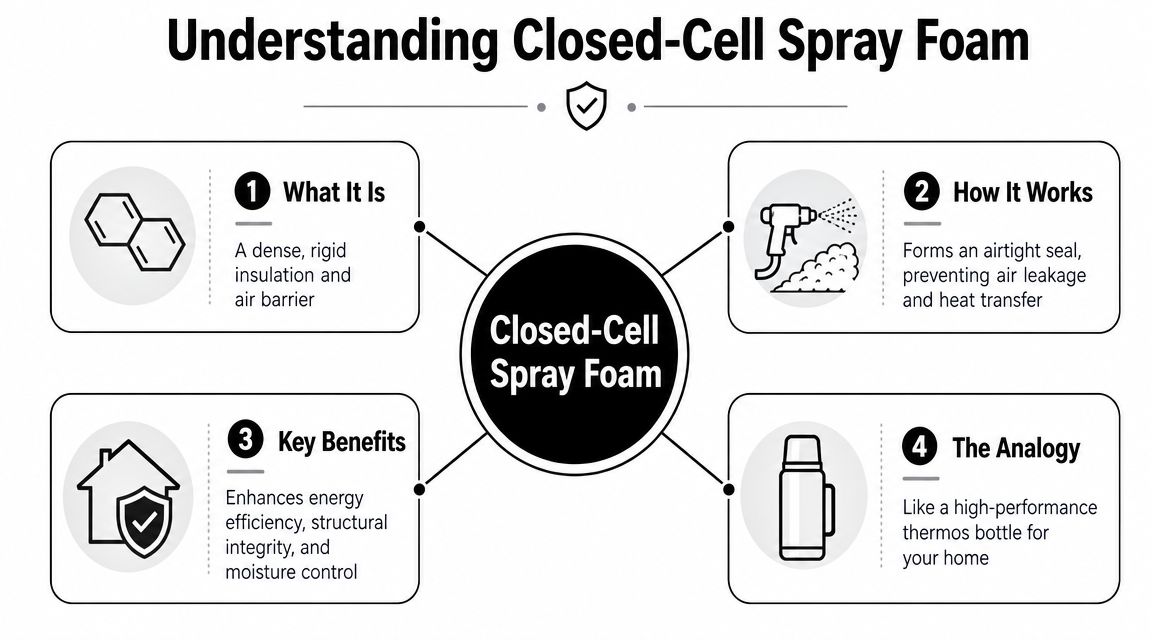
The compact cell structure does several jobs at once. It slows heat flow, resists air leakage, and is far less vapor-permeable than open-cell foam. ORNL's review notes that closed-cell foam offers “relatively high thermal resistance and intrinsic strength properties,” and that semi-rigid cured foam can provide structural enhancement, which is one reason it's commonly used in roofs, foundations, and metal buildings (ORNL review of spray polyurethane foam performance).
That's the practical difference. You're not just filling a cavity. You're creating a more controlled assembly.
For homeowners comparing thermal performance in limited-depth framing, this breakdown of closed-cell insulation R-value per inch helps show why the material is often chosen for tighter cavities and roof applications.
In real jobs, closed-cell foam works best where multiple problems overlap. You need insulation, but you also need to cut down air movement and reduce moisture risk. Roof decks, exterior walls, crawl spaces, rim areas, and metal structures all fit that description.
Practical rule: If the space is shallow, humid, or exposed to big temperature swings, the insulation has to do more than one job.
A simple way to think about it is this. Fiberglass mainly insulates. Closed-cell foam insulates and seals.
A quick visual helps explain the process in action.
People usually notice comfort before they notice anything else. Rooms feel less drafty. Indoor humidity becomes easier to control. Spaces near the roofline or garage stop feeling like weak spots.
That's why closed cell spray in insulation is often treated as a building performance upgrade, not just an insulation swap. The goal isn't only a higher labeled R-value. The goal is a tighter, drier, more stable building shell.
Closed-cell and open-cell spray foam are both useful. They're not interchangeable. In South Florida, the right choice usually comes down to available depth, moisture exposure, and what the assembly needs to do beyond insulation.
According to independent industry guidance, closed-cell spray foam delivers about R-5.7 to R-7.0 per inch, while open-cell is roughly R-3.6 to R-3.7 per inch. In a standard 2×4 wall cavity, closed-cell can reach about R-20, while open-cell in that same cavity is usually around R-13. The same guidance also notes that closed-cell's dense structure can function as a Class II vapor retarder, which is one reason it's often used in moisture-prone assemblies (industry guidance on R-values and performance).
| Feature | Closed-Cell Foam | Open-Cell Foam |
|---|---|---|
| R-value per inch | R-5.7 to R-7.0 per inch | R-3.6 to R-3.7 per inch |
| Performance in a 2×4 wall | About R-20 | Usually around R-13 |
| Density and feel | Dense and rigid | Softer and lighter |
| Vapor behavior | Can function as a Class II vapor retarder | More vapor-permeable |
| Air sealing role | Strong air-sealing performance | Also seals air, but with different moisture behavior |
| Best fit | Limited-depth cavities, moisture-prone areas, tougher assemblies | Areas where thickness is available and vapor openness is preferred |
If you only have a 2×4 cavity and need more thermal resistance, closed-cell has a clear advantage. The same goes for rooflines, rim areas, and assemblies where moisture control matters as much as insulation value.
That's the biggest practical distinction for a South Florida owner. Space is often limited, and humidity isn't optional.
Open-cell can still be a good fit in the right assembly. If drying potential is a priority and cavity depth isn't the main limitation, it can be a reasonable choice. The mistake is assuming closed-cell is automatically superior in every location just because the R-value per inch is higher.
Choosing between the two isn't about buying the “better” foam. It's about matching the foam to the assembly.
For humid coastal work, that matching process is where experience matters.
Closed-cell foam shines where heat, air leakage, and moisture all hit the building at once. In South Florida, that usually means roof assemblies, crawl spaces, garages, exterior walls, and metal structures.
Roof heat is relentless here. When closed-cell foam is applied to the underside of the roof deck, it helps bring that attic boundary into a more controlled part of the building. That can reduce the extreme temperature swing above the ceiling and help HVAC equipment or ductwork in attic spaces operate under less punishing conditions.
This approach works well when the roof assembly is designed correctly. It does not work well when someone treats the attic like a generic foam job without thinking through ventilation strategy, roof leaks, and drying potential.
Crawl spaces in humid climates collect trouble fast. Moisture intrusion, warm air infiltration, and musty odors all tend to start low and move upward. Closed-cell foam fits these areas because it resists moisture movement better than more vapor-open products and adheres well to irregular surfaces.
A lot of retrofit work runs into the same problem. The wall cavity is shallow, but the owner still wants stronger thermal performance. Closed-cell foam is useful there because it packs more insulation into less thickness while also reducing air leakage through the assembly.
Metal buildings are a separate category in Florida because they deal with both heat gain and condensation. Closed-cell foam is often used under metal roof and wall panels because it can help control sweating on those surfaces while improving interior comfort.
Common good fits include:
The best applications all share one trait. The foam is solving more than one problem at once.
A proper spray foam job looks controlled from the start. The crew should protect adjacent surfaces, isolate the work area, manage ventilation, and apply the material evenly to the intended depth. Good installation is part chemical handling, part surface prep, and part building science.
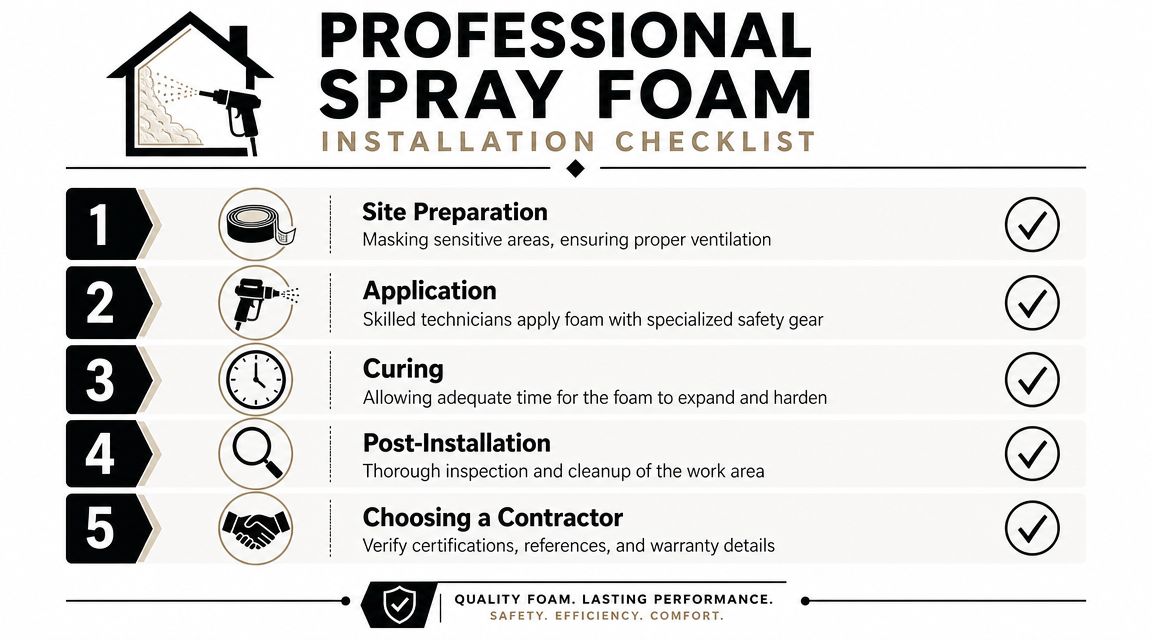
Most projects start with prep. Existing insulation may need to be removed. Floors, windows, equipment, and finished surfaces are masked off. The crew checks access, substrate condition, and where the foam should and should not go.
Then comes application. Two chemical components are combined through specialized equipment and sprayed onto the target surface. The foam expands, cures, and hardens into place. After curing, excess material may be trimmed where framing or finish surfaces require it, followed by cleanup and inspection.
Closed-cell foam is not forgiving of sloppy work. Uneven application, poor surface prep, bad ventilation practices, or spraying the wrong areas of an assembly can create comfort and moisture issues instead of solving them.
That's why the contractor matters as much as the product. A company like Airtight Spray Foam Insulation is one example of a local installer working in the South Florida market, but regardless of who you hire, the questions should stay the same.
Good foam installed in the wrong assembly is still a bad job.
Use this checklist when you interview contractors:
A contractor who can't explain the assembly shouldn't be spraying it.
South Florida punishes generic insulation advice. Heat is constant, humidity is heavy, roof assemblies get stressed, and wind-driven rain changes how buildings dry. An insulation strategy that works fine in a milder climate can create moisture trouble here if no one thinks through the full wall or roof assembly.
Building America guidance makes the key point clearly. In hot-humid climates, closed-cell spray foam is highly effective for air and moisture control, but because it is vapor-impermeable at typical thicknesses, interior vapor retarders must be avoided and the wall assembly must still be able to dry to the exterior if sheathing gets wet (Building America spray foam guidance for hot-humid climates).
Many consumer articles fail by stating closed-cell foam “blocks moisture” and stopping there. That sounds reassuring, but blocking vapor movement in one direction can become a problem if the assembly gets wet from a roof leak, flashing issue, or storm event and has nowhere to dry.
In South Florida, that nuance isn't academic. It's jobsite reality.
For owners trying to understand that part of the conversation, this page on closed-cell spray foam insulation waterproof performance is useful because it addresses the difference between moisture resistance and a full assembly drying strategy.
A contractor has to think beyond “more foam equals better.” They need to know where vapor drive is going, what's behind the substrate, whether the assembly may see wetting, and how the structure can dry after that happens.
That's especially important in coastal homes and storm-prone properties. If you're planning broader resilience upgrades too, this guide to luxury storm protection offers a helpful view of how envelope choices connect with hurricane-conscious design.
In South Florida, the right insulation question isn't “Is closed-cell good?” It's “Is this assembly designed correctly for closed-cell?”
When designed properly, closed-cell foam is a strong fit for many Florida applications because it combines air sealing with moisture-vapor control. Its rigid, dense character can also contribute to assembly stiffness, which is part of why it's often specified in roof and wall systems where durability matters.
The regional advantage isn't just energy performance. It's control. Control of humid air, control of condensation risk, and control of how vulnerable areas of the building envelope behave through long cooling seasons.
Closed-cell foam costs more upfront than simpler insulation options. That's real, and there's no reason to soften it. The value comes from what the material replaces or improves at the same time: insulation, air sealing, and in many assemblies, moisture control.
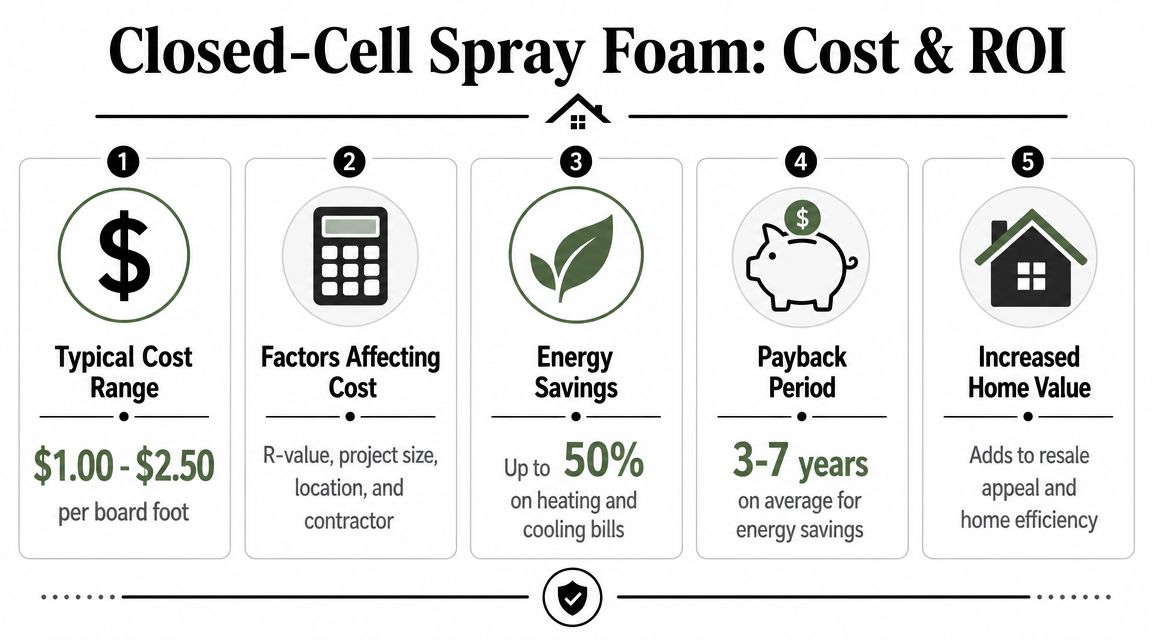
Final cost depends on the size of the project, accessibility, target thickness, existing conditions, and the type of assembly being sprayed. An easy open attic and a tight retrofit roofline are not priced the same in the field, even if the square footage looks similar on paper.
If you want a local pricing breakdown, this page on closed-cell foam spray insulation cost is a useful starting point for understanding how contractors usually frame estimates.
GreenBuildingAdvisor cites data showing that about 3 to 4 inches of closed-cell foam can achieve 90%+ of conductive heat-flow reduction, which is one reason installers often talk about a point of diminishing returns rather than adding more thickness indefinitely. The same source also notes a roof example where 5 inches of closed-cell foam produced about R-24.4 overall, nearly matching a hybrid assembly of 2 inches of foam plus 3.5 inches of batt insulation at R-24.3. That same industry summary notes a projection that the spray foam market could reach $4.37 billion by 2030 (GreenBuildingAdvisor discussion of closed-cell depth and diminishing returns).
The practical takeaway is simple. You're often paying for high performance without needing deep framing or oversized build-outs.
Owners also look at resale and durability. Better comfort, less humid air intrusion, and more stable interior conditions all make a property easier to live in and easier to maintain. If you're thinking about improvements from that broader ownership angle, these property management tips for homeowners offer a good lens on value-focused upgrades.
Closed-cell foam usually makes the most sense when the owner is solving multiple problems at once, not just chasing one lower bill.
A few questions come up near the end of almost every estimate conversation.
Homeowners should ask about the contractor's ventilation and re-entry process for the specific product being used. That's part of a professional installation. Once cured, the focus shifts from application safety to proper assembly performance and code compliance.
No. Fire performance is formulation-specific. Product literature in the market shows that some formulations are available as Class I flame-retardant systems meeting ASTM E-84. That's why the exact product matters, not just the category name.
Some newer products are moving toward lower-GWP blowing agents. The EPA's HFC phase-down under the AIM Act is pushing the market toward lower-GWP alternatives such as HFO-based formulations, so it's worth asking what chemistry your contractor is proposing and why (closed-cell foam product overview discussing Class I formulations and lower-GWP trends).
The foam itself is not something homeowners typically “service” like HVAC equipment. What matters is protecting the building assembly around it. Roof leaks, bulk water intrusion, and other enclosure failures still need prompt attention.

If you own a home, manage property, or build in Jupiter, Palm Beach Gardens, West Palm Beach, Wellington, Stuart, or nearby areas, the right next step is a site-specific evaluation. Closed cell spray in insulation works best when the recommendation is based on the actual roof, wall, crawl space, or metal building in front of you, not a generic sales pitch.
If you want a practical recommendation for your property, contact Airtight Spray Foam Insulation. They work with South Florida homeowners, builders, and property managers to evaluate where closed-cell foam fits, where it doesn't, and how the assembly should be detailed for heat, humidity, and storm exposure.