Your AC runs for hours. The thermostat says one thing, your skin says another, and the house still feels faintly damp. In South Florida, homeowners often assume the problem is the equipment, the ductwork, or the attic insulation itself.
Sometimes the weak point is much smaller.
A basic attic access panel can leak air, break the insulation layer, and let humid attic conditions interact with your conditioned living space in a way that keeps comfort just out of reach. That's why attic hatch covers matter so much here. In a dry climate, a sloppy hatch wastes energy. In a hot, humid climate, it also becomes a moisture-management problem.
A lot of South Florida homes have a simple ceiling hatch that was never treated as part of the building envelope. It was framed, trimmed, and painted. That was enough for access, but not enough for performance.
If the hatch isn't insulated and sealed, your home has a break in the ceiling plane right where you least want one. The attic is hot, humid, and under constant thermal stress. Your living space is cooled and dehumidified. The hatch sits between them.
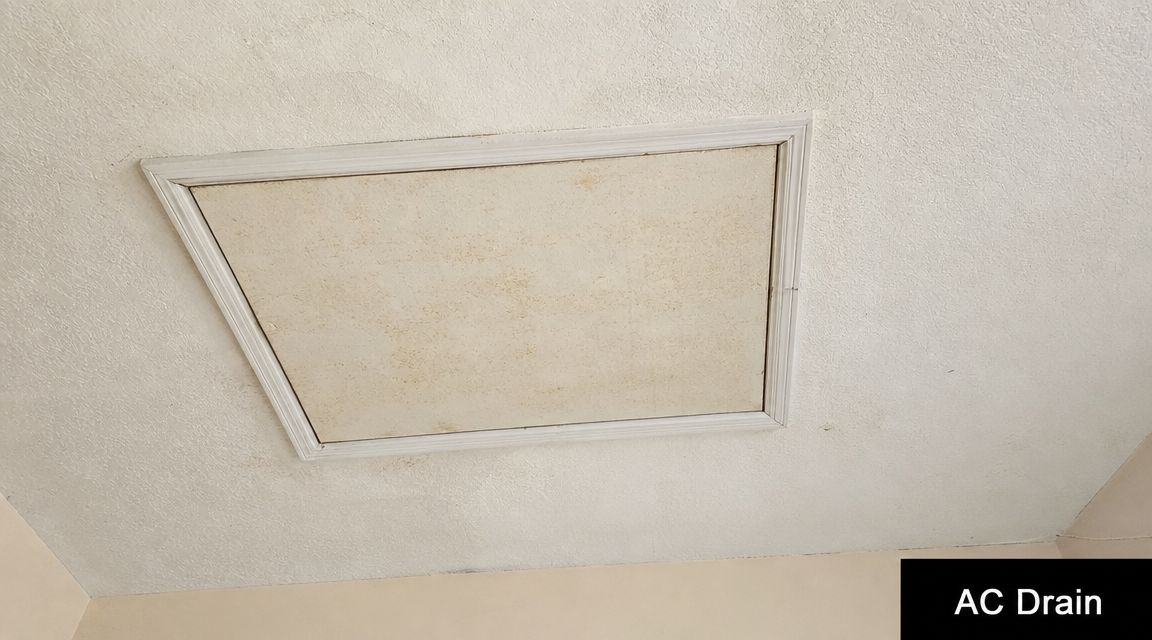
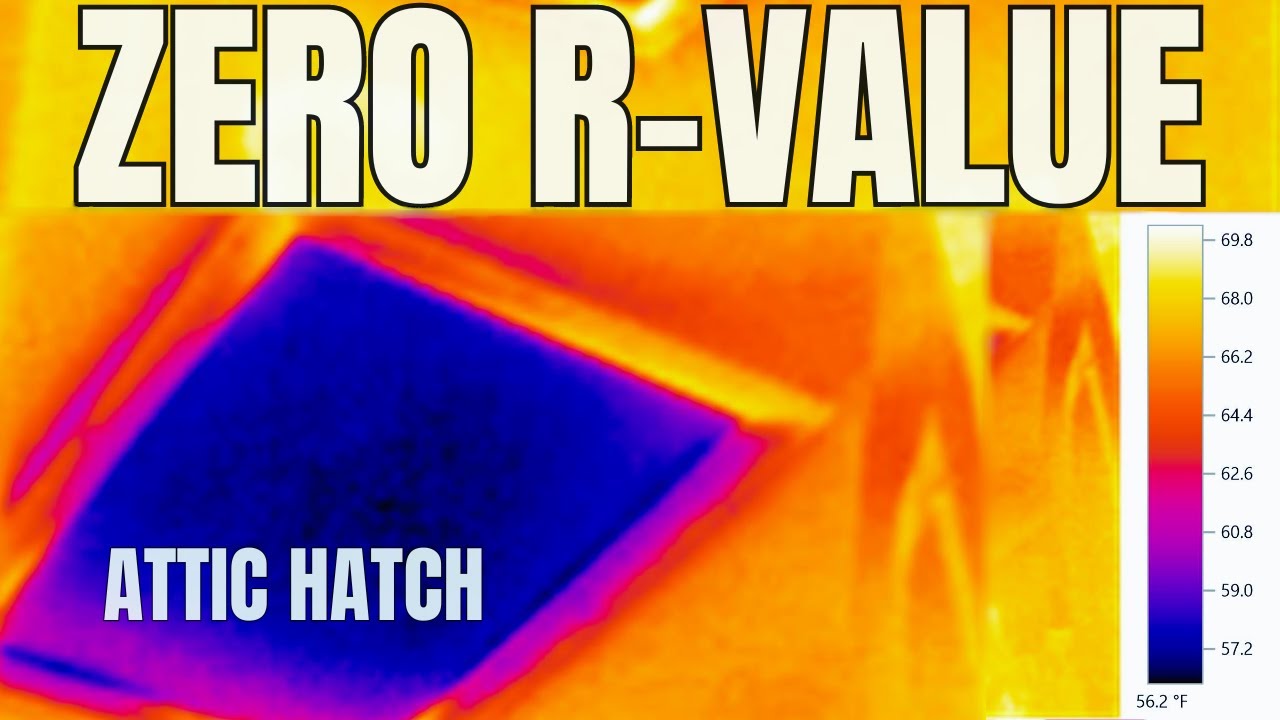
The U.S. Department of Energy warns that attic access hatches can undermine the performance of the entire attic's insulation unless they are both insulated and properly air-sealed, as summarized in Green Building Advisor's attic hatch guidance. That's the key point homeowners miss. The hatch isn't a minor trim detail. It's part of the thermal boundary.
In practical terms, a leaky hatch acts a lot like a small opening in the ceiling that never fully closes. Cooled indoor air escapes upward. Hot attic air and humidity can move in the opposite direction. The AC keeps running because the envelope keeps leaking.
A good hatch assembly does two jobs at once:
Practical rule: If the hatch looks like a plain panel with no gasket, no insulation, and no positive seal, treat it as an energy and humidity leak until proven otherwise.
If you're trying to improve comfort room by room, hatch sealing belongs in the same conversation as ways to lower house humidity from Coral Plumbing and Air. And if the bigger issue is leakage across the attic boundary, it helps to understand how contractors seal attic air leaks before adding or upgrading insulation.
An unsealed hatch doesn't fail in one way. It usually fails in several ways at once. That's why homeowners notice a mix of symptoms instead of one obvious problem.
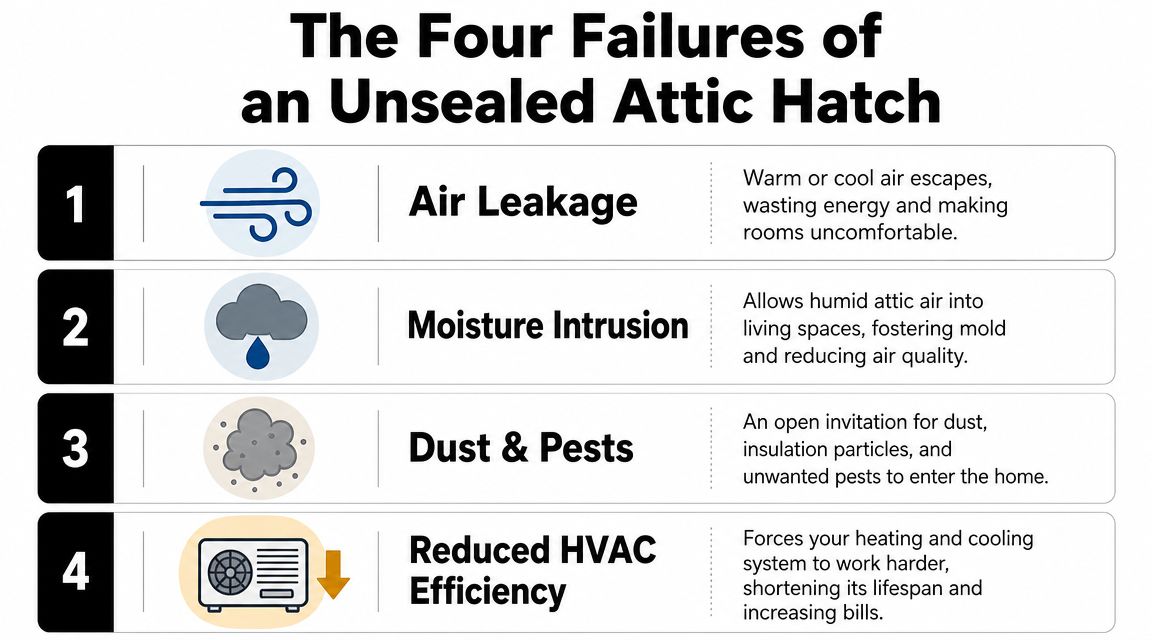
The first problem is straightforward. Your cooled air finds gaps around the panel or through an uninsulated lid and drifts into the attic.
ENERGY STAR recommends treating the attic hatch like an exterior door: seal its perimeter with weatherstripping and add rigid foam or fiberglass board to its back side so the closure is both airtight and thermally continuous in its attic hatch air-sealing guide. That recommendation matters because the hatch isn't just a lid. It's a door between conditioned and unconditioned space.
When that closure is loose, the AC has to replace air you already paid to cool.
In South Florida, this is the issue that gets underestimated. Air movement carries moisture. So when attic air moves through a hatch opening, it doesn't arrive empty. It brings humidity with it.
That added moisture load makes the home feel sticky. It also pushes the HVAC system to spend more effort on dehumidification, not just temperature control. Homeowners often describe this as “the AC runs, but the house never feels crisp.”
A hatch can be insulated and still perform poorly if the frame and lid don't seal tightly.
That's why a foam board glued to the back of an old panel isn't always enough. If the perimeter leaks, the moisture pathway is still there.
To see the air-sealing concept demonstrated visually, this walkthrough is useful:
Once there's air movement, there's usually debris movement too. Dust from the attic, loose insulation fibers, and fine particles can work their way through a poorly seated hatch. In older homes, that often shows up as dark streaking around trim or a dusty smell near the opening.
Pests also exploit weak access points. The hatch itself may not be the main entry route into the attic, but once insects or rodents are up there, a loose access panel gives them one more path toward the living space.
This last failure is broader than energy loss alone. A leaky hatch disrupts temperature balance and indoor comfort. Rooms near the opening often feel more variable. The system cycles longer. Humidity lingers.
Here's the simple way to understand it:
| Failure | What the homeowner notices |
|---|---|
| Air leakage | Warm or cool air doesn't stay where it should |
| Moisture intrusion | Indoor air feels damp or musty |
| Dust and attic debris | More particles near the hatch or in nearby rooms |
| HVAC strain | Longer run times and less stable comfort |
A proper attic hatch cover addresses all four. It isn't magic. It just closes one of the most common holes in the ceiling plane.
Not all attic hatch covers solve the same problem in the same way. The right choice depends on the access style, how often you use it, how much clearance you have above the opening, and whether the hatch is a simple panel or a pull-down stair.
Rigid covers are often the best fit for a basic push-up or lift-out hatch. They create a defined insulated cap over the opening and can be paired with weatherstripping at the hatch perimeter.
Commercial products have become more standardized. Commercially available attic hatch covers are often designed for openings up to 22.5 x 30 inches and are offered in versions like R-20 or R-38 to match surrounding insulation levels, though higher R-values require more vertical clearance in the attic, as described by Energy Guardian product details. That matters in low-slope roof areas where space above the opening can be tight.
Rigid systems usually work best when:
Tent-style covers are common over pull-down stairs. They sit above the attic stairs on the attic side and create an insulated enclosure around the folded ladder.
Their main advantage is simplicity. They're often easier to retrofit than building a custom rigid box over a stair unit. For homeowners who need access but want a better thermal barrier than the bare stair door provides, they can be a practical middle ground.
Their trade-offs are different:
A custom foam box is common when the opening isn't standard or when the installer wants to match the site conditions more precisely. This approach can work very well, especially when the attic has unusual framing or the hatch sits near obstructions.
What works: A custom cover that fits the opening, seals at the perimeter, and can be removed without crushing insulation or damaging the gasket.
What doesn't work is a loose foam box dropped over the hatch with gaps around the edges. A cover has to be part of a controlled assembly, not just something sitting nearby.
| Cover type | Best for | Main advantage | Main trade-off |
|---|---|---|---|
| Rigid hatch cover | Standard push-up hatches | Strong shape and defined insulation level | Needs proper fit and attic clearance |
| Tent-style cover | Pull-down stairs | Easier retrofit for ladder openings | More wear points and more handling |
| Custom foam box | Odd openings or site-built upgrades | Flexible to field conditions | Quality depends heavily on workmanship |
The best material choice usually isn't the one with the biggest label. It's the one that seals reliably, survives repeated use, and fits the actual geometry of the opening.
An attic hatch matters everywhere. In South Florida, it matters more because heat and humidity work together.
A lot of national advice treats attic hatches as energy upgrades only. That's too narrow for this climate. Here, the hatch can be a moisture-control detail just as much as an insulation detail.
In hot-humid climates like South Florida, uncontrolled air movement is a primary driver of moisture transport. A leaky attic hatch can undermine comfort and efficiency even if the attic is well-insulated, as noted in Dr. Energy Saver's discussion of attic hatch covers.
That's the local reality. You can have decent attic insulation and still struggle with indoor dampness if the access point leaks.
When humid air migrates through or around the hatch, several problems start stacking up:
In the field, the worst hatch problems usually aren't just “missing insulation.” They're crooked lids, warped panels, rough drywall cuts, undersized trim, and framing that never gave the panel a clean surface to close against.
That matters because attic hatch covers don't fix bad carpentry by themselves. If the opening is out of square or the lid can't compress against a seal evenly, the cover becomes a partial solution. It may help, but it won't fully control the air path.
A reliable South Florida hatch detail usually needs:
In this climate, a hatch cover is often less about adding insulation and more about controlling the movement of wet air.
Homeowners sometimes assume the hatch is less important once the attic has been upgraded. In practice, better insulation can make hatch defects stand out more. As the rest of the attic boundary improves, the remaining leaks become more noticeable.
That's why homes with otherwise solid attic upgrades can still have one stubborn comfort complaint. The hatch was left behind, and the house keeps paying for it in humidity, run time, and uneven comfort.
Spray foam changes the way an attic performs because it addresses both insulation and air leakage at the larger assembly level. But even a strong attic insulation strategy can be compromised if the access point remains weak.
That's where attic hatch covers stop being an accessory and become part of the full enclosure system.
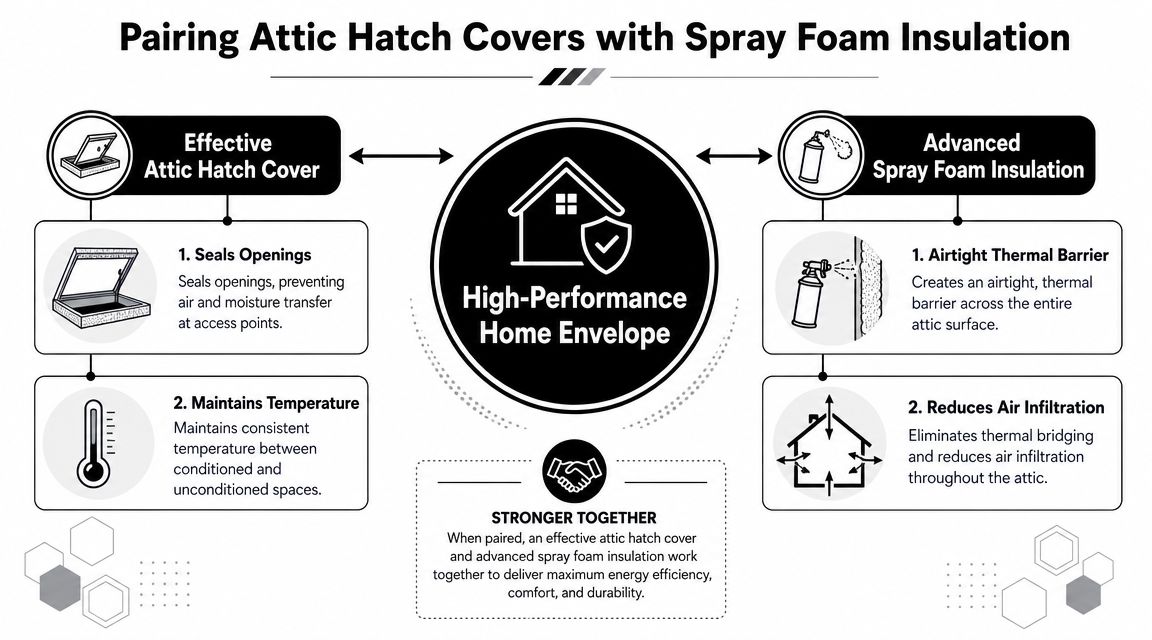
Think about the attic as one connected boundary. Spray foam can create the primary air and thermal barrier across the attic roofline or other designated surfaces. The hatch is the interruption in that barrier. If you leave it untreated, you've left a removable weak point in the system.
That's why the hatch should be detailed to the same standard as the surrounding work. It needs insulation. It needs an air seal. And it needs to stay functional so people don't remove it carelessly and never reseal it.
Building codes and industry best practices require that attic hatch insulation should meet or exceed the surrounding R-value without being compressed, according to the Insulation Institute critical details guide. Compression reduces thermal performance and can create cold spots that encourage condensation.
A complete attic system usually includes these pieces working together:
For small perimeter irregularities, installers often use compressible sealants and tapes where appropriate. If you're comparing materials for gap control around assemblies, Emseal products from Contractor's Den are one example of the kinds of expansion-based sealing products builders evaluate when they need a reliable compression seal in challenging joints.
This point gets missed all the time. Homeowners ask whether the hatch detail matters less if they choose open-cell or closed-cell spray foam. It doesn't. The foam choice changes the larger assembly characteristics, but the access opening still needs its own closure strategy.
If you're weighing attic options overall, it helps to review how professionals compare the best spray foam insulation approaches for different assemblies and climate demands.
A hatch cover belongs in that discussion because performance comes from continuity. The spray foam does the broad work. The hatch cover finishes the job where the assembly has to remain openable.
You can spend good money on attic insulation and still lose performance at the access point every time the hatch closes crooked or fails to compress the gasket. In South Florida, that is not a small defect. It is a direct path for hot, damp attic air to work back into the house and force the AC to remove that moisture.
Some hatch cover projects are realistic for a careful homeowner. Others need a pro who knows how to get repeatable pressure, clean alignment, and a seal that still works after the hatch has been opened and closed dozens of times.
DIY usually makes sense on a basic push-up hatch with a flat panel, solid trim, and enough room to add insulation without interfering with closure. In that situation, a homeowner can often improve the hatch by adding rigid insulation to the lid, installing weatherstripping, and adjusting the fit so the panel lands evenly.
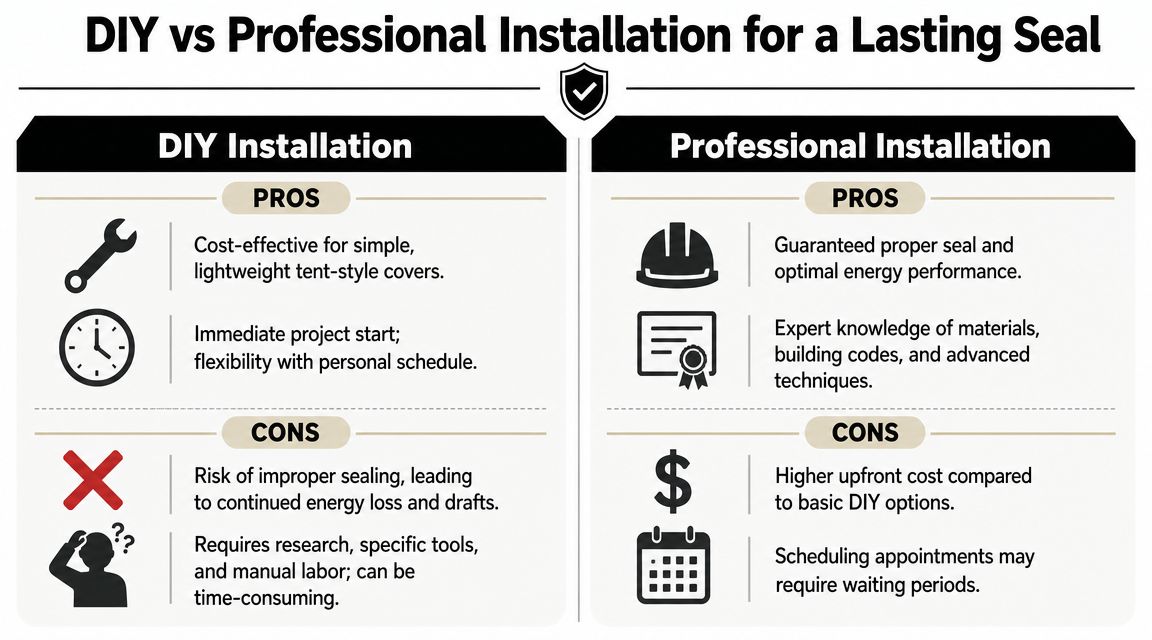
DIY tends to work best when:
That last point matters. A hatch can look finished and still leak badly, especially in a garage hallway or closet ceiling where nobody notices the weak seal.
The U.S. Department of Energy has long advised that attic access openings need both insulation and air sealing or they can undercut the rest of the attic assembly. The challenge is not knowing that. The challenge is building a hatch that closes the same way every time in a hot, humid house where materials expand, flex, and age.
Professional help is usually the right call when:
| Situation | Why it needs more precision |
|---|---|
| Pull-down attic stairs | Hinges, joints, and folded sections create multiple leakage paths |
| Warped or damaged hatch | Weatherstripping cannot seal well against an uneven panel |
| Low attic clearance | Cover thickness, insulation depth, and service access have to fit together |
| Spray foam or whole-attic work is underway | The hatch needs to match the air barrier strategy, not work against it |
I see this often after partial retrofits. The attic gets upgraded, but the hatch is treated like finish trim. Then the house still feels sticky, the AC runs longer, and the owner assumes the insulation did not work. The weak point was the opening all along.
Field advice: If the hatch has to be shoved, twisted, or forced shut, the seal is usually inconsistent.
Whether the work is DIY or professional, inspect the hatch after a few weeks of normal use. South Florida homes put these details under stress. Humidity swells materials. Storage bumps panels out of alignment. Ladder hardware loosens. Gaskets flatten.
Check these items:
If the hatch is part of a bigger comfort or humidity problem, a contractor who understands enclosure details can save a lot of trial and error. This guide to finding air sealing contractors near me is a useful starting point.
A lasting seal comes from fit, compression, and durability. In South Florida, that means more than neat workmanship. It means protecting the spray foam or attic insulation you already paid for, keeping attic moisture out of the living space, and giving the AC less hidden leakage to fight.