
If you've ever walked into a metal warehouse in South Florida at 7 a.m. and felt the ceiling sweating while the floor still feels workable, you already know the problem. The air seems fine near the dock, then you step deeper inside and the place turns sticky, hot, and hard on both people and product. That's warehouse climate control in practice, not the neat version people get from generic HVAC brochures.
In this region, the job isn't just cooling air. It's controlling temperature, humidity, airflow, door leakage, and heat coming through the building shell, all at once. If you miss one of those pieces, the whole facility feels off, even if the thermostat says the system is running.
A South Florida warehouse is rarely fighting one clean problem. It's usually fighting several at once, a metal roof that heats up fast, dock doors that open all day, forklifts and equipment that add internal heat, and moisture-rich outside air that keeps sneaking in every time someone rolls a door up. In that kind of building, a comfortable reading at the thermostat can hide miserable conditions at floor level or inside storage bays.
A lot of owners ask for “more AC” when what they need is better moisture control. That matters because South Florida air can feel oppressive long before the building gets hot, and once humid air gets in, cold surfaces can start collecting condensation. That's how you get damp cardboard, slippery floors, rust concerns, and staff who feel like the warehouse never dries out.
Practical rule: if the building feels clammy, don't assume the cooling equipment is undersized. The issue may be infiltration, moisture load, or poor zoning.
The building itself also behaves differently here. Metal structures pick up heat fast and shed it unevenly, which makes the roof and upper walls act like a big radiant panel. A warehouse can look “finished” from the outside and still perform like a toaster inside if the envelope leaks air and moisture.
That's why the usual one-size-fits-all advice falls apart. A light-industrial storage facility, a workshop, and a temperature-sensitive stock room can sit in the same zip code and still need different answers. One may need more dehumidification, another may need focused airflow, and a third may need the envelope tightened before any mechanical upgrade makes sense.
The rest of this guide follows that reality. Warehouse climate control works best here when the building shell, the equipment, and the controls are designed together, not bought one piece at a time.
The fastest way to waste money is to pick equipment before defining the actual job. A storage bay holding boxed inventory has a different target than a pharmaceutical room, a metal workshop, or an office corner inside a warehouse. The use case drives the design, not the other way around.
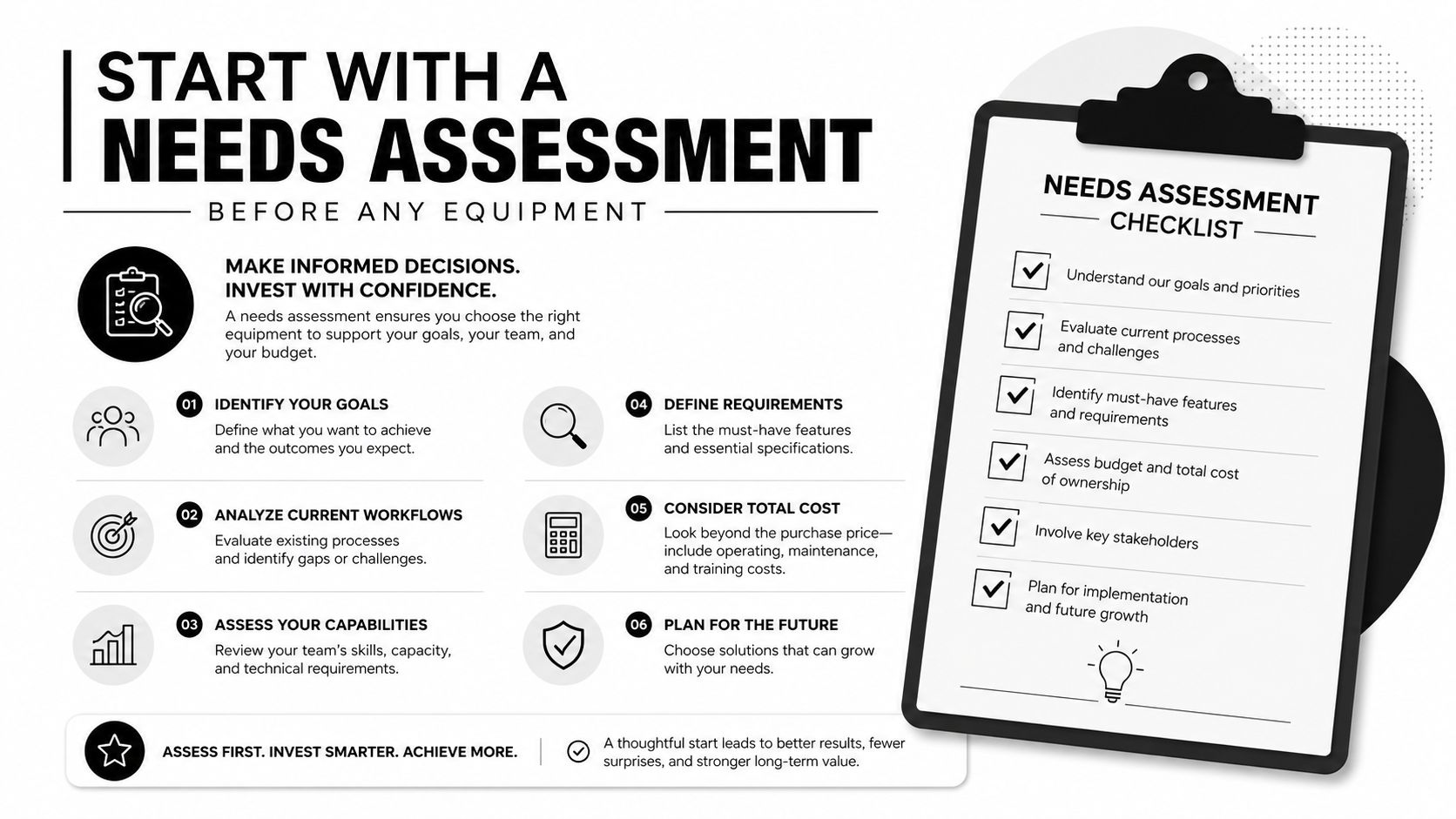
Start with what lives in the building and what can't tolerate drift. If the facility stores temperature-sensitive goods, humidity-sensitive materials, or regulated products, the tolerances are not optional. For some operations, even a small swing can create real inventory risk, while a general storage building may just need a more stable, drier environment.
Use this checklist before anyone sizes a system:
A 7,000-square-foot warehouse with tall clear height and frequent dock traffic does not behave like a smaller, sealed indoor storage room. That's why the same tonnage, the same dehumidifier, or the same fan package can be a good fit in one building and a bad fit in another.
For a broader look at envelope efficiency, the practical side of this work is tied closely to the way air leaks and heat move through the shell, and that's worth understanding in the context of commercial building energy efficiency.
A contractor who skips this step and goes straight to equipment sizing is guessing. The better approach is to define the storage risk, the moisture risk, and the use pattern first, then match equipment to those realities. That's how you avoid paying for cooling capacity you'll never use while still missing the actual comfort and humidity problem.
A warehouse doesn't always need more cooling. Sometimes it needs drier air, sometimes it needs better zone control, and sometimes it needs both. The mistake is assuming every heat complaint is an air-conditioning complaint.
Conventional HVAC makes sense when the goal is to lower temperature across a defined occupied area, especially offices, small conditioned rooms, and limited storage zones. Dedicated dehumidifiers make more sense when the air already feels damp, the building sees frequent door cycling, or the priority is protecting materials from moisture rather than chasing a lower thermostat reading. Hybrid systems are the best fit when both temperature and moisture have to stay in a narrower band.
If you want a deeper reference on the mechanical side, a central cooling and heating guide can help frame how standard systems are normally built before you start layering in moisture control.
| Warehouse Conditioning Systems Compared | ||
|---|---|---|
| System | Strength | Best Fit |
| Conventional HVAC | Lowers temperature | Offices, small zones, limited occupied areas |
| Dedicated dehumidification | Controls moisture directly | Humidity-prone storage, dock-adjacent areas, sensitive goods |
| Hybrid DX plus dehumidification | Handles both temperature and moisture | Mixed-use warehouses, regulated goods, tougher South Florida loads |
A standard air conditioner can pull temperature down and still leave the space clammy if the outside air keeps replacing what was just cooled. That's where warehouse owners get frustrated. They pay for cold air, but the building still doesn't feel stable because moisture keeps re-entering through dock doors, cracks, and weak envelope points.
A useful planning reference is the difference between cooling air and managing moisture, which is covered in this dew point overview. That distinction matters in South Florida more than in drier climates because humidity drives comfort, condensation risk, and how hard the equipment has to work.
For metal workshops, I've seen better results from zone-based conditioning and moisture control than from trying to force one giant system to treat every cubic foot the same way. For food, pharma, and electronics, the acceptable answer is usually tighter control, better monitoring, and less reliance on the whole building staying perfectly mixed. For general storage, the winning setup is often simpler, as long as the envelope is tight and the docks aren't bleeding in humid air all day.
The building shell is part of the system. In South Florida, that's not theory, it's the difference between a facility that stays manageable and one that fights you all year.
A 2023 warehouse temperature-control study found that adding a stainless-steel insulation cavity reduced internal warehouse temperatures by 2 to 16°C source. That kind of change matters because it shows envelope work can deliver large cooling gains without changing how the building is used. In a hot metal warehouse, that's a big deal.
On metal roofs and walls, closed-cell spray foam is usually the default because it does more than slow heat gain. It also acts as a moisture barrier and a vapor retarder, which is exactly what a humid climate asks for when metal is the primary building material. Open-cell foam has its place in some assemblies, but in conditioned metal warehouses, closed-cell is usually the safer starting point.
A warehouse shell that leaks heat and humidity forces the mechanical system to chase a moving target all day.
Fiberglass batt insulation can be fine in the right assembly, but in a humid, high-heat metal building it's vulnerable when air moves around it. Reflective barriers can help with radiant load, but they don't seal gaps the way spray foam does. That's why the best South Florida jobs usually start with tightening the envelope, then sizing mechanical equipment after the shell is under control.
For more detail on the application side, see spray foam insulation for metal buildings.
A lot of owners want to buy bigger equipment first. That's usually backwards. If the shell is leaking air, adding capacity just makes the system work harder against the same problem. If the shell is tighter, the cooling and dehumidification equipment can finally hold a stable condition instead of playing catch-up all day.
If you're comparing envelope upgrades with broader equipment options, it helps to think in terms of load reduction first, machine selection second, and control tuning third. That order is what makes a warehouse feel controlled instead of merely cooled.
For a broader equipment comparison, an industrial HVAC solutions overview can help frame the mechanical side, but in a South Florida warehouse the shell often delivers the cleanest improvement per dollar of effort.
In a high-bay warehouse, the heat does not sit evenly. Warm air climbs and collects near the roof, while the work zone below can feel different enough to fool a thermostat and the people reading it.
Destratification fans are often the right answer in tall buildings because they push trapped warm air back down and narrow the temperature gap across the room. They cost far less than trying to overcool a large air volume that nobody uses. In real jobs, that means less energy spent fighting empty cubic footage and more of it spent where staff and inventory are.
Ventilation still has to be sized for the building, not guessed at. A practical warehouse ventilation example cited by NBC News, drawing on industry guidance, points to a minimum rate of 0.06 CFM per square foot per person, and it shows that a 7,000-square-foot, 30-foot-tall warehouse would need 420 CFM per person source. Those figures matter because ventilation is part of the load calculation, not a nice extra, and it affects both air exchange and worker safety.
Offices, pick-pack stations, and temperature-sensitive storage should be cooled as separate targets whenever possible. That keeps the system from wasting capacity on empty aisles, tall rack volume, or areas that do not need the same condition as the work zone. In South Florida, that is often the difference between a building that feels controlled and one that just costs a lot to run.
If the facility has frequent dock use, airflow planning has to account for infiltration at the doors. A fan setup alone will not solve that. It can improve circulation, but it cannot replace a tight envelope or a smart door strategy.
Do not condition the entire tall volume just because it exists. That is usually the most expensive way to get average results. In actual warehouse work, the better approach is to make the occupied zone comfortable, manage air movement above it, and keep the building shell from undoing the work.
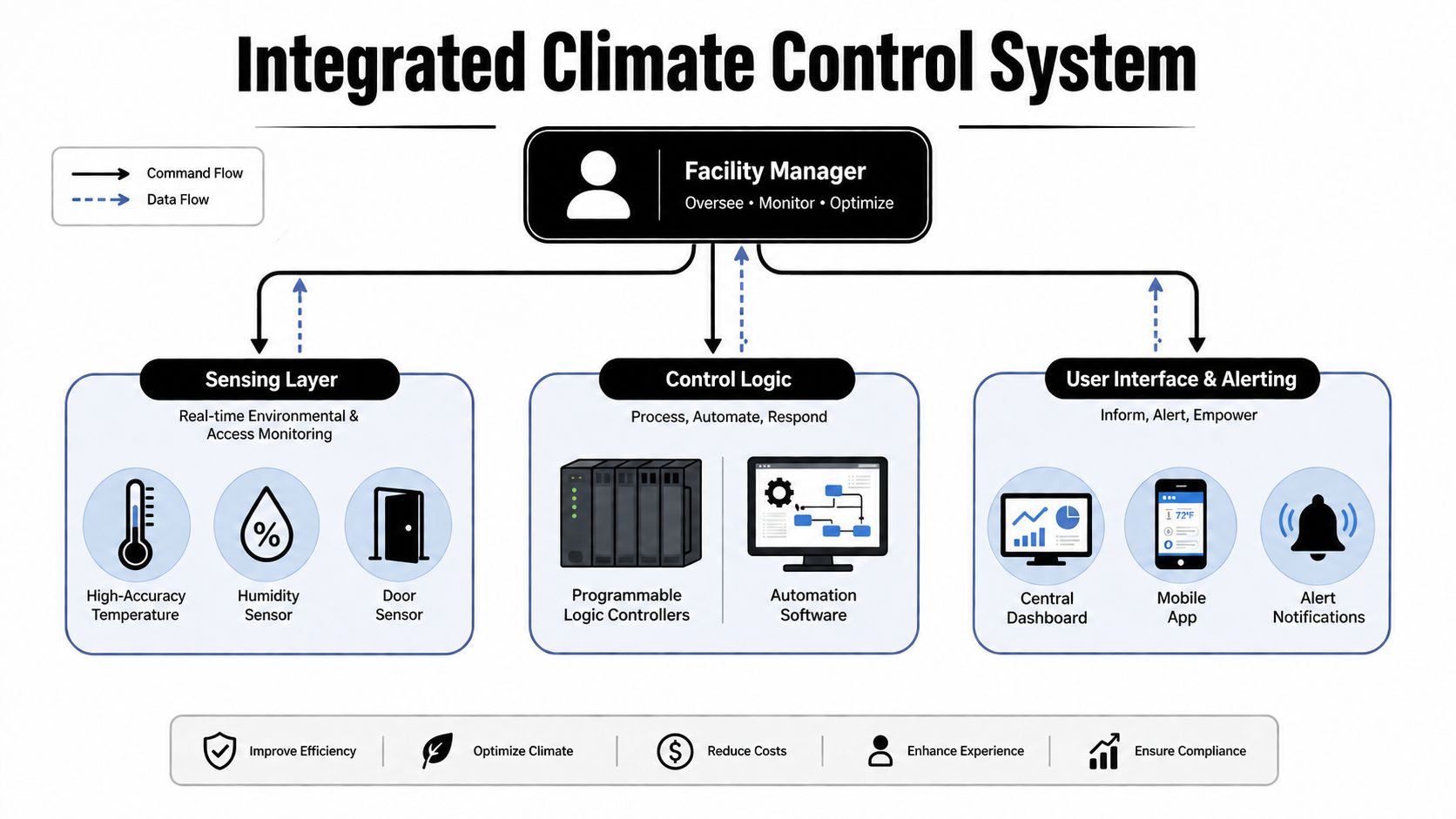
A warehouse can look fine and still be drifting out of spec. In South Florida, that usually starts with humidity, not temperature. If the sensors are sloppy or the alarms are set too loosely, the building can spend hours outside the range you thought you had under control.
In regulated storage, the monitoring system has to show you where the building is hottest, coldest, and most humid, not just what the lobby sensor says. WHO guidance calls for electronic temperature sensors accurate to ±0.5 °C or better, placed where the greatest temperature variability is expected, and it recommends mapping hot and cold points across the storage volume source. Pharma GMP guidance also expects warehouse-level monitoring to use ±0.5 °C accuracy, traceable calibration, alarm thresholds with pre-alerts, and validation steps like IQ/OQ/PQ and periodic recalibration.
That is not overkill if you are storing regulated goods. It is what lets you catch a drift before product spends too long outside spec, and it gives you a record you can defend during an audit.
Practical rule: if the monitoring system cannot show hot spots, cold spots, and humidity swings, it is not controlling the warehouse, it is just collecting weather data.
For a general South Florida warehouse, start with temperature, relative humidity, and door-position logging. Those three inputs tell you what the air is doing, how wet it is, and whether door cycling is undermining the envelope. In a humid metal building, that matters as much as the cooling tonnage, because moisture gain can make a space feel uncontrolled long before the air temperature looks alarming.
Alarm setup should match how the building is used. Pre-alerts should come first, so staff has time to respond before conditions slide too far, and hard alarms should be reserved for the point where the building really needs intervention. If the site has zones with different uses, the sensors should reflect that zoning instead of treating the warehouse like one flat condition.
The right monitoring setup turns the building into something you can manage by zone, not by guesswork. In a South Florida warehouse, that is where control starts, at the envelope, at the occupied areas, and at the sensors that tell the truth when humidity or door traffic starts working against you.
Owners usually ask what to buy first, but the better question is where the most waste is happening now. In South Florida warehouses, the answer is usually the same, money is leaking through the shell, the doors, and the fact that the whole building is being treated like one zone.
The strongest energy strategy is still the simplest one, seal the envelope before you chase larger equipment. If air isn't leaking through gaps, seams, and weak transitions, the cooling system has a fighting chance. Add strip curtains or air curtains at docks, and you reduce how much humid air the building keeps swallowing during normal operations.
Dehumidification can also let you raise cooling setpoints without making the building feel wet and sticky. That matters because the goal isn't to make the warehouse cold everywhere, it's to make the occupied and storage zones stable enough to work in and store product safely. Destratification fans help too, because they reduce the tendency for hot air to sit unused near the roof.
The spending order that usually makes the most sense is:
That order isn't flashy, but it's how you avoid paying twice. You don't want to buy oversized cooling equipment to solve an infiltration problem that should've been handled at the shell.
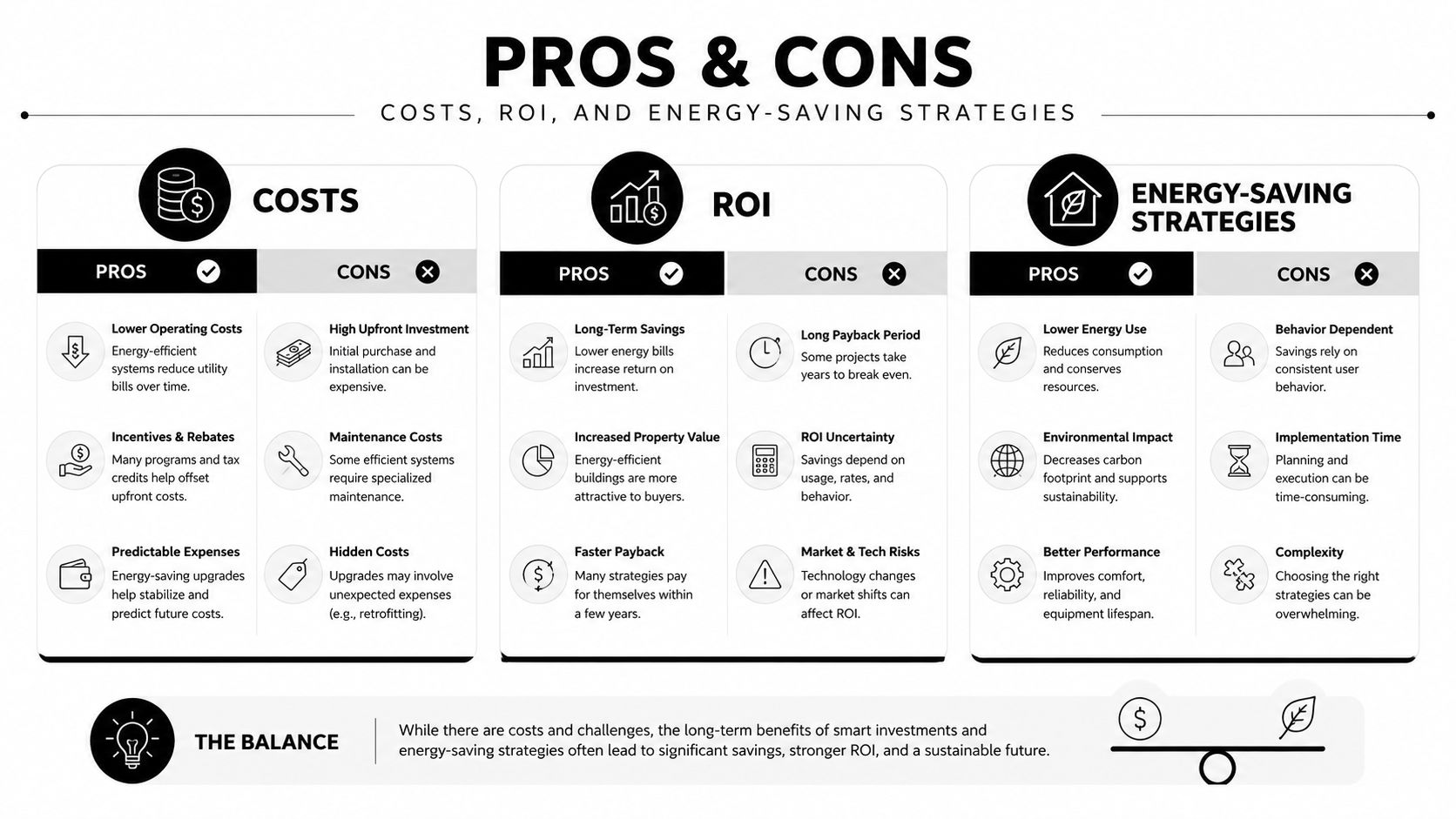
Blanket cooling is often the wrong default in a large South Florida warehouse. Selective zone conditioning plus humidity management usually gives better reliability because it puts capacity where people and sensitive goods are. That's especially true in buildings with frequent door cycling, tall clear height, and mixed-use spaces.
If you're planning a retrofit, compare the cost of making the whole volume “comfortable” against the cost of making the envelope tighter and the critical zones more controlled. In many real jobs, the second path is the one that holds up.
A good system can still fail if nobody maintains the parts that move, seal, measure, and drain. South Florida humidity is relentless, so maintenance isn't a nice-to-have, it's part of the operating plan.
Filters need attention, coils need cleaning, dehumidifier components need periodic checks, and sensor calibration can't be an afterthought. Dock-door seals should also be inspected regularly, because a worn seal can undo a lot of the work you paid for elsewhere.
A contractor who thinks in one system, envelope, equipment, and controls, usually delivers a better result than someone selling three separate purchases. That's the mindset that keeps a warehouse stable long after the install crew leaves.
A CTA for Airtight Spray Foam Insulation. If your warehouse in South Florida still fights heat, humidity, and condensation, ask for a site visit and a plan that treats the shell, the airflow, and the moisture load as one system.