You paid for spray foam because you wanted the attic to stop acting like an oven. Maybe the house still feels sticky by midafternoon. Maybe there's a smell near the attic hatch that shouldn't still be there. Maybe your power bill didn't drop the way you expected. When that happens, the wrong question is often asked first.
They ask whether spray foam is bad.
The better question is whether the attic was designed and sprayed correctly for the house, the roof, and the climate. That's where most attic spray foam insulation problems start. Not with the material itself, but with a bad decision, a rushed crew, poor prep, or a foam type that didn't match the assembly.
In humid coastal climates, an attic spray foam job changes the way the whole house works. It affects the roof deck, moisture movement, HVAC behavior, and how leaks show up. Done right, it can be a strong system. Done wrong, it can hide trouble where you won't see it until the repair gets expensive.
A common call goes like this. The homeowner says the attic was sprayed a while back. At first, everything sounded great. Lower bills, tighter house, better comfort. Then something felt off. A chemical odor lingered longer than expected. One upstairs room stayed warm. The attic looked sealed, but the house didn't feel finished.
That's the split personality of spray foam in an attic. It can be an excellent performer, but it doesn't forgive sloppy work. It also isn't just an insulation upgrade. Once you spray the underside of the roof deck and gable walls, you're turning that attic into a conditioned part of the house. That's a building-systems change, not a simple material swap.
The appeal is real. One industry source says spray foam can reduce energy bills by 30% to 50% and recover its cost in about 3 to 5 years, but only when the attic is properly transformed into an unvented conditioned space and the whole system is executed correctly, as described in this spray foam performance overview.
Those numbers help explain why so many homeowners choose it. The problem is that people often hear the promise and miss the conditions attached to it.
The installer is the critical variable. Foam has to be mixed correctly, applied to the right surfaces, at the right temperature and thickness, in an attic that's ready for it. If the crew sprays over damp wood, leaves hidden voids, blocks the wrong pathways, or ignores the HVAC side of the house, the material can't save the project.
Practical rule: Spray foam rewards precision and punishes shortcuts.
If you're weighing whether the system makes sense for your house, it helps to start with a balanced look at the pros and cons of spray foam insulation. In my experience, most failures people blame on foam are really failures in planning, substrate prep, chemistry control, or attic design.
Some attic spray foam insulation problems are easy to spot. Others stay hidden for a long time. The dangerous ones are usually the hidden ones.
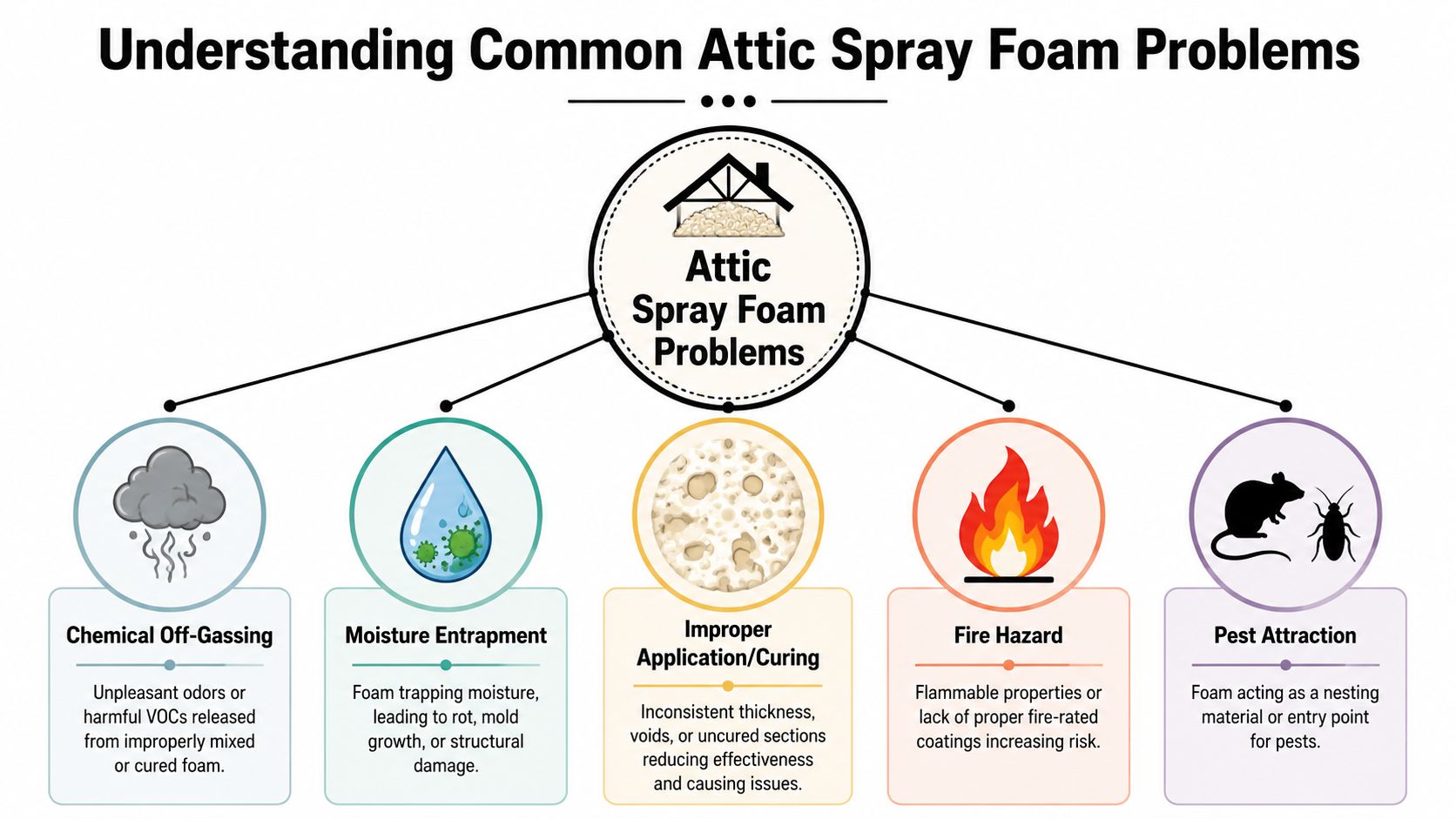
Off-ratio foam is one of the first things a seasoned installer thinks about when a homeowner mentions odor, brittleness, shrinking, or sticky surfaces. Spray foam is a two-part chemical system. If the proportions are off, it behaves like cake batter with the wrong amount of flour or oil. It won't rise, set, or bond the way it should.
That can show up as:
A good crew watches hose heat, drum temperature, substrate condition, spray pattern, lift thickness, and foam appearance constantly. A bad crew just keeps pulling the trigger.
You can have chemically sound foam and still get a poor result if the application is uneven. Thin spots, skipped corners, and voids around penetrations create hidden thermal bridges and air leaks. In South Florida, that means humid air finds the weakness fast.
Here's the simple version. Spray foam only works as a control layer if it's continuous. Consider a raincoat. One small tear in the shoulder can soak the shirt underneath.
A few field mistakes I see most often:
| Problem | What it means in real life |
|---|---|
| Thin coverage | Hot spots, comfort complaints, HVAC strain |
| Gaps at framing transitions | Air leakage and hidden condensation risk |
| Poor adhesion | Foam separates from the surface and loses continuity |
| Spraying before other trades finish | Electricians and plumbers cut into the assembly later |
If a home already has humidity issues, it's also worth understanding how to reduce indoor humidity, because foam can't compensate for a house with unmanaged moisture loads.
The most serious failures involve water that can't dry where it needs to. One industry article notes that closed-cell foam can trap water from a hidden roof leak against the wood sheathing, while open-cell foam may allow water to pass through and reveal the leak. That same source states that a code-compliant conditioned attic under IRC 2006 R806.4 should have no attic ventilation, which raises the stakes on correct design and installation in the first place, as outlined in this discussion of spray foam attic moisture behavior.
That doesn't mean closed-cell is bad or open-cell is always better. It means each foam changes the way the roof assembly handles moisture, and the installer needs to understand that before spraying a single bay.
A bad foam job doesn't just miss efficiency. It can change how water announces itself, and sometimes it stops announcing itself at all.
For homeowners worried about whether sealed attics can contribute to hidden biological growth, a good starting point is this page on spray foam insulation and mold. The short version is simple. Foam doesn't excuse moisture mistakes.
You don't need to be an installer to catch warning signs early. You do need to slow down and inspect the attic with your senses. Look first. Then smell. Then feel. Then pay attention to what the house has been telling you through comfort and utility patterns.
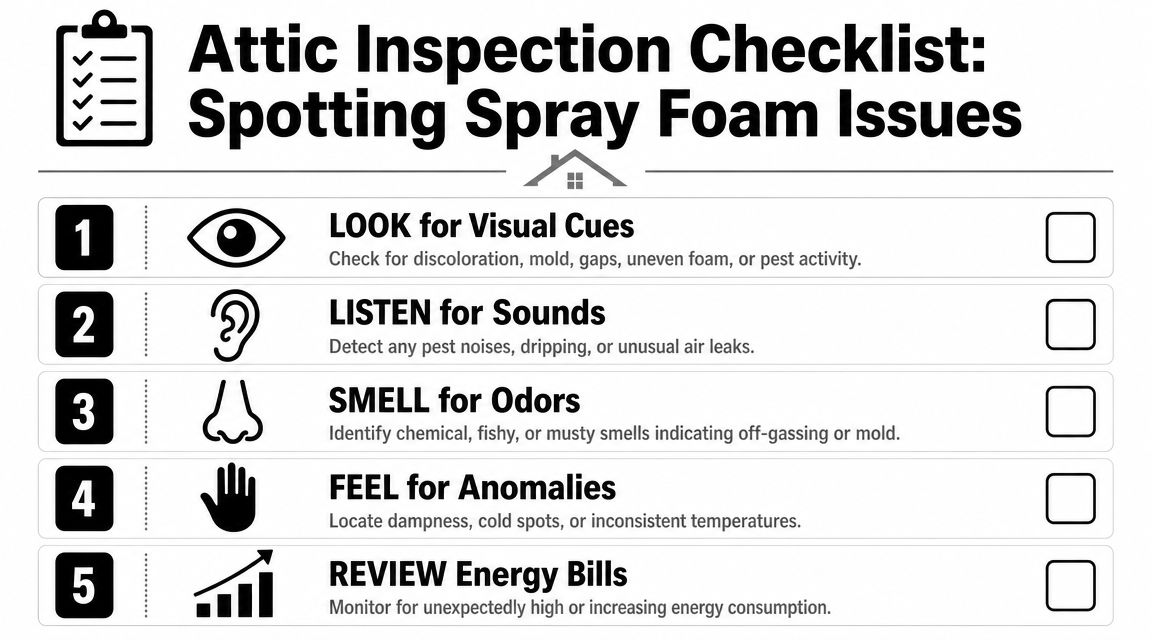
Start with a bright flashlight and take your time around the roof deck, rafters, eaves, and penetrations.
Look for:
If you're seeing staining on wood adjacent to foam, don't assume the problem started there. Water often travels before it shows itself.
A fresh installation can have a temporary odor during curing. A persistent chemical smell, especially one that feels sharp, fishy, or irritating, deserves attention. A musty smell points your attention in a different direction. That often means moisture.
Touch matters too, but do it carefully and only where it's safe to reach. Fully cured foam shouldn't feel wet, gummy, or unusually soft. If it does, stop poking at it and document the location.
Here is a useful visual walkthrough before you climb up there yourself:
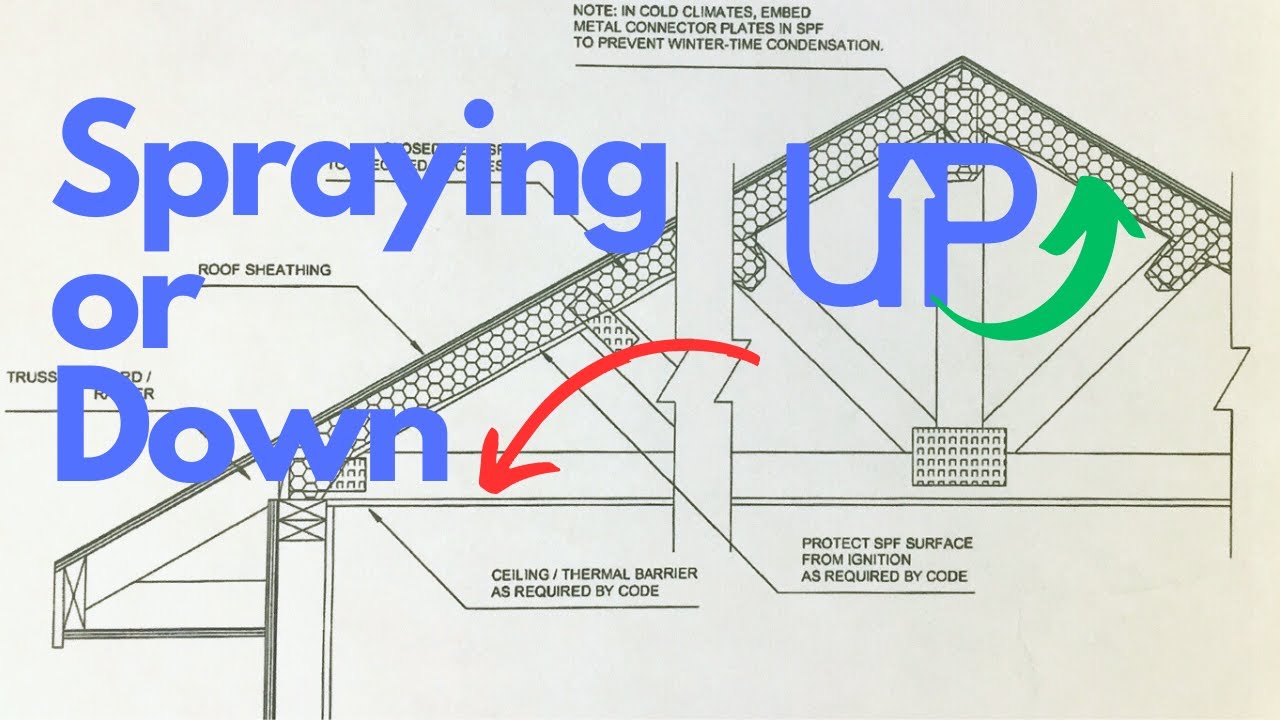
One building-science source warns that moisture entrapment can happen when humid indoor air slips through small unsealed gaps, reaches a cold roof deck, and condenses. Because the foam is bonded to the wood, that trapped moisture can stay hidden while rot and mold develop, as described in this report on concealed spray foam moisture damage.
Use this short checklist:
If you want proof instead of guesswork, ask for a blower door test. It helps identify whether the foam layer is actually acting like a continuous air barrier.
Once you know something is wrong, the next step is deciding whether the issue is cosmetic, repairable, or a full removal job. Homeowners get in trouble when they try to treat every foam problem with the same fix.
Some defects can be corrected without tearing out the whole attic assembly. If the foam is generally well-bonded and properly cured, a contractor may be able to repair isolated voids, touch up thin sections, or seal missed transitions.
These are the kinds of situations that often qualify for targeted repair:
This kind of correction only works when the original foam is chemically sound. If the underlying product is bad, patching over it is like painting over rotten trim.
Widespread off-ratio foam, persistent odor, major shrinkage, or foam that has detached across large areas usually needs to come out. That's the part homeowners hate hearing, but partial repairs on a failed chemical installation often waste money.
Removal is labor-heavy. Crews may cut, scrape, shave, and mechanically abrade material away from rafters and sheathing. The goal isn't just getting the foam out. It's getting the substrate clean enough for the next assembly to work.
The expensive part of bad spray foam isn't always the re-spray. It's the cleanup and lost confidence between the first job and the second.
I won't invent square-foot pricing where no verified data exists. In practice, repair costs vary based on access, roof geometry, foam type, contamination, how firmly the foam is bonded, and whether electrical or mechanical work has to be exposed and protected.
A realistic way to think about budget is by category:
| Scope | Typical complexity |
|---|---|
| Small touch-up work | Lower disruption, highly dependent on access |
| Sectional removal and re-spray | Moderate disruption, careful substrate prep required |
| Full attic remediation | Highest disruption, often more involved than the original install |
If a contractor gives you a firm price without inspecting the attic closely, that's a red flag. A serious remediation plan should identify the cause, define the affected areas, explain the removal method, and spell out how the attic will be verified before reinstallation.
Most failures can be prevented before the hoses ever come off the truck. Homeowners tend to focus on the foam brand or the price per job. The better focus is the installer's judgment.
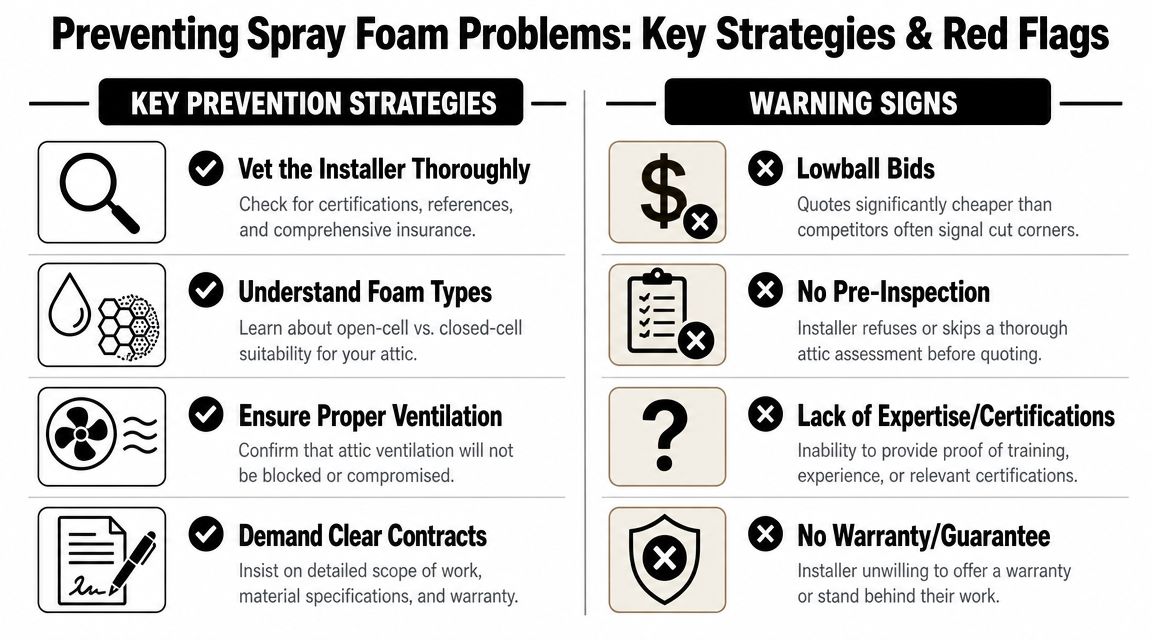
A qualified contractor should be comfortable answering direct questions. If they get vague or defensive, keep looking.
Ask things like:
I trust contractors who slow the process down enough to protect the house. I don't trust crews who treat attics like a race.
Watch for these red flags:
| Red flag | Why it matters |
|---|---|
| Very low bid | Someone may be cutting prep, thickness, or labor quality |
| No attic inspection | They can't design a system they haven't studied |
| No discussion of moisture | They don't understand the assembly |
| No plan for ignition or thermal barriers where required | They may be ignoring safety and code issues |
| One-size-fits-all recommendation | They may be selling inventory, not solving your problem |
Open-cell and closed-cell foam both have legitimate uses. In a humid climate, the right choice depends on drying potential, roof type, leak visibility, HVAC strategy, and how the house manages interior moisture. The installer has to think like a building scientist, not just a sprayer.
Field advice: The cheapest bid on spray foam often becomes the most expensive attic in the neighborhood.
A good contract should identify the foam type, the application area, what prep work is included, what happens if hidden moisture is found, and how the finished job will be reviewed before payment.
South Florida punishes lazy attic design. Heat is constant, humidity is relentless, salt air shortens material tolerance, and storm season raises the stakes for every roof assembly. An attic that works in a drier inland climate can struggle here if the installer copies the same recipe without adjusting for moisture and mechanical realities.
In this climate, the wrong assumption is that tighter always means better. A tighter attic only works when the whole house manages moisture correctly. That includes the roof assembly, duct location, air leakage pathways, and the way the HVAC system handles latent load.
Open-cell and closed-cell each carry trade-offs here. Open-cell can make roof leaks easier to notice because water can show itself sooner. Closed-cell can be useful where added rigidity and lower permeability are part of the goal, but it also demands sharper judgment because concealed leaks become a bigger concern.
If you're dealing with even minor moisture warning signs, don't wait around wondering how long you have before contamination starts. This guide on how long mold takes to grow gives homeowners a practical sense of why fast response matters in Florida conditions.
Along the coast, roof performance isn't only about comfort. It's also about resilience. Material choice, adhesion quality, and substrate condition matter more when the assembly may face storm pressure and repeated wetting cycles.
In South Florida, attic foam should be approached as part of the roof and indoor climate system together. The best jobs come from installers who understand local roof behavior, not just spray technique.
It depends on the defect. Isolated gaps or missed areas can often be repaired. Widespread off-ratio foam, chronic odor, major shrinkage, or poor adhesion usually points to removal.
A persistent odor is never something I'd dismiss. Sometimes it's a sign of curing or ventilation issues after installation. Sometimes it points to off-ratio foam. If the smell hangs on, especially if occupants notice irritation, get the attic evaluated by a qualified professional.
Sometimes, but not as a default shortcut. A key question is what assembly you're trying to create. If you're moving the thermal boundary to the roof deck, the installer needs to account for moisture behavior, access, and how the attic is meant to perform afterward.
That depends on the extent of removal, attic access, roof geometry, and whether other trades need to get involved. Small corrective work moves much faster than full remediation. A trustworthy contractor will inspect first, then give you a clear scope and timeline.
Hiring by price alone. In attics, you don't just buy foam. You buy judgment, prep, chemistry control, sequencing, and accountability.
No. They should avoid bad spray foam jobs. In this climate, the margin for error is smaller, which makes installer skill more important, not less.
If you're in Jupiter, Palm Beach Gardens, West Palm Beach, Wellington, or Stuart and you want a professional opinion on your attic, Airtight Spray Foam Insulation can inspect the existing assembly, explain what went wrong if there's a problem, and recommend the right fix for your home and climate. When the attic is designed and sprayed correctly, foam performs the way homeowners expect. The key is making sure the installer treats it like a building system, not just another product.