If air is such a good insulator, why doesn't an empty wall outperform a well-insulated one?
That question exposes the biggest misunderstanding behind air gap insulation R value. People hear that “air insulates,” then assume any cavity, gap, or void inside a wall or attic must add meaningful thermal resistance. In real buildings, especially in South Florida, that shortcut leads to bad decisions.
Heat doesn't move one way. It moves by direct contact, by moving air, and by radiant energy. An air gap can slow one of those paths under the right conditions, but it can also encourage the others. Add humidity, wind-driven leakage, and long cooling seasons, and a gap that looked helpful on paper can become a weak point in the building shell.
For contractors and homeowners in Jupiter, Palm Beach Gardens, West Palm Beach, Wellington, and Stuart, that matters. A wall assembly isn't judged by theory alone. It's judged by how it handles hot roof decks, humid outdoor air, interior cooling, and all the little leaks around framing joints, block cells, soffits, penetrations, and transitions.
Air can insulate. An unmanaged air gap usually doesn't insulate well. Those are not the same statement.
If you trap air in a stable, enclosed space, it can resist heat flow to a degree. That's the principle behind double-pane windows, insulated bottles, and some wall assemblies. But if that air space is too small, too open, too leaky, or exposed to the wrong surfaces, it stops acting like a helpful thermal layer.
The confusion starts because people use the word air as if it always behaves the same way. It doesn't. Air inside a sealed cavity behaves differently from air moving through a crack near a top plate or through vented spaces under a roof. In South Florida, where buildings fight heat and moisture at the same time, that difference is everything.
Think about an empty cooler versus a thermos. Both contain air. The thermos works better because it controls how heat moves. It limits air movement and reduces radiant transfer. An ordinary empty box does neither very well.
That's how wall and attic cavities behave too. A gap can help only when it's part of a controlled assembly. If it's incidental, leaky, or connected to humid outdoor air, it often becomes a pathway for heat and moisture.
Practical rule: Don't ask whether a cavity contains air. Ask whether the air is sealed, still, and facing the right surfaces.
Before you assign any value to an air space, you have to think about:
An air gap can interact with all three. That's why the phrase air gap insulation R value is more complicated than it sounds. It isn't one universal number you can add to any assembly and call it done.
A campfire gives you the easiest way to understand this.
Touch a hot skillet over the fire and you feel conduction. Hold your hand above the flames and you feel convection from rising hot air. Sit nearby without touching anything and feel warmth on your face. That's radiation.
Those same three heat flows happen inside walls, roof assemblies, and block cavities.
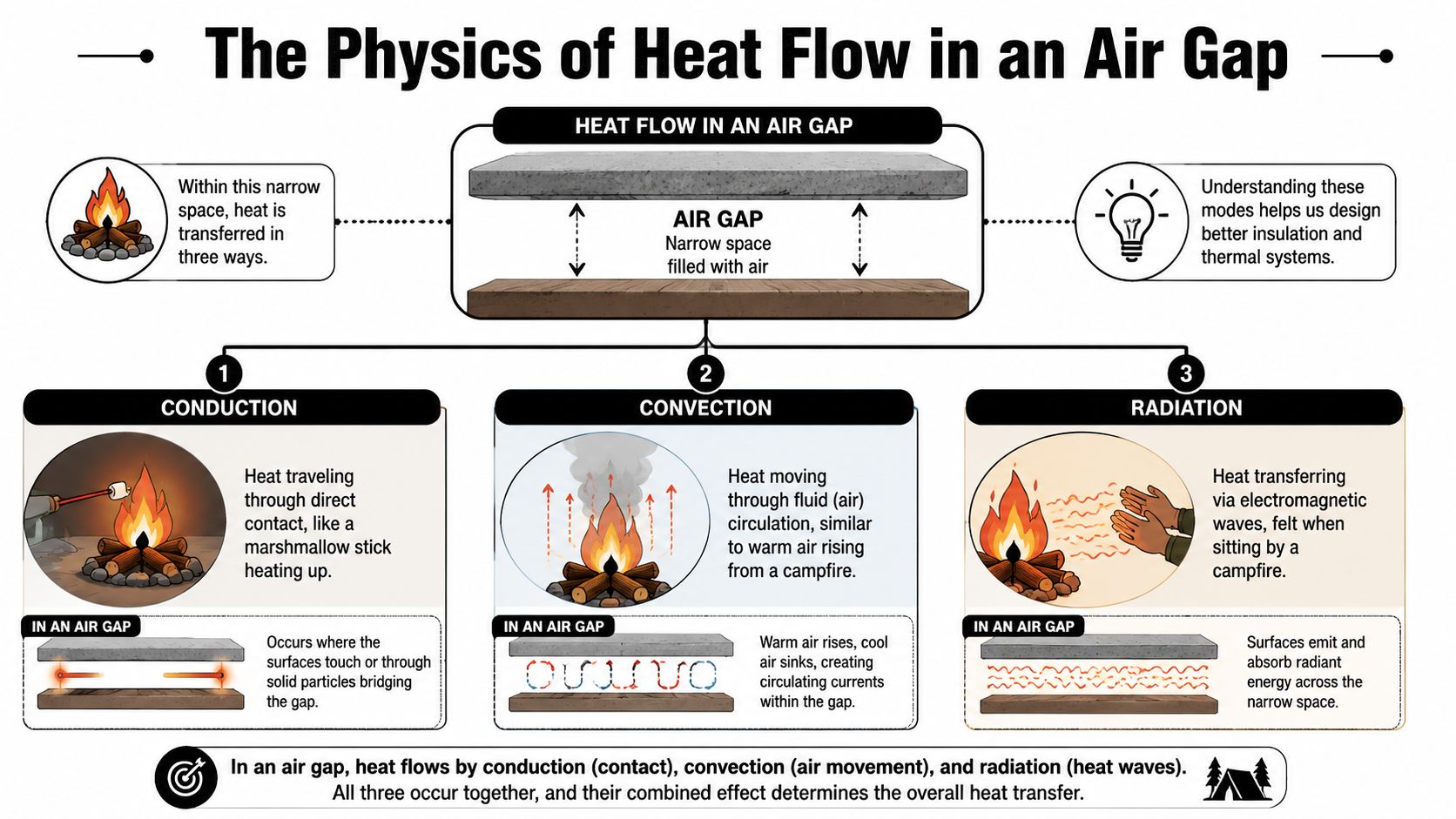
Air is a relatively poor conductor compared with solid materials. That's why people assume a cavity must help. But the surfaces around the cavity still conduct heat. If the gap is connected to framing, masonry, or metal components that are heating up, the assembly can still move plenty of heat.
In a South Florida attic, for example, the roof deck gets hot. That heat conducts into nearby materials, and the cavity only helps if it's part of a well-controlled system.
This is the piece most homeowners miss. Air doesn't just sit there politely. Warm air rises, cooler air falls, and once air starts circulating inside a cavity, it can carry heat from one surface to another.
That's why a random void isn't automatically an insulation layer. If air can loop, wash, or leak through the space, the gap becomes a little transport system for heat.
According to ASHRAE-based air space guidance summarized by Continuous Insulation, the idea that an air gap has a fixed additive R-value is oversimplified. For airspaces under 1/2 inch, the R-value is effectively zero, and in hot, humid conditions with air infiltration, an unsealed gap can speed heat flow by convection and conduction rather than stop it.
An air gap only helps when the air stays controlled. If the air moves, the thermal story changes.
Radiation is invisible but important, especially under roofs. One hot surface can radiate heat across an air space to a cooler surface. If both surfaces have ordinary high-emittance finishes, the gap doesn't block much of that radiant exchange.
If one surface is low-emittance and reflective, the gap can perform much better. That's the logic behind radiant barriers. But the reflective surface needs an adjacent air space to do its job. If another material presses directly against it, the radiant benefit largely disappears.
In drier climates, a small assembly defect might stay a thermal problem. In South Florida, it often becomes a thermal and moisture problem at once. Humid outdoor air leaking into cooled assemblies can carry heat and moisture into places where you don't want either.
That's why air gap discussions that ignore leakage are incomplete. The physics on a chart may assume ideal conditions. Real houses in coastal Florida rarely live in ideal conditions.
The actual R-value of an air space depends on the assembly, not just the fact that a gap exists.
That's where many online guides go wrong. They talk about “an air gap” as if every cavity behaves the same in every wall, ceiling, or roof. It doesn't. The performance changes with geometry, surface properties, and leakage.
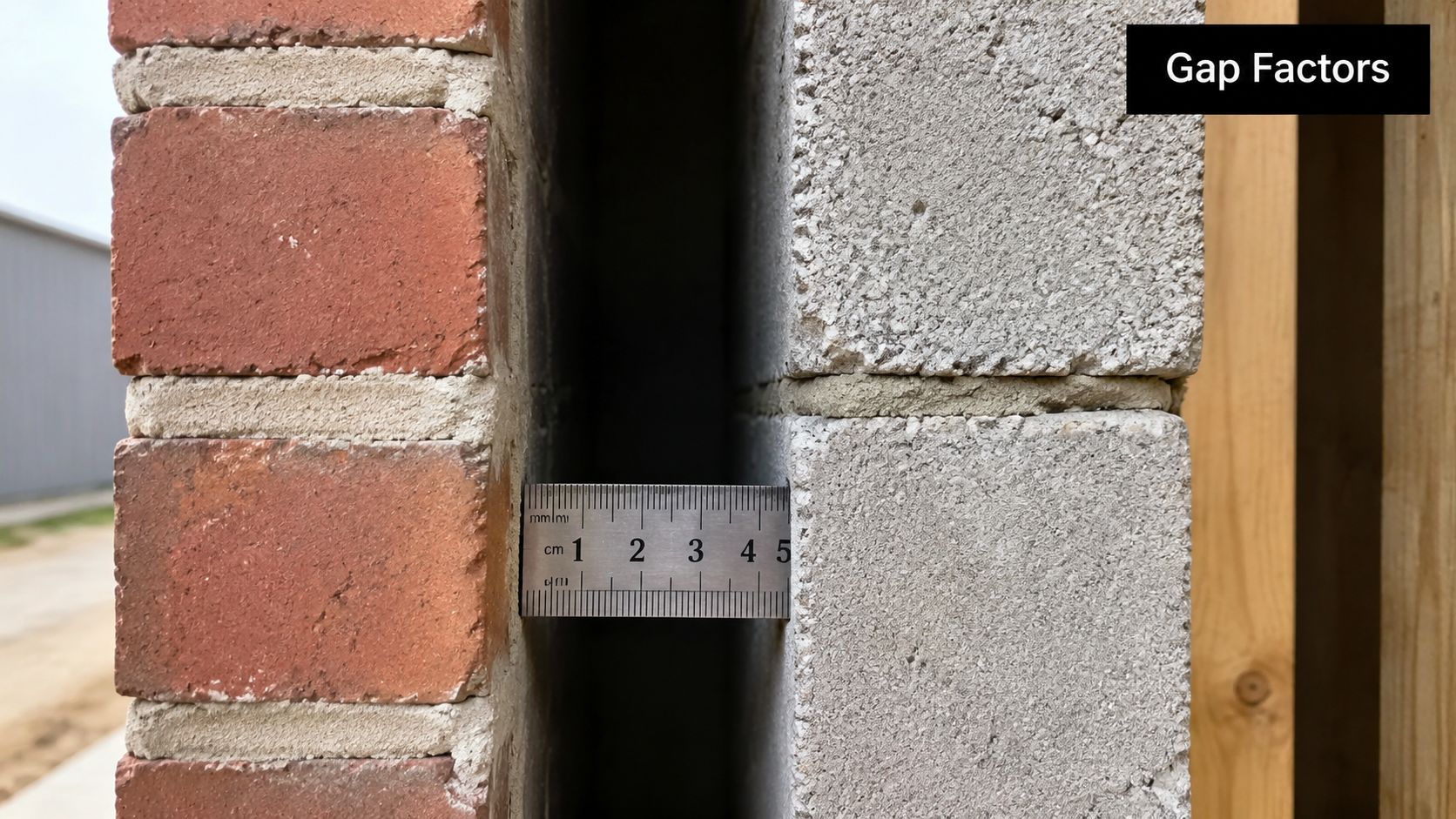
A tiny incidental crack isn't the same as an enclosed cavity. Airspaces under 1/2 inch have no assigned R-value for code purposes, while larger enclosed spaces may have some thermal value depending on conditions. For a standard surface with emittance of 0.82, an enclosed airspace can be about R-1.01 under the referenced conditions from ASHRAE guidance described earlier.
That's useful, but it's modest. It also doesn't mean every field-built gap earns that value.
A wall cavity, a ceiling cavity, and a sloped roof cavity don't behave the same because gravity affects the air movement differently.
In vertical spaces, warm air tends to rise along one side while cooler air falls along the other. In horizontal spaces, upward and downward heat flow can create different convection patterns. The cavity may look identical on a drawing, but its thermal behavior changes once it's installed.
A shiny low-emittance surface changes the radiation exchange inside the cavity. That's why a reflective layer can improve performance in the right assembly.
The easiest analogy is a thermos. The shiny lining isn't “thick insulation” in the usual sense. It works by reducing radiant heat transfer across the space. But a thermos only works because the whole system is controlled. If you punch holes in it, the concept falls apart.
A little leakage can wipe out the benefit that looked promising on paper. Hot, humid outdoor air doesn't need a large opening to start moving through a building assembly. Once it does, the cavity stops being a quiet thermal buffer and starts acting like a channel.
That also raises moisture risk. If humid air reaches a cooler surface inside the assembly, condensation risk goes up. If you need a good refresher on that relationship, this guide to understanding dew point is worth reading.
Field check: If you can't explain how the cavity is sealed, don't assume it deserves a meaningful R-value.
Individuals generally don't need to calculate heat flow like a lab. They do need to think in layers.
An assembly works because each layer contributes something. One layer may resist conduction. Another may manage bulk water. Another may reduce radiation. Another may stop air leakage. Trouble starts when one weak layer is asked to do all four jobs.
You don't assign magic value to empty space. You look at each component, then ask how the full stack behaves. For homeowners who want a quick estimate tool, this insulation R-value calculator can help organize the layers.
Here's a practical comparison table using only the air-space values supported in the verified data. For the non-air-gap layers, the exact values will depend on the products and thicknesses you choose, so those are shown qualitatively.
| Material Layer | Assembly 1 R-Value (Standard Air Gap) | Assembly 2 R-Value (Air Gap + Radiant Barrier) | Assembly 3 R-Value (Cavity Filled with Insulation) |
|---|---|---|---|
| Interior drywall | depends on product | depends on product | depends on product |
| Stud or block backup wall | depends on assembly | depends on assembly | depends on assembly |
| Air cavity | about R-1.01 under the referenced enclosed-air-space conditions | may perform better than a standard air gap if the reflective surface faces a true air space | not applicable if cavity is fully insulated |
| Reflective facing | not present | contributes by reducing radiant transfer only when adjacent to an air space | often no meaningful radiant benefit if compressed against insulation |
| Sheathing or exterior finish | depends on product | depends on product | depends on product |
| Added cavity insulation | none | none | depends on insulation type and thickness |
| Air leakage control | weak if cavity is incidental or unsealed | still weak unless assembly is sealed | can be strong if insulation system also acts as an air barrier |
The main lesson isn't the exact total. It's the role of each layer.
A standard enclosed air gap may add a small amount of thermal resistance in the right conditions. A reflective layer may improve that if it faces a real cavity. A cavity filled with actual insulation changes the assembly much more because the material is designed to resist heat flow, not just rely on trapped air.
If you look at a block wall with furring strips and drywall, don't ask, “Does the space behind the drywall count?” Ask:
That's how building scientists think. The assembly wins or loses as a system.
At this point, the comparison gets blunt. Even a decent enclosed air space is still a small thermal contributor compared with modern insulation materials.
The U.S. Department of Energy says homes with proper insulation solutions can reduce heating and cooling costs by up to 20%, and it emphasizes sealing leaks before insulating. The same source also highlights the performance gap between an air space and real insulation: a 3.5-inch air space is about R-1.01, while a 3.5-inch fiberglass batt is R-10.90. You can review that comparison in this explanation of R-value, thermal resistance, and air sealing.
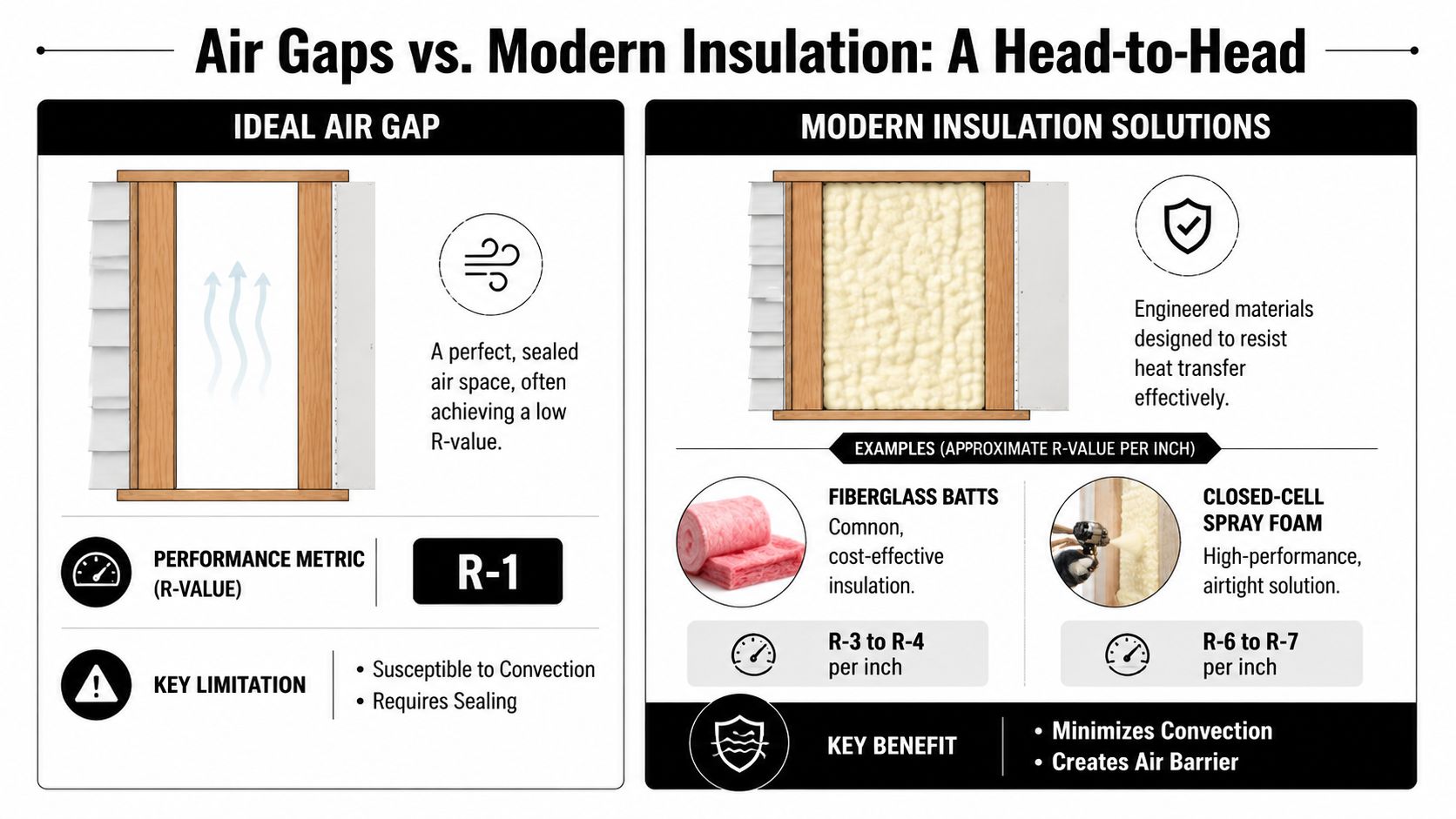
Here's the practical version of that comparison.
Air gap
Fiberglass batt
Cellulose
Closed-cell spray foam
If you only compare nominal R-values, you miss the field reality. Buildings don't fail from conduction alone. They fail at transitions, seams, penetrations, and air pathways.
That's why some roofing and enclosure upgrades that boost energy efficiency focus on the full thermal layer instead of one isolated material property. The same principle applies in walls and attics. A system with decent insulation and strong air control usually outperforms one with good insulation numbers but lots of leakage.
For a side-by-side look at common products, this insulation R-value comparison is a useful reference.
A material can test well in isolation and still disappoint in a leaky assembly.
South Florida punishes loose thinking about insulation. The climate combines intense solar gain, long cooling seasons, salty air, wind-driven rain, and outdoor humidity that keeps pressing inward.
That means incidental cavities are not a strategy. They're leftovers. If you want reliable performance, each assembly has to control heat, air, and moisture together.
In a vented attic, radiant heat from the roof deck can drive attic temperatures up, and any duct leakage or ceiling leakage makes the house work harder. A reflective product can help only if it faces a true air space and stays part of a controlled assembly.
A sealed roofline changes the conversation because it turns the attic into a more controlled environment. That matters in homes with equipment or ductwork in the attic, which is common in Florida.
Concrete block walls often confuse homeowners because the blocks contain voids. Those voids are not the same as high-performance insulation. They may offer limited resistance under some conditions, but they don't solve the bigger problems of thermal bridging, air leakage at transitions, and inward moisture drive.
If you're evaluating a retrofit, treat those cavities as part of the wall geometry, not as proof the wall is “already insulated.”
For code compliance, enclosed airspaces less than 1/2 inch are assigned no R-value, and for gaps 1/2 inch or greater, R-1.0 is often used qualitatively as a prescriptive benchmark under the referenced standard conditions. The point isn't just the number. It's that small incidental gaps are not a valid insulation strategy in professional construction.
In South Florida, the best-performing assembly is usually the one that controls air movement most aggressively.
A lot of people look for one magic product. They ask whether foil works, whether an air gap works, whether foam works, whether batts work. The better question is whether the whole assembly is continuous.
If your thermal layer is broken by leaks, humid air finds the break first. Once that happens, comfort drops, HVAC loads rise, and moisture problems become harder to diagnose because they often show up far from the actual leak path.
An air gap can play a role. It can support drainage, separate materials, or help a radiant barrier work. But by itself, it's not a complete answer for a hot, humid climate.

A sealed system wins because it handles the problem at the source. It limits uncontrolled air movement, reduces convective heat transfer, and helps keep humid outdoor air from reaching cooler interior surfaces. In South Florida, that combination is often more important than squeezing a little extra theoretical value out of a cavity.
Homeowners and contractors often ask whether foil can be added over foam to increase performance. Yes, but only under the right sequence and geometry. According to rFOIL's guide to applications and airspace requirements, foil needs a true air gap to function as a reflective layer. If it's pressed directly against another material, it becomes just another conductive layer. That means the foam has to establish the sealed boundary first, and the reflective surface has to face an actual cavity.
That's the key insight. The air space only helps after the assembly is controlled.
For a visual look at how a sealed roof or wall strategy changes performance, this video is a useful companion.

The topic of air gap insulation R value typically leads to a more fundamental question: “Can I rely on empty space to keep my home comfortable?” In South Florida, the safest answer is usually no.
You need an assembly that treats heat flow and air leakage as one problem. Once you do that, the role of an air gap becomes clearer. It's a detail, not the foundation.
If you want help evaluating your attic, block walls, roofline, or a new construction assembly, Airtight Spray Foam Insulation serves South Florida with spray foam solutions designed for the realities of heat, humidity, and air leakage. Their team can walk you through where your current assembly is losing performance and recommend a sealed approach that improves comfort, controls moisture, and supports long-term energy efficiency.