Your air conditioner runs all day, but a couple of rooms still feel sticky by midafternoon. The ceiling below the attic gets warm. The utility bill keeps climbing. In South Florida, that combination usually points to the same problem. The house isn't just fighting heat. It's fighting heat plus moisture-laden air finding every weak spot in the building shell.
That's why the usual blown in or batt insulation debate gets oversimplified. Homeowners hear R-value first, then stop there. In Jupiter, West Palm Beach, Wellington, and Stuart, that's not enough. The material that looks good on paper can still underperform if it leaves air gaps, gets damp, or can't handle the conditions of a messy attic full of trusses, wiring, duct boots, and uneven framing.
The real question isn't only which insulation has the higher listed rating. It's which one keeps hot attic air and humidity from sneaking into conditioned space. That's where the decision gets practical fast.
A common South Florida call goes like this. The homeowner says the house never quite dries out, one side of the home feels warmer than the other, and the AC seems to run nonstop. They've already checked the thermostat and changed the filter. What they haven't looked at yet is the attic.
In this climate, insulation is your first line of defense against attic heat gain and indoor humidity problems. If the attic floor has thin coverage, gaps around penetrations, compressed sections, or old material that no longer lays right, the home feels it immediately. The AC has to pull longer cycles. Rooms drift in temperature. Supply air can't keep up with the load.
Comparing blown in or batt insulation typically involves looking at the two most familiar options.
| Insulation type | What it is | Best fit | Main strength | Main limitation |
|---|---|---|---|---|
| Batt insulation | Pre-cut fiberglass blankets or rolls | Open framing and straightforward cavities | Simple layout and lower upfront cost | Performance depends heavily on careful fitting |
| Blown-in insulation | Loose-fill fiberglass or cellulose installed with a hose | Attics, retrofits, irregular spaces | Covers around obstacles and fills gaps better | Usually needs professional equipment |
| Cellulose blown-in | Recycled paper-based loose fill | Air sealing focused attic work | Strong coverage in irregular areas | More moisture-sensitive if thoroughly soaked |
| Fiberglass blown-in | Loose fiberglass fill | Attic top-ups and full attic coverage | Very good coverage with low long-term settling | Still needs proper depth and even installation |
R-value still matters. It just isn't the whole story.
In South Florida, three issues decide whether insulation performs:
The best insulation for a hot, humid home is the one that stays continuous, stays dry, and limits air movement.
That's the lens to use for every choice that follows.
Batt insulation is the product most homeowners recognize immediately. It comes in pre-cut sections or rolls, usually fiberglass, sized to fit between framing members like ceiling joists or wall studs. Installers place it by hand, trim around obstacles, and lay it into cavities.
Blown-in insulation is different in both form and method. Instead of pre-shaped pieces, it uses loose particles of fiberglass or cellulose. A blower machine feeds the material through a hose, and the installer distributes it across the attic floor or into enclosed cavities.
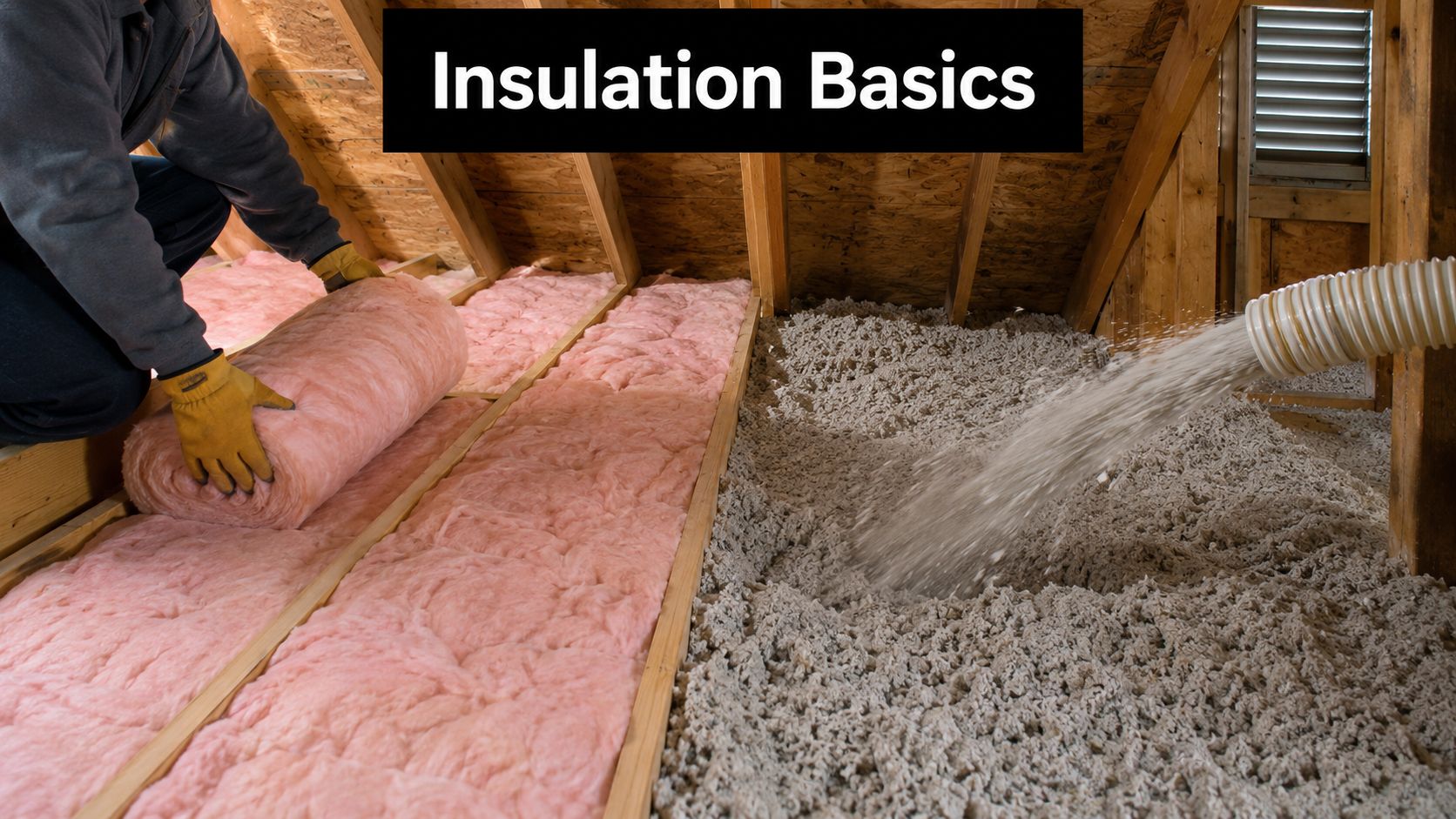
Batt installation is straightforward in theory. The installer measures the bay, cuts the piece if needed, and places it between framing members. In new construction, where cavities are open and clean, that process is easier to control.
In real attics, the details get harder:
A batt has to contact the surfaces it's meant to insulate without being jammed in or left loose with gaps. That sounds simple until you're working around a truss web, flex duct, and low roof deck in July.
Blown-in work starts with setup. The material goes into a hopper, gets fluffed and fed through the hose, and is applied to the target depth. In attics, the installer builds an even blanket over the surface. In enclosed walls or hard-to-reach cavities, the same concept lets the material move into spaces hand-placed products can miss.
The two main loose-fill options are:
Field reality: Batt insulation is shaped before it reaches the attic. Blown-in insulation takes shape after it gets there. That one difference explains a lot about how each performs.
Most homeowners start with the listed R-value, but what matters in an attic is effective performance after installation. A product can have a strong nominal rating and still lose ground if the installer leaves voids, compression, or unsealed edges around penetrations.
According to this batt versus blown-in insulation comparison, fiberglass batt insulation provides a nominal thermal resistance of R-3.1 to R-4.3 per inch, while blown-in cellulose or fiberglass offers R-2.2 to R-4.0 per inch. On paper, that can make batts look equal or better. The same source also notes that blown-in insulation delivers 15–25% superior energy efficiency in retrofit and attic applications because it fills irregular cavities and reduces the thermal bridging and air leakage common with manually placed batts.
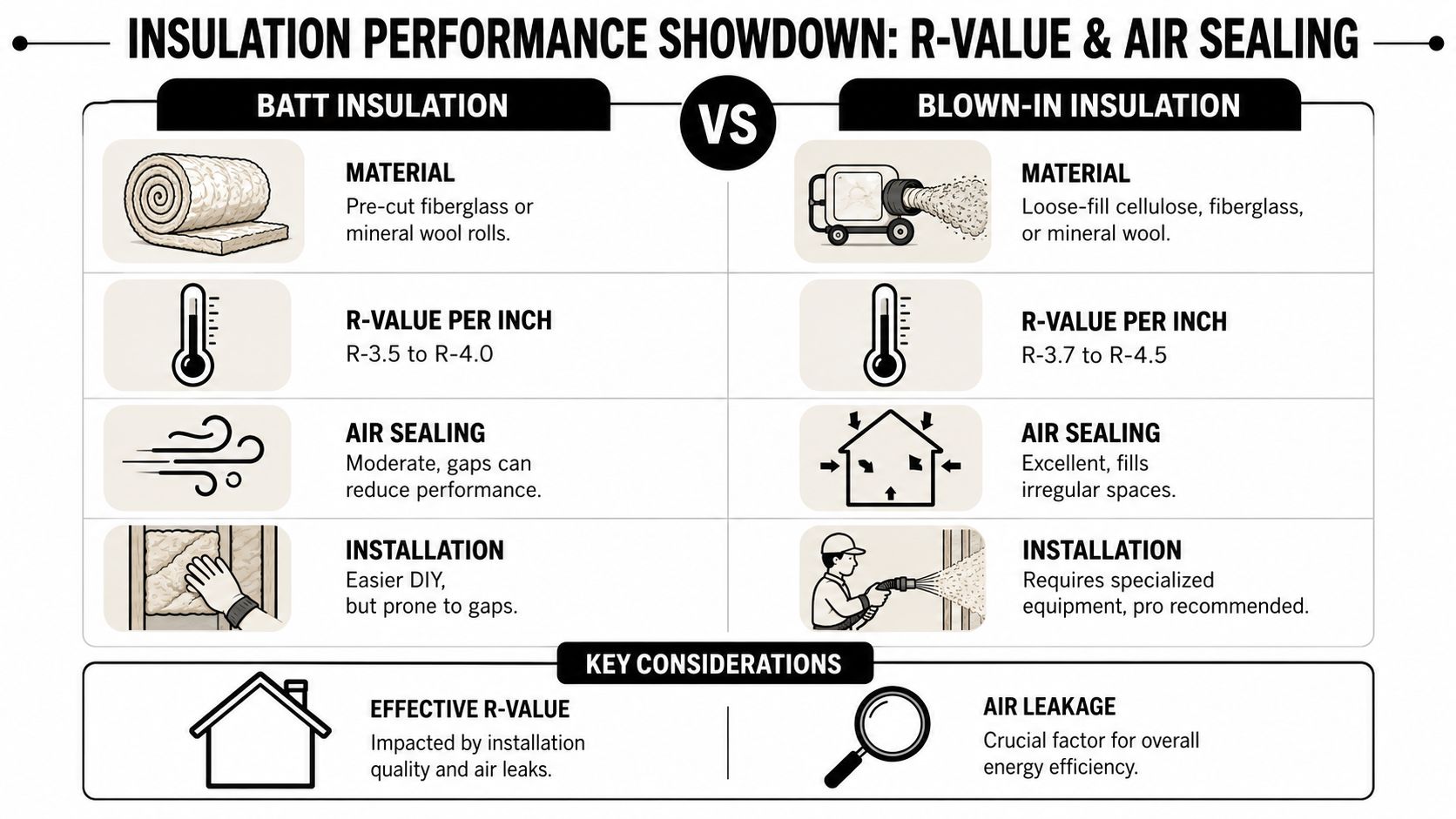
Batt insulation gets its rating under controlled conditions. Real attics aren't controlled. They have odd framing, penetrations, old repairs, duct runs, and access limitations. Every place a batt has to be cut, tucked, split, or bent is a place the assembly can lose continuity.
Blown-in material has a different advantage. It flows around those interruptions instead of forcing the installer to shape the product manually around them.
Here's the practical difference:
| Performance factor | Batt insulation | Blown-in insulation |
|---|---|---|
| Standard open cavities | Can perform well if carefully fitted | Performs well |
| Irregular attic geometry | Harder to fit cleanly | Naturally adapts |
| Obstructions and penetrations | Often leaves cut points and voids | Flows around them |
| Consistency across attic floor | Depends on hand placement | Easier to keep continuous |
In a dry climate, small installation misses may show up mostly as energy loss. In South Florida, those same misses also let humid air move where it shouldn't. That changes indoor comfort fast.
The reason blown-in insulation often wins in existing attics isn't that the material itself is magic. It's that a loose-fill blanket is better at maintaining contact across uneven surfaces. That improves coverage where batt edges, seams, and cutouts tend to create trouble.
Gaps don't care what the label says. If attic air can move through the assembly, the system won't perform to its rated potential.
For homeowners who want a deeper look at fiberglass ratings themselves, this guide to the R-value of fiberglass insulation batts is useful. The key takeaway is simple. Nominal R-value and delivered comfort are not the same thing.
What works:
What doesn't work:
In South Florida attics, continuity beats theory.
Heat gets most of the attention. Moisture causes some of the ugliest problems.
When warm, humid air leaks into building cavities and meets cooler air-conditioned surfaces, condensation can form. That moisture may show up as staining, damp insulation, musty odors, or microbial growth around the places where the assembly was weakest to begin with. In older homes, I often see the issue start around attic penetrations, top plates, recessed fixtures, and awkward framing transitions.
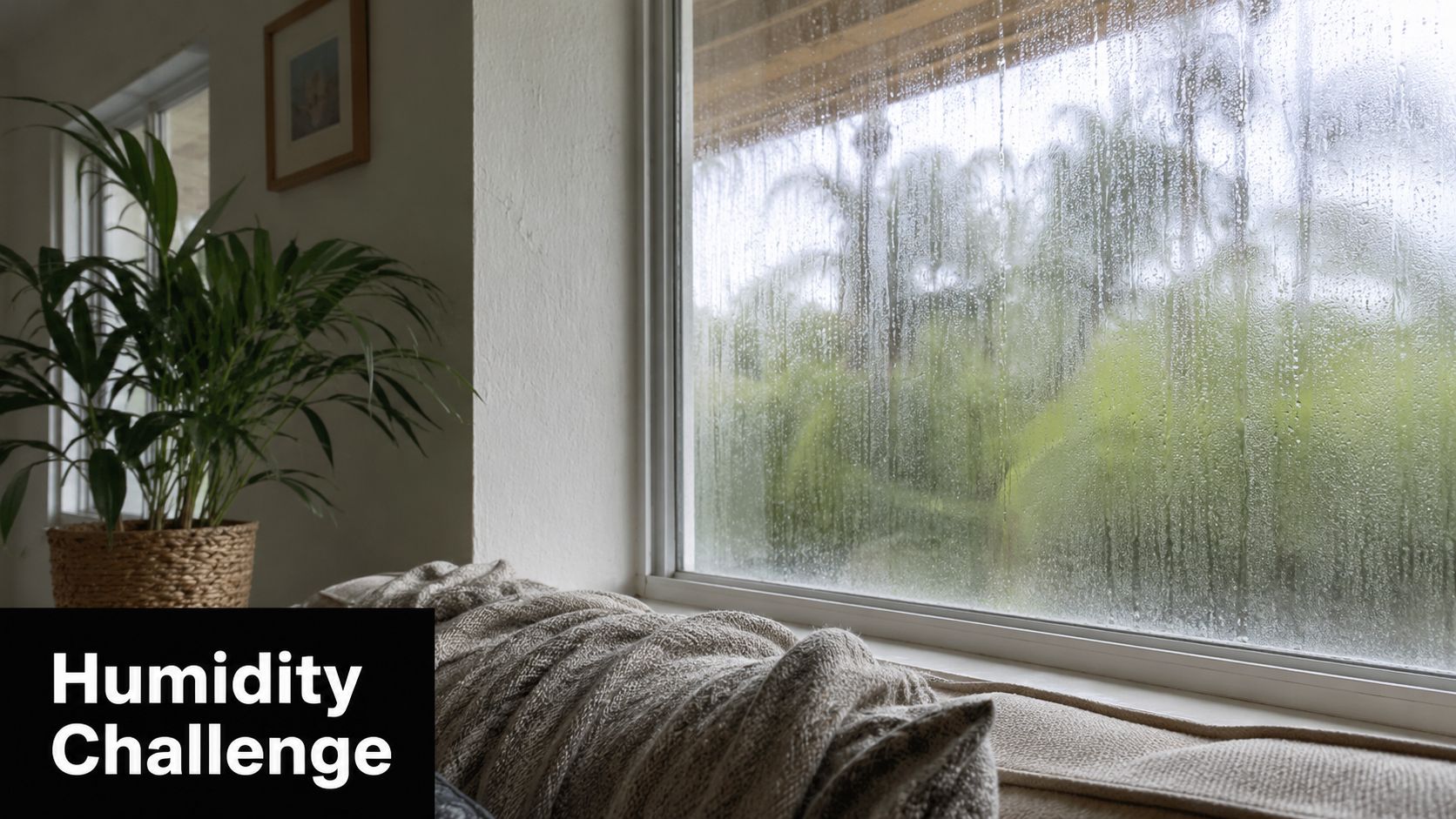
Batt insulation doesn't create those moisture issues by itself. The problem is the air space that often comes with a less-than-perfect batt installation. A small void can become a path for humid air movement. Once that happens, the insulation layer isn't just losing thermal performance. It's allowing the conditions that lead to damp materials.
That's why South Florida attic work has to be looked at as a system:
If you're trying to diagnose whether insulation or surrounding materials have already taken on moisture, a practical reference is Restore Heroes moisture meter guide. It helps homeowners understand what moisture readings mean before they assume the problem is only an HVAC issue.
Cellulose blown-in insulation deserves a more careful discussion in South Florida than it usually gets. According to this review of blown-in versus batt insulation, cellulose settles 10–15% over 20 years and absorbs moisture more readily, requiring replacement if thoroughly soaked. That same trade-off is especially relevant in humid markets like South Florida because cellulose also offers stronger air-sealing behavior than fiberglass batt installations.
That means cellulose can be the better performer for coverage and infiltration control, while still carrying more risk if the attic has a roof leak or chronic moisture problem.
Moisture rule: Don't pick an insulation type before you know whether the attic is dry, venting properly, and free from active leakage.
If there's any doubt about past leaks or damp insulation, this explanation of what happens when insulation gets wet is worth reading. Wet insulation isn't just a comfort issue. It can become a durability issue.
If the attic is irregular and leak-free, strong air coverage matters a lot. If the roof has a history of water intrusion, the moisture response of the insulation matters just as much. South Florida homes don't get to ignore either side of that equation.
Batt insulation usually wins the first glance. It's cheaper to buy, easier to stage, and more approachable for a budget-minded project. For that reason alone, many homeowners lean batt before they've thought through what happens after the job is done.
The more useful comparison is upfront cost versus ownership value.
According to this blown-in versus batt cost comparison, batt insulation typically costs $1.00–$2.00 per sq ft installed, while blown-in typically runs $1.50–$2.75 per sq ft installed. That same source states the premium for blown-in is typically recovered within 2 years through stronger energy performance and lower utility use.
That's a meaningful distinction for South Florida homes where cooling demand stays high for much of the year.
| Cost and value factor | Batt insulation | Blown-in insulation |
|---|---|---|
| Upfront installed cost | Lower | Higher |
| Equipment needs | Minimal | Specialized blower required |
| DIY appeal | Higher | Lower |
| Retrofit performance value | More dependent on fit | Stronger in irregular attics |
| Payback outlook | Lower initial spend | Premium may be recovered within 2 years |
There's nothing wrong with choosing a lower-cost material when the application is simple and the installation is clean. The problem comes when a homeowner saves money on day one but ends up with uneven comfort, rooms that stay warm, or an attic floor full of gaps around obstructions. Then the home keeps paying for that decision every month.
That's why builders and homeowners who care about total project cost should separate budget control from false economy. If you're balancing quality upgrades across a broader build or renovation, RBA Home Plans' budget building tips offer a sensible framework for deciding where low bid pricing makes sense and where better long-term performance is worth paying for.
Paying less for insulation only works when the assembly still performs after the installer leaves.
Blown-in usually earns its keep in three situations.
For homeowners considering that route, this overview of blown insulation installation gives a practical picture of how the process works.
If this is a new addition with clean framing and easy access, batt can be cost-effective. If this is a South Florida attic that's already showing the usual signs of poor comfort control, blown-in often makes more financial sense than the initial quote suggests.
The cheaper number on the estimate sheet doesn't always produce the cheaper house to run.
The right answer depends on where the insulation is going and what the framing looks like. Asking whether blown in or batt insulation is better without talking about the application leaves out the most important part.
Retrofit work is where blown-in usually separates itself.
Existing attics are rarely neat. You've got old wiring, plumbing vents, junction boxes, framing changes, low-clearance corners, and insulation that may already be patchy. Trying to lay batts perfectly in that environment takes time and still leaves plenty of chances for voids.
For retrofit attic floors, blown-in is usually the cleaner solution because it can:
If the attic has complex geometry, loose-fill coverage is generally the practical winner.
Batt insulation still has a place, especially in new construction where the framing is open and regular. When stud bays or joist bays are accessible, dry, and consistent, crews can fit batt material carefully before the assembly gets closed up.
That makes batt a reasonable choice when:
In open framing, batt can work well. In messy attics, it often asks too much from the installer.
Some projects look simple but aren't.
A home with previous roof leaks, signs of moisture, or uneven attic ventilation needs diagnosis before any insulation decision. An old attic with layered materials, disturbed sections near service work, or obvious hot spots may also need more than a simple material swap. In those cases, choosing the insulation type comes after fixing the underlying problem.
Good insulation can improve a bad assembly. It can't rescue a wet one.
Most homeowners don't need a theoretical answer. They need a decision they can live with for years.
If you want the shortest version of this whole discussion, here it is. Batt insulation can work well in controlled conditions. Blown-in insulation usually works better in real attics. Spray foam is the premium option when air leakage and humidity control are the top priorities.
That's the practical South Florida answer.
If you want help choosing the right insulation for your attic, walls, or roofline, Airtight Spray Foam Insulation serves homeowners and builders across South Florida with site-specific recommendations, professional installation, and solutions built for heat, humidity, and long-term comfort.