A lot of South Florida homeowners end up in the same spot. The vaulted ceiling looked great when they bought the house or planned the remodel, but now that room gets hammered by heat every afternoon, the AC runs constantly, and certain areas never feel quite dry or comfortable.
That isn't just a comfort problem. In this climate, a vaulted ceiling sits right at the intersection of solar heat, outside humidity, indoor moisture, wind-driven rain risk, and limited insulation space. If the assembly is wrong, you don't just get a hot room. You can end up with hidden condensation, stained drywall, mold smells, and roof framing that stays damp longer than it should.
The best insulation for vaulted ceilings in South Florida has to do more than slow heat transfer. It has to control air movement, manage moisture, and fit your existing roof design.
Vaulted ceilings work against you in South Florida faster than they do in milder climates. The roofline sits close to the occupied space, so the room feels the roof load directly. There's no forgiving attic buffer above the ceiling to absorb mistakes.
That's why a vaulted room can look finished and still perform badly. The drywall may be clean, the paint may be fresh, and the trim may be tight, but if the roof assembly leaks air or traps moisture, the room will still feel hotter, stickier, and harder to cool than the rest of the house.
Two problems usually show up together:
Practical rule: In South Florida, a vaulted ceiling isn't just an insulation job. It's an air-sealing and moisture-control job that happens to include insulation.
The homes that perform best treat the whole ceiling as a system. Material choice matters, but so do roof design, rafter depth, ventilation path, and installation quality. If one part is wrong, the whole assembly can underperform.
Standard attic logic doesn't apply to a vaulted ceiling. In a vented attic, you usually have room for deep insulation and a separate air space above it. In a vaulted ceiling, the insulation has to share a tight cavity with framing, wiring, lighting, and sometimes a ventilation channel.
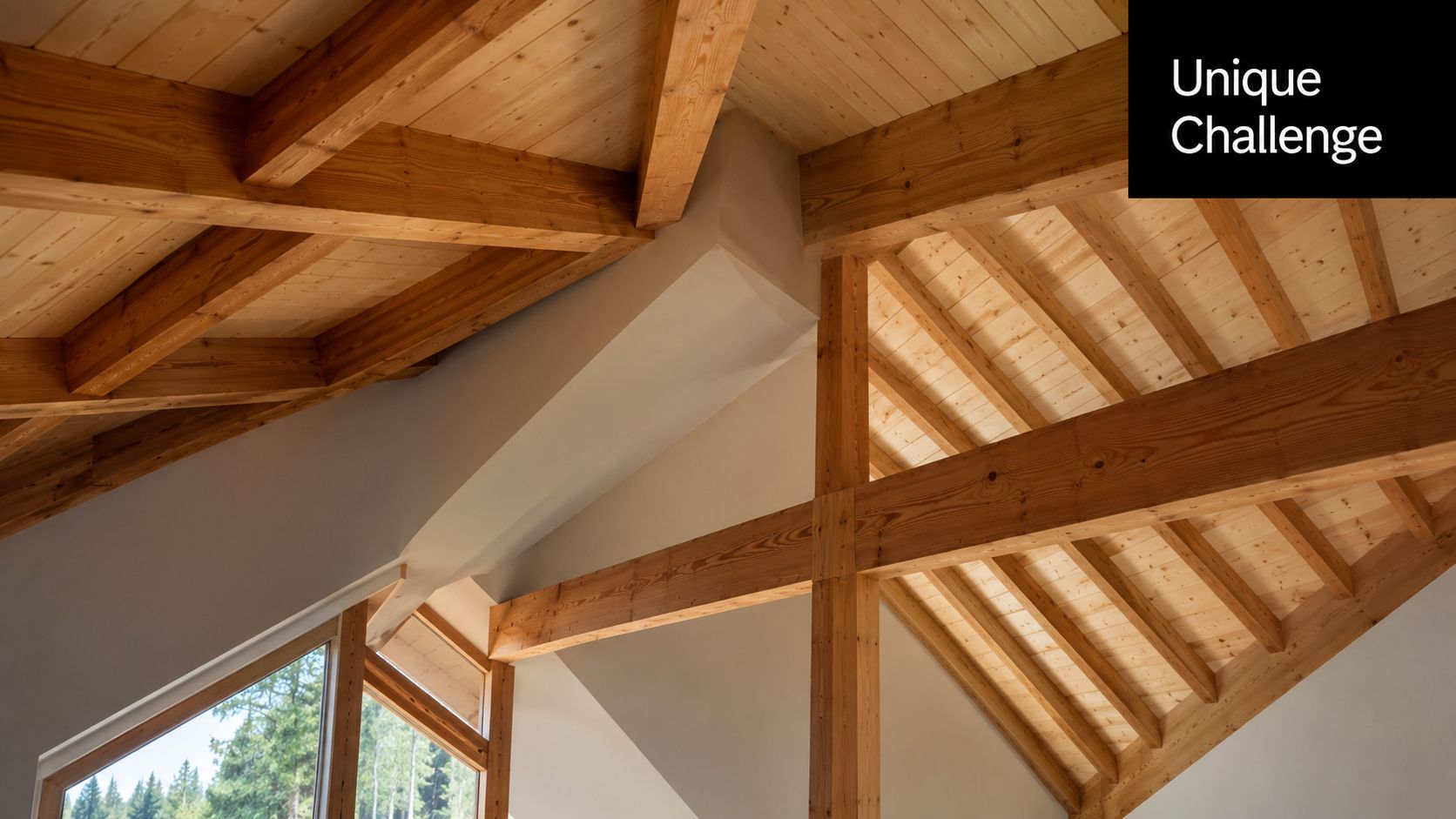
The first problem is simple. You don't have much room to work with. That's why material thickness alone doesn't solve the problem. You need insulation with enough performance per inch to make that shallow cavity count.
Many poor retrofits arise when someone treats the rafters like a regular wall cavity, stuffing in batt insulation, and closing it up. On paper, it sounds reasonable. In the field, it often leaves voids, compression, and air movement around the insulation.
Even if the cavity insulation is decent, the rafters themselves still interrupt the assembly. Wood transfers heat more readily than a fully continuous insulated layer. That means the whole ceiling doesn't perform at the same level as the insulation label suggests.
It's akin to wearing a good rain jacket with the zipper partly open. Most of the surface is protected, but the breaks still matter.
In South Florida, moisture is what turns a mediocre assembly into a failure. Warm, humid air will move toward cooler surfaces whenever it gets the opportunity. If that air reaches the wrong layer inside the roof assembly, water can form where you can't see it.
That's why understanding dew point matters. If you want a clear explanation of how warm humid air turns into hidden moisture inside building assemblies, this guide on understanding dew point is worth reading before you pick a system.
A vaulted ceiling can look dry from the room side while the roof deck above it cycles through repeated moisture exposure.
Vaulted ceilings usually include details that punish sloppy work:
A flat ceiling gives installers room for minor errors. A vaulted ceiling doesn't. That's why the best insulation for vaulted ceilings isn't just about the product. It's about whether the assembly can stay dry and continuous once the work is complete.
In South Florida, the wrong insulation choice for a vaulted ceiling usually shows up as a comfort problem first, then a moisture problem, then an expensive repair. I've seen plenty of ceilings that looked fine from below while the roof deck above them was taking on moisture because the assembly was built around R-value alone.
Material choice matters, but in this climate the essential question is simpler. Which product gives you enough R-value in limited depth, controls air movement, and fits the roof design without leaving weak spots installers will struggle to seal?
| Insulation Type | R-Value per Inch | Air Barrier | Vapor Barrier | Best Use Case |
|---|---|---|---|---|
| Closed-cell spray foam | About R-6 to R-7 per inch according to the Spray Polyurethane Foam Alliance | Yes | Yes, at sufficient thickness | Tight rafter bays, unvented assemblies, maximum performance in limited space |
| Open-cell spray foam | About R-3.5 to R-4 per inch from The Energy & Environmental Building Alliance | Yes | No, more vapor permeable | Assemblies where drying potential is part of the design |
| Rigid foam boards | Varies by product | Can be, if seams are detailed well | Depends on product and assembly | Outboard insulation over roof sheathing, thermal break strategies |
| Fiberglass batts | About R-3 to R-4 per inch from the North American Insulation Manufacturers Association | No | No | Budget-focused projects with excellent air sealing done separately |
| Mineral wool batts | About R-4 to R-4.3 per inch from ROCKWOOL | No | No | Hybrid assemblies and cavities where a denser batt fits better |
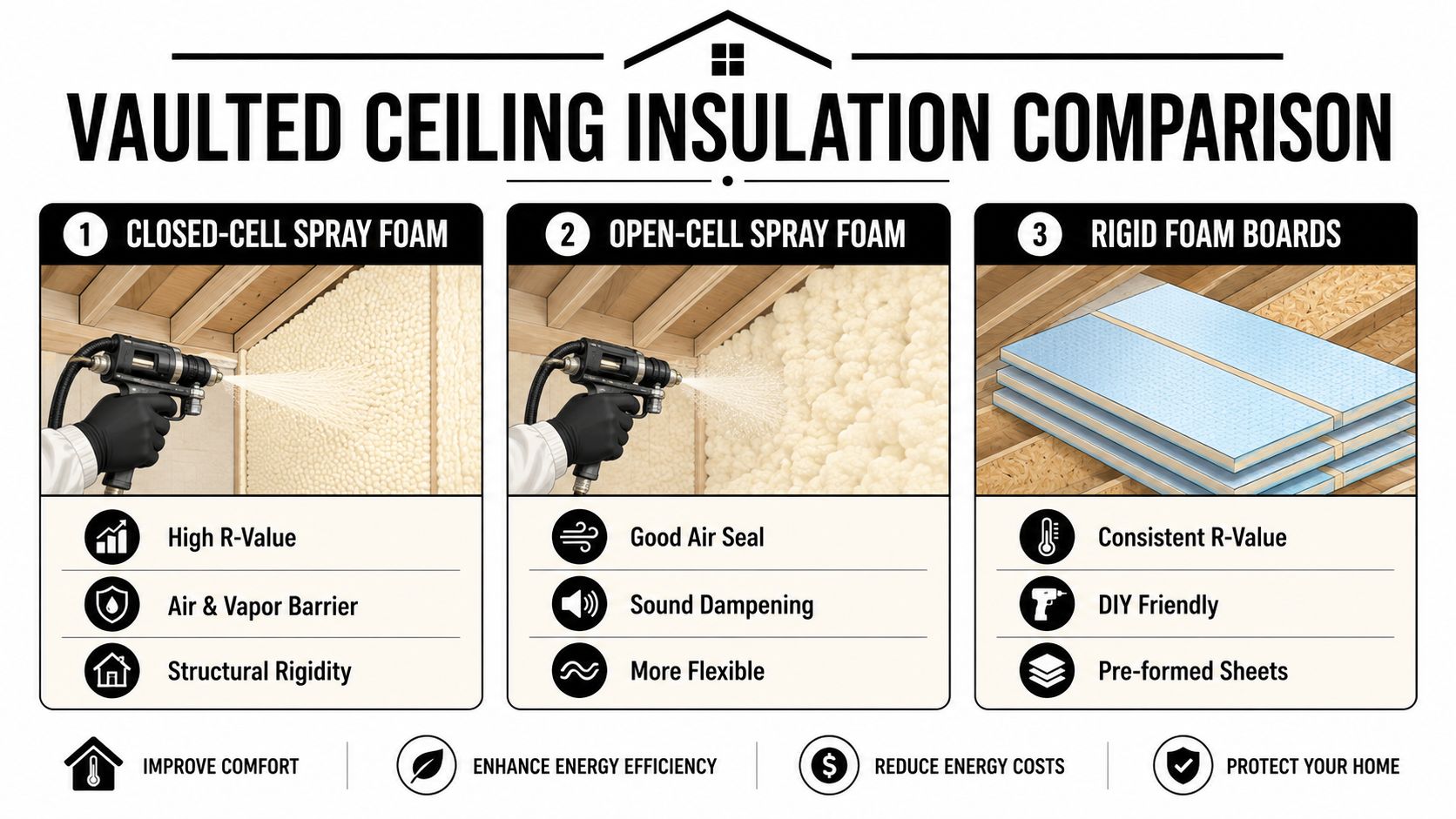
Closed-cell spray foam solves more problems at once than any other option in a shallow vaulted roof. It gives high R-value per inch, it air seals, and it adds a layer of moisture resistance that matters in a hot, humid climate where outside moisture is working against the assembly for much of the year.
That does not make it the automatic answer on every house. It costs more, and bad installation wastes the premium fast. If the foam is sprayed unevenly, pulled away from the framing, or installed by a crew that does not understand roof assemblies, you can still end up with hot spots, hidden air leakage, and callbacks.
In difficult vaulted ceilings with tight rafters, multiple penetrations, or awkward geometry, it is often the most forgiving material once installed correctly. That is why it shows up so often in successful South Florida retrofits.
Open-cell foam air seals well, but it handles moisture very differently. It is more vapor permeable, softer, and lower in R-value per inch. In the right roof design, that can be useful. In the wrong one, it can create risk you do not see until the roof has gone through enough heat and humidity cycles.
Often, homeowners get tripped up. They hear "spray foam" and assume both products perform the same. They do not.
Open-cell can make sense where the assembly is designed to dry and the roof strategy supports it. If you are comparing foam to other products, this guide to spray foam insulation alternatives lays out the trade-offs well.
Before moving on, this video does a good job of showing why roof assembly strategy matters as much as insulation choice:
Rigid foam board works best when the roof design gives it a job it can do well. Installed above the roof sheathing, it helps keep the sheathing warmer and reduces condensation risk inside the assembly. That approach can be very effective in high-humidity climates because it deals with temperature control where it matters most.
Inside a vaulted cavity, rigid board is less forgiving. Every seam has to be sealed. Every cut around rafters, lights, and framing transitions has to be clean. On paper, that looks manageable. On a real South Florida remodel with intersecting slopes, patched framing, and limited access, it turns into a workmanship test.
If you want a better sense of how airflow paths tie into these roof details, this overview of understanding roof ventilation systems is useful before settling on board insulation inside a vaulted assembly.
Batts are still common because they are familiar and cheaper upfront. That is also why they get misused.
Fiberglass and mineral wool can work in a vaulted ceiling, but only if the air control layer is handled separately and done well. The batt itself does not stop humid air from reaching colder surfaces. If the cavity is uneven, the cuts are sloppy, or the drywall plane is leaky, performance drops fast.
Mineral wool has a few field advantages over fiberglass. It is denser, usually friction-fits better, and tends to hold shape better in irregular cavities. Fiberglass is cheaper and easier to find. Neither one fixes an air leakage problem.
In South Florida, a batt-only vaulted ceiling without a serious air-sealing plan is one of the easiest ways to end up with comfort complaints, moisture accumulation, and mold that stays hidden until the repair bill gets large.
A vaulted ceiling in South Florida usually fails at the roof assembly, not at the insulation label. I've seen plenty of homes with decent insulation and bad roof details that still ended up with hot rooms, damp cavities, and hidden mold.
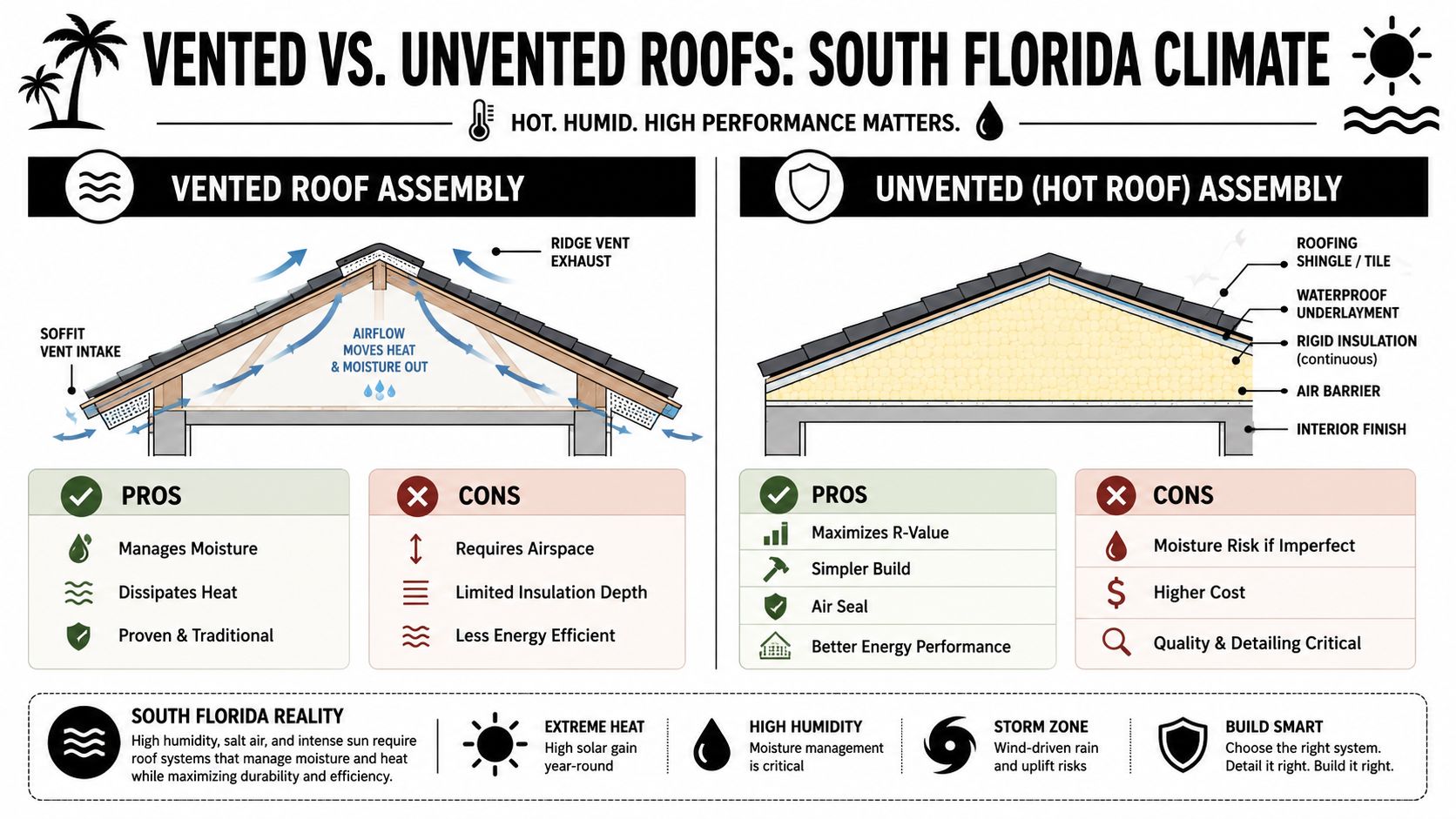
A vented vaulted roof leaves space between the roof deck and the insulation so air can move from intake to exhaust. In a simple roof with enough depth, clear soffit intake, and a clean ridge or other high exhaust path, that approach can work.
South Florida makes that harder than it sounds. Complex rooflines, shallow rafters, interrupted bays, recessed lights, and retrofit conditions all make the vent path easier to block. Wind-driven rain and storm exposure add another layer of risk if the roof and vent details are sloppy. For homeowners sorting through those details, a practical overview of understanding roof ventilation systems helps clarify what proper airflow paths are supposed to do before insulation goes in.
A vented assembly also does not excuse poor air sealing at the ceiling line. If indoor air leaks into the cavity, the ventilation channel has to correct a problem it was never meant to solve.
An unvented roof puts insulation directly against the roof deck and removes the interior ventilation channel. In South Florida remodels, that usually gives the installer fewer ways to fail.
That is the main advantage.
You are not trying to hold a narrow air space open across every rafter bay while also fitting insulation below it. You are building a compact assembly that depends on full insulation contact, reliable air control, and careful moisture planning. Closed-cell spray foam is common here because it can provide insulation and air sealing in one layer, which matters in a humid climate where air leakage carries a lot of moisture.
Still, unvented does not mean safe by default. If the foam thickness is inconsistent, the roof deck is wet when the assembly is closed in, or transitions are left leaky, the roof can hold moisture where no one sees it until stains, odor, or decay show up.
The better roof assemblies are often the ones homeowners never hear about. Building Science Corporation's discussion of unvented roof systems explains why putting rigid insulation above the roof sheathing can improve moisture control by keeping the sheathing warmer and reducing condensation risk inside the assembly.
That matters in South Florida because condensation risk is the primary danger. Cold interior conditions, humid outdoor air, and air leakage can create wet roof components even in a hot climate. Exterior rigid insulation is not the cheapest route, and it is usually only practical during reroofing, major renovation, or new construction, but it gives the roof deck more protection than an interior-only approach.
Cold-climate assemblies are built around a simple rule. Keep the condensing surface warm enough, or vent the assembly well enough, that moisture does not accumulate. The exact ratios and code paths change by climate zone, but the building science does not.
That lesson applies in South Florida even though the moisture drive is different. The roof assembly has to control humid air first, then manage drying potential. If a vaulted ceiling traps moisture between impermeable layers, or allows outside humidity to reach a cool surface, the repair cost gets high fast. The right choice between vented and unvented comes down to roof geometry, available depth, reroofing access, and whether the installer can execute the assembly they are proposing.
A cheap vaulted ceiling job in South Florida can look fine on the invoice and still turn into an expensive correction. I've seen homeowners save on the insulation bid, then pay far more later for ceiling tear-outs, odor investigations, drywall repairs, and roof deck replacement after moisture got trapped where nobody could see it.
Utility savings matter, but they are only part of the return. In this climate, the bigger financial question is whether the assembly stays dry through long cooling seasons, wind-driven rain events, and years of humid air trying to find its way into the roof.
Basic batt systems usually win on first cost. They often lose once the ceiling is closed and the assembly starts leaking air. In a vaulted ceiling, there is very little room for sloppy work, compression, gaps around framing, or missed transitions at soffits, ridge lines, and mechanical penetrations.
Closed-cell spray foam costs more because it does more. It insulates, air seals, and helps control vapor drive in one application. Outboard rigid insulation costs more still, especially if it requires reroofing coordination, but it can reduce the chance that the roof deck becomes the wettest part of the assembly.
That trade-off is the core budget decision.
Spend based on access, roof design, and failure cost. A finished vaulted ceiling is expensive to reopen.
The best return usually comes from avoiding the second job. In South Florida, that means choosing an assembly that controls humid air first, then choosing an insulation strategy that fits the roof you have, not the one an estimator wishes you had.
Interior-only foam can still be the right choice, especially in retrofits where the ceiling is open from below and the roof stays in place. But there are projects where adding rigid insulation above the roof sheathing during reroofing is the smarter long-term move, as noted earlier. It raises the moisture safety of the whole assembly, not just the cavity insulation level.
That matters because durability is part of ROI. Lower cooling loss helps every month. Avoiding hidden moisture damage protects the framing, sheathing, finishes, and indoor air quality.
I see the same expensive mistakes over and over:
The worst outcome is paying for a low-cost installation, then paying again for demolition and remediation. In many South Florida homes, the strongest long-term value comes from building the roof assembly correctly the first time, even if the initial number is higher.
A vaulted ceiling in South Florida can look fine from the living room while the roof cavity is trapping heat and pulling in wet air every afternoon. I see that combination after storms, after reroofs, and after low-bid insulation jobs that treated R-value as the whole job.
The right strategy depends on when you have access to the assembly. It also depends on whether the goal is basic improvement or a roof system that holds up against heat, humidity, and wind-driven rain for years.
If the project includes reroofing, I usually want the owner to at least price exterior rigid insulation over the roof sheathing. That approach improves dew-point control across the whole roof assembly, reduces thermal bridging through the rafters, and gives the house more forgiveness if indoor humidity or small leaks get out of hand. It costs more up front. It also fixes problems that interior-only insulation cannot.
Retrofits are where bad advice gets expensive.
If the drywall comes down, closed-cell foam is often the cleanest corrective option for uneven cavities, awkward framing, and old air leakage paths. If the roof covering is coming off, the better question is whether the house should get exterior insulation while the roof is already open from above. Skipping that window is a common mistake.
If the ceiling stays closed, the ceiling stays in charge. You can improve comfort in some cases, but there are plenty of homes where the full fix is not possible without opening something up. That is why homeowners looking for attic insulation contractors with vaulted ceiling experience should ask about assembly design, not just material type.
Lower budget does not mean lower standards for air control.
Batts can still work in the right vented assembly, but only if the details are handled tightly and consistently. A cheap install with gaps at can lights, top plates, soffit transitions, or chases will fail fast in this climate. The ceiling may look finished and the invoice may look good. The roof cavity will still be taking on hot, humid air.
Focus on these items before drywall goes back:
The labor is what makes or breaks a lower-cost assembly.
For many South Florida vaulted ceilings, the order is usually:
The best choice is the assembly that keeps humid air out of the roof cavity and gives the structure a safe way to deal with moisture if something goes wrong.
A good product installed badly becomes a bad system. That's especially true in vaulted ceilings, where small misses create hidden failures.
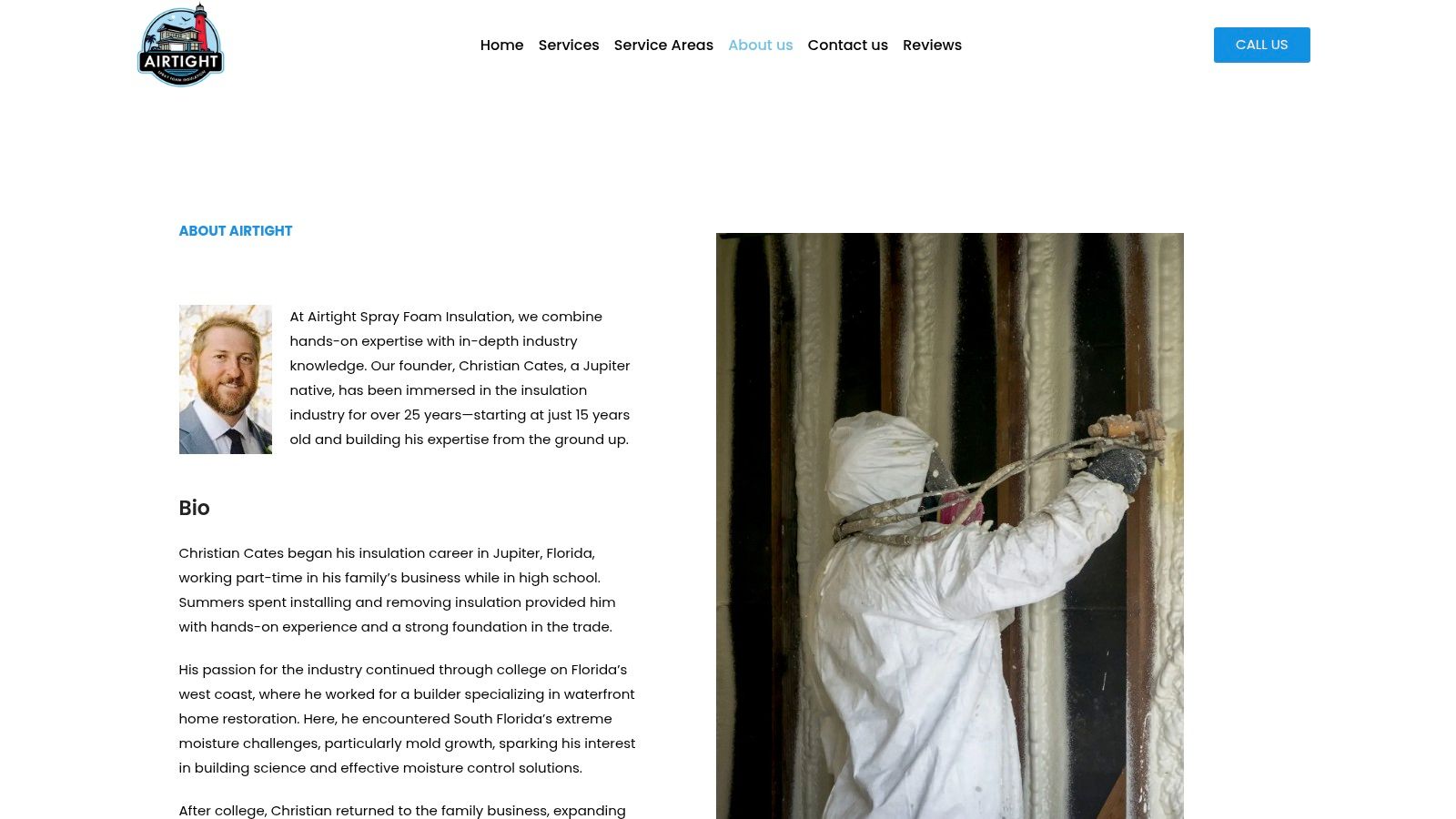
The crew has to understand roof assemblies, not just spray technique or insulation thickness. They need to know where humid air will travel, how transitions get sealed, when a vent path is required, and when the roof design calls for a different strategy entirely.
Use a short screening list. If the contractor struggles with these, keep looking.
If you're comparing companies, it also helps to review specialists who focus on attic insulation contractors and ask specifically how their process changes when the attic is replaced by a vaulted roof cavity.
The right installer doesn't just fill space with insulation. They protect the roof assembly from the inside out.
If your vaulted ceiling is hot, uneven, or showing signs that moisture may be getting where it shouldn't, Airtight Spray Foam Insulation can help you evaluate the assembly before you commit to the wrong fix. Their South Florida team handles spray foam with a building-science mindset, so you can choose a vaulted ceiling insulation strategy that fits your roof, your climate, and your long-term durability goals.