If you live in South Florida, you probably know the pattern. The AC kicks on before breakfast, runs through the afternoon, and still the house feels damp. One room is cool, another is sticky, and the utility bill lands with enough force to make you question the thermostat setting all over again.
That usually isn't just an AC problem. It's often a house performance problem. In this climate, heat, moisture, and air leakage work together. If your attic, walls, duct paths, or rim areas let outside air in, your cooling system keeps fighting a battle it can't fully win.
A good home energy efficiency program can help you fix that with a plan instead of guessing. The value isn't just lower monthly costs. It's better comfort, better humidity control, and smarter use of rebates or tax credits that already exist.
In South Florida, comfort depends on more than the thermostat. A home can show a low temperature on the wall and still feel clammy because humid outside air keeps sneaking in through gaps, poorly insulated attic areas, leaky transitions, and old building materials that were never sealed well in the first place.
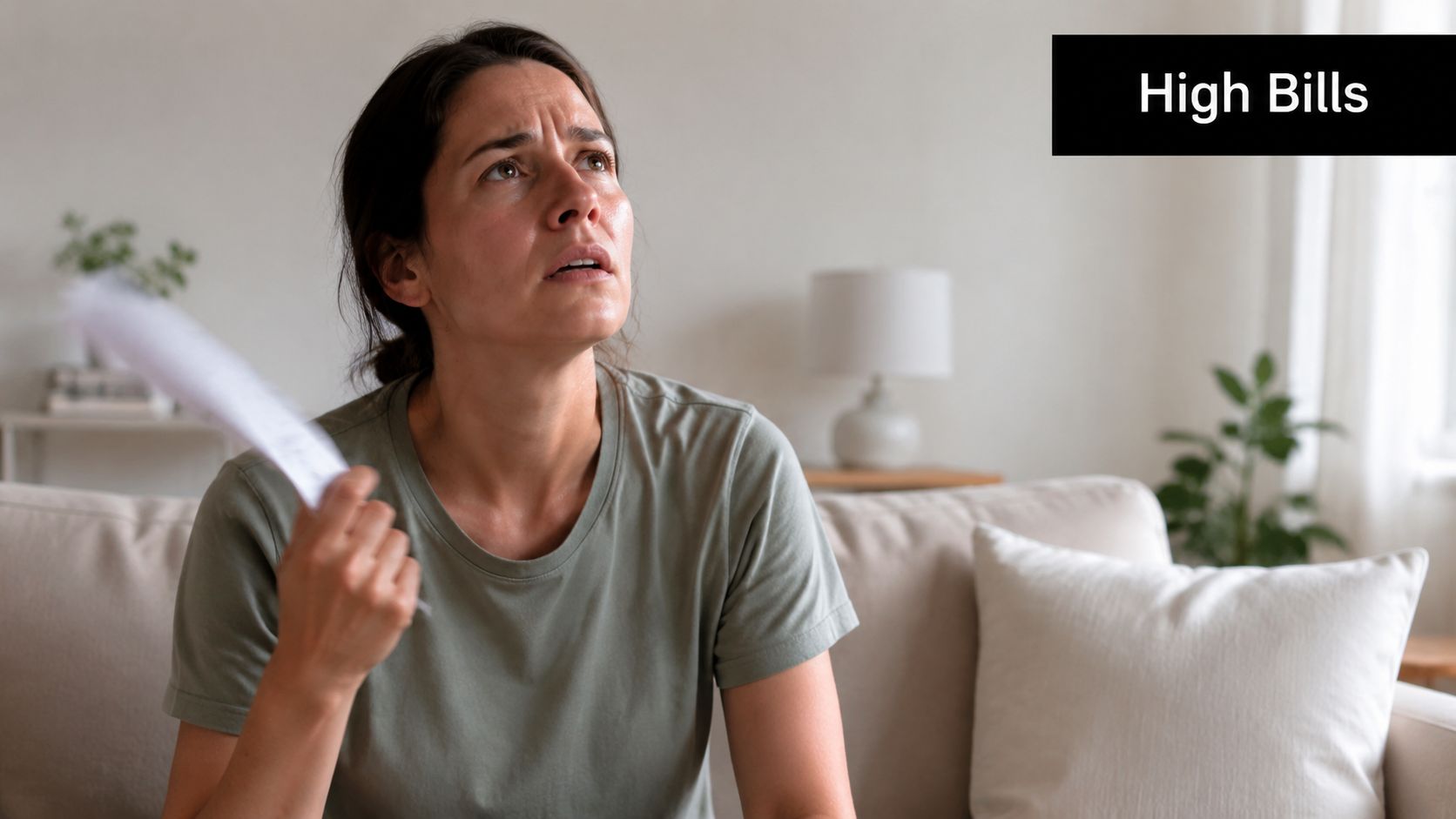
That's where a home energy efficiency program starts to matter. Instead of treating high bills as normal, these programs push homeowners to identify where the house is losing performance, then use incentives to offset part of the cost of fixing it. For South Florida homes, that often means focusing on air sealing, attic performance, insulation quality, and moisture control first.
The bigger issue isn't just personal cost. The residential sector accounts for nearly 25% of the world's total energy use, and improving a home's efficiency can reduce its carbon footprint by an average of 900 kilograms of CO2 equivalent annually according to this ScienceDirect summary of residential energy use and emissions. For a homeowner, that translates into something simpler. A tighter, better-insulated house wastes less conditioned air.
If you're trying to estimate whether an upgrade is worth pricing out, it helps to look at real-world cost discussions for similar insulation projects. A resource on GTA spray foam insulation costs is useful because it shows how homeowners often compare scope, material type, and labor before they commit. The exact local price will differ, but the decision process is similar.
In this region, homeowners often spend too much time on low-impact changes and not enough on envelope problems. A smart order of operations looks like this:
Practical rule: If your AC runs hard but the house still feels damp, look at insulation and air sealing before assuming the equipment is the only issue.
For homeowners who want a plain-language overview of the everyday changes that reduce monthly costs, this guide on how to reduce utility bills is a solid starting point.
A home energy efficiency program is basically a co-investment in your house. A utility, government agency, or state-backed initiative helps offset part of the cost when you make approved upgrades that reduce energy waste. The homeowner pays some or all of the upfront cost depending on the program. In return, the home performs better and the electrical grid carries less unnecessary demand.
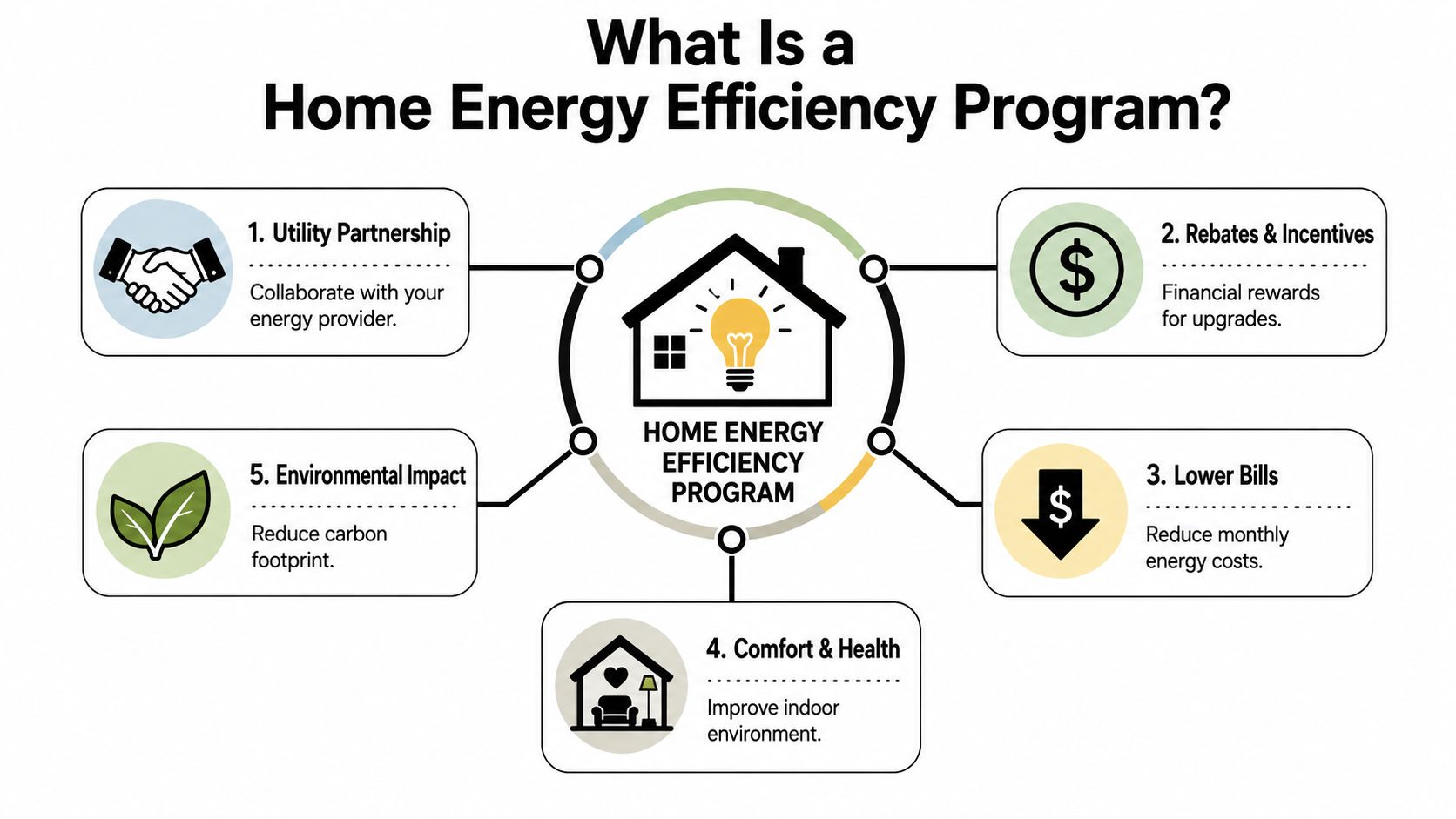
That's why these programs usually focus on proven measures. Insulation. Air sealing. HVAC upgrades. Water heating improvements. Sometimes windows and doors. The goal isn't to make your house “green” in a vague way. The goal is to reduce wasted energy in parts of the home that affect daily operation.
In practice, South Florida homeowners usually deal with some mix of:
National policy matters because it shapes what's available at the local level. Major policies like the 2022 Inflation Reduction Act allocated significant funding toward clean electricity tax credits and energy efficiency initiatives, with the aim of lowering household energy costs and strengthening the grid, as summarized by Statista's overview of global energy efficiency policy and investment.
A lot of people hear “program” and think paperwork first. In the field, it usually works the other way around. First you identify the weak points in the house. Then you match the job to whatever incentive applies.
A good program doesn't change the physics of your home. It helps pay for the work that already makes sense.
If you want a checklist mindset before talking to a contractor, even a market-specific article like how to cut energy costs in Phoenix can be useful because the audit logic carries over well. Different climate, same principle. Find waste before buying solutions.
For a more direct explanation of what happens during an inspection, this page on what is an energy audit lays out the process in homeowner terms.
This is the part most homeowners care about first. Fair enough. If you're going to improve the house, you want to know how the money works.
There are three common buckets to think about: rebates, tax credits, and financing. They don't behave the same way. Some reduce your cost after installation. Some lower your tax bill if the project qualifies. Financing can spread the expense out, but it doesn't automatically mean the project is subsidized.
The clearest federal item for many homeowners is the Energy Efficient Home Improvement Credit. Under that credit, taxpayers can receive up to $1,200 annually for qualifying home improvements including insulation and air sealing, and the materials must meet the applicable IECC standards in effect under the IRS rules, as described by the IRS guidance for the Energy Efficient Home Improvement Credit.
That detail matters. The government isn't paying for just any material thrown into an attic. The credit is tied to qualifying products and performance standards. It also applies to new systems and materials, not used products.
Rebates are usually more program-specific. Some are utility-linked. Some are tied to whole-home performance models. Some require a contractor network or pre-approval. In South Florida, that means you need to ask one practical question before starting: “Do I need approval before work begins?”
A lot of homeowners miss incentives because they install first and ask later.
| Comparing Home Energy Efficiency Incentives | |||
|---|---|---|---|
| Incentive Type | How It Works | Best For | Example |
| Rebate | Money returned through a utility or program after eligible work, sometimes with approval or modeling requirements | Homeowners doing a defined package of upgrades | A whole-home program tied to insulation and air sealing improvements |
| Tax credit | Claimed on taxes when qualifying materials and installation meet program rules | Homeowners with tax liability who want to offset project cost | Federal credit for insulation and air sealing that meets IRS requirements |
| Loan or financing | Spreads project cost over time, but terms depend on lender or contractor | Homeowners who want improvements now without paying all at once | Contractor-arranged or third-party financing for envelope upgrades |
For homes in this climate, envelope upgrades often make the most sense because they affect cooling load, moisture control, and comfort all at once. That's why insulation and sealing work tend to line up well with program logic. They address root causes.
Takeaway: The best incentive isn't always the biggest-sounding one. It's the one your specific project can actually qualify for without rework or rejected paperwork.
If you're sorting through utility-related options in Florida, this guide to FPL rebates for insulation helps connect the paperwork side to actual insulation projects.
Most successful projects follow the same path. Not because the bureaucracy says so, but because that's the cleanest way to avoid mistakes.
Start by finding key problem areas. In South Florida, those are often attic assemblies, rooflines, wall penetrations, duct-adjacent spaces, garage transitions, and older areas where insulation is thin or poorly installed. If the home leaks hot, humid air, you won't get the full benefit from any efficiency program unless the upgrade package addresses that.
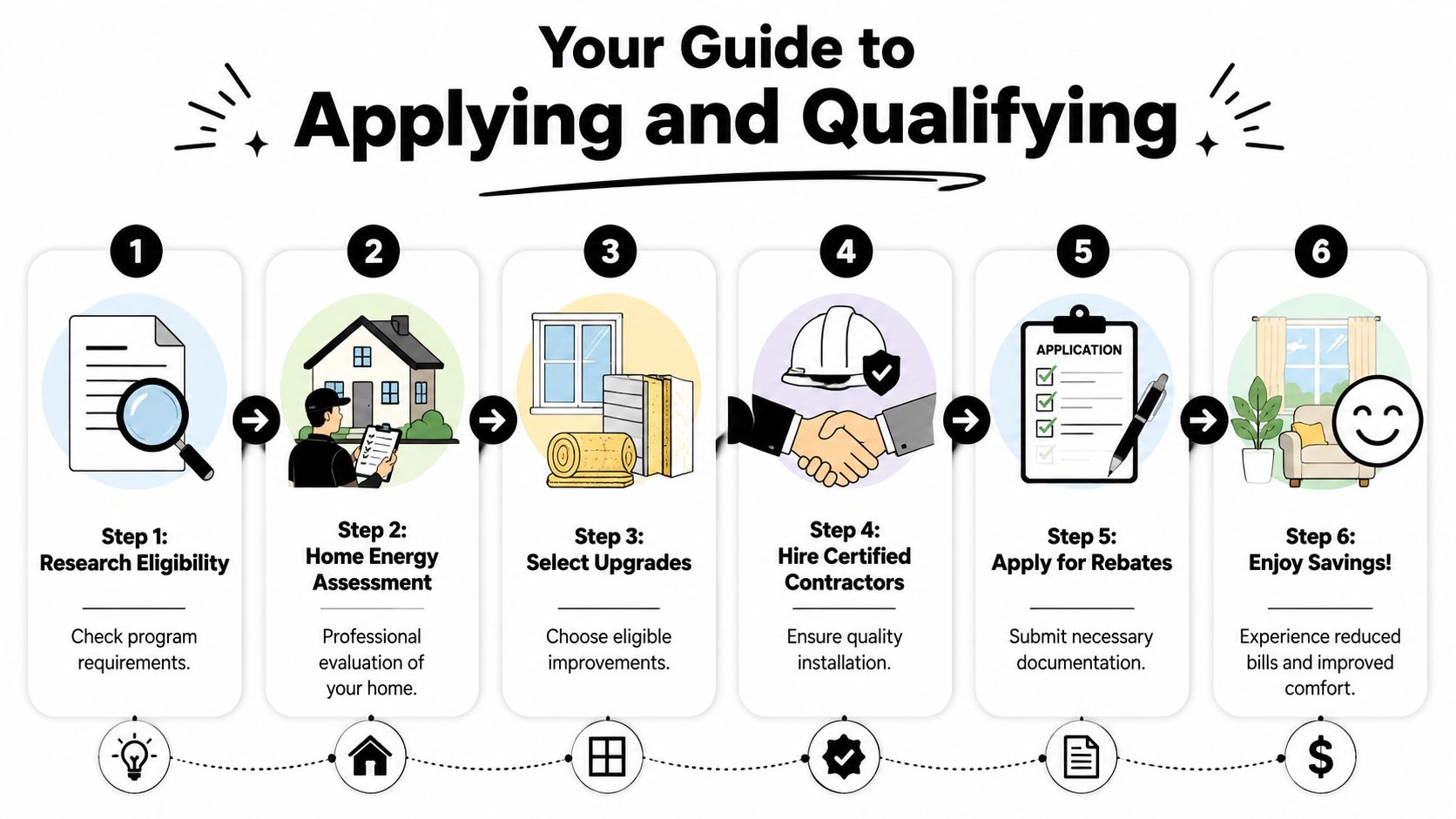
A home energy assessment or audit helps you decide where the money should go. Many homeowners think windows are the main issue because that's what they see. In practice, attics and leakage paths often deserve attention first.
The reason this matters for rebates is simple. The HOMES rebate program requires at least a 20% reduction in whole-home energy usage for qualifying projects, with savings verified through energy modeling, according to Focus on Energy's summary of HOMES program requirements. That pushes homeowners toward real building-shell improvements, not cosmetic changes that sound efficient but don't move the whole-house number enough.
For this climate, high-impact upgrades usually include:
Air sealing the building envelope
If moist outside air gets in freely, the AC has to cool and dehumidify more than it should.
Upgrading attic insulation
Solar heat load on the roof is relentless here. A weak attic assembly shows up fast in both comfort and bills.
Using spray foam where it fits the assembly
Spray foam can do two jobs at once by insulating and sealing. In humid conditions, that combination is often more valuable than insulation alone.
Before moving to the next step, it helps to see how this work looks in practice:
A qualifying job still needs a qualifying paper trail. Keep these items organized from day one:
If a contractor can install the work but can't explain how to document it, that's a risk.
Some programs require pre-approval. Others don't. Some tax credits depend on the year the property is placed in service. Don't assume all incentives can be claimed after the fact. Ask early, in writing, and keep copies.
The money gets attention first. The day-to-day benefits are what usually make homeowners glad they did the work.
In South Florida, a well-sealed and well-insulated home feels different. The AC doesn't have to chase the weather every hour. Rooms stay more even. The air feels less sticky. The house settles into a steadier indoor environment instead of swinging between cold blasts and damp recovery periods.
Temperature consistency matters more than people realize. A house with hot ceiling lines, weak attic insulation, or leaky wall transitions often creates rooms that never quite match. You lower the thermostat to fix one area, and another area turns too cold.
Better envelope performance reduces that tug-of-war. The house holds conditioned air longer, and the cooling system isn't constantly trying to catch up after outside heat and humidity push in.
This region isn't just hot. It's wet. That changes the conversation.
When air leakage is reduced, your home has a better chance of controlling indoor moisture the way it should. That can help with the musty feel many homeowners notice in closets, garages, bonus rooms, and rooms under poorly insulated roof sections. It can also help the house feel comfortable at a more reasonable thermostat setting because dry, stable air feels different from cool-but-damp air.
A house that controls humidity well usually feels comfortable sooner and stays comfortable longer.
Spray foam and better envelope work can also improve sound control. That matters more in dense neighborhoods, near traffic corridors, or in homes where one room always seems to carry outside noise more than the rest. It's not the main reason insulation is typically sought, but it's often one of the first improvements they notice after the job is done.
There's also the equipment side. A house that leaks less puts the AC in a better position to do its job. That doesn't guarantee equipment outcomes, but it usually means the system isn't fighting avoidable load created by the building itself.
An energy-efficient home isn't only about consuming less power. It's about making the house easier to live in.
South Florida homeowners need to connect national incentives to local conditions. That's the practical challenge. A federal credit may apply broadly, but the way you get real value from it depends on what your house is dealing with here: marine humidity, harsh sun, long cooling seasons, and building assemblies that often leak more than owners realize.
For many homeowners, Florida Power & Light is the first place to look for utility-side information. Tools like home energy surveys and usage tracking can help you identify patterns before you commit to a larger insulation or air-sealing project. The utility side may not solve the whole problem by itself, but it can help you narrow down where the waste is showing up.
That local context matters because South Florida homes don't fail the same way homes in dry climates do. Here, moisture movement can be just as important as heat gain. If the house takes on humid air through the attic or other leakage points, your comfort problem and your energy problem are tied together.
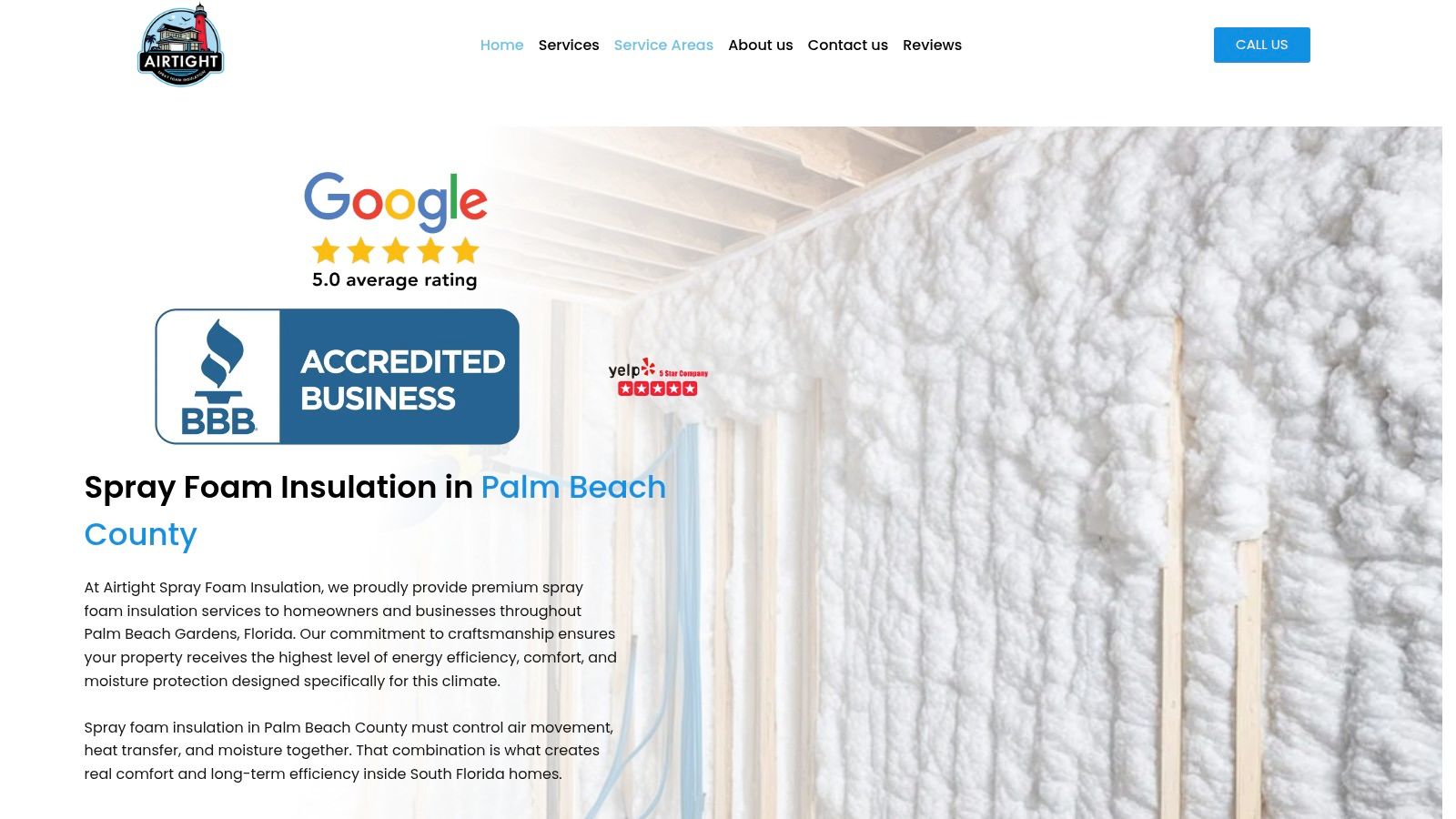
Not every energy upgrade deserves equal priority in this region. The projects that usually deliver the best practical value are the ones that improve the building envelope first.
A contractor should be able to answer a few direct questions without dancing around them:
In South Florida, the right upgrade is the one that handles heat and moisture together. A solution that ignores either one usually disappoints.
For homeowners in Jupiter, Palm Beach Gardens, West Palm Beach, Wellington, and Stuart, that local knowledge matters as much as the material itself. A national program can help pay for the work. It still takes a region-aware contractor to choose the right work in the first place.
| FAQ on Home Energy Efficiency Programs | |
|---|---|
| Question | Answer |
| Can renters use a home energy efficiency program? | Sometimes, but this is one of the biggest gaps in the market. Programs for renters and rental property owners are rare, which leaves many households underserved, as noted by ACEEE's discussion of program strategies for underserved households. In practice, renters often need landlord participation because the building owner controls the insulation, equipment, or envelope upgrades. |
| Do I have to pay for an energy assessment up front? | It depends on the program. Some offer assessments through utility or partner channels, while others leave that cost to the homeowner at the start. Ask before scheduling. Don't assume the audit is free just because rebates exist later. |
| What's the difference between a rebate and a tax credit? | A rebate usually comes through a program administrator or utility and may require approval, modeling, or specific equipment rules. A tax credit is claimed on your taxes if the installed work meets the federal requirements. |
| What upgrade usually matters most in South Florida? | In many homes, envelope improvements matter most first. That means air sealing, attic work, and insulation upgrades that help with both heat and moisture. |
| How do I find a qualified contractor? | Ask for license information, proof of insurance, clear written scope, product details, and documentation support. A good contractor should explain not just how they install, but how the work will be recorded for any program paperwork. |
| Should I replace my AC first? | Not always. If the house leaks badly, replacing equipment before tightening the envelope can leave performance on the table. Many homes benefit from addressing leakage and insulation issues before making bigger HVAC decisions. |
If you want help turning rebates, tax credits, and local utility options into a practical plan, Airtight Spray Foam Insulation serves South Florida homeowners with region-specific insulation recommendations and spray foam solutions built for heat, humidity, and real-world comfort.