You step out of a hot shower, wipe the mirror, and notice the wall looks wet. Not splashed. Wet. A few minutes later, there are beads of water on the paint, streaks running downward, and maybe even damp corners near the ceiling.
That unsettles a lot of homeowners because it feels like something must be wrong with the house.
Usually, the first assumption is bad paint, a cleaning problem, or mold starting to form. In most bathrooms, that's not the primary cause. Bathroom walls sweating is a condensation problem. Warm, moisture-laden air from bathing meets a cooler wall surface, and water forms on that surface. It's physics, not a housekeeping issue, as explained in this guidance on why bathroom walls sweat.
In South Florida, this problem shows up faster and sticks around longer because the air already carries a lot of moisture before anyone even turns on the shower. Add a cool wall, weak exhaust, a closed-up room, or an exterior block wall, and the bathroom starts acting like a cold drink sweating on a patio table.
That's the good news, too. If the cause is physics, the fix is practical. You can change the moisture level, the air movement, the surface temperature, or all three.
You finish a shower, open the bathroom door, and the walls look like they were misted with a spray bottle. In South Florida, that can happen in a bathroom that looks clean, has fresh paint, and never had a plumbing leak.
What you are seeing is the warning sign, not the full problem. Water shows up on the wall because that surface is one of the first places humid air can turn back into liquid.
I see this a lot in South Florida homes. The bathroom starts with heavy outdoor humidity already working its way into the house. Then a hot shower adds more moisture, the air conditioner keeps some surfaces cool, and a weak exhaust fan lets damp air linger too long. The result is a room that behaves like a cold glass on a patio table. Moisture collects on the coolest surface first.
That matters because the fix depends on the cause. If walls get wet mainly during or right after bathing, condensation is the first suspect. If a wall stays damp long after the room should have dried, or the problem shows up without anyone using the shower, it is time to look for a leak, an air leakage path, or a wall that stays cold because it is poorly insulated.
The part many homeowners miss is that habits and house conditions work together. Long showers, a closed door, and a fan that runs too late or not at all can trigger the moisture. But in South Florida, those habits often expose a deeper weakness in the bathroom shell. Missing insulation, thermal bridging, and air leaks around soffits, exhaust housings, or exterior block walls can keep surfaces cool enough to keep condensing day after day. If you have noticed similar moisture above the bathroom, this related guide on why a ceiling starts sweating points to the same building science pattern.
Short-term steps can reduce the dripping. The long-term answer is usually better moisture removal, better air control, and warmer interior surface temperatures so the room stops reaching the conditions that make walls sweat in the first place.
A bathroom wall “sweats” for the same reason a glass of iced tea does on a hot day. The glass isn't leaking. Water from the surrounding air turns into liquid when it hits a surface that's cold enough.
That's what happens in bathrooms. Warm air carries moisture. A shower adds even more. When that air touches a cooler wall, the air cools down at the surface. If it cools enough, the moisture can't stay suspended and turns into droplets.
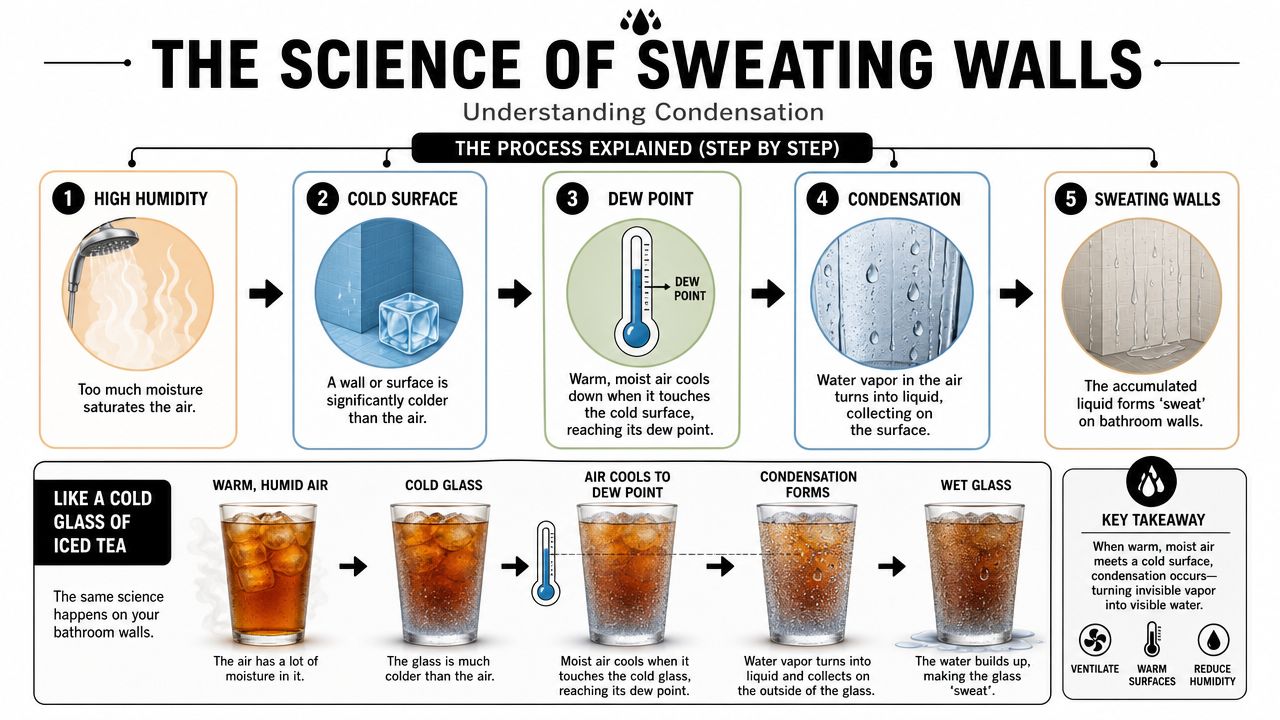
Technical guidance describes this as a dew point issue. Bathroom walls “sweat” when warm, moisture-laden air reaches a surface below the air's dew point, and the consistent root drivers are high indoor humidity, inadequate ventilation, and insufficient insulation or thermal separation, according to this explanation of why walls sweat.
In plain language, you need three things:
A lot of homeowners focus only on the moisture. That's only half the equation. You can also attack the cold-surface side of the problem. That's why some bathrooms with similar shower habits behave very differently.
One wall may be fine while the wall by the shower drips every morning. That usually points to a colder surface, not necessarily more water in the room.
Common examples include:
If you've noticed similar moisture on upper surfaces too, this short article on why a ceiling sweats helps connect the same principle to other rooms.
A sweating wall is rarely random. The wet spot usually tells you where the room is cold, humid, or poorly ventilated.
A South Florida bathroom can look fine all day, then turn into a wet box after one hot shower. That pattern matters. If you know when the moisture shows up, where it collects, and how long it hangs around, you can tell the difference between a simple ventilation problem and a wall assembly problem that needs deeper work.
Start with one question. Does the wall only sweat during and after bathing, or do you notice dampness even when nobody has used the room? If moisture shows up outside shower times, expand the search beyond steam. I check for plumbing leaks, humid air leaking into the room, and surfaces that stay cold because of missing insulation or poor air sealing. In South Florida, high outdoor humidity makes those hidden weaknesses show up faster.

Use a simple sequence. It keeps the diagnosis grounded.
The fan check is easy. Hold a tissue near the grille while the fan runs. If it barely sticks, airflow is probably weak. I treat that as a clue, not a final answer, because a fan can pass the tissue test and still fail if the duct is crushed, disconnected, too long, or venting into an attic or soffit.
Certain patterns show up again and again in the field.
| Pattern | Likely issue | What to investigate |
|---|---|---|
| Whole room fogs up and stays wet | Humid air is not leaving fast enough | Dirty fan, undersized fan, blocked or poorly routed duct |
| One exterior wall sweats the most | Surface temperature is lower there | Missing insulation, masonry wall, thermal bridging, air leakage |
| Condensation shows up without shower use | Moisture source is not limited to bathing | Plumbing leak, house-wide humidity problem, HVAC or duct issue |
| Ceiling edges and upper corners stay damp | Air is pooling and not mixing well | Weak exhaust, poor makeup air, closed door, low circulation |
That table matters even more in South Florida. Outdoor air already carries a heavy moisture load, so a small air leak around a light fixture, fan housing, window, or wall penetration can feed condensation day after day. A bathroom can have decent habits and still sweat if the enclosure is letting humid air reach a cooler surface.
If you are also seeing moisture in other rooms, this guide on how to reduce humidity in the house helps you determine whether the bathroom is the only problem or part of a larger indoor humidity issue.
After you've checked those clues, watch this short walkthrough for another practical perspective on bathroom moisture problems.
I see these mistakes all the time in humid climates.
One final check helps separate habits from building defects. If the room stays much wetter on the same wall every day, even after better fan use, shorter showers, and leaving the door open afterward, I start looking hard at the wall itself. That is often where South Florida homes need more than a fan. They need the enclosure fixed so humid air cannot keep finding a cold spot.
If your bathroom walls are dripping after a shower, the room is holding more moisture than it can get rid of. The fastest relief comes from lowering that moisture load before it settles on paint, tile, and drywall.
Start with the fan, but use it like a moisture tool, not background noise. Turn it on before the shower starts. Let it run while you bathe, then keep it running until the room feels dry. In South Florida, that usually means longer run times than homeowners expect because the air coming into the room is often humid to begin with.
A simple routine makes a real difference:
Windows are tricky here. On a dry day, opening one can help. In South Florida, outdoor air is often so damp that an open window makes the bathroom wetter, not drier. If the air outside feels heavy, use the fan instead of inviting that moisture indoors.
Some quick fixes sound helpful but do very little. Fresh paint can hide stains for a while, but it does not change wall temperature or humidity. Surface cleaners can remove residue and mildew staining, but they do not stop condensation from forming again tomorrow morning.
If your current fan is loud, weak, or rarely used because nobody wants to listen to it, equipment choice matters. This expert guide to bathroom fans gives a useful overview of fan features that improve everyday use, especially quieter operation and better controls.
One more point matters in South Florida homes. If the bathroom improves only a little after better fan use and wiping surfaces down, the problem may be bigger than one room. Whole-house moisture levels often keep bathrooms on the edge of condensation. This guide on how to reduce humidity in a house is a good next check if the entire home feels muggy.
The short-term goal is simple: remove moisture faster than the bathroom can collect it. If one wall still sweats day after day, even with better habits, that usually points to a cooler wall surface, air leakage, missing insulation, or all three.
A bathroom that keeps sweating for weeks or months usually has a building problem behind it, not just a routine moisture spike after a shower. In South Florida, that often means the room is fighting humid outdoor air, cool air-conditioned surfaces, and a wall assembly that is not doing enough to slow heat and moisture movement.

The best long-term results come from matching the fix to the failure. Some bathrooms need better moisture removal. Others have a cold exterior wall, air leaks around a window or plumbing penetration, or missing insulation in a spot that stays cool all day.
| Solution | What it helps | Where it falls short |
|---|---|---|
| Better exhaust fan | Removes moisture at the source | Won't raise wall temperature |
| Timer or humidity control | Improves day-to-day consistency | Still depends on proper ducting and setup |
| Portable dehumidifier | Lowers room moisture | Uses floor space and needs maintenance |
| Added insulation | Keeps interior wall surfaces warmer | Won't stop humid air leaks by itself |
| Air sealing | Reduces humid air movement into the wall and room | Does not replace source ventilation |
| Moisture-resistant finishes | Holds up better if surfaces get damp | Does not stop condensation from forming |
A stronger fan is often part of the answer, but fan replacement alone does not solve every sweating wall. I see plenty of bathrooms with a decent fan on paper and poor results in real life because the duct run is too long, the termination is restricted, or the fan is so noisy that nobody uses it long enough.
Controls matter too. A timer switch or humidity sensor removes the guesswork, which is useful in busy households where showers happen back-to-back. In South Florida, that consistency matters because the room starts humid and reaches the condensation point faster than people expect.
A portable dehumidifier can also help in stubborn cases. It is a support tool, especially during the wet season, but most homeowners do not want to empty a bucket forever just to compensate for a wall that stays cold.
That is why insulation and air sealing are usually the lasting fix when a bathroom keeps having the same problem. Insulation slows heat transfer so the interior face of the wall stays closer to room temperature. Air sealing blocks humid air from slipping through cracks around fixtures, soffits, window frames, and wall penetrations where it can hit cooler materials and leave moisture behind.
In South Florida homes, this is easy to miss. Air conditioning cools interior surfaces. Outdoor air stays damp for much of the year. If humid air keeps leaking into the bathroom or wall cavity, the room can keep condensing even when occupants are doing a decent job with fan use.
The assembly matters.
Bathrooms on exterior block walls, around older windows, or under poorly insulated roof lines often need more than surface treatment. Paint, mildew-resistant coatings, and caulk have their place, but they do not change how the wall handles temperature and moisture.
A similar envelope principle shows up in other parts of the house. The assemblies are different, but controlling water and air movement is also the goal when waterproofing basement walls.
Spray foam is worth considering when the wall needs insulation and air sealing together. That combination can be useful in bathrooms because many condensation problems are not caused by one missing piece. They come from humid air getting in and a surface staying too cool.
Open-cell and closed-cell foam are not interchangeable. Open-cell foam expands well and can help with sound control. Closed-cell foam is denser and is often chosen where a stronger air barrier and added moisture resistance are priorities. The right choice depends on the wall type, whether the bathroom is on an exterior exposure, and how the rest of the home is handling humidity.
If you want background before deciding, this guide to vapor barrier and insulation choices for humid climates explains how the layers work together.
One local company homeowners may come across is Airtight Spray Foam Insulation. In a bathroom, the value of spray foam is straightforward. It can improve the wall assembly when air leakage and missing insulation are both feeding the condensation problem.
South Florida changes the equation because the house starts with a moisture handicap. The outdoor air is often humid before anyone showers, so the bathroom doesn't need much extra steam to cross the line into visible condensation.
That's why a fix that seems good enough in a drier climate often underperforms here. A barely adequate fan, a cool exterior wall, and a long hot shower can be manageable elsewhere and still cause repeated bathroom walls sweating in Jupiter, West Palm Beach, Wellington, or Stuart.
Many South Florida homes have concrete block construction or wall assemblies that behave differently from framed walls in milder climates. Interior surfaces can stay cool enough for moisture to form when air conditioning runs hard and warm humid air keeps entering the room.
Common local trouble spots include:
Coastal conditions add another headache. Salt air and constant humidity are tough on finishes, metal components, and any material that stays damp too often. Once repeated condensation starts, paint failure, staining, and musty odors tend to show up sooner.
In South Florida, homeowners often do the obvious things. They run the fan more. They wipe down surfaces. They keep the room clean. Those steps help, but they don't always solve the root problem because the climate keeps reloading the room with moisture.
In this region, the long-term win usually comes from controlling both moisture production and the wall assembly itself.
That means fan performance matters, but so do insulation continuity, air sealing, and the temperature of the interior wall surface. In many local homes, that's the difference between a bathroom that dries normally and one that keeps sweating no matter how often you repaint it.
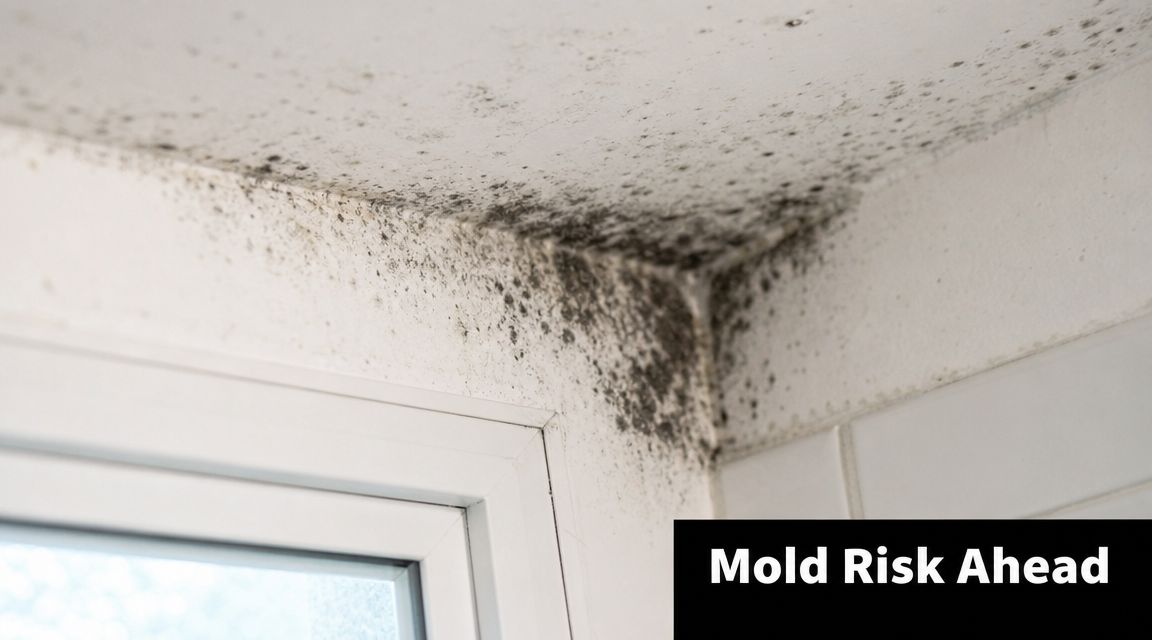
There's a point where this stops being a simple bathroom annoyance and becomes a building problem. If you're seeing persistent moisture, recurring staining, peeling paint, or a musty smell that doesn't clear, it's time to bring in someone who can inspect the room as a system.
The biggest warning sign is persistence. If the fan is being used correctly and the walls still sweat regularly, the room likely has a deeper issue with ventilation design, insulation gaps, air leakage, or hidden moisture.
Call a professional if any of these are true:
A good inspection looks at the room as a moisture system, not just a wet wall.
That includes fan performance, duct routing, whether the fan exhausts outdoors, likely air leaks, insulation quality in the wall or ceiling, plumbing leak potential, and whether the coldest surfaces line up with the wettest surfaces. In South Florida, a contractor should also think about the interaction between air conditioning, high outdoor humidity, and wall temperature.
If moisture keeps returning to the same area, the house is giving you a map. Follow it before the damage spreads.
Professional work costs more than a new can of paint, but repainting over recurring condensation is wasted money. The better investment is fixing the cause so the room stays dry, the finishes last longer, and the indoor air stays healthier.
If your bathroom walls keep sweating and you want a real diagnosis instead of another temporary patch, Airtight Spray Foam Insulation can help evaluate whether insulation gaps, air leakage, or a cold wall assembly are part of the problem. For homeowners in Jupiter, Palm Beach Gardens, West Palm Beach, Wellington, and Stuart, a focused moisture-control review can identify what to fix now and what will keep the bathroom dry for the long haul.