
If you live in South Florida, you already know what “quiet at home” is supposed to feel like. You shut the doors, the AC kicks on, and you expect the outside world to stay outside. Then the landscaping crew starts three houses down. A neighbor's pool equipment hums all afternoon. Rain hammers the roof. Traffic rolls in from the main road long after dark.
That's usually the moment people start looking for a soundproofing fix. What they often find is a confusing mix of products that do one job well and ignore the rest. Some materials absorb echo inside a room. Some block outside noise better. Some insulate. Some handle moisture. Very few do all of that in one assembly.
For South Florida properties, that matters. Noise is only one part of the problem. Humidity, wind-driven rain, condensation, and heat all work on the same wall, roof, or ceiling system. That's why closed cell foam for sound deadening stands out. It isn't just a noise product. It's a building-envelope upgrade that helps control sound while also resisting moisture and improving thermal performance.
Many homeowners call about noise when the underlying issue is exposure. New roads, denser neighborhoods, more service traffic, and more outdoor equipment all add up. In South Florida, homes also deal with long stretches of windows shut tight for cooling, which means small weak points in the envelope become much more noticeable.
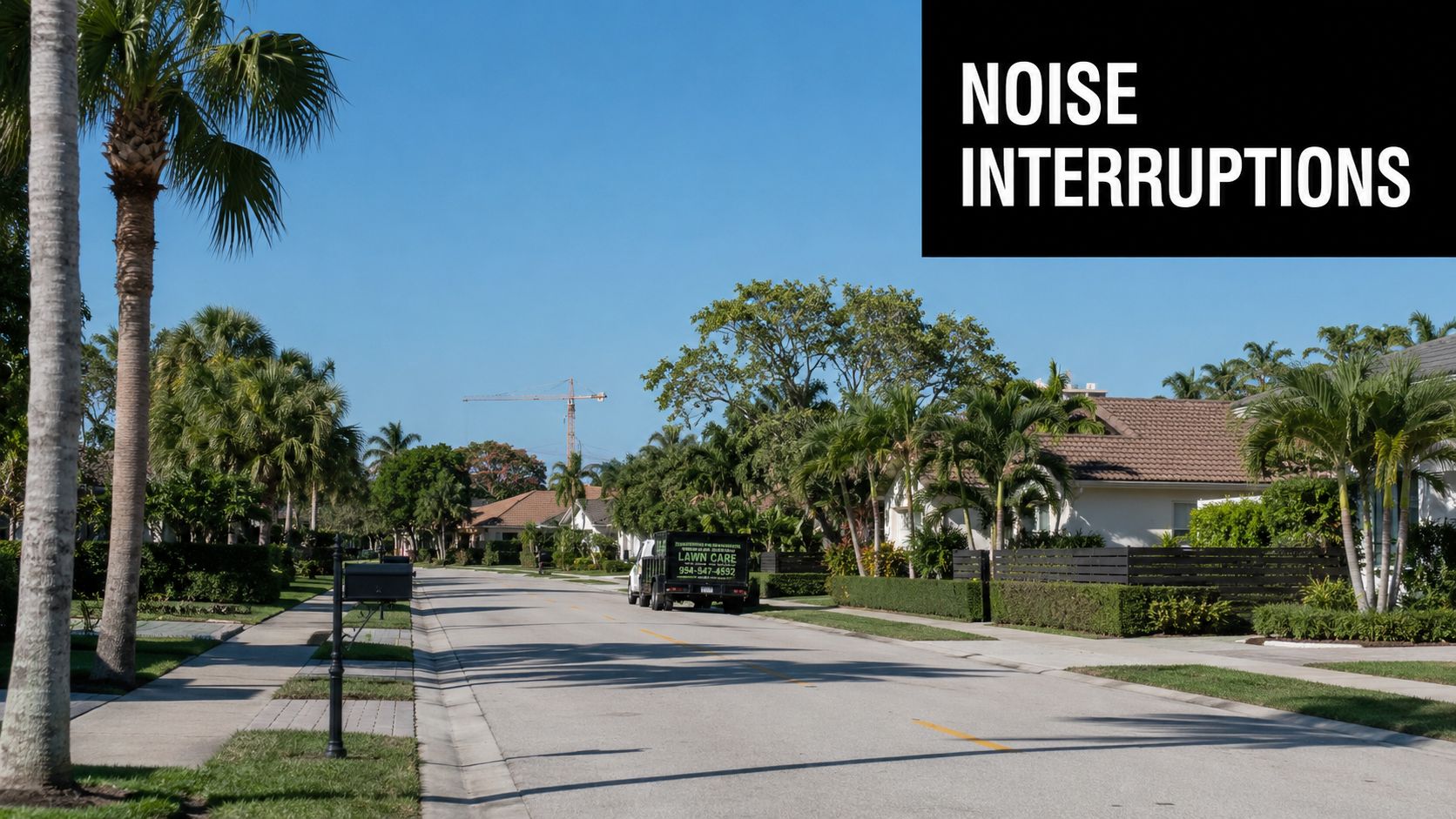
A bedroom on the street side of the house picks up tire noise before sunrise. A back office near the condenser or pool pump never feels fully quiet. In a metal workshop, a passing storm can turn the whole roof into a drum. Most people don't need a recording studio. They just want a room that feels sealed off enough to sleep, work, or relax without constant intrusion.
That's the part many people miss. Sound rarely leaks through one obvious hole. It travels through wall cavities, roof decks, joints, gaps, and lightweight panels. If the assembly is thin, loose, or vulnerable to moisture, performance slips over time.
Closed-cell foam became mainstream in part because its sealed-cell structure gives builders and automotive engineers several useful properties at once: sound damping, moisture resistance, and stronger thermal resistance. It's also more rigid and denser than open-cell foam, with typical R-values of about 6.0 to 7.0 per inch, compared with 3.5 to 4.5 per inch for open-cell foam, according to Technicon Acoustics' comparison of open-cell and closed-cell foam.
In South Florida, the best sound-control material often isn't the one that wins a lab conversation. It's the one that still performs after heat, humidity, and seasonal storms work on the assembly.
This is why a simple “soundproofing” mindset can lead to the wrong product. If a material helps with acoustics but struggles with moisture, loses shape, or adds little insulation value, it may not be the best fit for an exterior wall, attic line, or metal building near the coast.
For many South Florida homes and commercial spaces, the better question is this: which material improves sound control while also helping the building hold up better in a humid, storm-prone climate? Closed cell foam earns attention because it answers more than one problem at the same time.
Most sound-control mistakes come from mixing up two different jobs. Sound blocking stops noise from passing through a wall, ceiling, or floor. Sound absorption reduces echo and reverberation inside a space.
Think of it this way. A brick wall and a sponge both affect sound, but they do it differently. The brick wall resists transmission. The sponge soaks up energy inside the room. If your problem is highway noise coming through an exterior wall, you need more blocking. If your conference room sounds harsh and bouncy, you need more absorption.
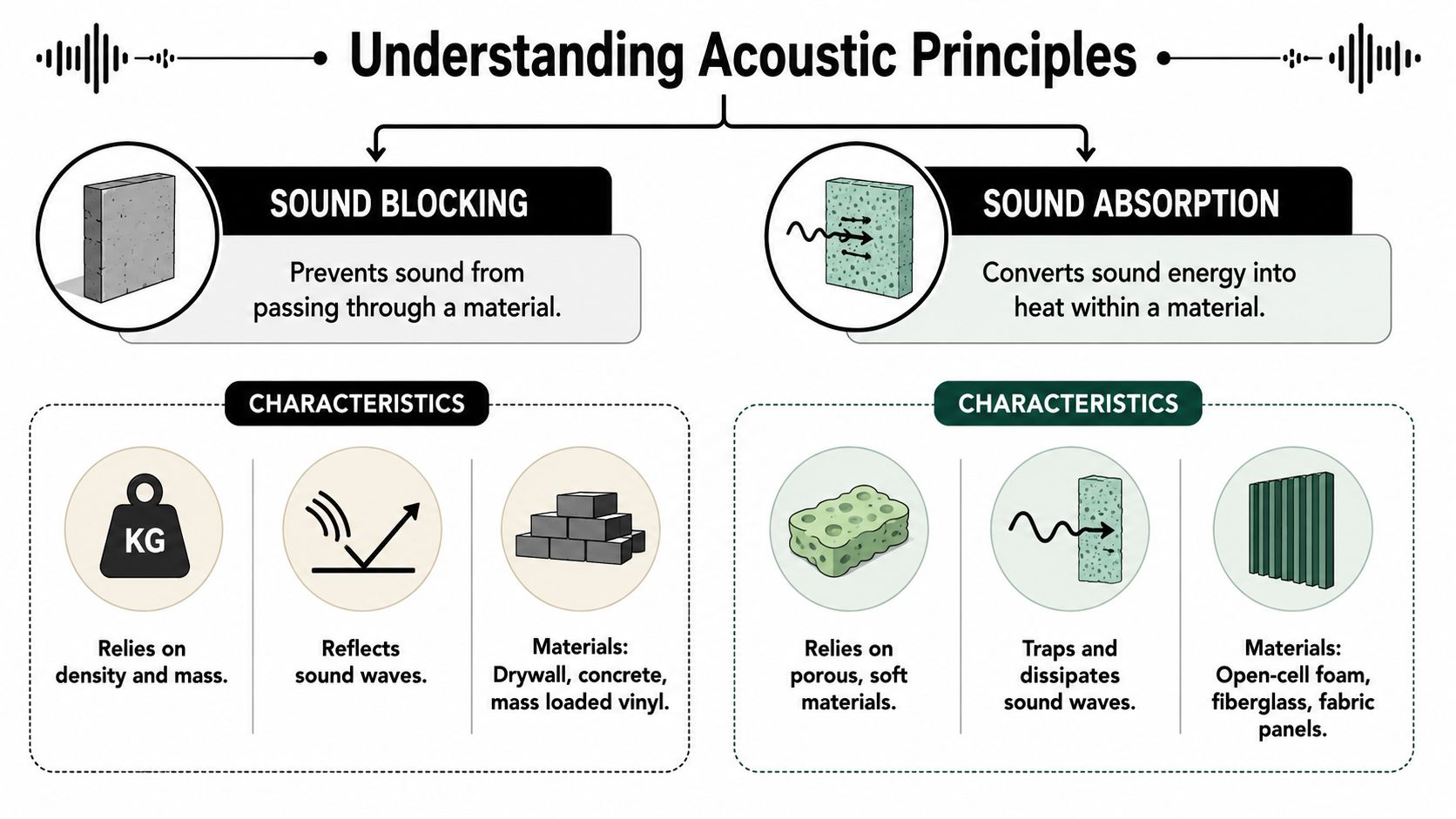
When contractors talk about keeping noise from crossing from one side of an assembly to the other, they're talking about transmission. That's where dense, rigid materials matter. Closed-cell spray polyurethane foam fits this role because its value comes mainly from resisting sound movement through the assembly.
Carlisle describes closed-cell spray polyurethane foam as a medium-density, two-component system with more than 90% closed-cell content, a reported STC of 41, and water absorption of less than 2% by volume, which is why it works as a sound-blocking material that also holds up in humid conditions, as shown on Carlisle's closed-cell spray foam product page.
That's an important distinction. Closed cell foam for sound deadening doesn't act like studio foam stuck on a wall. It helps the assembly resist transmission.
Absorbers are soft, porous, and useful inside rooms where speech clarity or echo control matters. They're often the right move for conference rooms, call areas, and open-plan interiors. If you're dealing with workplace echo, guides on office acoustics solutions can help you think through panels, partitions, and layout choices that improve the sound inside the room.
But those products don't automatically stop exterior noise from entering the building envelope. That's a separate job.
Here's the practical way to sort it out:
Practical rule: If your complaint starts with “I can hear,” think blocking. If it starts with “This room sounds echoey,” think absorption.
For a homeowner deciding between insulation strategies, this matters more than product labels. A lot of “acoustic” products are aimed at room treatment, not envelope performance. If you want a deeper look at how insulation helps reduce transmission through assemblies, this guide on insulation as a sound barrier is a useful companion.
Choosing sound control for a South Florida property means judging materials by more than acoustic labels. A wall or roof assembly also has to deal with humid air, wind-driven rain, heat load, and, in many homes, the pressure changes that come with storm season. The best option is the one that keeps doing its job after years of moisture exposure and weather stress, not just the one that looks good on a product sheet.
Closed-cell foam is the strongest all-around choice when the assembly has to reduce noise and protect the building envelope at the same time. Other materials can perform well in a narrower role. Closed-cell stands out because it adds density, resists water, air-seals gaps, and stiffens the assembly in one application.
That matters in South Florida. A softer insulation may help with sound inside a cavity, but if it can hold moisture, allow humid air movement, or do nothing to strengthen the assembly, the homeowner is left solving the same wall or roof problem in pieces.
A lot of homeowners start with windows, and that is often the right first check for traffic noise. If glazing is part of the plan, this guide to Auckland soundproofing window solutions gives a clear look at how window choices affect noise intrusion.
| Material | Primary Acoustic Function | Moisture Resistance | R-Value/Inch (Approx.) |
|---|---|---|---|
| Closed-cell foam | Sound blocking and air sealing within assemblies | Strong moisture resistance | About 6.0 to 7.0 per inch |
| Open-cell foam | Sound absorption inside cavities | Lower moisture resistance | About 3.5 to 4.5 per inch |
| Fiberglass | Basic cavity absorption | Depends heavily on installation and assembly conditions | Lower than closed-cell foam |
| Mass loaded vinyl | Added mass for blocking | Depends on how the full system is built | Not applicable |
The practical comparison is less about which material is "acoustic" and more about what job the assembly needs done.
Closed-cell foam works best where outside noise, moisture control, and thermal performance all matter. Open-cell foam has value in interior partitions where the main goal is softening sound transfer between rooms and moisture exposure is limited. Fiberglass and mineral wool remain common budget choices, but both depend heavily on careful installation. Small gaps, compression, and air leakage can chip away at real-world performance. Mass loaded vinyl can be effective, but it is usually an add-on layer, not a one-product fix.
Here is the trade-off contractors run into all the time. If the project only needs absorption inside a dry interior wall, a softer material may be enough. If the project needs one system to help with road noise, humid air, and the wear that comes from South Florida weather, closed-cell foam usually gives the better return because it handles several building problems at once.
That is the difference between solving an acoustic symptom and improving the assembly itself.
If you are also comparing loose-fill products, this guide on blown-in insulation for soundproofing explains where those materials fit, and where they tend to come up short compared with spray-applied options.
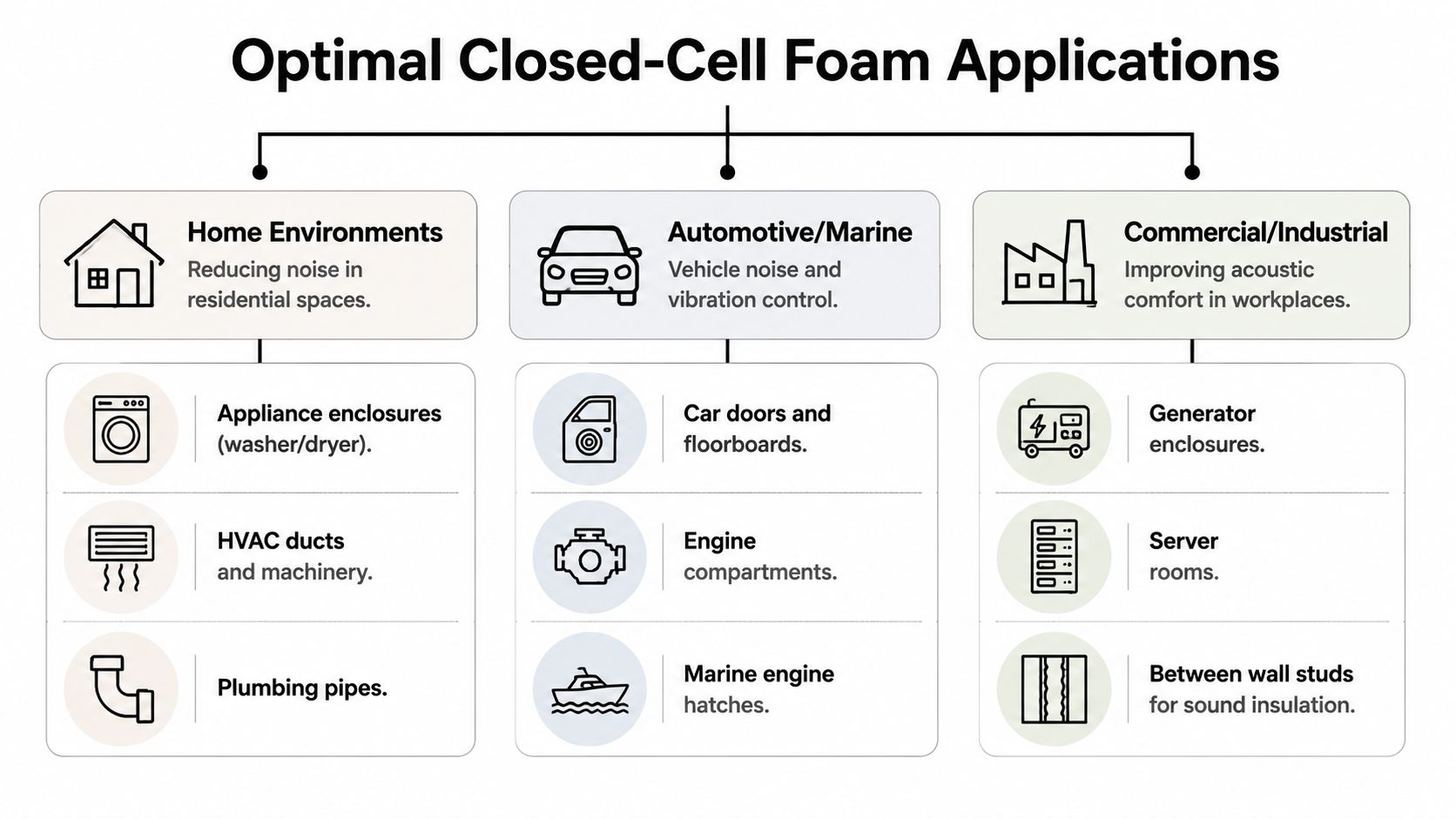
Location matters more than brand names or buzzwords. Closed cell foam for sound deadening delivers the most value where the assembly is exposed to outside noise, moisture, temperature swing, or vibration. In South Florida, three areas stand out.
Street-facing bedrooms, home offices, and living rooms often suffer from repeat noise. Traffic, lawn equipment, barking dogs, and pool systems don't need to be loud to become irritating. They just need to be constant.
Closed-cell foam works well in these wall assemblies because the goal isn't to make the room feel like a theater. It's to reduce transmission through the wall while strengthening the envelope against outdoor moisture and humid air. That combination is why it tends to outperform softer insulation choices when the wall has to do multiple jobs.
Roof noise is one of the most common complaints in Florida homes, especially during heavy rain and wind. The roof assembly takes direct impact from weather, and any weakness overhead gets noticed fast.
This is also where homeowners feel the full benefit of a multi-function material. A roof deck insulated with closed-cell foam isn't just addressing sound. It also helps create a tighter thermal and moisture boundary in one of the hardest-working parts of the house.
For a broader view of insulation choices aimed at reducing noise transfer through the building shell, this guide to the best insulation for noise reduction is worth reviewing before you choose an attic or roof strategy.
A quick visual helps show the kinds of applications where closed-cell products make the most sense:

Metal structures amplify sound in a way drywall homes usually don't. Rain hits harder. Mechanical noise reflects more. Temperature swings are sharper. That's why workshops, garages, and warehouse-style spaces benefit so much from rigid foam insulation that also controls the climate.
In these buildings, closed-cell foam helps tame the “drum effect” while adding stiffness and moisture resistance to surfaces that otherwise sweat, radiate heat, and echo badly.
Common strong-fit applications include:
The best place for closed-cell foam is usually the place where a cheap fix fails first.
The biggest cost mistake isn't choosing a premium material. It's paying for a sound-deadening project that only solves one problem while leaving the others in place.
If all you want is less echo in a media room, there are cheaper ways to get there. Fabric panels, soft finishes, rugs, and targeted acoustic treatment can make a big difference. But that's not the same project as improving a South Florida exterior wall, roofline, or metal building.
Closed-cell foam earns its keep when you look at the whole assembly. You're not only buying quieter rooms. You're investing in a tighter envelope, stronger moisture control, and better thermal performance in the same area of the building.
This material only performs well when the installer treats the building like a system. Missed edges, inconsistent thickness, untreated penetrations, and poor prep work all reduce results. Sound follows weak points. Moisture does too.
That's why professional installation matters so much with spray foam. The job has to be complete and deliberate. A partial seal is a lot like leaving one side of a cooler lid open. You still spent the money, but the assembly can't do what it was built to do.
Here's where the return usually shows up over time:
A short-lived fix often costs more than a durable assembly upgrade. Homeowners sometimes stack products over the years. First weatherstripping, then panels, then added insulation, then another round of repairs after moisture shows up. That path gets expensive because each step addresses symptoms instead of the envelope itself.
A sound-deadening project has the best ROI when the same installation also improves comfort, efficiency, and resilience.
In South Florida, that's the logic behind closed cell foam for sound deadening. It isn't the right answer for every room, but it's often the smartest answer for the places where noise, humidity, and heat all collide.
A lot of bad advice about foam insulation comes from treating every foam product as if it does the same job. It doesn't.
Open-cell and closed-cell foam are built differently and behave differently. One is softer and more absorptive. The other is denser, more rigid, and better suited to assemblies that need blocking, shape retention, and moisture resistance. If someone says “foam is foam,” they're skipping the part that determines performance.
That confusion shows up in other industries too. If you've ever compared seat cushions or upholstery cores, you've seen how density and structure affect feel and durability. This overview of understanding furniture foam quality is a good reminder that foam category alone doesn't tell you much.
It's common in new builds, but retrofit work is absolutely possible. Existing homes often benefit the most because they already reveal where the noise and comfort problems are. A contractor can target the wall, roof, garage, or metal building area that's causing trouble.
Retrofit projects do require planning. Access, existing finishes, and the condition of the assembly all matter. But “only for new construction” isn't accurate.
That usually comes from confusing room treatment with transmission control. Closed-cell foam isn't a decorative acoustic panel. It's part of a barrier assembly. When the goal is to reduce sound moving through the building shell, that absolutely counts as real soundproofing work.
The better question is whether the chosen foam matches the job. For a humid exterior wall or roof assembly in South Florida, closed cell usually makes more sense than a softer material that mainly absorbs sound inside a room.
People usually reach the same practical questions once they move past the theory. They want to know what the process feels like, what can stay, and what result to realistically expect.
During installation, you can expect the material and process to have a noticeable odor. After proper application and curing, that typically subsides. The important part is using an experienced installer who follows correct safety and ventilation procedures for the building and the occupants.
Sometimes yes, sometimes no. It depends on where the old insulation is, what shape it's in, and whether it interferes with proper adhesion or full enclosure of the target area. In many projects, crews remove old material so the new foam can form a clean, continuous layer where it matters most.
That depends on the size of the area, access, prep work, and drying or curing needs on site. A small targeted project moves much faster than a full attic, roof deck, or wall package. The right contractor should walk you through the schedule before work starts so you know what part of the house will be affected and for how long.
No honest contractor should promise that. Sound control is about reduction, not magic. Windows, doors, framing details, duct paths, and roof or wall design all influence the final result. Closed-cell foam can make a meaningful difference, especially in assemblies exposed to outside noise and humidity, but total silence isn't a realistic goal in a normal home.
A visual reference can help if you're evaluating whether spray foam fits your property:

The main takeaway is simple. Closed cell foam for sound deadening works best when you need more than quieter rooms. In South Florida, the primary benefit is the package: better sound blocking, better moisture resistance, and stronger thermal performance in the same assembly. That's what makes it such a practical choice for exterior walls, attics, roof decks, garages, and metal buildings.
If you want a quieter, tighter, and more moisture-resistant building envelope, Airtight Spray Foam Insulation can assess the trouble spots and recommend the right closed-cell application for your South Florida property. Request a free site assessment and get a plan built around your walls, roof, or metal building, not a one-size-fits-all guess.