Attic insulation cost usually falls around $1,700 to $2,500, with an average project near $2,100, or about $1 to $3 per square foot. For a South Florida home, that number is only the starting point, because heat, humidity, air leakage, and attic conditions often matter as much as the insulation itself.
If you're reading this, there's a good chance your air conditioner runs hard all afternoon, one side of the house never feels quite right, and the rooms below the attic stay warmer than the thermostat says they should. That's common in South Florida. The mistake I see homeowners make is assuming the fix is just "add more insulation" and shop for the cheapest square-foot price.
Sometimes that works. Often it doesn't.
A Florida attic isn't just a hot box. It's a moisture-control zone, an air-leak zone, and in many homes, a big reason the HVAC system feels like it's always behind. The question isn't just what attic insulation costs. It's what kind of attic system your house needs, what prep work has to happen first, and whether you're paying for a thermal upgrade, an air-sealing upgrade, or both.
Most homeowners start with the same complaint. The house cools down at night, then by early afternoon the second floor or the back bedrooms feel sticky again. The AC is on, but comfort isn't there.
In South Florida, that usually points to the attic.
I've seen attics with thin insulation, patchy insulation, old insulation that's been shifted around by service work, and attics where the bigger issue wasn't thickness at all. The main problem was uncontrolled air movement. Hot attic air finds every gap around wiring, recessed lights, duct boots, top plates, and access hatches. Once humid air starts moving where it shouldn't, comfort drops fast.
A lot of online pricing articles sound simple because they stop at material cost. That creates the wrong expectation. A homeowner sees a low price for fiberglass or blown-in material and assumes that number reflects the full job.
It rarely does.
A proper attic insulation project may include inspection, prep, removal of damaged or dirty insulation, air sealing, ventilation corrections, and then the actual insulation install. In some homes, that's a straightforward attic floor job. In others, especially in hot-humid conditions, the better solution involves a different material and a different strategy.
Practical rule: If two quotes are far apart, don't assume the higher one is inflated. Check whether one contractor priced insulation only and the other priced a complete attic system.
The other point South Florida homeowners need to keep in mind is resilience. A roof system here deals with wind-driven rain, long cooling seasons, and heavy humidity. That changes the value equation. A cheaper material can hit the basic thermal target, but it may do much less to control air movement and moisture.
That doesn't mean the most expensive option wins every time. It means you need to understand what you're buying.
The cleanest national benchmark comes from HomeAdvisor's attic insulation cost guide, which places a typical attic insulation project at $1,700 to $2,500, with an average around $2,100, or $1 to $3 per square foot. The same guide notes that labor alone commonly adds $1.50 to $3 per square foot, or roughly $1,000 to $3,000 for a standard attic, which tells you something important. Installation isn't a minor add-on. It's often a major part of the bill.
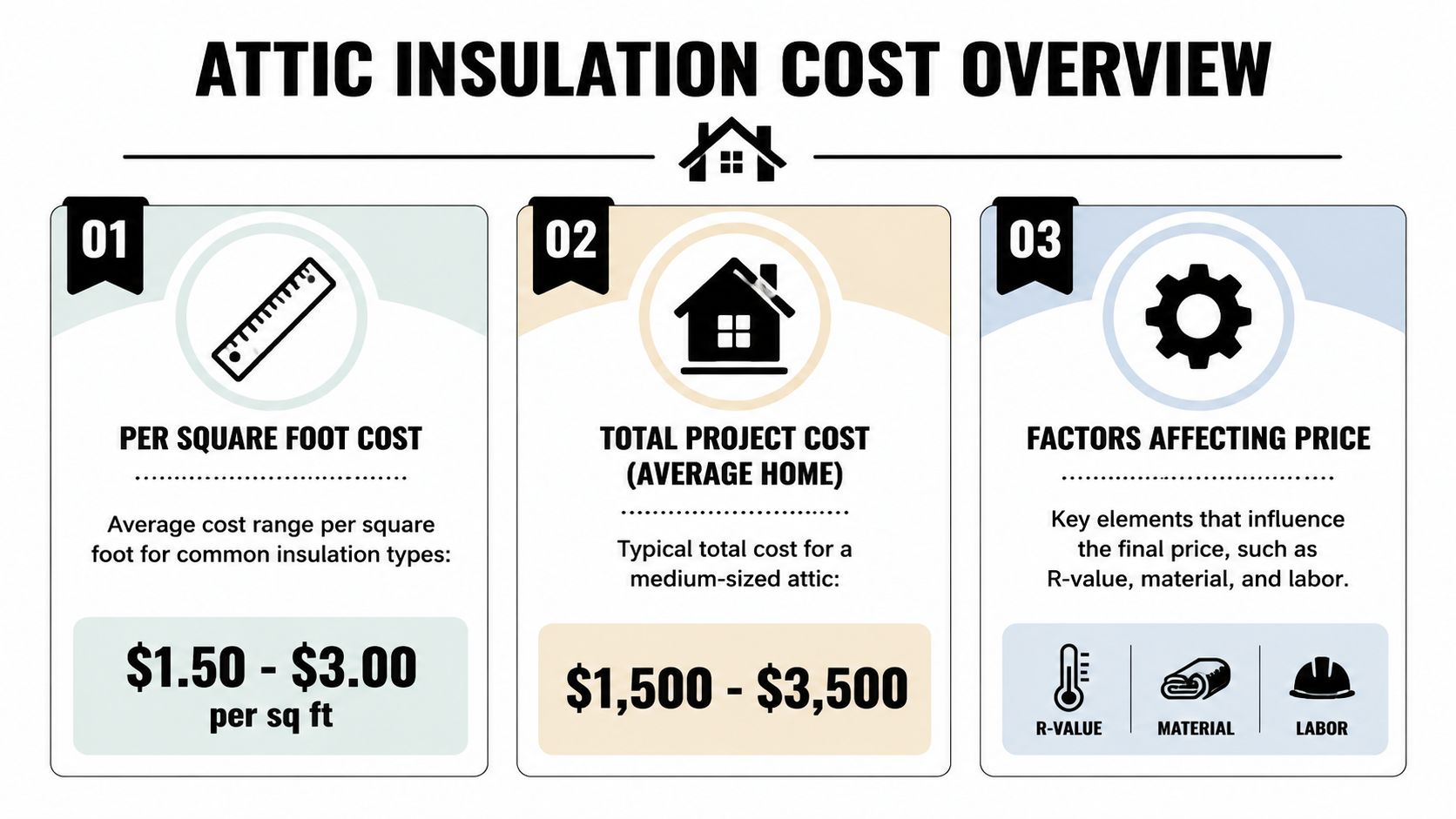
That national average is useful because it gives you a starting frame. It tells you what a routine attic upgrade often costs when the job is fairly standard and access is reasonable.
What it doesn't tell you is what condition the attic is in before work starts.
If the estimate you're reviewing looks low, ask what it includes. Is it just insulation placed over what's already there? Does it include correcting obvious air leaks? Does it account for difficult access, limited headroom, ductwork congestion, or a material upgrade? Those details move the number fast, especially in older Florida homes.
Attics are slow, physical work spaces. Crews deal with heat, tight framing, low-clearance areas, electrical penetrations, duct runs, and careful material placement. Even when the material itself isn't premium, the labor can still be substantial because the install quality determines whether the insulation performs as intended.
That matters even more if you're comparing traditional insulation to foam options. Homeowners who are evaluating foam often benefit from seeing how product class changes the budget, especially when looking at closed-cell foam spray insulation cost, because the price isn't just about more material. It's about a different level of air control and moisture resistance.
A cheap quote can still be expensive if the house stays hot, humid, and uncomfortable after the job is done.
For budgeting purposes, think of the national range as a fair baseline for a typical project. Then expect your real number to depend on the attic's condition, the material chosen, and how much corrective work has to happen before insulation can do its job.
The price homeowners remember is usually the insulation line. The price that surprises them is everything around it.
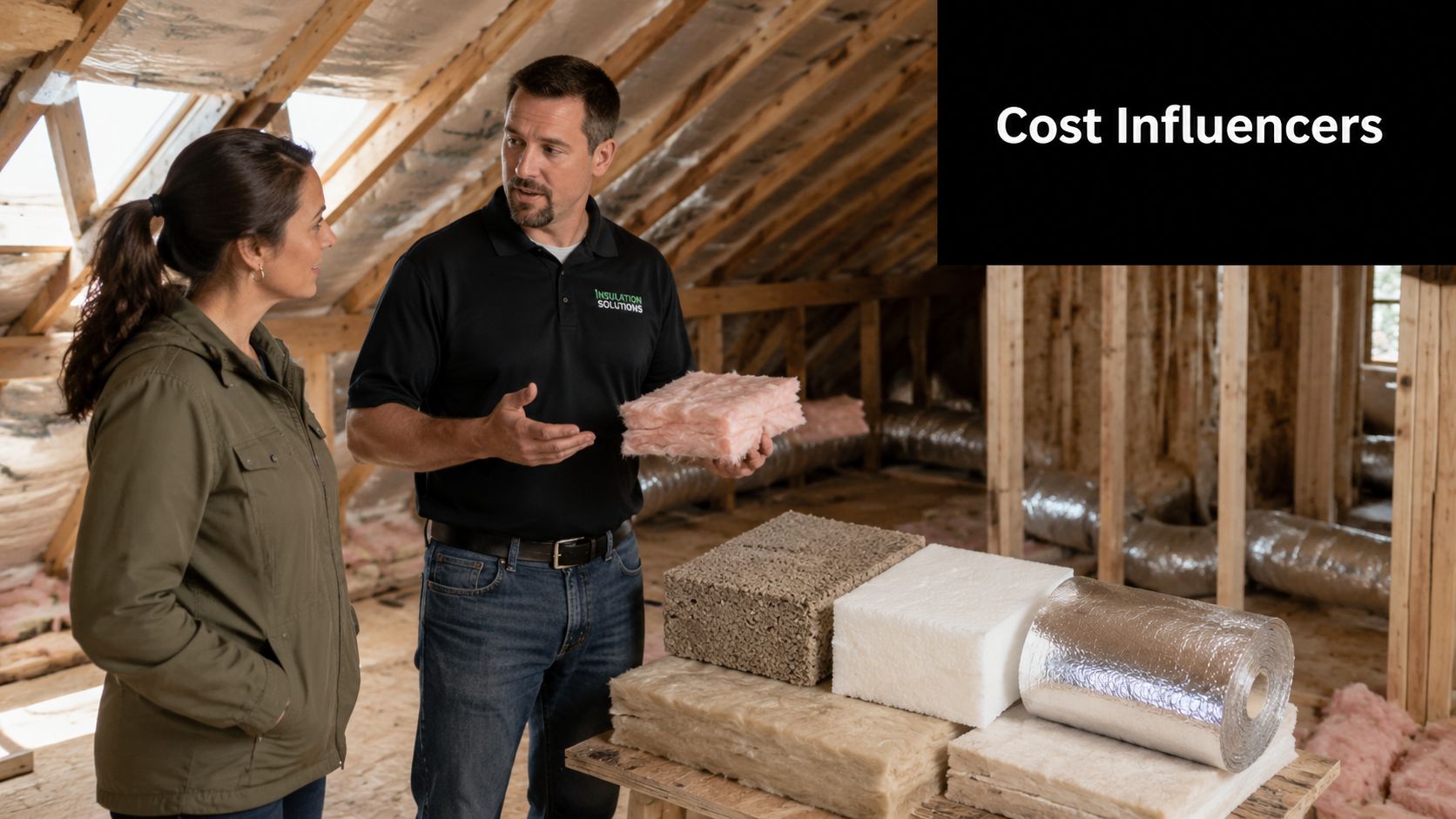
According to First Quality Roofing's breakdown of attic insulation costs, air sealing can add $300 to $600, insulation removal can add $1 to $2 per square foot, and ventilation upgrades can add $300 to $700 on top of the base insulation and labor price. That's why the cheapest insulation material doesn't always produce the lowest all-in project cost.
If your attic leaks air into the living space, new insulation alone won't solve the problem. Conditioned air escapes upward, and hot humid air can move downward through gaps and penetrations.
That's why good contractors treat the attic as a system.
When those leaks are left open, homeowners often pay for new insulation and still complain about uneven comfort.
Old insulation doesn't always have to come out, but sometimes it should. If it's compacted, contaminated, badly disturbed, or covering areas that need air sealing work, removal becomes part of doing the job right.
That prep work is where a lot of bids separate. One contractor may quote over the top of existing conditions. Another may price removal, sealing, cleanup, and reinstallation. Those are not equivalent proposals.
If you're also weighing ventilation changes, it's worth spending a few minutes understanding attic fan costs because fans, vents, and airflow corrections can affect both attic conditions and the scope of the insulation plan.
Here's a useful walkthrough on what contractors often evaluate before finalizing the work:
A solid estimate usually spells out more than material type and square footage. It should clarify:
If a quote skips prep, it may not be a value quote. It may just be an incomplete one.
That's the mindset to keep. You're not shopping for bags, batts, or foam alone. You're paying for a finished attic assembly that performs in real South Florida conditions.
Material choice changes both the project cost and the result you live with afterward. Some products are mainly thermal barriers. Others combine insulation with air sealing. In South Florida, that difference matters.
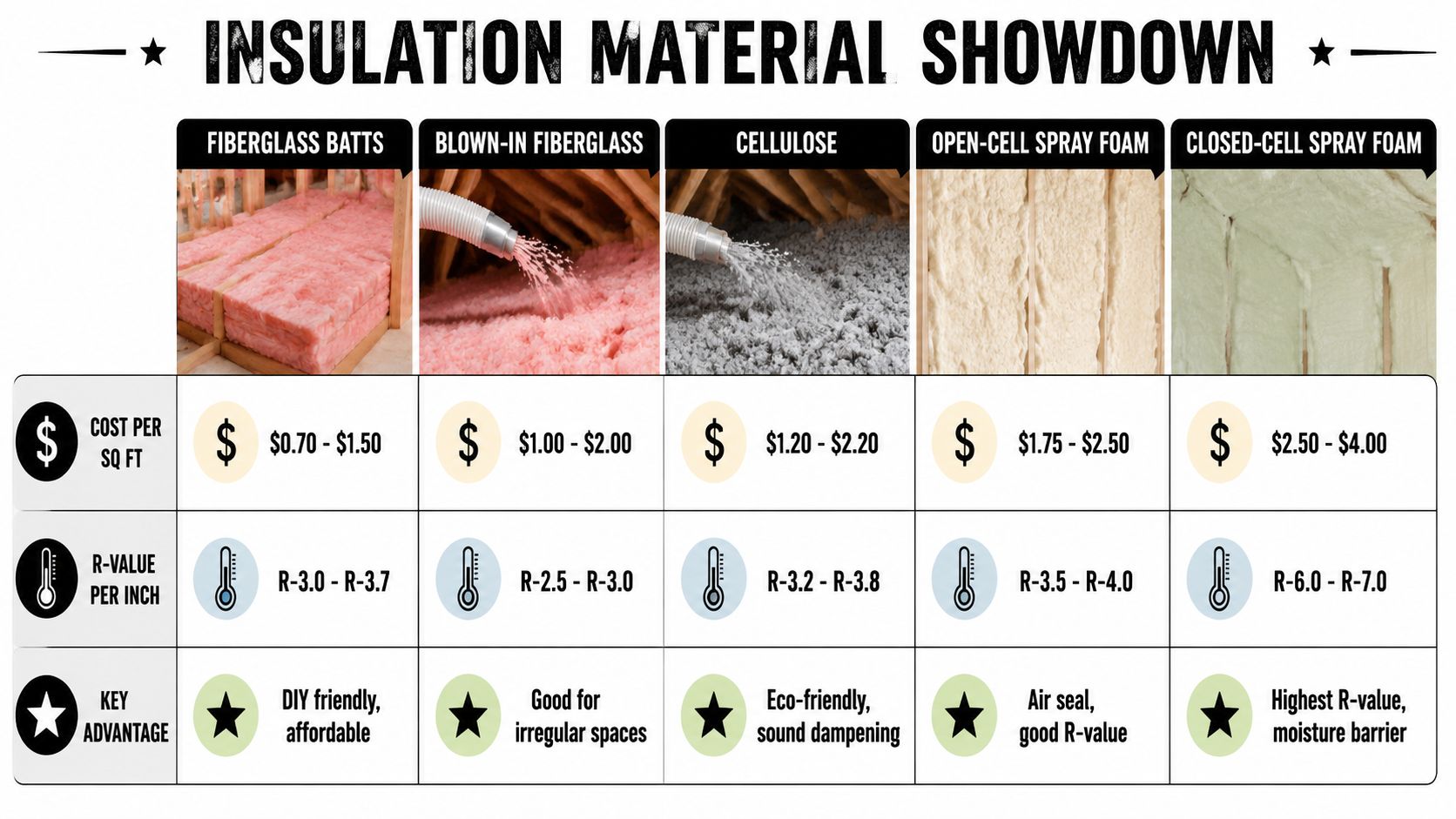
RetroFoam of Michigan's attic spray foam pricing guide gives a useful installed comparison: fiberglass batts run about $1.00 to $2.50 per square foot, blown-in insulation runs about $1.50 to $3.50 per square foot, and spray foam runs about $3.00 to $7.00 per square foot. The same source notes that existing-home attic spray foam projects can reach roughly $5,900 to $12,000 for higher-performance retrofits.
| Material | Installed cost range | Where it fits best | Main limitation |
|---|---|---|---|
| Fiberglass batts | $1.00 to $2.50 per sq ft | Straightforward attic floor installs with regular framing | Doesn't air seal by itself |
| Blown-in insulation | $1.50 to $3.50 per sq ft | Covering large attic floors and irregular cavities | Still needs separate air sealing |
| Spray foam | $3.00 to $7.00 per sq ft | Homes needing insulation plus air control | Higher upfront cost |
Traditional insulation still makes sense for many homes. If the attic floor is accessible, the framing is simple, and the main goal is reaching a solid thermal level at a moderate price, fiberglass products are often the value play.
Batts work best when the attic is open and regular enough to install cleanly. Blown-in material is better when there are obstructions, uneven spaces, or areas where batts would leave gaps. For many homeowners, especially those focused on code-level performance and budget discipline, this category is the practical answer.
The catch is simple. These materials slow heat flow, but they do not, by themselves, stop air movement. If the attic leaks badly, you still need a separate air-sealing step.
Spray foam sits in a different category. It insulates, but it also seals gaps and helps limit convective heat transfer. That's why the premium isn't just "more insulation." You're paying for a different function.
Open-cell and closed-cell products don't perform the same way either. Closed-cell carries a higher price because it delivers higher R-value per inch and stronger moisture resistance. Open-cell is commonly used in attics because it offers strong air sealing at a lower cost than closed-cell. Homeowners comparing these options usually benefit from reviewing open-cell foam insulation cost alongside the project goals, because the right choice depends on whether the attic needs basic thermal improvement or a more aggressive air-control strategy.
In a humid climate, the best material isn't just the one that insulates well. It's the one that matches how the house actually gains heat and moisture.
A few practical truths help simplify the choice:
What doesn't work is choosing material by unit price alone. I've seen homeowners spend less upfront and still end up disappointed because the attic's biggest problem wasn't thickness. It was airflow.
A South Florida attic behaves differently from an attic in a dry climate. Heat is relentless, but humidity is what complicates the job.
When outside air enters the attic assembly and finds cooler surfaces near conditioned space, moisture risk goes up. That's why insulation decisions here can't be based on thermal performance alone. Air movement and dew point matter just as much. If you want to understand that interaction better, this explanation of understanding dew point is worth reading before you choose a system.
Loose-fill and batt systems can work well in the right attic. But in South Florida, the recommendation changes when the home has obvious infiltration paths, duct leakage, chronic humidity complaints, or irregular framing around the roofline.
Those homes need tighter control of air movement.
A damp attic smell, staining, microbial growth, and condensation concerns usually point to a larger attic strategy problem, not just a missing layer of insulation. If mold is already part of the equation, resources on solutions for Orlando attic mold issues can help homeowners understand when remediation needs to happen before insulation work.
South Florida homeowners also think differently about roof systems because they have to. Wind events, heavy rain, and long cooling seasons put real stress on the building envelope.
In some roof deck applications, higher-performance foam products can offer benefits beyond simple thermal resistance. Homeowners often value them for tighter air control and a more durable roof assembly in demanding conditions. That doesn't mean every house needs a premium foam application, but it does explain why some Florida bids look very different from generic national averages.
The best-performing Florida attic projects usually have three things in common:
A Florida attic isn't just hot. It's active. Heat, moisture, and air movement are all working at the same time.
That's why national averages only get you so far. In this climate, attic insulation cost is tied closely to building science, not just square footage.
The right way to think about attic insulation is not "How fast will this pay back to the penny?" That's too rigid, and no honest contractor should promise a fixed savings number without measuring your house, ductwork, usage habits, thermostat settings, and attic conditions.
A better question is whether the project reduces avoidable cooling load and improves comfort enough to justify the cost. In South Florida, that's usually where the value shows up first. Homeowners notice longer temperature stability, fewer hot rooms, and an AC system that doesn't seem to chase the set point all day.
Use a simple framework:
If you're collecting multiple contractor proposals, tools like Exayard HVAC estimating software can give you a sense of how professionals structure labor, material, and scope, which helps when you're comparing line items that aren't written the same way.
If one bedroom becomes usable again, if the upstairs stops feeling clammy, or if the AC cycles more normally instead of running endlessly through peak heat, that's real value. It may not show up in a neat spreadsheet the first week, but it changes how the house lives every day.
A poor attic upgrade also has a hidden cost. If the installer skips air sealing or chooses the wrong material for the condition, you can spend money and still need corrective work later.
Think in layers:
That's the standard I use. If the project addresses all four, the investment usually makes sense. If it only adds material and ignores the attic's real weaknesses, the return gets a lot harder to defend.
Before you call for quotes, do a little homework. It helps you get more accurate pricing and better answers.
That last point matters because mechanical equipment in a hot attic changes the value of better air control.
Can I install attic insulation myself?
Some homeowners can place batt insulation in a simple attic floor, but most full attic upgrades are better left to pros. The moment the job involves air sealing, removal, ventilation decisions, or spray foam, professional installation matters.
Do I always need to remove old insulation?
No. If the existing insulation is dry, reasonably intact, and not blocking necessary corrective work, it may stay. If it's damaged, contaminated, matted down, or hiding major leakage points, removal often makes sense.
Is spray foam always the best choice?
No. Energy Trust of Oregon's insulation guidance notes that spray foam is a high-performing product but less commonly used for the average attic project, and that it's best installed by a professional. The most expensive option isn't automatically the right one when the goal is straightforward code-level thermal resistance. In South Florida, the better choice depends on how much air leakage control and moisture management the attic needs.
What should I watch for in quotes?
Watch for missing scope. If one estimate includes removal, air sealing, and ventilation work while another only lists insulation, they aren't competing on the same job.
If you want a quote based on real South Florida attic conditions instead of a generic national average, Airtight Spray Foam Insulation can help. Their team serves homeowners across Jupiter, Palm Beach Gardens, West Palm Beach, Wellington, and Stuart with attic evaluations, open-cell and closed-cell spray foam options, and practical recommendations built around comfort, humidity control, and long-term performance.