Faced insulation is fiberglass or mineral wool insulation with an attached paper or foil layer that acts as a vapor retarder, and that facing usually has a perm rating of approximately 1.0 perm or less. In plain English, it's insulation with a built-in moisture-control layer, but in South Florida that feature can help or hurt depending on where and how it's installed.
If you're standing in the insulation aisle staring at pink batts with paper backing, silver-faced rolls, and plain unfaced batts, the labels don't tell you the part that matters most. Climate does. What works in a cold northern wall can create a moisture problem in a hot, humid Florida house.
That's the mistake I see all the time. Homeowners hear one rule, “put the facing toward the warm side,” and assume it applies everywhere. It doesn't. In South Florida, that kind of one-size-fits-all advice can trap moisture inside a wall and feed mold where you can't see it.
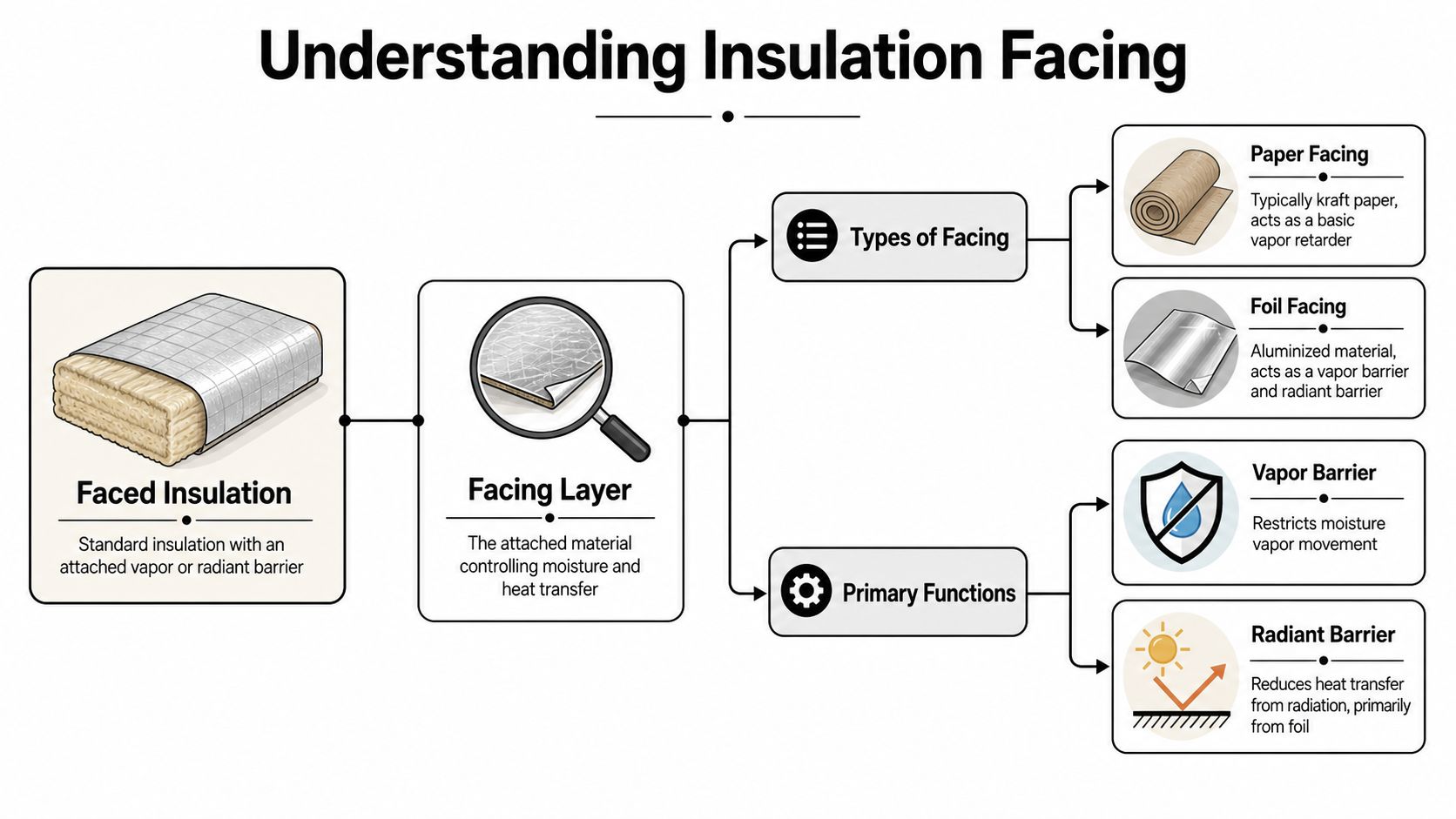
At the most basic level, faced insulation is batt or roll insulation with a factory-attached facing. That facing is usually kraft paper, foil, or a reinforced variation of the two. The fluffy part handles thermal resistance. The facing handles moisture control and gives the installer something to staple to the framing.
That second job matters more than people think. Faced batts are easier to position neatly in open stud bays because the flange gives the installer a fastening surface. Done right, that helps the batt stay full-thickness instead of getting mashed into the cavity.
The attached layer isn't there for decoration. It's there to slow moisture vapor moving through the assembly. In the right wall and the right climate, that's useful. In the wrong wall, it becomes a problem.
Here's the practical definition I give homeowners:
If you're still sorting out the bigger picture of why insulation matters in the first place, this plain-language breakdown of what house insulation does is worth reading before you choose a product.
Bottom line: Faced insulation isn't “better” by default. It's only better when the wall assembly needs that vapor retarder and can still dry the way it's supposed to.
Big-box store packaging makes faced insulation sound simple. It isn't. The product itself is straightforward. The building science behind it is not. Most of the bad installs I see don't happen because the homeowner bought bad insulation. They happen because the facing got used in the wrong climate, the wrong direction, or on top of another low-perm material.
That's why asking “what is faced insulation?” isn't enough. The better question is whether your wall, attic, or roof should have a facing at all.
The facing is the whole reason this product category exists. Without it, you just have standard batt insulation. With it, you have insulation plus a vapor retarder.
According to this guide on vapor retarder performance in faced insulation, faced insulation is engineered with an attached vapor retarder, typically asphalt-backed kraft paper or aluminum foil-reinforced kraft paper, that limits vapor transmission to approximately 1.0 perm or less, which classifies it as a Class II vapor retarder.
People use those terms like they mean the same thing. They don't.
A vapor retarder slows moisture. A vapor barrier is much more restrictive. Faced batt insulation usually falls into the first category, not the second. It is like a breathable jacket instead of a rubber raincoat. It reduces moisture movement, but it doesn't seal the assembly shut.
That distinction matters because walls need a drying path. If you block vapor on one side but the wall can still dry the other way, you may be fine. If you block both directions, you've built a moisture trap.
You'll usually run into a few standard options:
A separate guide on vapor barrier and insulation choices gives a helpful overview if you want to understand how these layers work together inside a wall or roof.
Moisture problems don't start because water always leaks in bulk. A lot of them start because vapor moves slowly, repeatedly, and invisibly.
Insulation facing is only one piece of the moisture puzzle. Air leaks, HVAC sizing, duct leakage, and indoor humidity all affect how a house performs. If your home already feels damp, sticky, or musty, it helps to look at broader ways to control indoor moisture instead of assuming insulation alone will fix it.
That's why I tell South Florida homeowners not to obsess over the paper backing itself. Focus on the whole assembly. Faced insulation can slow vapor. It can't solve a humid house by itself.
Faced insulation is useful when you need built-in vapor control and a stapling flange. Unfaced insulation is the safer choice when another layer already controls vapor, or when the assembly needs to dry in more than one direction.
Neither product is universally right.
In a typical cold-climate wall, faced batts can be a practical choice because the facing does two jobs. As Johns Manville explains in its discussion of faced insulation installation and vapor control, the facing acts as the primary fastening surface for installers to staple batts without compressing the glass fibers, which helps maintain specified R-value. The same source notes that it can also provide a fire-resistant barrier when using FSK-25 flame-resistant facing.
That's useful in open wall cavities, basement framing in colder regions, and some new construction applications where code requires vapor control.
Unfaced insulation is the cleaner option when you're adding insulation over existing material, insulating interior walls for sound control, or working in assemblies where a facing would be redundant or risky.
I prefer unfaced batts whenever a wall already has another low-perm layer. If there's exterior rigid foam, spray foam, foil-faced sheathing, or another material that already limits drying, adding faced batts inside can be asking for trouble.
| Feature | Faced Insulation | Unfaced Insulation |
|---|---|---|
| Attached layer | Has paper or foil facing | No facing attached |
| Moisture control | Adds a built-in vapor retarder | Depends on other assembly layers |
| Installation | Easier to staple in open cavities | Friction-fit only |
| Best use | New cavity installs where vapor control is needed | Adding over existing insulation, interior walls, assemblies needing more drying potential |
| Risk if misused | Can trap moisture if paired with another low-perm layer | Less risk of creating a double vapor barrier |
| Fire consideration | Standard kraft and foil facings must stay concealed unless using a rated facing | No paper facer to conceal, but finish requirements still depend on the full assembly |
Use faced batts only when you know the assembly calls for an interior vapor retarder and you know the wall can still dry correctly. Use unfaced when you're layering insulation, insulating interior partitions, or dealing with a warm-humid assembly that already has low-perm components.
Practical rule: If you can't clearly identify where the wall dries, don't add another facing.
That's the simplest way to avoid expensive mistakes.
The standard insulation advice commonly heard was written for heating climates. South Florida is not a heating climate. That matters.
In our region, moisture usually isn't trying to get from your house into the cold outdoors for months at a time. It's often trying to move from the hot, humid exterior toward the cooler, air-conditioned interior. If you ignore that and install faced insulation like you're in the Midwest, you can trap moisture in the cavity.
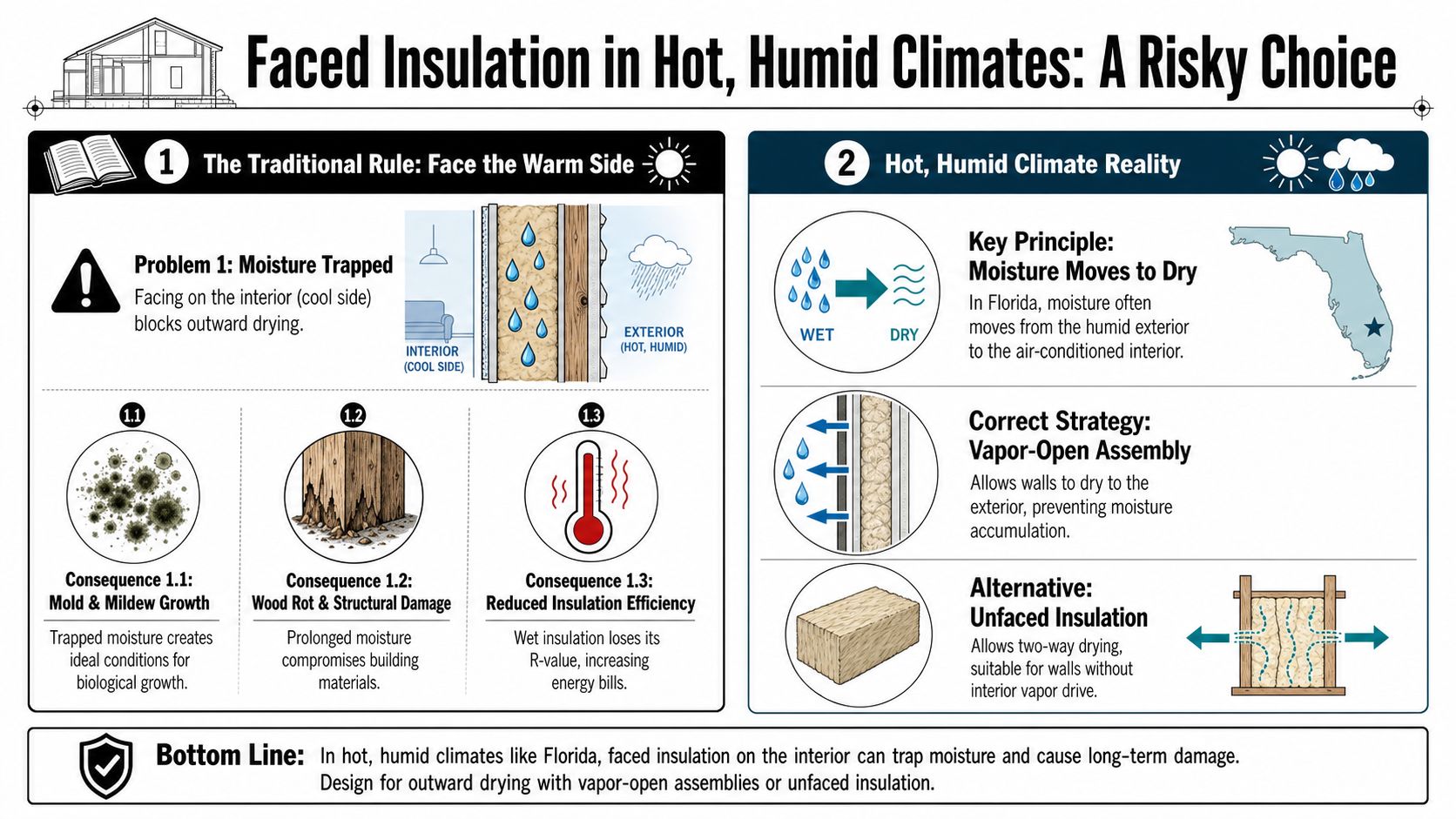
The worst version of this mistake is the double vapor barrier. That happens when faced batts sit next to another low-perm material, such as spray foam in parts of the assembly or another vapor-resistant layer. Moisture gets in, but the wall can't dry effectively in either direction.
A South Florida-focused insulation article discussing faced insulation in humid climates notes that in this hot-humid region, the standard rule of facing toward the warm side often reverses, and the facing should often point outward or be omitted entirely to allow walls to dry inward. The same source cites Building Science Corporation data showing that trapping moisture between two low-perm layers increases condensation risk by 40% in humid climates compared to vapor-open systems.
That's not a minor detail. That's the difference between a wall that manages moisture and a wall that hides it.
I see versions of the same error over and over:
The result isn't always obvious on day one. It shows up later as musty smells, stained drywall, microbial growth, and soft framing.
If a wall can't dry, it won't forgive installation shortcuts.
People also mix up hot-dry and hot-humid guidance. Those aren't the same. Roofing and insulation strategies used in desert climates can still be useful for comparison, especially when you're looking at broader insulation for Arizona roofs, but South Florida assemblies have to handle much higher humidity loads and very different moisture behavior.
My opinion is simple. In South Florida, faced batt insulation is often overused because it sounds safer than it is. If you don't have a clear reason to install the facing, leave it out and build an assembly that can dry.
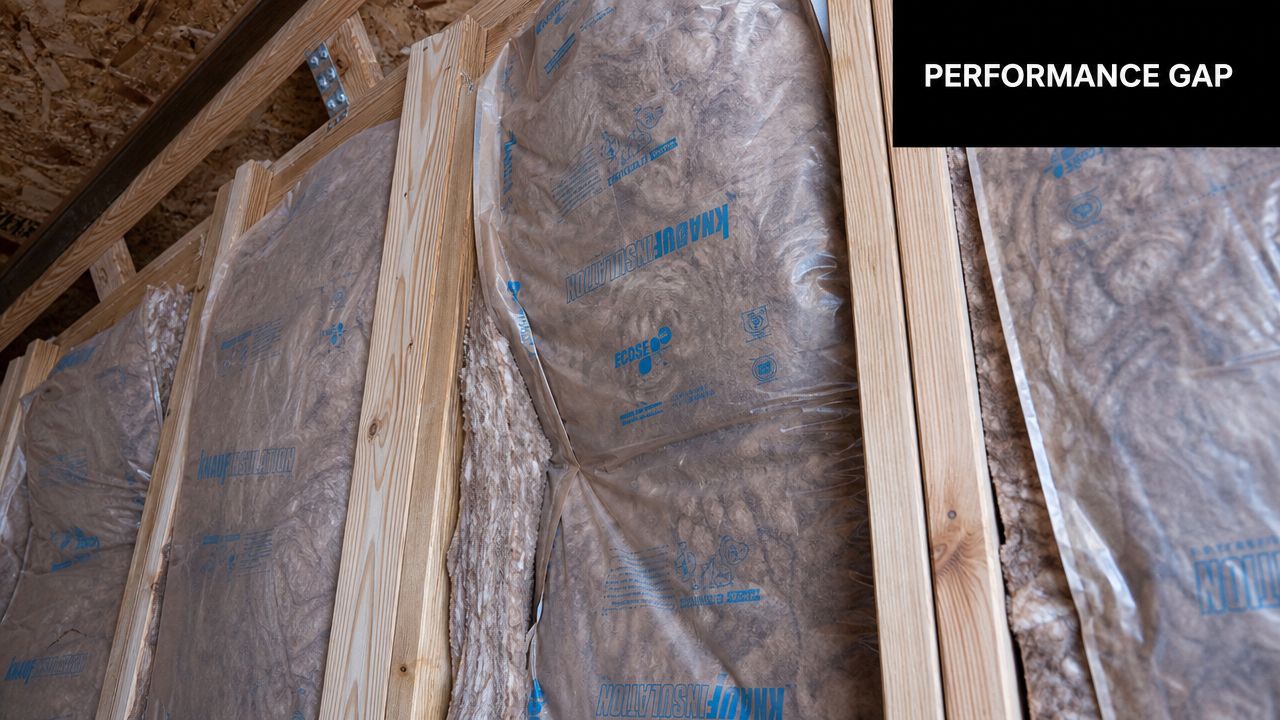
The number printed on the bag is only part of the story. Batt insulation performs best when it's installed cleanly, cut accurately, and left at full loft. That's hard to pull off around wiring, plumbing, electrical boxes, irregular framing, and rushed labor.
Even before installation quality enters the picture, the product itself can lose performance if the facing process isn't controlled well. The insulation industry article on certified faced insulation performance warns that without certification, faced insulation can suffer from adhesive compression that reduces fiber resilience, lowering effective R-value by 10 to 15% compared to unfaced equivalents, while also creating voids that compromise air sealing.
Three field conditions hurt performance fast:
That last point is the one homeowners usually miss. Insulation and air sealing are not the same job. You can fill a wall cavity and still leave the house leaky.
I'm not saying faced batts never work. They do. But they're unforgiving. They need proper orientation, careful cutting, clean stapling, and a wall design that manages moisture correctly. Miss one of those steps and the assembly underperforms.
Field note: A batt can look installed from across the room and still have enough gaps and compression to miss the performance you paid for.
That's why I treat batt insulation as a product that depends heavily on installer discipline. In South Florida, where humidity punishes weak details, that dependency becomes a bigger liability.
South Florida homes need more than cavity fill. They need air control and moisture control that hold up in a punishing climate. That's where spray foam separates itself from traditional faced batts.
Spray foam doesn't rely on a paper flange, friction fit, or perfect cutting around every wire and outlet. It expands into cracks, bonds to the substrate, and turns a leaky cavity into a much tighter assembly. For a region where humid outdoor air is always looking for a path inside, that matters.
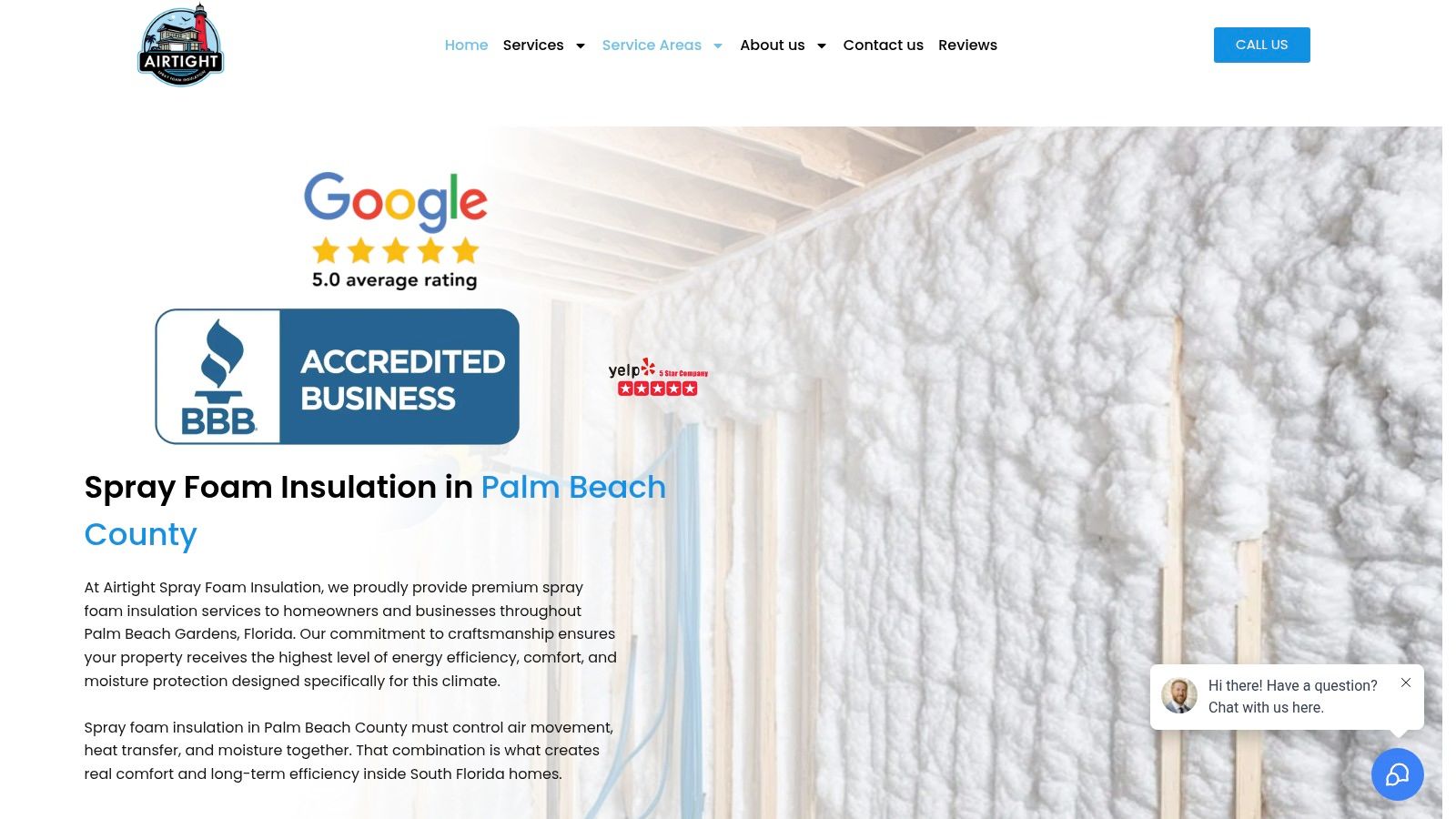
Faced batt insulation can slow vapor diffusion. It does not air-seal the house. Spray foam handles insulation and air sealing together, which is exactly what many Florida homes are missing.
That changes the conversation from “Which side should the paper face?” to “How do we keep humid air from getting into the assembly in the first place?” That's the better question.
If you're comparing systems for walls, attics, or rooflines, this guide to the best spray foam insulation lays out where different foam types make sense.
I'm not going to pretend batt insulation has no role. It can still be a practical option for certain interior walls, budget-sensitive projects, and assemblies designed specifically for it. But in South Florida, I wouldn't treat traditional faced batts as the default answer for exterior envelopes.
Here's why spray foam often wins on real jobs:
A short visual helps if you want to see how foam behaves in actual applications.
If you're insulating a South Florida attic, roof deck, exterior wall, garage, or metal building and your main goals are comfort, humidity control, and a tighter home, spray foam is usually the smarter move. It addresses the weak point that batt systems leave behind, which is uncontrolled air movement.
Faced insulation belongs in narrower situations than most stores and most DIY articles suggest. In this climate, that paper backing isn't automatically protection. Sometimes it's the detail that causes the problem.
If you want a professional recommendation for your house, attic, metal building, or new construction project, talk to Airtight Spray Foam Insulation. Their team works across South Florida and understands the moisture, humidity, and air-leakage problems that generic insulation advice misses.