Your AC seems to run all afternoon, yet the back bedroom still feels warmer than the rest of the house. The hallway ceiling feels slightly muggy. Maybe you've already replaced the HVAC system, added insulation, or lowered the thermostat, and the house still doesn't feel steady.
In Florida, that usually points to a building envelope problem, not just an equipment problem. Attic air sealing is often the missing step. It deals with the small openings that let cooled indoor air escape upward while humid attic air, dust, and pollutants find their way into the house.
That matters everywhere, but it matters more in South Florida. Heat is only part of the problem here. Moisture is the other half. If the attic and the living space are connected by dozens of hidden leaks, your home isn't just inefficient. It's harder to keep dry, comfortable, and clean.
Attic air sealing means closing the cracks, seams, and penetrations between your living space and the attic. These aren't dramatic holes you notice from the hallway. They're the everyday gaps around wiring, plumbing, light fixtures, wall tops, chases, and attic access points that let air move where it shouldn't.
A lot of homeowners assume insulation handles this. It doesn't. Insulation slows heat flow. It does not stop air from slipping through openings. A good way to think about it is this: insulation is the sweater, air sealing is the windbreaker. Without the windbreaker, moving air cuts right through the system.
In Florida homes, I'd put it even more bluntly. Trying to insulate an unsealed attic floor is like patching the cushions on a boat while water still pours in through the hull. Until the leaks are closed, you're asking your AC and your insulation to fight an avoidable battle.
For a quick primer on the concept itself, this overview of what air sealing is gives the basic building-science picture.
Cool air doesn't just sit politely in your rooms. Pressure differences, duct leakage, wind, and the natural tendency of air to move toward easier pathways all work against you. The attic becomes a pressure relief zone. If the ceiling plane has gaps, conditioned air leaves the house and the system has to replace it.
That's why some homes still feel uneven after expensive upgrades. The equipment may be fine. The enclosure isn't.
Practical rule: Seal first, then judge the insulation and HVAC. Otherwise you're measuring performance through a leaky lid.
A well-sealed attic floor helps the whole house behave more predictably. Rooms stay closer to thermostat setpoint. Dust infiltration often drops. Humidity swings become easier to manage because outdoor air and attic air aren't slipping in through bypasses all day.
That's the part standard advice often misses in Florida. Attic air sealing isn't only about reducing heat gain. It's about controlling unwanted air movement so moisture doesn't ride into the house with it.
The cost of attic leaks shows up in three places: your utility bill, your comfort, and the condition of the air you breathe. In a humid climate, all three problems feed each other.
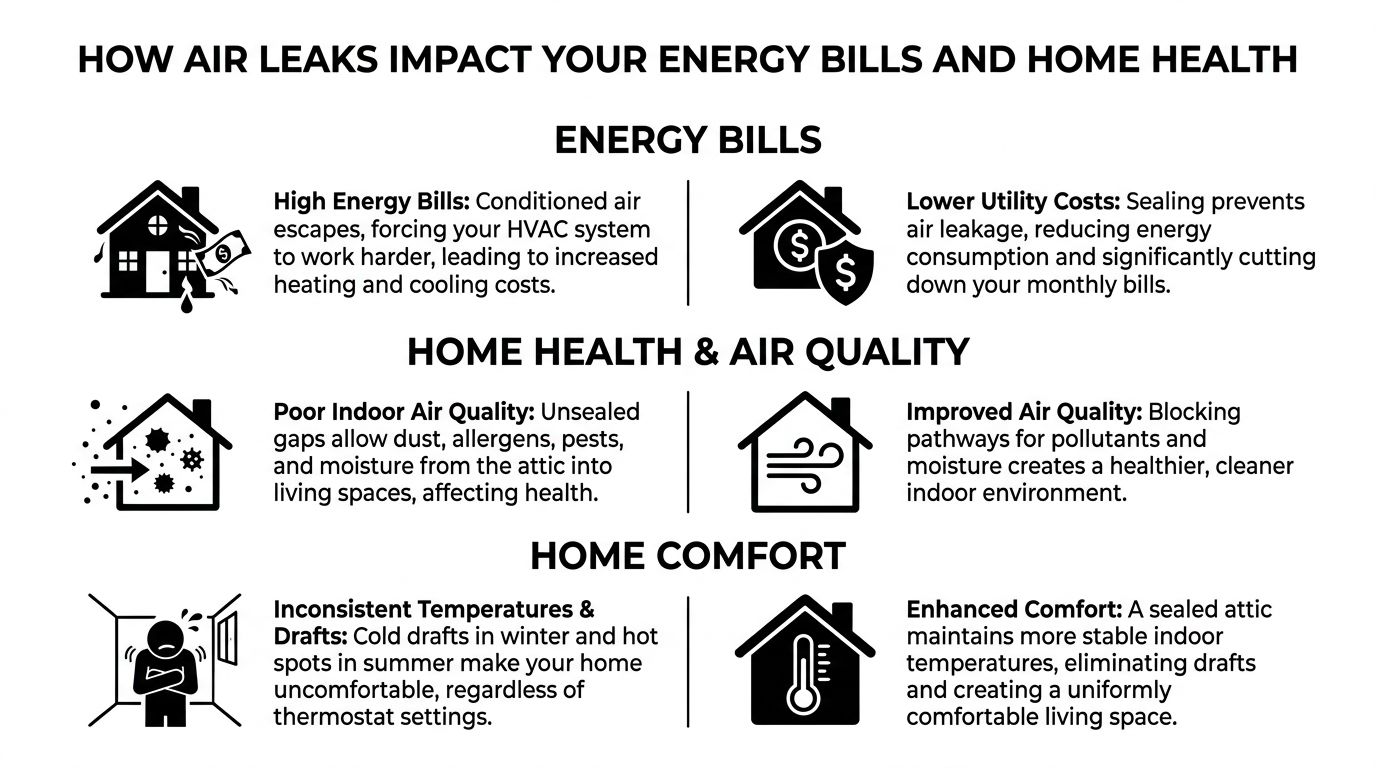
When conditioned air leaks into the attic, your HVAC system has to keep replacing it. That means longer run times and more wasted output. According to the U.S. Environmental Protection Agency, homeowners who air seal their homes and add insulation in attics can save an average of 15% on heating and cooling costs, which translates to about 11% of total annual energy costs through ENERGY STAR attic sealing and insulation guidance.
That figure matters, but the daily reality matters too. Even before you look at the bill, you feel it. The AC doesn't seem to get ahead. Late afternoon recovery takes longer. The home starts to feel sticky sooner if the system falls behind.
Many people describe attic leakage as “drafts,” but in Florida it often feels less like a cold draft and more like weak temperature control. One room stays warm. Another gets clammy. The thermostat says one thing, your body says another.
That happens because the house is no longer separating conditioned space from unconditioned space very well. Air sealing restores that boundary. Once that boundary improves, insulation can do its job instead of sitting over active leaks.
A house with attic leaks doesn't fail in one dramatic spot. It fails in dozens of small places at once.
Florida homes deserve special attention. Air leaks don't only move temperature. They move humidity, dust, insulation fibers, allergens, and attic air. When the house pulls from the attic through ceiling penetrations, that contamination path reaches bedrooms, hallways, closets, and return air pathways.
Moisture is the bigger concern. Humid air sneaking into the house can find cooler surfaces and contribute to condensation risk in hidden places. That's one reason some homes smell musty even when the AC seems to be working.
Good envelope work also pairs well with other efficiency maintenance. For example, clean windows can improve solar performance and daylighting, and this look at the benefits of energy-efficient window cleaning is worth reading if you're trying to tighten up your overall home-efficiency strategy.
Most attic leakage isn't random. It shows up in repeat locations. If you know where to look, you can inspect the attic like a technician instead of just scanning for “bad insulation.”
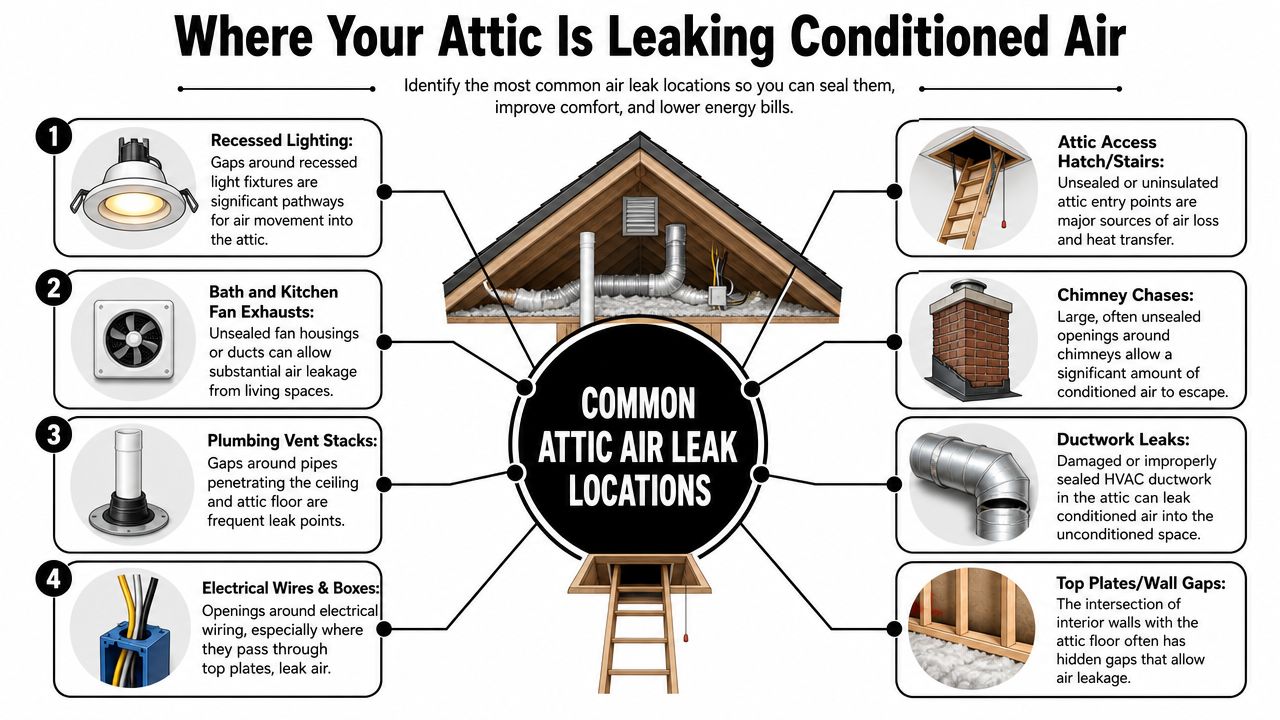
Start with the easy suspects, then work toward the hidden ones.
Attic access hatch or pull-down stairs
If the hatch doesn't close tightly or lacks weatherstripping, it acts like an open invitation between the house and the attic.
Plumbing penetrations
Vent stacks and pipe openings often have rough cutouts around them. Those gaps are classic bypasses.
Electrical penetrations and junctions
Wires that pass through framing leave small but important leak paths, especially where multiple cables run through top plates.
Recessed lights and fan housings
Older can lights and fan boxes often leak more than homeowners expect. Even when the fixture looks finished from below, the attic side can be wide open.
Chases and dropped soffits
Areas above cabinets, tub enclosures, and interior soffits can conceal larger openings that connect wall cavities to the attic.
Duct boots and register connections
The boot-to-drywall joint is a frequent leak point, and duct problems in the attic can worsen pressure imbalances.
If I had to choose one area to inspect first in a typical attic, it would be the top plate to attic drywall junction, where the tops of interior walls meet the attic floor. The Insulation Institute's air sealing guidance notes that sealing this location can reduce leakage by up to 1.6 ACH50, which is greater than any other single sealing location.
That makes sense in the field. Those wall lines run all through the house, and the gaps can be continuous. They're often buried under insulation, easy to miss, and highly connected to the living space below.
Field note: If the top plates are open, the house is leaking along the bones of the structure, not just around a few penetrations.
They don't always look dramatic. You might see dark dust tracing around a penetration. You might spot insulation that looks oddly disturbed around a wall line. You might feel temperature variation near a hallway ceiling even though the nearest supply register seems fine.
A careful inspection usually reveals a pattern, not a single culprit. That's why piecemeal fixes often disappoint. Homeowners seal one obvious hole, but the larger network of bypasses keeps moving air.
Not every attic leak needs the same material. Using the wrong product is one of the biggest reasons DIY sealing jobs fail early. Some gaps are narrow and stable. Others are irregular, deep, hard to access, or exposed to movement and moisture.
In Florida, material choice matters even more because a weak seal doesn't just lose efficiency. It can allow humid air to keep moving through the assembly.
Caulk works best on small, stable seams. Think narrow cracks around stationary materials where the joint is visible and clean. It's a useful product, but it has limits. It doesn't bridge larger voids well, and it's not ideal for jagged attic bypasses with uneven edges.
One-component canned foam is common for medium gaps and irregular penetrations. It's handy around plumbing and wiring openings. For targeted repair work, it can be effective. The downside is that success depends heavily on prep, product choice, and restraint. Too much expansion can create a mess or push materials apart.
Rigid foam board is useful when you have a larger opening that needs to be blocked first, then sealed at the edges. It's a good detail material for certain chases and vertical transitions. It's not quick, and it usually requires cutting, fitting, fastening, and edge sealing to work properly.
Professional spray foam is different because it creates a more continuous seal across uneven surfaces. Instead of treating dozens of gaps as isolated repairs, it can form a monolithic air barrier over complicated geometry.
| Method | Best For | Durability | Air & Moisture Barrier |
|---|---|---|---|
| Caulk | Small, visible cracks and seams | Good in the right joint | Air barrier for small gaps, limited moisture control in larger or uneven areas |
| One-component canned foam | Medium penetrations around pipes and wires | Moderate to good, depends on installation | Better for irregular gaps, but still spot-treatment based |
| Rigid foam board with sealed edges | Larger openings and chase covers | Good when properly fitted | Strong barrier if seams are fully sealed |
| Two-component spray foam | Irregular surfaces, multiple leak paths, comprehensive attic sealing | High when professionally applied | Strong air barrier and strong moisture-control performance, especially valuable in humid climates |
Spray foam's biggest advantage is continuity. Attics are full of awkward transitions: framing intersections, rough cutouts, uneven substrates, hidden cavities. A product that expands and bonds across those shapes has a practical edge.
That's also why the open-cell versus closed-cell choice matters. They don't behave the same way, and the right selection depends on where the foam is going and what the assembly needs. If you're weighing that decision, this breakdown of open-cell vs. closed-cell foam is a useful starting point.
Not every attic needs foam in every location. But when the goal is a durable, whole-system air seal in a humid climate, spray foam is usually the most effective tool on the truck.
That doesn't mean caulk and canned foam have no place. They do. For a homeowner sealing a few accessible gaps, those products can be the right move. For a contractor handling isolated penetrations before an insulation top-off, they're part of the standard toolkit.
The trade-off is completeness. Spot sealing can help. Complete sealing changes how the house performs.
A homeowner can absolutely inspect an attic and seal minor leaks. The key is knowing where DIY work ends and where safety, access, or complexity make a professional job the smarter call.
Start with safety, not materials. Attics in Florida get brutally hot, the footing is limited, and electrical hazards are real.
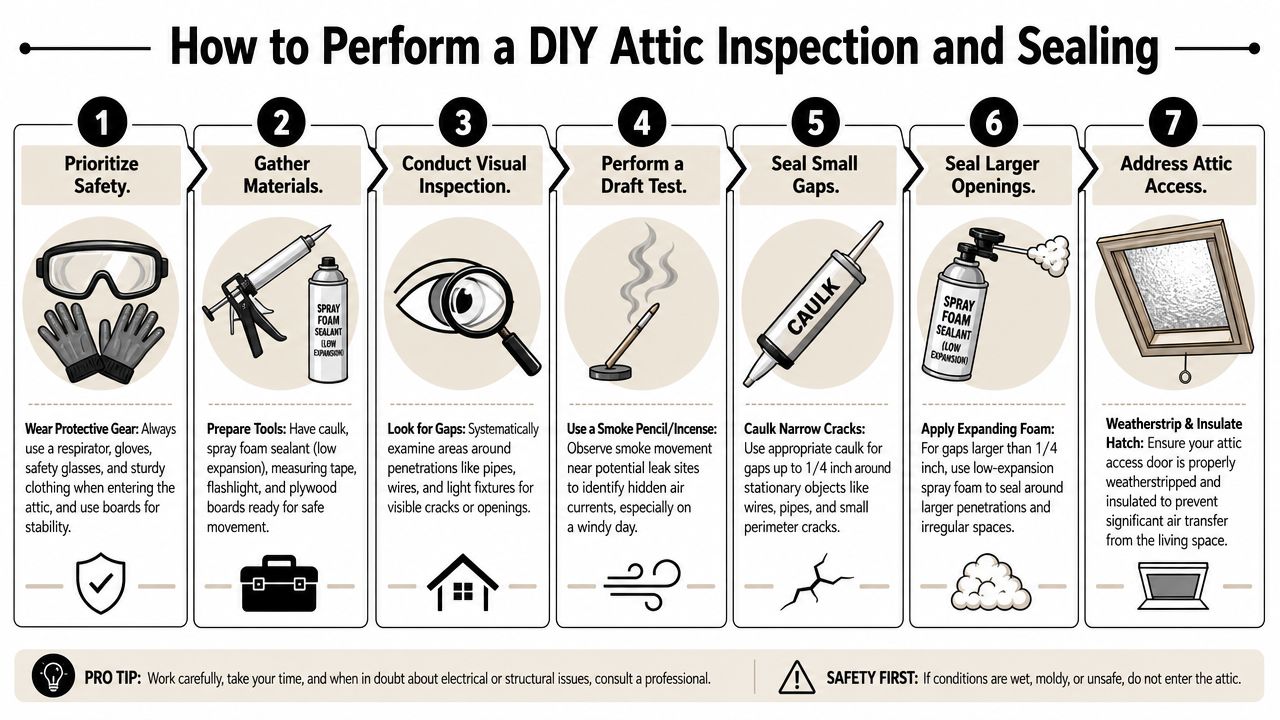
Use a respirator, gloves, safety glasses, long sleeves, and stable shoes. Bring a bright flashlight, a utility knife, measuring tape, caulk, low-expansion spray foam, and scrap plywood or boards to span framing where needed. Never step blindly on attic insulation because the drywall below won't support your weight.
Keep your body weight on framing or on boards placed across framing. Watch for wiring, recessed fixtures, and low roof nails. If the attic is tight, heavily insulated, or hard to move within, stop before you turn a repair project into a ceiling repair project.
Work in a sequence so you don't miss areas.
Check the attic access first
Look for missing weatherstripping, light around the hatch perimeter, and an uninsulated cover.
Trace every visible penetration
Follow plumbing stacks, wire bundles, fan housings, and duct boots. Shine the flashlight sideways across surfaces so gaps cast shadows.
Pull insulation back carefully
At wall lines and around penetrations, move insulation gently to expose the actual ceiling plane.
Use a smoke source when conditions allow
An incense stick or smoke pencil can reveal air movement near suspected leaks. It's a simple test, but it works best when there's enough pressure difference across the ceiling plane.
Mark areas before sealing
Painter's tape, a marker, or a quick photo can keep you organized.
A more thorough diagnostic approach often includes pressure testing. If you want to understand how pros quantify leakage before and after improvements, this explanation of what a blower door test is helps connect the dots.
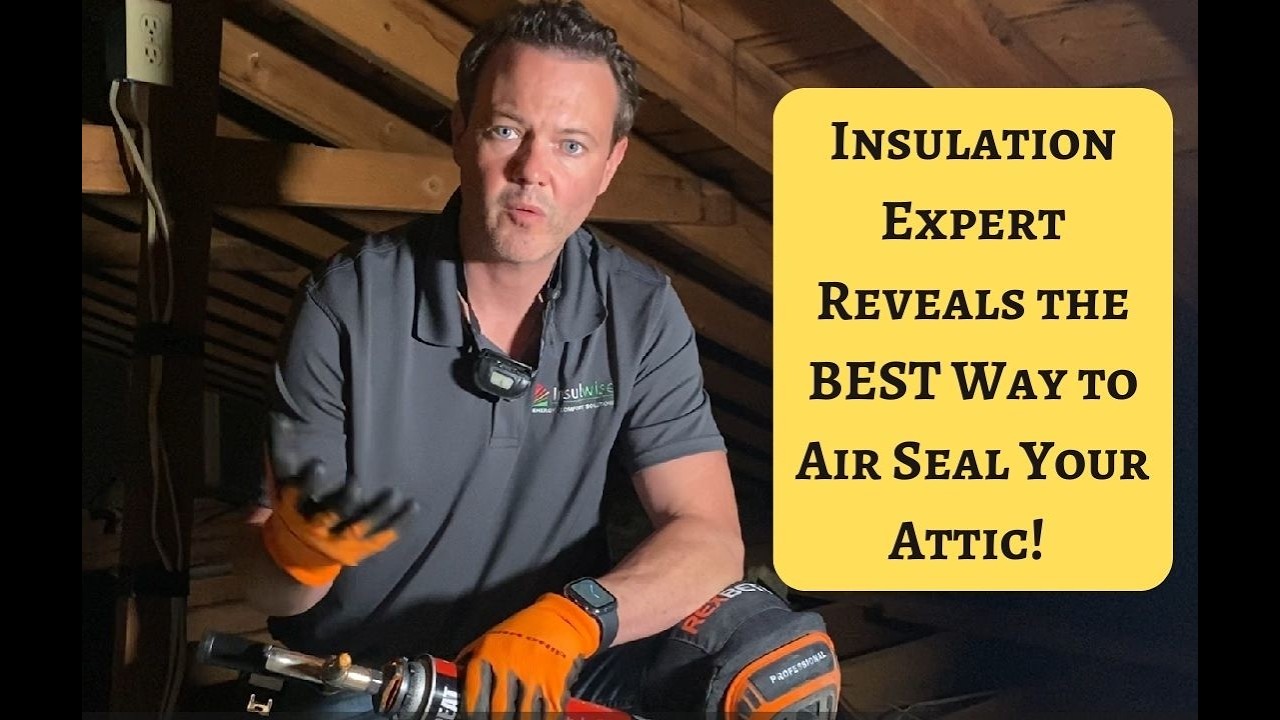
Here's a visual walkthrough before getting into the repair side:
Use caulk for narrow, stable cracks. Use low-expansion spray foam for larger or irregular openings around penetrations. Don't bury active heat sources with the wrong material, and don't seal around components that require specific clearances unless you know the rating and code requirements.
A simple workflow looks like this:
Expose the surface
Move insulation aside and clean loose dust so the sealant can adhere.
Match the product to the gap
Small seam, use caulk. Irregular opening, use foam. Larger chase, block it first, then seal the perimeter.
Let the seal fully set
Don't rush insulation back over a fresh application if the product needs curing time.
Restore insulation coverage
Put the insulation back in place evenly after the air seal is complete.
Safety reminder: DIY attic sealing is for accessible, low-risk leak points. If the attic has extensive bypasses, difficult access, combustion concerns, or major moisture signs, bring in a qualified professional.
That isn't about protecting the trade. It's about respecting the detail work. Good attic air sealing is slower and more meticulous than is commonly expected.
Professional attic air sealing isn't priced by square footage alone. Key variables are access, layout, the number of penetrations, how buried the leaks are under existing insulation, and whether the project includes insulation upgrades at the same time.
That's why one attic can be straightforward and another can turn into a detail-heavy job. Tight truss spaces, multiple soffit chases, complicated mechanical runs, and hard-to-reach wall lines all add labor. Homes with older recessed lights, messy prior work, or poorly sealed duct boots also take more time to address correctly.

The financial case is stronger than most homeowners expect. The U.S. Department of Energy reporting summarized in this attic insulation cost versus savings review states that proper attic insulation, which requires effective air sealing to work correctly, typically reduces heating and cooling costs by 15% to 25%. The same source notes that air sealing alone can save an average home up to $200 per year.
For combined attic air sealing and insulation work, that same source outlines estimated annual savings of $180 to $240 at a 15% reduction, $240 to $320 at a 20% reduction, and $300 to $400 at a 25% reduction, with a typical payback period of 4 to 8 years.
Those savings are only part of the return. Professional air sealing also supports more stable indoor temperatures, helps insulation perform as intended, and reduces the wear that comes from an HVAC system running longer to overcome leakage.
For Florida homeowners, I'd add one more value point that doesn't fit neatly on a spreadsheet. Better moisture control lowers the odds of the comfort complaints and musty conditions that make a house feel older than it is.
Usually, no. The problem in most homes isn't a lack of ventilation. It's the wrong kind of ventilation. Uncontrolled leakage through the attic is not healthy fresh air. It's random air movement that brings heat, humidity, dust, and pollutants where you don't want them. Good air sealing reduces unwanted leakage. If a home needs fresh-air ventilation, that should be handled in a controlled way.
Yes. Insulation and air sealing do different jobs. Insulation slows heat transfer. It does not stop air from moving through cracks, penetrations, and seams. If the attic floor leaks, insulation is working with a handicap from day one.
Expect a real inspection, not a quick glance from the attic hatch. A good contractor should identify key leakage sites, explain what can be sealed, note any safety or access concerns, and provide a clear scope of work. The job itself should include preparation, protection of the home, careful sealing at targeted locations, and a final walkthrough so you can see what was done and ask questions.
The best experience feels methodical. You should understand the problem, the solution, and what kind of performance improvement to reasonably expect.
If your home in Jupiter, Palm Beach Gardens, West Palm Beach, Wellington, or Stuart feels humid, uneven, or expensive to cool, Airtight Spray Foam Insulation can help you evaluate whether attic air sealing, spray foam, or a full attic upgrade is the right next step. Their team specializes in South Florida conditions, where stopping air leakage also means controlling moisture, improving comfort, and helping your insulation do its job.