
If your garage in South Florida feels like a second attic, you're not imagining it. By midday, the air gets heavy, the concrete sweats, cardboard boxes soften, tools start spotting with rust, and anything stored near the door seems to absorb that damp, stale smell. A lot of homeowners in Jupiter, Palm Beach Gardens, West Palm Beach, Wellington, and Stuart run into the same problem. The garage is technically enclosed, but it still behaves like an outdoor space.
That becomes more than an annoyance when the garage shares walls or ceilings with the house. A hot, humid garage pushes heat into adjacent rooms, makes bonus rooms above it harder to cool, and keeps your HVAC system working longer than it should. If you use the garage as a gym, workshop, laundry area, or overflow storage, the discomfort becomes impossible to ignore.
Garage spray foam solves that problem differently than traditional insulation. It doesn't just slow heat transfer. It seals the leaks that let South Florida air keep pouring in.
A garage in this climate usually fails in three places at once. Heat comes through the walls and roofline. Humid air slips through gaps around framing, penetrations, and transitions. Then the garage door leaks enough air that the whole space never settles down.
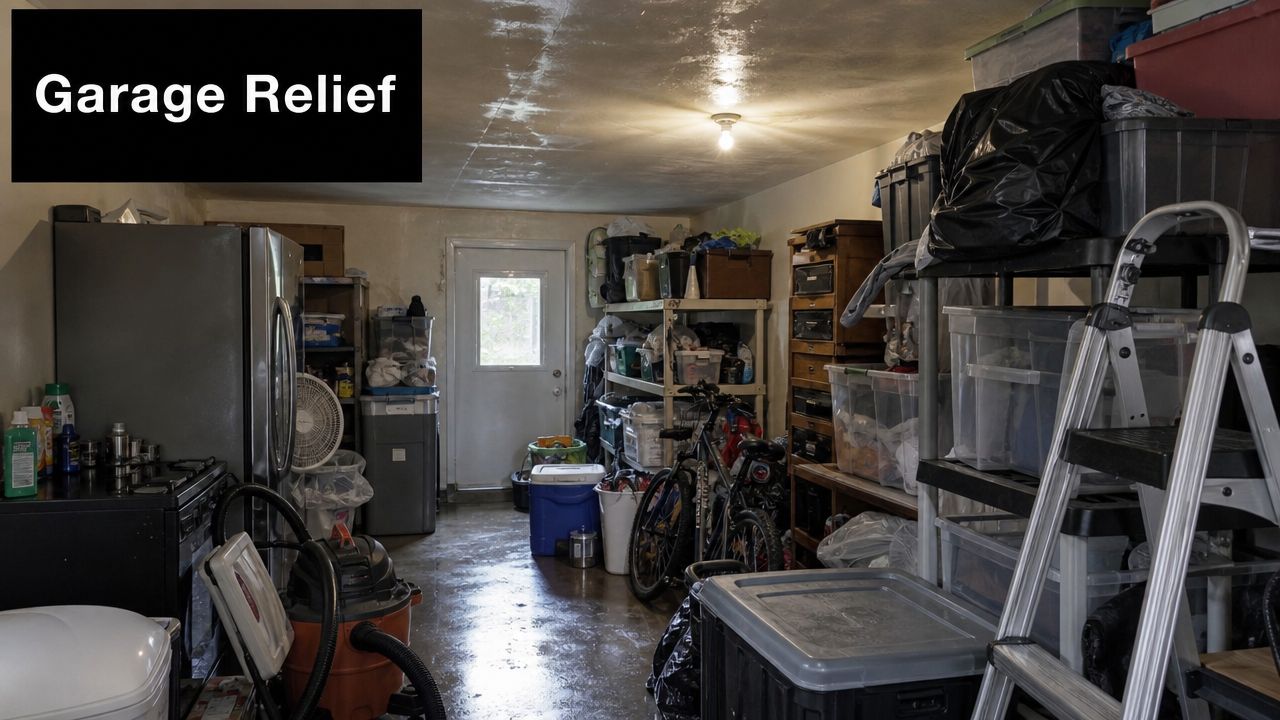
That's why generic insulation advice often falls short here. In a dry climate, you can sometimes get away with treating the garage like simple storage. In South Florida, the primary enemy is hot air loaded with moisture. Once that air gets into wall cavities and around stored belongings, you start dealing with musty smells, condensation, and rooms next to the garage that never feel quite right.
Spray foam turns the garage envelope into a controlled shell instead of a leaky buffer zone. That matters because air leakage accounts for 25% to 40% of heating and cooling energy consumption in residential buildings, according to Rmax on garage insulation performance. In practical terms, if your garage is attached, every unsealed crack can affect comfort beyond the garage itself.
A properly sealed garage can help with:
If you're planning a bigger remodel, this guide on an ultimate garage transformation project is useful for thinking through how insulation fits into the overall space.
Don't start with drywall colors or storage systems. Start with the building shell. If the shell leaks, everything you add after that fights the environment instead of improving it.
Practical rule: In South Florida, garage comfort starts with air control and moisture control first. Everything else comes after that.
For homeowners comparing insulation options, a focused look at how to insulate a garage helps clarify where the biggest gains usually come from.
Spray foam works more like a site-applied seal than a fluffy insulation blanket. Two liquid components mix at the spray gun, hit the surface, and expand into place. It acts as a two-part material that becomes part of the wall or ceiling instead of something loosely tucked between framing members.
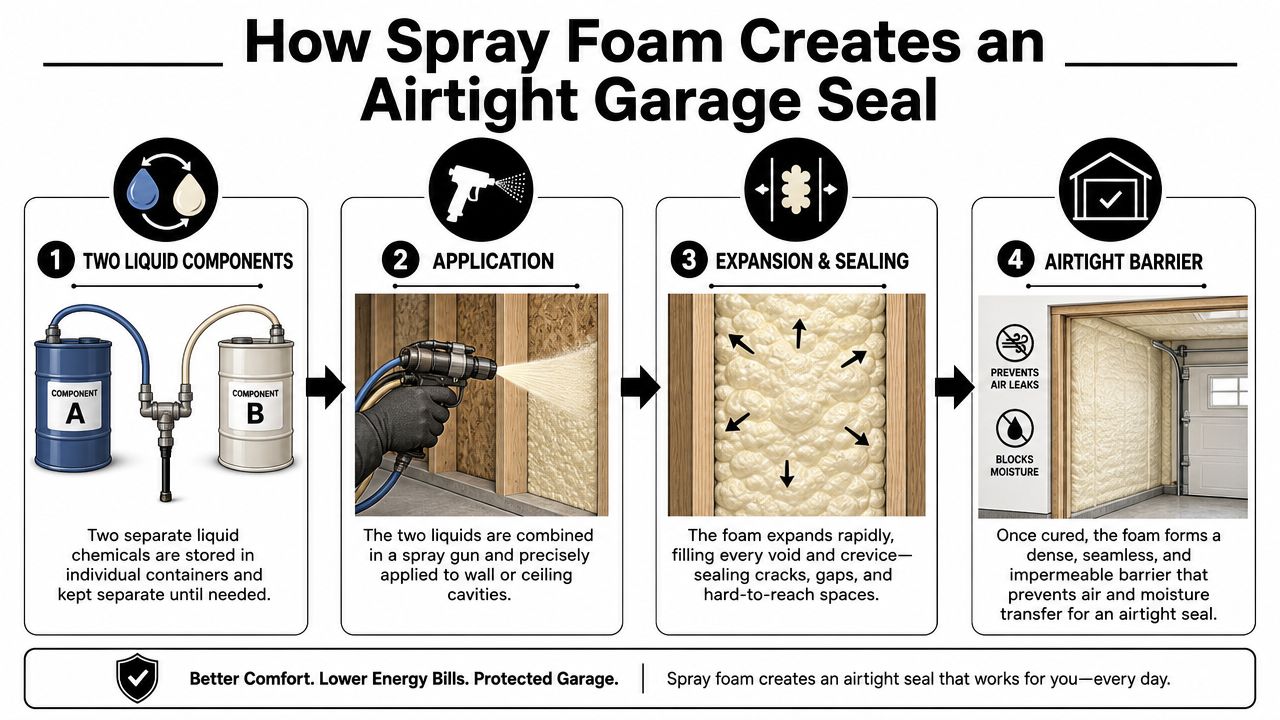
That expansion is what makes garage spray foam so effective in real-world conditions. The foam fills cracks, irregular voids, wiring penetrations, and framing transitions that batt insulation can't close off. In a South Florida garage, those little gaps are where humid air keeps sneaking in.
Fiberglass can slow heat transfer, but it doesn't stop moving air by itself. If the garage has leaks around top plates, bottom plates, outlet boxes, or framing joints, air still passes through the assembly. In a humid climate, that means the insulation may be sitting in a system that never really gets under control.
Spray foam behaves differently because it creates a continuous air and moisture barrier when applied, which is why many homeowners see it as more than just another insulation product. It becomes part of the assembly.
Here's the simple difference:
A good spray foam job leaves you with a garage shell that feels more stable. Temperatures don't swing as wildly. Drafts drop off. The space stops feeling clammy all the time. That's the result homeowners are usually after, especially when the garage doubles as a work area.
The biggest improvement most people notice isn't the wall itself. It's that the garage stops acting like an outdoor room.
This is the same principle behind air sealing in a home envelope. The material matters, but the seal matters more.
In garage projects, the trouble spots are usually predictable:
When those areas are sealed correctly, the garage becomes much easier to manage. When they're missed, the project may look finished while the comfort problems stay in place.
South Florida homeowners usually ask the same question once they decide on spray foam. Which type belongs in a garage, open-cell or closed-cell?
For this climate, the answer is usually straightforward. Closed-cell foam is the better fit for most garages because moisture control matters as much as temperature control here.
Open-cell foam is lighter and softer. Closed-cell foam is denser and more rigid. That density changes performance in ways that matter in a hot, humid garage.
According to Why Spray Foam on R-values and performance, closed-cell spray foam delivers an R-value of R-5.6 to R-8.0 per inch, with medium-density formulations achieving R-5.6 to R-6.0 per inch, and that same density creates a Class II vapor retarder that helps prevent moisture migration.
That's the key point for South Florida. A garage isn't just dealing with heat. It's dealing with moisture trying to move through the assembly.
| Feature | Open-Cell Foam | Closed-Cell Foam |
|---|---|---|
| Density | Softer, lighter material | Denser, more rigid material |
| Moisture behavior | More vulnerable in humid garage conditions | Better at limiting moisture migration |
| R-value per inch | Lower than closed-cell | R-5.6 to R-8.0 per inch |
| Air sealing thickness in open wall cavities | About 3 inches for a complete air seal | 2 to 3 inches for a complete air seal |
| Best fit for South Florida garages | Limited cases | Usually the stronger choice |
If a garage is attached, stores valuable equipment, or sits under brutal afternoon sun, closed-cell usually makes more sense. It gives you more thermal resistance per inch and does a better job resisting moisture movement. That's a practical advantage when the goal is a garage that stays dry, stable, and easier to cool.
Open-cell still has uses in some assemblies, but garages are less forgiving than other parts of the house. If outside humidity keeps pressing on the structure, a material that can better resist that pressure gives you more margin for error.
Field reality: In South Florida, a garage insulation choice that looks acceptable on paper can fail in practice if it doesn't control moisture well.
A lot of people compare foam types based only on upfront price or stated R-value. That misses the bigger issue. Garage performance depends on the whole assembly. If the material fits the cavity but doesn't fit the climate, you can still end up with a garage that smells damp and feels unstable.
Closed-cell also adds rigidity by bonding to surfaces. In garages used as workshops or hobby spaces, homeowners often appreciate the added sound dampening and the more solid feel of the assembly after installation.
If you want a side-by-side breakdown before making the call, this comparison of open-cell vs. closed-cell foam gives a useful overview.
Choose closed-cell when your priorities are:
Open-cell becomes harder to justify when the garage already has moisture issues, the walls face direct weather exposure, or you want the strongest possible barrier in limited space.
Open a South Florida garage in August and the cost question gets real fast. The space feels like a heat sink, the air feels wet, and anything stored out there takes the hit. Homeowners want to know what spray foam costs, but they also want to know whether it fixes a problem they deal with every day.
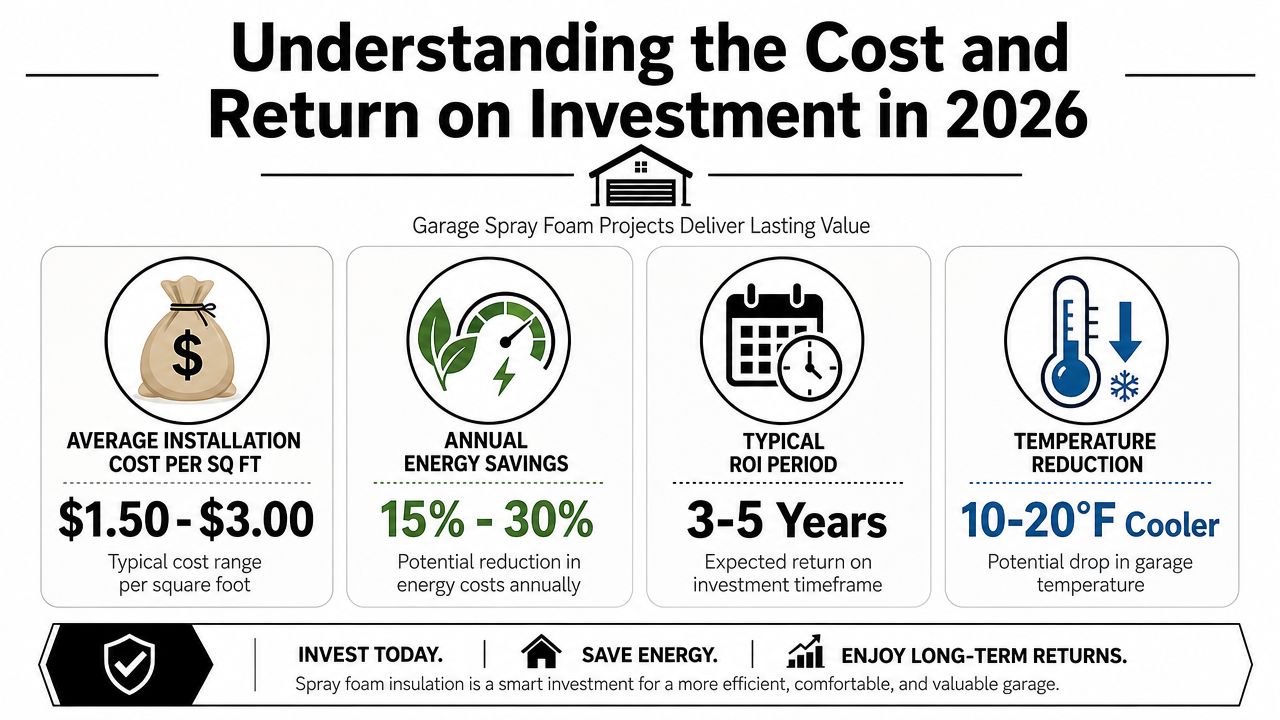
Based on 2026 garage spray foam pricing from OneClickDIY, insulating a standard two-car garage of about 20×20 feet typically falls between $2,000 and $6,000, with overall pricing ranging from $1.00 to $4.50 per square foot depending on material choice and labor complexity.
Price moves for practical reasons, not random ones. A clean, open garage with easy access is one number. A garage with packed storage, awkward framing, older wall conditions, or extra prep work costs more because the crew spends more time getting the job right.
The main cost drivers are straightforward:
That upfront number can feel high if you compare it to batt insulation alone. In South Florida, that comparison misses the point. A garage here is dealing with outdoor heat, high dew points, hot rooflines, and air leakage that keeps feeding the problem. Generic insulation advice from drier climates does not hold up well in Miami-Dade, Broward, or Palm Beach.
Return on investment shows up in a few places.
The first is comfort in adjacent rooms. If the garage shares walls or ceilings with conditioned space, reducing heat and moisture transfer can make those rooms easier to cool and less prone to temperature swings. Homeowners usually notice that before they notice a dramatic utility-bill payback.
The second is protection. Tools rust less. Cardboard and stored fabrics stay in better shape. Refrigerators and freezers in the garage do not have to fight the same level of ambient heat all day. If you use the garage as a gym, workshop, laundry area, or hobby space, the room becomes more usable for more months of the year.
The third is equipment runtime. In many homes, the air-conditioning system works harder because the garage keeps loading heat into shared surfaces. Spray foam can reduce that burden, but the savings vary by layout, garage door condition, and how air-connected the garage is to the rest of the house. That is why I avoid promising a neat payback timeline on every job.
A better way to judge the return is to ask two questions. Does the garage currently make nearby rooms hotter, more humid, or harder to keep comfortable? Does the space hold items you would rather not expose to South Florida moisture and heat?
If the answer is yes, the project usually has real value beyond the monthly power bill.
There is also a whole-house angle. A garage under living space is one common weak point, but it is not the only one. Homeowners comparing multiple upgrades can get useful context from this article on insulating your floors, especially when the room above the garage is part of the comfort problem.
A South Florida garage can look dry and still be holding enough moisture to ruin a spray foam job. That is why a good installation starts with inspection, moisture awareness, and prep, not with the spray gun.

The contractor should check more than wall size. In this climate, key questions are whether the framing is dry enough, where humid air is getting in, what the garage is used for, and whether there is conditioned space beside or above it. A garage that only shelters cars is one thing. A garage with a freezer, tools, stored boxes, or a bedroom above it calls for a tighter plan.
Homeowners usually need to clear out movable items, remove vehicles, and leave access around the walls and ceiling areas being sprayed. Crews should handle masking, floor protection, and overspray control, but an open workspace always leads to a cleaner result.
Spray foam does not forgive wet surfaces or bad humidity control. In open wall cavities, closed-cell foam requires 2 to 3 inches, and the substrate must be dry with ambient relative humidity under 80% for proper curing and performance, based on technical guidance in this garage spray foam video reference.
That matters more in South Florida than in a drier market. Concrete block, framing, and garage slab edges can all hold moisture longer than a homeowner expects, especially after rain or during a humid morning. If the crew sprays anyway, adhesion problems, shrinkage, and uneven curing can show up later.
Good installers wait for the right conditions or adjust the work plan. They do not force the job just to stay on schedule.
Installer mindset: If the substrate is not ready, spraying anyway creates expensive repairs.
Airtight Spray Foam Insulation handles garage applications in South Florida with both open-cell and closed-cell systems, along with the prep and walkthrough those jobs require.
Professional crews set up proportioning equipment, protect adjacent surfaces, and spray in controlled lifts. They are watching yield, surface temperature, expansion, and adhesion as they work. In a hot garage, that control matters because foam can react differently from one wall to the next depending on sun exposure and moisture load.
A typical sequence looks like this:
Masking and protection
Floors, doors, appliances, mechanicals, and finished surfaces are covered to control overspray.
Environmental check
The installer checks temperature, humidity, and substrate dryness before spraying.
Application in lifts
Foam is applied in stages so it expands and cures properly instead of overheating or building unevenly.
Trimming, inspection, and cleanup
Excess foam is cut back where needed, missed spots are corrected, and the site is cleaned before the final walkthrough.
Here's a useful visual overview of a spray foam job in action:

By the end, the foam should be consistent, well-adhered, and properly trimmed where finishes will go back. Gaps around common leak points should be addressed, not skipped because they were awkward to reach.
Homeowners should also expect a walkthrough. A professional crew explains what was sprayed, what was not, how long the area needs before re-entry or follow-on work, and whether any next steps are needed before drywall. In a garage, that communication matters because performance problems usually start at the edges, not in the middle of an easy wall cavity.
The process is straightforward. The quality comes from prep, climate control, and disciplined application.
DIY kits look attractive because the material cost is lower. According to the same 2026 pricing reference already discussed, DIY kits can bring cost down to $0.50 to $2.50 per square foot by removing labor. On paper, that sounds like a smart shortcut.
In a South Florida garage, it often isn't.
Garage spray foam only works when the mix, surface conditions, and coverage are right. Most DIY problems come from one of three issues:
A garage can look insulated and still perform poorly if the seal is incomplete. That's the part many homeowners don't catch until the garage still feels sticky weeks later.
With a critical space like a garage, a weak install can do more than disappoint. It can trap moisture where you don't want it, leave vulnerable transitions untouched, and create a patchwork result that's hard to fix cleanly after finishes go in.
Professional crews bring better equipment, controlled application methods, and a repeatable process. They also know where garages usually fail. Top plates, corner transitions, penetrations, and irregular framing don't get solved by guesswork.
A DIY kit can fill a cavity. It can't replace installer judgment.
South Florida is not a forgiving place for half-finished air sealing. If your goal is to lower heat gain, control moisture, and make the garage usable, professional installation gives you a far better chance of getting the result you're paying for.
That doesn't mean every contractor is equal. It means you should ask direct questions about foam type, prep, target thickness, humidity conditions, and how the crew handles missed areas and cleanup. The right contractor will answer those questions plainly.
If your garage is hot, damp, and wasting conditioned air from the rest of the house, fixing the shell is the right first move. Done correctly, garage spray foam changes how the space feels every day.
If you want a professional assessment of your garage in Jupiter, Palm Beach Gardens, West Palm Beach, Wellington, or Stuart, Airtight Spray Foam Insulation can provide a no-obligation quote and explain whether closed-cell spray foam makes sense for your walls, ceiling, and garage door based on your home's layout and moisture exposure.