Open-cell spray foam is typically R-3.5 to R-3.8 per inch, while closed-cell spray foam is typically R-6.0 to R-7.0 per inch. Those numbers matter, but in South Florida they're only the starting point, because insulation that doesn't control humid air often underperforms where it counts.
If your AC seems to run all day, certain rooms stay muggy, or the house never quite feels dry even when the thermostat says it should, you're dealing with more than a heat problem. In Jupiter, West Palm Beach, Wellington, and the rest of South Florida, the primary battle is against heat plus moisture plus air leakage.
That's why homeowners ask about spray foam insulation value per inch. They want to know how much performance they're getting in the space they have. That's the right question, especially in attics, walls, rim joists, garage ceilings, and retrofit jobs where every inch matters.
R-value is the standard measurement for how well insulation resists heat flow. Higher numbers mean more resistance. But a house isn't a lab test. In the field, performance depends on whether insulation stays in full contact with the surface, whether outside air can move through the assembly, and whether moisture is being managed correctly for this climate.
South Florida punishes weak assemblies fast. A decent-looking batt installation can leave gaps around wiring, top plates, soffits, and irregular framing. Humid air finds those openings. Once that happens, comfort drops, the AC works harder, and moisture problems start showing up in the places owners usually don't see until damage is already underway.
A lot of people start this conversation because something feels off in the house. The upstairs is hotter. The garage ceiling radiates heat. The bonus room feels sticky. Or the utility bill looks wrong for how carefully the thermostat is being managed.
In South Florida, those complaints usually trace back to the building envelope. Heat is part of it, but air movement is what makes many homes feel uncomfortable. When hot, damp outdoor air leaks into cavities or attic-adjacent spaces, the AC has to remove both heat and moisture. That's a tougher job than cooling dry air.
The phrase spray foam insulation value per inch matters because most assemblies have depth limits. A wall cavity only gives you so much room. A roofline detail may need insulation without changing framing. A retrofit often has to work with the cavity that already exists.
Open-cell and closed-cell foam solve that space problem differently:
Practical rule: In South Florida, the “right” foam isn't just the one with the higher number. It's the one that fits the assembly and controls humid air reliably.
Good insulation should do more than post a strong spec sheet. It should help a home feel more even from room to room, reduce that damp sensation, and support the air-conditioning system instead of forcing it to fight attic heat and moisture all day.
That's why experienced installers don't stop at material labels. They look at roof decks, wall depth, transitions, penetrations, and the moisture profile of the space. In this climate, details decide whether insulation performs the way the brochure says it should.
Think of R-value like the thermal resistance of clothing. A thin windbreaker helps a little. A heavy insulated coat slows heat movement much better. Insulation works the same way inside a wall or roof assembly. The higher the R-value, the harder it is for heat to move through that material.
What confuses many property owners is the phrase per inch. That part matters because it tells you how much thermal resistance you get for each inch of installed thickness. If two products fit in the same cavity, the one with the higher per-inch value can deliver more insulation in the same space.

Here are the numbers essential to know first:
| Foam type | Typical R-value per inch | What that means in practice |
|---|---|---|
| Open-cell spray foam | R-3.5 to R-3.8 per inch | Better when you have room for thickness and want air sealing with sound dampening |
| Closed-cell spray foam | R-6.0 to R-7.0 per inch | Better when cavity depth is limited and higher thermal resistance is needed |
Closed-cell foam is widely cited at R-6.0 to R-7.0 per inch, with many references clustering around R-6.5 per inch. At that rate, only 3.1 inches are needed to reach R-20, which is a practical reason builders use it in tight assemblies and retrofit situations where every inch counts, as outlined in this closed-cell spray foam R-value overview and supported by R-Value Associates.
If you're comparing insulation options, per-inch value helps answer a simple jobsite question: can this assembly hit the target without changing the framing or losing usable space? That's why designers and contractors often compare insulation by installed thickness, not just by product category.
For readers who want a cleaner explanation of how thermal resistance is measured against heat flow, Hutter Architects has a useful R-value vs U-value guide that breaks down the difference without overcomplicating it.
Higher R-value per inch doesn't automatically make one product “better” everywhere. It makes that product more efficient in limited depth.
The mistake is treating R-value like the whole story. It isn't. It's one performance metric. A useful one, but still just one. In hot, humid regions, insulation performance depends on whether the system also controls air leakage and moisture movement.
That's where generic guides usually stop too early. They explain the number, but not what the number does inside a South Florida home.
Most homes aren't choosing between open-cell and closed-cell alone. They're choosing between spray foam and more familiar materials like fiberglass batts or blown insulation. That comparison matters because the installed result is what affects comfort, not the label on the package.
Here's the quick visual comparison.
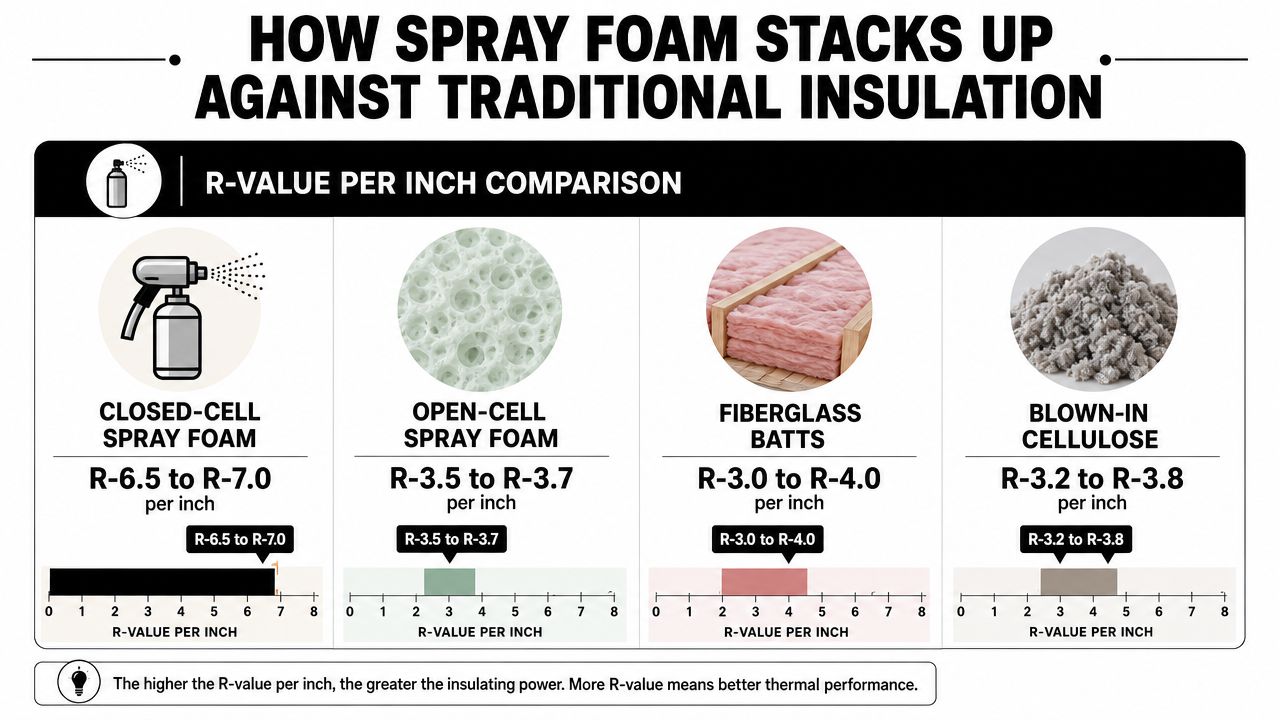
A standard 2×4 cavity filled with open-cell spray foam lands around R-13, while that same cavity filled with closed-cell foam can reach about R-20, according to Tiger Foam's breakdown of spray foam R-values. That's the practical reason contractors look hard at closed-cell when the cavity is shallow and the target is aggressive.
By contrast, fiberglass and cellulose can work well in the right assembly, but they don't conform and seal the way spray foam does. In a perfect install, traditional insulation can provide solid thermal resistance. In the field, perfection is rare. Gaps around penetrations, compression at wiring, and voids at corners are common.
| Insulation type | Typical use case | Air sealing behavior | Best fit |
|---|---|---|---|
| Closed-cell spray foam | Tight cavities, rim joists, rooflines, foundations | Strong air sealing when properly installed | High performance where depth is limited |
| Open-cell spray foam | Walls, roof decks, interior partitions | Strong air sealing when properly installed | Larger cavities and sound control |
| Fiberglass batts | Standard framed walls and ceilings | Needs separate air sealing strategy | Budget-driven projects with careful detailing |
| Cellulose | Attics and dense-pack wall applications | Can help fill irregular spaces, but still depends on assembly details | Retrofit and attic applications where design allows |
If you're comparing assemblies for resale or long-term property appeal, this roundup of energy-efficient features buyers might like from Pinnacle Property Media is useful because it connects insulation decisions to what occupants and buyers notice.
A lot of owners also look at open-cell specifically for larger cavity fills and sound control. This overview of open-cell expanding foam applications gives a solid picture of where that material makes sense.
The video below helps show how installers and homeowners typically compare these systems in real jobs.
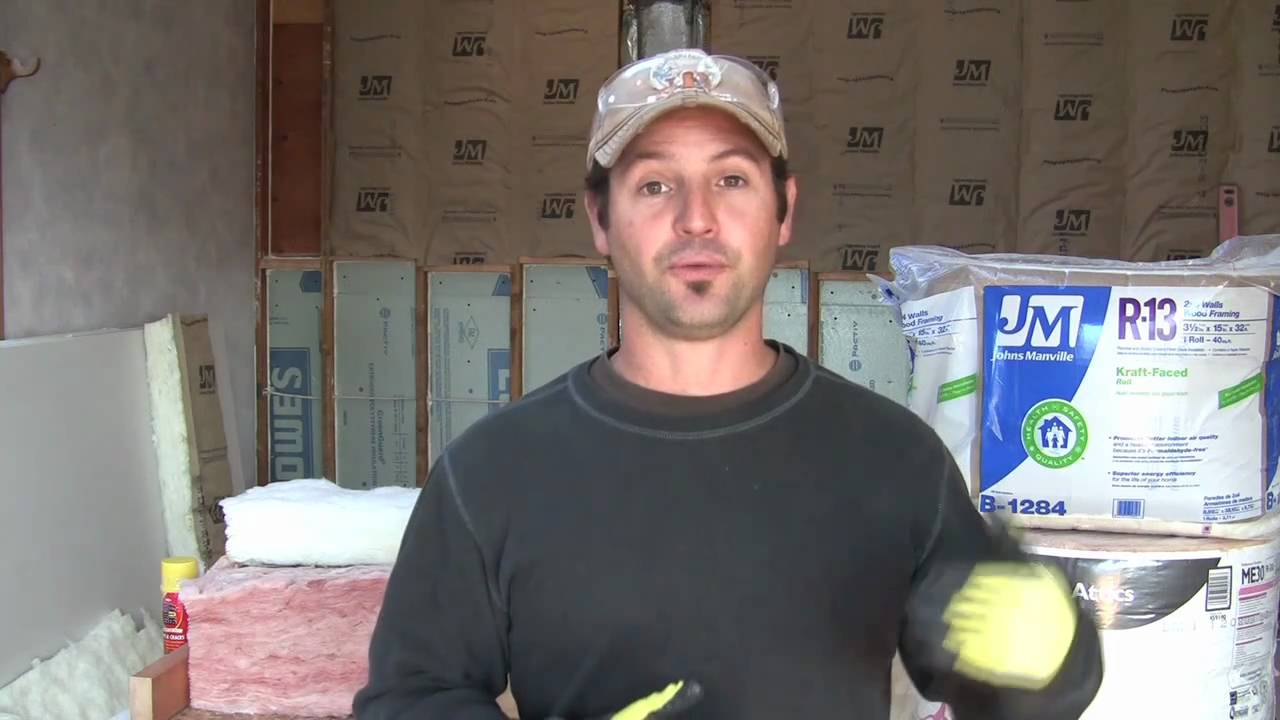
In South Florida, insulation effectiveness is viewed differently. A high R-value on paper won't carry the load if humid air keeps leaking into the house. Real performance comes from a combination of thermal resistance, air sealing, and moisture control.
That's why many generic insulation guides miss the point for this climate. They compare materials as if heat transfer is the only issue. It isn't. In coastal and humid markets, uncontrolled air movement often creates the bigger comfort problem.
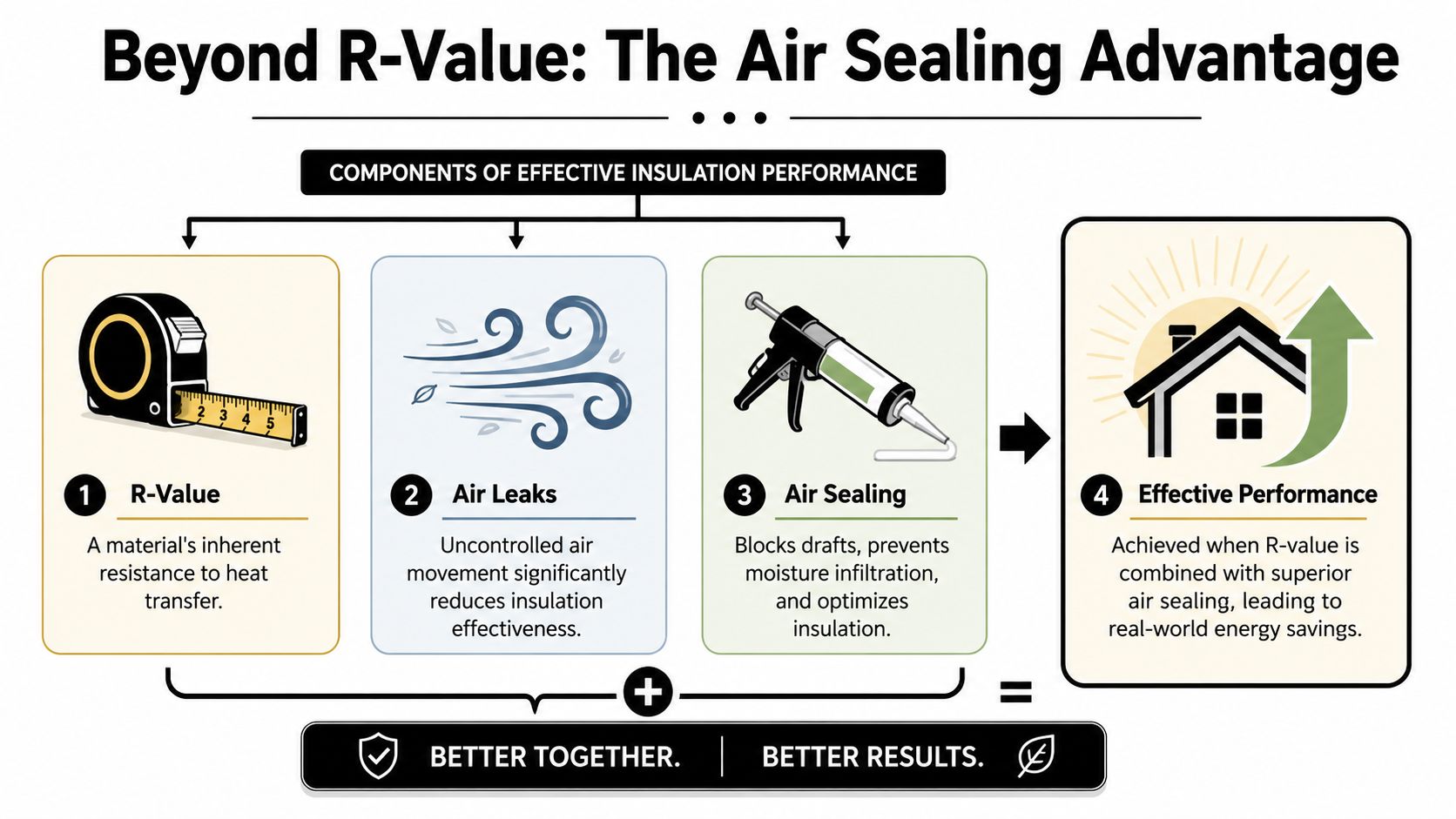
When foam expands and bonds to the substrate, it can close off the little leakage paths that make houses uncomfortable. That includes joints, cracks, penetrations, and awkward framing transitions that batt insulation often leaves exposed.
The result is more than just a better thermal number. It's a more controlled interior environment. Less humid infiltration can mean fewer clammy rooms, less strain on the AC system, and a lower chance of condensation forming inside vulnerable assemblies.
In South Florida, a lower-R assembly that seals air well can outperform a higher-R assembly that still leaks.
Both open-cell and closed-cell foam can serve as air barriers at sufficient thickness, but they don't handle vapor the same way. Johns Manville notes that only closed-cell foam can function as a vapor barrier at around 1.5 inches, while open-cell foam needs an additional vapor barrier to reduce condensation risk. That distinction matters in humid climates like South Florida, where moisture management can be just as important as thermal resistance, as explained in Johns Manville's open-cell vs closed-cell comparison.
That single difference changes where each product belongs. Open-cell can be a strong option where air sealing is the main goal and the assembly is designed correctly for drying potential. Closed-cell is often the safer call where the assembly faces higher moisture exposure or needs vapor control built into the insulation layer.
The weak points aren't theoretical. They're familiar:
If you want the short version of why contractors use foam in these problem areas, this guide on the benefits of spray foam insulation covers the practical advantages well.
Thickness should follow the assembly, not the sales pitch. South Florida homes need an insulation plan that respects roof design, wall depth, interior humidity, and the fact that cooling loads stay relevant most of the year.
That's why there isn't one universal answer. The right thickness in an attic isn't always the right thickness in an exterior wall or garage ceiling. Good recommendations start with what the foam has to do, not just how much can be sprayed.
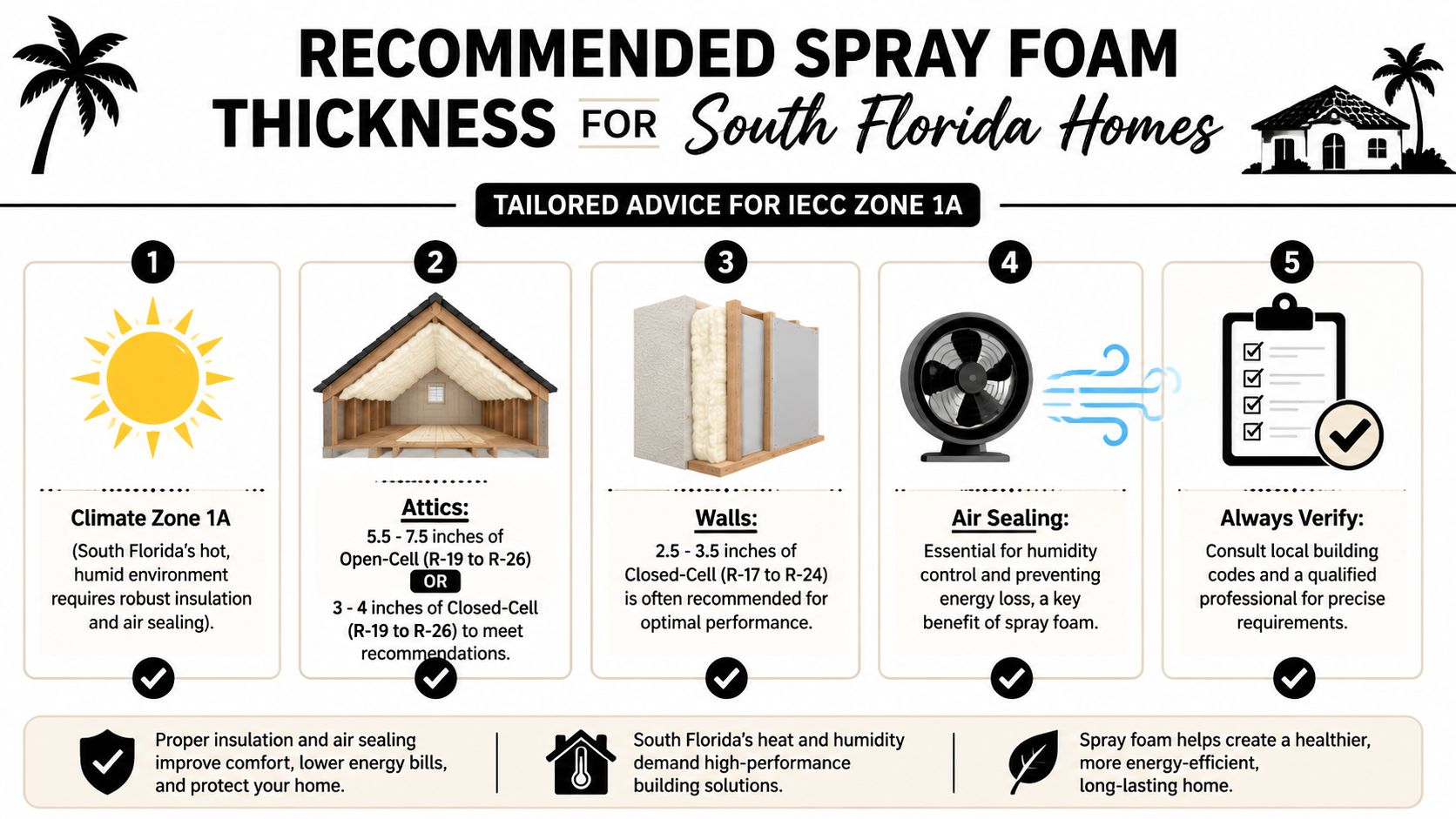
Open-cell makes the most sense when the cavity has enough depth to build the needed thermal layer and the assembly is designed to manage vapor correctly. In practice, that often means larger attic or roofline applications where the goal is broad air sealing plus usable insulation depth.
Its softer structure also makes it a common choice in places where sound dampening matters, such as interior partitions or spaces between living areas and garages. But in South Florida, the moisture profile of the assembly still has to be checked carefully before choosing it.
Closed-cell is the material many contractors turn to when depth is limited or the assembly is more exposed to moisture. That includes rooflines with shallow framing, rim joists, foundation-adjacent areas, and wall assemblies where every inch has to work hard.
Because it delivers more thermal resistance per inch and can also provide vapor control at the right thickness, it's often the more practical answer in the toughest South Florida details. The material costs more, but it solves more problems at once in the right location.
The best thickness is the one that matches the assembly's depth, leakage pattern, and moisture risk. More foam in the wrong place doesn't fix a bad design.
For homeowners and builders who want project-specific guidance, companies such as Airtight Spray Foam Insulation evaluate attics, walls, garages, metal buildings, and new construction assemblies based on those exact conditions rather than using one blanket recommendation for every house.
Spray foam isn't a casual weekend project. It's a chemical product that needs proper proportioning, surface prep, application technique, ventilation control, and personal protective equipment. If those pieces go wrong, the foam can miss the target on adhesion, coverage, or long-term performance.
That's why professional installation matters. The goal isn't just getting foam onto a surface. The goal is getting continuous coverage in the right places, at the right thickness, without voids or skipped transitions. In South Florida homes, a small miss at a roofline joint or wall penetration can undo a lot of the value the insulation is supposed to provide.
A trained crew evaluates more than square footage. They look at substrate condition, penetration density, difficult corners, recessed areas, and how the insulation layer connects to the rest of the air barrier. That's the difference between “insulated” and “properly insulated.”
The safety side matters too. Occupants shouldn't have to guess about application conditions, re-entry timing, or whether the material was installed correctly. A professional process protects the crew, the property, and the final result.
The upfront cost is usually higher than traditional insulation. That part is real. But the comparison shouldn't stop at install price alone.
A better way to look at it is through avoided waste and avoided damage:
Cheap insulation that leaves leakage paths behind can become expensive insulation once comfort complaints and moisture repairs start.
The headline numbers are simple. Open-cell spray foam gives less R-value per inch than closed-cell. Closed-cell gives more. But South Florida homes don't live on headline numbers alone.
What matters most in this climate is effective performance. That means the insulation has to resist heat, stop uncontrolled air movement, and support moisture management in the assembly where it's being installed. If one of those pieces is missing, the house won't feel as comfortable as the spec sheet suggests.
That's why the best insulation decisions are made by location, not by slogan. A roof deck may call for one approach. A wall cavity may call for another. A rim joist or foundation transition may need the higher per-inch value and vapor control of closed-cell. The right answer depends on the detail.
For homeowners, builders, and property managers in Jupiter, Palm Beach Gardens, West Palm Beach, Wellington, Stuart, and nearby areas, local experience matters. Christian Cates brings 25+ years of hands-on experience leading projects in the exact climate conditions that make South Florida insulation work challenging. That kind of field knowledge helps translate product specs into assemblies that stay comfortable, dry, and durable over time.
If you're comparing options, ask a simple question before looking at price alone: will this insulation just fill space, or will it control heat, air, and moisture in the part of the building that keeps giving me problems? That question usually leads to a much better decision.