
You're standing in the aisle with a can in your hand because the problem looks small. There's a draft around a window. A pipe penetration is pulling humid air into the house. You can feel warm, damp air near the baseboard or around a ceiling box, and the label says closed-cell spray foam.
For some jobs, that can is exactly the right tool.
For others, it's the start of an expensive mistake.
The biggest misunderstanding around canned spray foam closed cell is that people assume the word “closed-cell” means it performs like the professional foam used in walls, rooflines, and crawlspaces. It doesn't. A one-component can and a two-component insulation system belong in the same broad family, but they are not the same class of product. If you treat them like they are, you can end up with a messy repair, uneven sealing, trapped moisture, or a project that still leaks air after all the work.
A homeowner feels a hot draft under the sink where the water lines come through the wall. Another finds daylight around a dryer vent. Someone else notices the bedroom near the garage is always harder to cool. They go to the hardware store, see a can labeled closed-cell, and figure they can solve the whole issue in an hour.
That instinct isn't wrong. The trouble starts when the scope changes.
A can works well when you're dealing with a small, defined gap. It gets risky when you start thinking, “If it seals this crack, maybe I can use a few more cans to insulate that wall bay too.” That's where DIY projects start crossing from touch-up work into building envelope work. If you've already seen examples of foam used in the wrong place, many of the issues look a lot like the failures discussed in these attic spray foam insulation problems.
The Spray Polyurethane Foam Alliance says one-component aerosol cans are intended for small bead-type applications like sealing gaps, while larger insulation jobs require two-component systems. It also notes that many DIYers don't realize a can labeled closed-cell won't perform like the structural, high-R-value material used in walls and attics in professional work, as outlined by the Spray Polyurethane Foam Alliance guidance on SPF types.
Field reality: A can is a gap sealer first. It is not a substitute for a full insulation system.
That difference matters most in South Florida, where air leakage usually isn't just about comfort. Leaky joints pull in humidity. Humidity drives condensation risk. Condensation leads to stains, odors, and eventually material damage if the assembly is wrong.
Used correctly, canned foam can help with:
Used incorrectly, it becomes a fake shortcut. And shortcuts in insulation work rarely stay small.
Canned closed-cell foam is best understood as a one-component, moisture-curing foam sealant. You press the trigger, the material comes out, expands, reacts with moisture in the air, and hardens into a rigid filler. It's closer to a controlled patch than a whole-house insulation system.
That's why the can feels simple. It is simple. But simple doesn't mean interchangeable with professional spray foam.
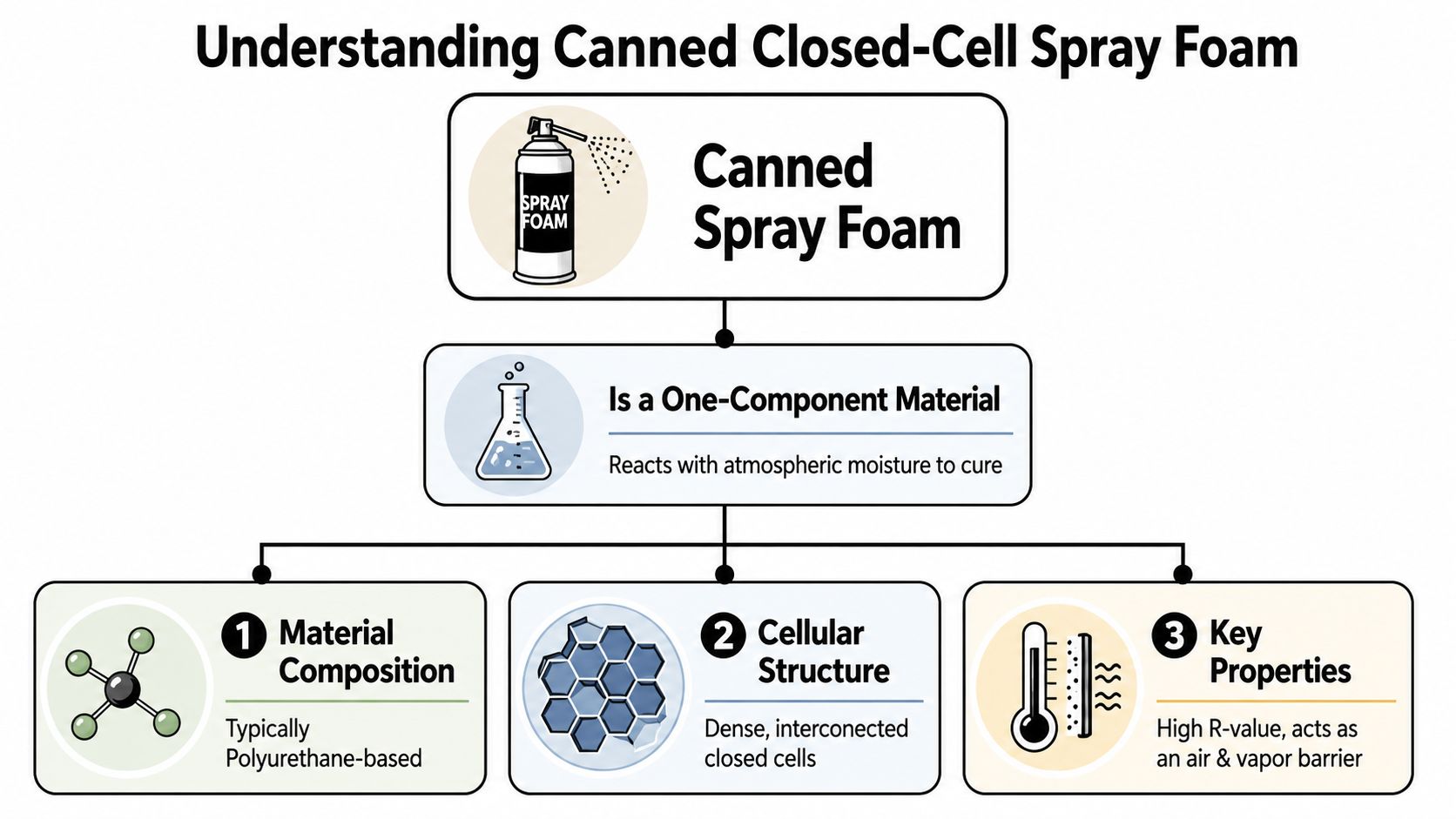
When insulation contractors talk about true closed-cell spray foam, they're talking about a much denser material category. Johns Manville notes that true closed-cell foam delivers about R-6 to R-7 per inch, can act as an air barrier at 1 inch, and can serve as a combined air and vapor barrier at 1.5 inches or more. It also has over 90% closed cells, which is why it resists moisture and feels much more rigid than open-cell foam, according to this closed-cell spray foam performance overview from Johns Manville.
If you're trying to understand what that means in an insulation assembly, this breakdown of closed-cell insulation R-value per inch is a useful reference point.
Think of canned foam like a self-expanding sealant that depends on conditions around it. Temperature matters. Surface condition matters. Humidity matters. Shake time matters. How deep the gap is matters.
That's one reason canned products can be inconsistent in larger voids. They aren't applied with the same mix control, pressure, and uniform coverage as a professional two-part system.
Here's the practical version:
The label tells you the product family. It doesn't tell you the job size it can handle well.
Homeowners often buy the can for an insulation problem when their real issue is an air leakage problem at a specific point, or a moisture management problem in a larger assembly. A can may solve the first one. It won't solve the second by itself.
That's the gap between marketing language and field performance. The can can absolutely earn its place in a toolbox. It just shouldn't be mistaken for a roofline, crawlspace, or wall-cavity insulation strategy.
The right way to think about canned foam is simple. Use it where precision matters more than coverage.

When the target is small and the path of air leakage is obvious, canned foam can work well. Typical jobs include:
These are the jobs where a can gives you control. You're sealing leakage paths, not trying to build a whole thermal layer.
The failure pattern is predictable. Someone sees a bigger void and decides to keep spraying.
Don't use canned foam to try to:
Those are system-level jobs. A can doesn't install like a system.
Practical rule: If the job needs even coverage across an assembly, you're beyond can territory.
A lot of homeowners also miss the moisture side of the equation. In South Florida, a small air leak can carry a surprising amount of humidity into a cavity. Sealing the visible hole may help, but wet crawlspaces, damp framing, and musty air usually point to a larger envelope or drainage problem. If that sounds familiar, this guide on permanent crawl space moisture solutions is worth reading before you keep adding foam to symptoms.
Here's a good visual example of how small-gap application differs from larger insulation work:
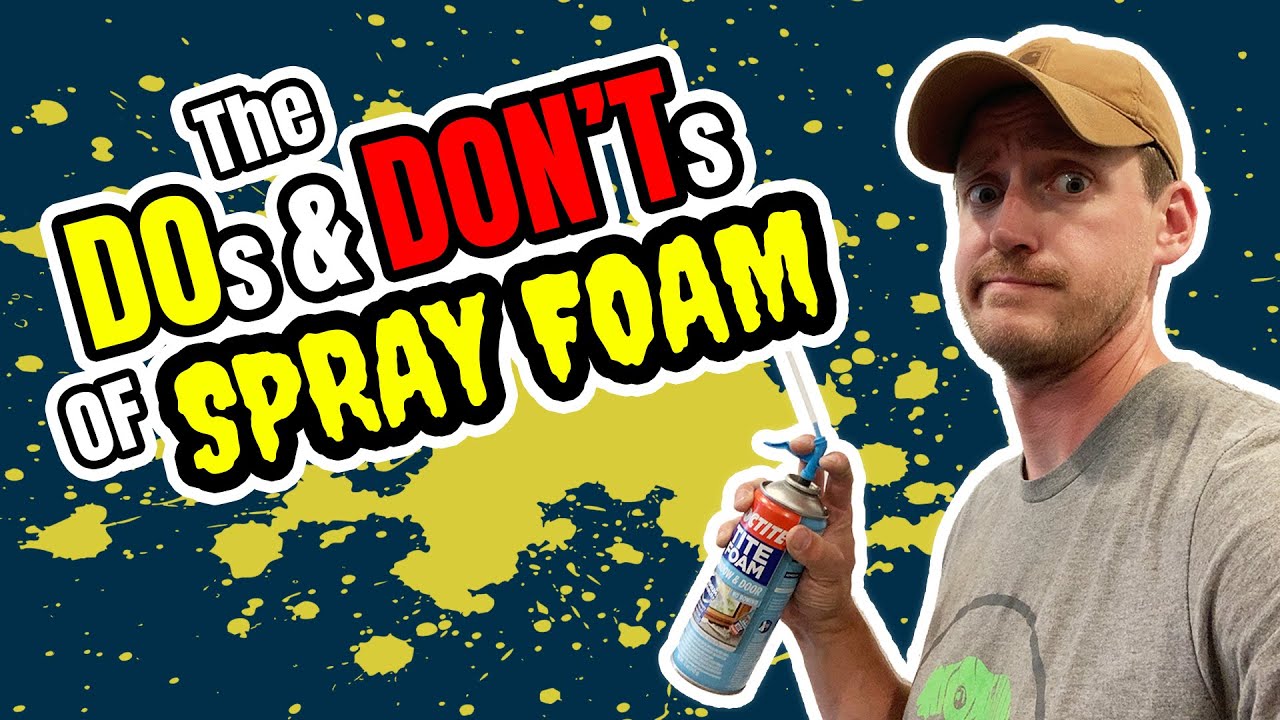
One can may make perfect sense around a hose bib or vent line. But once you start buying multiple cans for a “small insulation project,” the math and the performance both start slipping. At this point, many homeowners underestimate waste, overexpansion, and rework. If you're trying to compare where DIY stops making sense, this overview of DIY spray foam insulation cost helps frame that decision.
The short version is this. A can is often good enough for sealing. It is rarely good enough for insulating an assembly.
The performance gap between a can and a professional rig is not subtle. One is a convenience product for localized sealing. The other is a building material installed as a controlled system.
Professional closed-cell spray polyurethane foam is a 2-lb/ft³ medium-density insulation with more than 90% closed-cell content. Typical installed material is listed around R-6 to R-7 per inch, and a 3-inch installation can reach about R-21. The same density also makes it far stronger than open-cell foam. DOE guidance cited by Carlisle notes closed-cell SPF is about four times denser, 10 times stronger in compression, and 7 times stronger in tension, which is why pros use it in assemblies where durability, rigidity, and moisture resistance matter, as described in this closed-cell SPF technical overview from Carlisle.
A canned product doesn't deliver that category of installed performance across a wall, roof deck, or crawlspace boundary.
| Feature | Canned Closed-Cell Foam | Professional Two-Part Closed-Cell Foam |
|---|---|---|
| Primary role | Sealing small gaps and penetrations | Insulating and air-sealing larger assemblies |
| Application method | One-component aerosol can | Two-part system mixed during application |
| Best job size | Small repairs and localized leak points | Walls, roofs, crawlspaces, rim joists, larger envelope work |
| Coverage quality | Spot application, uneven on large areas | Continuous installed layer when applied correctly |
| Structural contribution | Minimal practical structural value in typical DIY use | Used where rigidity and assembly strength matter |
| Moisture control | Helpful for small leak paths | Suitable for assemblies where continuous control layers matter |
| Thickness control | Hard to keep uniform over broad areas | Installed to a planned depth across the assembly |
| Typical user | Homeowner or handyman | Trained installer with dedicated equipment |
People often focus on the word insulation and miss the more important word: assembly.
A wall or roofline doesn't perform because one area has foam in it. It performs because the air, moisture, and thermal layers are continuous. Professional two-part foam is installed to create that continuity. A can can spot-seal breaks, but it can't reliably replace a full, connected layer across a large area.
If the assembly needs continuity, patchwork isn't enough.
That's why pros use closed-cell foam in places where cavity depth is limited, the humidity load is high, or separate air and vapor control layers would be harder to execute cleanly. The installed result is part insulation, part air-sealing layer, and part moisture-management strategy. A can can assist that kind of assembly. It can't stand in for it.
In a mild dry climate, a mediocre patch sometimes gets tolerated for a while. In hot-humid coastal conditions, mediocre details show up faster. You feel them as uneven rooms, sticky indoor air, and AC systems that never seem to get ahead.
That's why the difference between these two foam categories matters so much in real houses. One handles detail work. The other handles envelope work.
Canned foam looks harmless until it gets on your skin, your trim, your flooring, or your glasses. Then you find out quickly that this isn't a casual craft product.
Uncured foam is sticky, fast-moving, and difficult to clean up. It also gives off vapors during application and curing, so basic protection isn't optional.
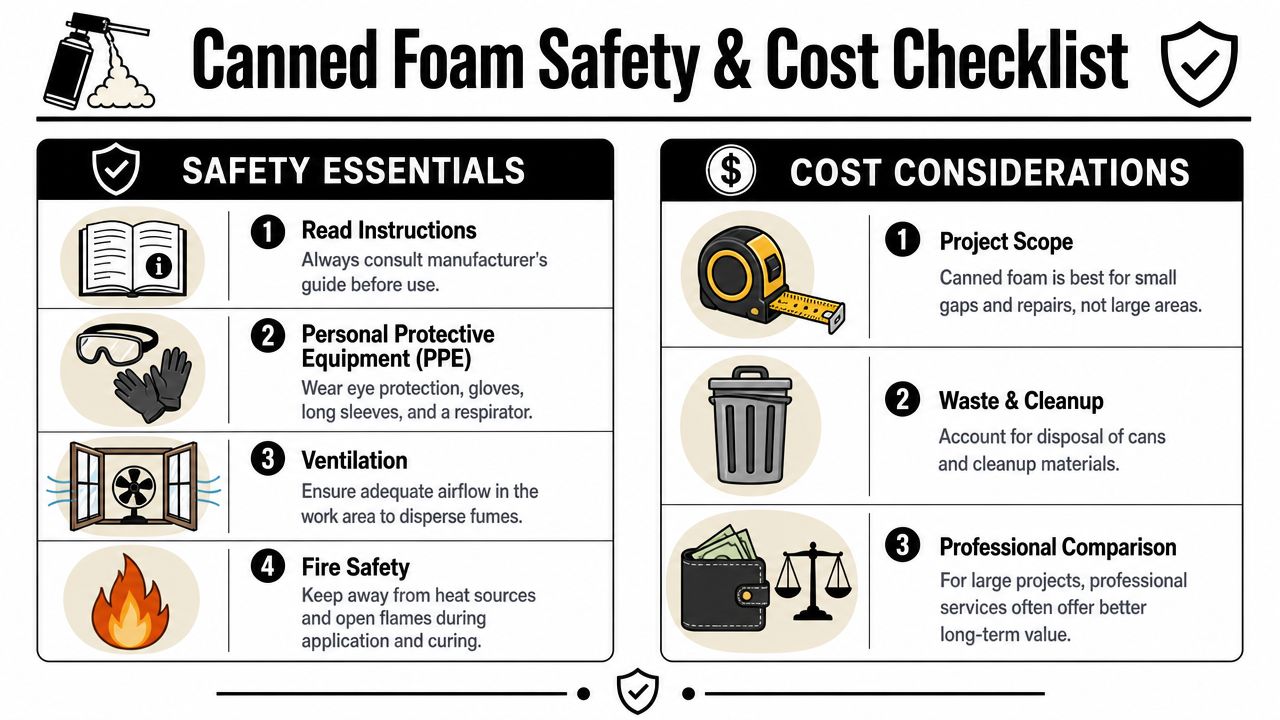
Before you spray, slow down and set up the area. The minimum common-sense checklist looks like this:
The biggest errors are basic ones:
Small lifts beat one oversized blob every time.
That approach gives the material a better chance to expand and cure without creating a warped trim detail or an ugly cleanup job.
A single can feels inexpensive because the upfront cost is low. That makes sense when the task is sealing a few known leak points.
The value flips on bigger work. Professional closed-cell spray foam typically costs about $1.10 to $1.25 per board foot, according to this spray foam cost and performance reference. That's a real investment, but it's also a real installed insulation system.
For small repairs, the can is economical. For true insulation work, sticker price is the wrong lens. You need to judge cost against coverage, consistency, and whether the job gets solved once.
South Florida exposes bad assumptions faster than most places. A house can look fine and still have humid air moving through the wrong places every day. That's why insulation decisions here aren't just about adding R-value. They're about controlling air movement and moisture movement together.
In humid climates like South Florida, the question isn't just thermal value. It's moisture performance. Guidance discussed by Armorthane makes that distinction clearly. Canned foam may be water-resistant for small gaps, but it can't replace a full moisture-management strategy in larger building envelopes where professional closed-cell foam's ability to act as a true vapor barrier matters for condensation and humidity control, as explained in this humid-climate closed-cell foam discussion.
If any of these sound familiar, the project has moved beyond a can:

A professional installation isn't just “more foam.” It's a different approach to the building envelope. The installer evaluates where outside air is entering, where humid interior and exterior conditions can create condensation risk, and how to apply a continuous layer without the gaps and weak points common in piecemeal DIY work.
That matters in Jupiter, Palm Beach Gardens, West Palm Beach, Wellington, Stuart, and other coastal areas where AC systems run hard and humidity stays relentless. A small can belongs in the toolbox for detail sealing. It does not belong at the center of a strategy for your attic, roofline, crawlspace, or full wall system.
South Florida homes punish partial fixes. If the problem is an assembly problem, the answer has to be an assembly solution.
If your project has moved past a few small gaps and into attic, wall, crawlspace, or whole-envelope performance, talk with Airtight Spray Foam Insulation. Their team serves South Florida with professional spray foam solutions designed for the humidity, heat, and moisture challenges that canned products can't solve on their own.