
You call three insulation contractors for the same South Florida attic and get three completely different answers. One says spray foam the roofline. Another says keep the attic vented and add more fiberglass. A third says you need attic foam baffles or the whole system will fail.
That's where most homeowners get stuck. The word baffle gets thrown around like it belongs in every attic, when it doesn't.
In this climate, the right answer starts with one question only. Is your attic vented or unvented? If you answer that correctly, the baffle decision gets a lot simpler. If you answer it wrong, you can spend money on parts that do nothing, or worse, build an attic that fights itself.
South Florida attics deal with heat, humidity, salt air, wind-driven rain, and long cooling seasons. That means the details matter. A vented attic needs a clear path for outside air to move from the soffits upward. An unvented attic works by sealing that path off and bringing the attic inside the building envelope. Those are two different systems, and they shouldn't be mixed casually.
Homeowners trying to sort through materials usually start with comfort and utility bills, then realize the bigger issue is assembly design. If you're comparing insulation options for a hot, humid region, this guide on the best attic insulation for hot climates is a useful companion. It helps frame why the same attic advice from a colder market often doesn't translate well to coastal Florida.
A lot of confusion comes from contractors talking about products before they talk about the roof assembly.
If someone says "you need foam baffles," the next question should be, "for what kind of attic?" If someone says "spray foam solves everything," the next question should be, "where is the foam going?" On the attic floor and on the roof deck are not the same strategy.
Traditional attic systems use insulation on the attic floor. In that setup, the attic above the insulation is outside the conditioned space, and ventilation matters. Air enters through soffit vents and leaves through higher vents. If insulation blocks the soffit intake, airflow gets choked off right where it starts.
An unvented attic works differently. The insulation moves from the floor to the underside of the roof deck, and the attic becomes part of the controlled interior space. In that assembly, preserving a soffit-to-ridge air channel isn't the goal anymore.
Most bad attic advice comes from mixing parts of a vented system with parts of an unvented system.
That's why one contractor insists on baffles while another says they're irrelevant. They may both be describing valid methods, but for different attic designs.
In South Florida, I see two patterns cause trouble more than anything else:
The fix is to stop thinking of baffles as a universal upgrade. They are a component with one job. If that job doesn't exist in your attic design, they don't belong there.
Attic foam baffles are not insulation. They are air channels.
Their job is simple. They hold insulation away from the underside of the roof deck at the eaves so air can move in from the soffit vents. Think of them as breathing lanes for the roof assembly. They don't cool the house by themselves, and they don't add meaningful insulation value by themselves. They preserve the path that a vented attic depends on.
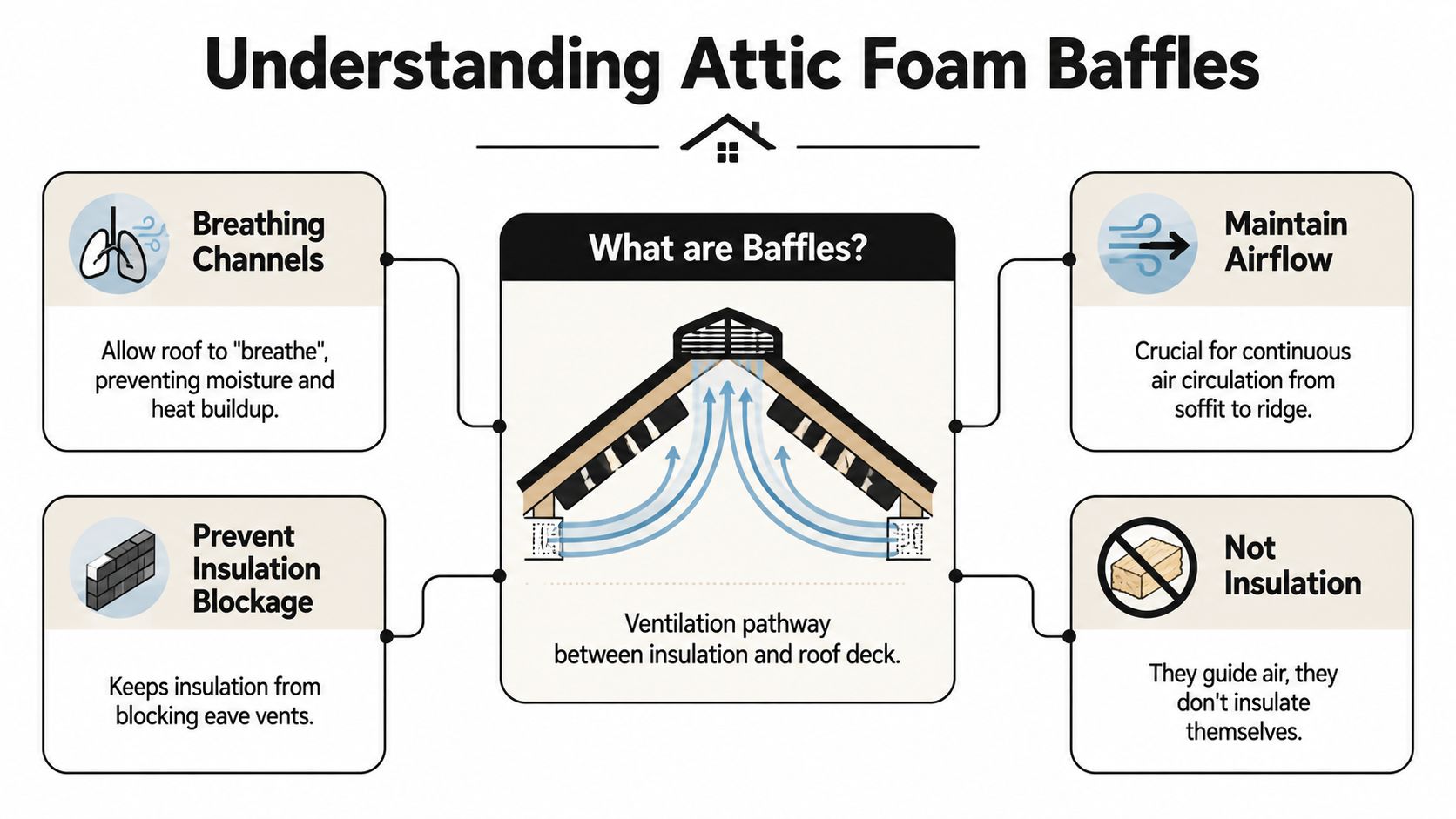
When installers blow loose-fill insulation or place batts deep into the attic floor, the material can crowd the eaves. Without a baffle, that insulation can cover the soffit opening or sag into the airflow path. The baffle creates a defined chute from the soffit into the attic.
A commercial baffle specification shows a common target of a 2-inch air channel with corrugated plastic panels made for 16-inch and 24-inch on-center rafters, installed by cutting and stapling them into rafter bays so insulation stays below the vent path. That design is intended to reduce airflow restriction and wind washing at the eaves, according to SmartBaffle product specifications.
You'll see baffles sold in a few common materials:
Material matters less than fit. A badly installed plastic baffle is still a bad baffle.
Practical rule: If the baffle gets crushed, leaves side gaps, or stops short of the insulation depth, it isn't protecting the airway the way it should.
Baffles don't fix poor air sealing. They don't solve roof leaks. They don't make an unvented attic better. And they don't replace a ventilation plan.
Their value exists only when the assembly needs a clear air path from the soffit upward. If that path is essential, the baffle matters. If that path has been intentionally eliminated by design, the baffle becomes dead weight in the budget.
This is the line that decides everything.
A vented attic has insulation on the attic floor and uses outside air moving through the attic space. An unvented attic has insulation at the roofline and does not rely on outside air flowing from soffit to ridge through the attic. Once you know which one you have, the baffle question answers itself.
In a vented assembly, airflow starts low and needs to stay open at the eaves. If insulation blocks the soffit intake, the whole strategy weakens. A technical study on attic ventilation found that baffle size and vent configuration measurably change attic air distribution and temperature profiles. The study evaluated three different baffle sizes and three different vent locations, which is why baffles should be treated as performance components rather than trim pieces. The same research also notes the commonly cited ventilation target of 1 square foot of net vent area for every 150 square feet of attic floor area, which baffles help preserve in real installations through the eave area, as discussed in this attic ventilation study.
That matters because the vented attic depends on continuity. The air path can't be good in the middle and blocked at the start.
In a sealed attic, the roofline insulation is doing the work. The goal is to stop humid outdoor air from moving through the attic assembly, not encourage it. Soffit-to-ridge airflow isn't part of that design.
That's why adding baffles to a true unvented roofline system usually makes no sense. You're trying to preserve a ventilation channel inside a design that no longer uses one.
For homeowners trying to identify existing problem signs before choosing a path, Purified Air Duct Cleaning's insights are a useful outside reference on what poor ventilation can look like inside a house. It helps separate general airflow symptoms from attic-specific design flaws.
| Feature | Vented Attic | Unvented (Sealed) Attic |
|---|---|---|
| Insulation location | On attic floor | At roofline |
| Outside air in attic | Yes | No, not by design |
| Need for soffit airflow path | Critical | Usually none |
| Role of attic foam baffles | Preserve intake air channel | Typically unnecessary |
| Best fit for mixed advice | Often where contractors mention vents and baffles | Often where contractors mention sealed roof deck |
If you're still sorting through vent types and airflow layouts, this overview of essential types of attic ventilation helps map the components. Just don't assume every vent component belongs in every attic.
South Florida changes the conversation because moisture is not a side issue here. It's one of the main issues.
A vented attic brings outdoor air into the attic space by design. In a hot, humid climate, that means the assembly has to manage both heat and moisture while keeping the insulation from blocking the air path.
In a vented attic with insulation on the floor, baffles are not just a nice detail. The 2021 International Residential Code says attic baffles used at soffit intakes must maintain a net free area opening at least equal to the size of the vent, and they must extend over the top of the attic insulation under IRC N1102.2.3.
That requirement tells you what the baffle is really doing. It is preserving the intake opening and carrying that opening above the insulation layer. In other words, the code treats it as part of the airflow path, not as packaging around insulation.
In South Florida, many homeowners are better served by deciding whether they want a vented attic at all, rather than just debating which baffle to buy.
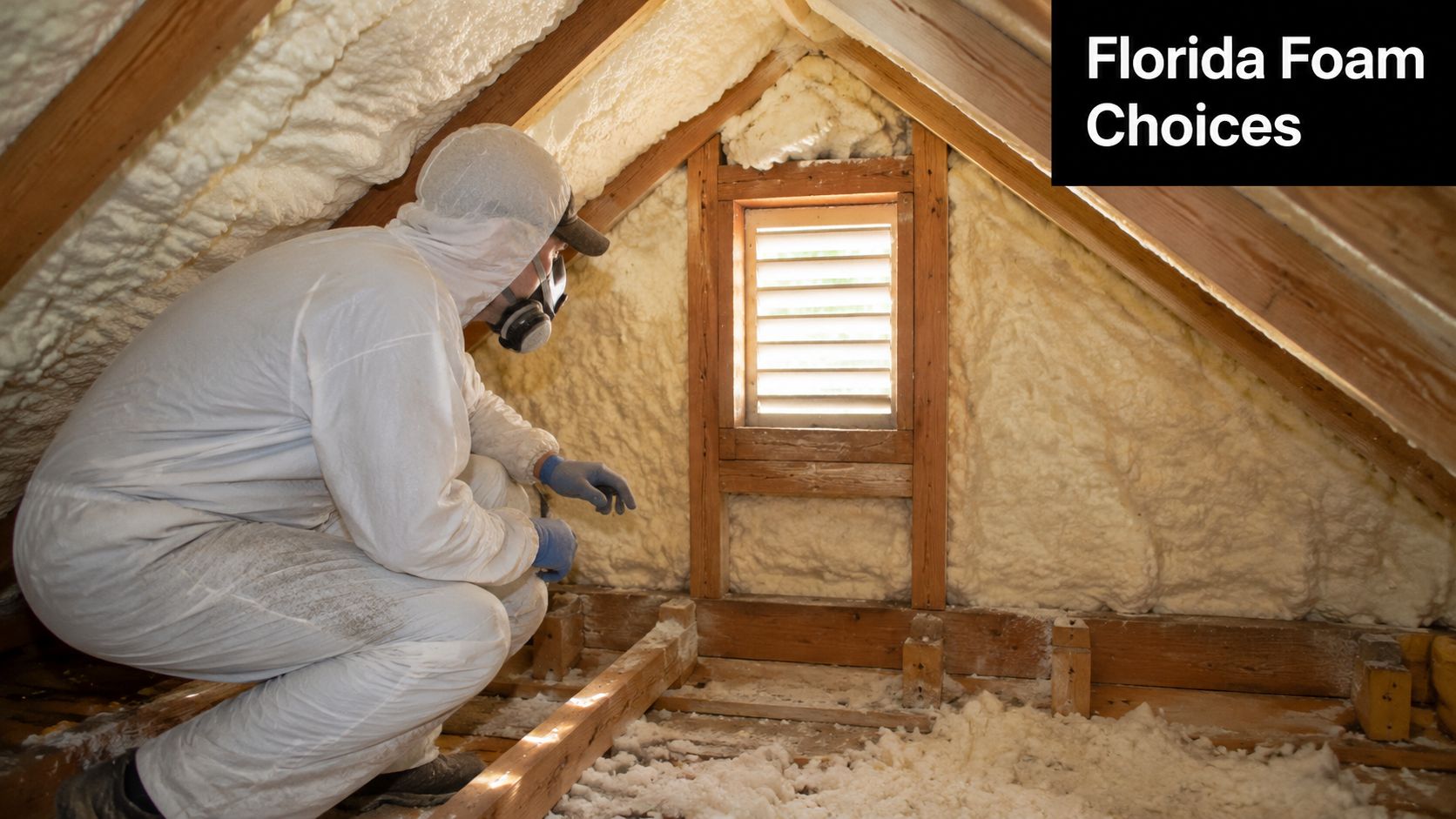
When spray foam is applied at the roofline in a properly designed unvented attic, the strategy changes from managing attic air movement to controlling the boundary of the house itself. That approach can make a lot of sense in a humid coastal climate because it limits the movement of hot, damp outside air through the attic space.
Open-cell and closed-cell spray foam don't behave the same way, and that distinction matters in this region. For many roofline applications, closed-cell foam is often the stricter moisture-control choice. The point isn't that every home needs the same foam. The point is that once the attic is intentionally sealed and the roofline becomes the thermal and air boundary, attic foam baffles stop being relevant.
In South Florida, the wrong attic strategy usually fails through moisture first and comfort second.
If you want a roofing-focused perspective on why attic airflow decisions affect the whole roof assembly, this article on attic ventilation and roof lifespan is worth reading. Roofers and insulation contractors often approach the same attic from different angles, and both views matter.
If you have a vented attic, a sloppy baffle install can undo good insulation work.
The goal is not just to slide a piece of foam near the soffit and call it done. The baffle has to create a real channel, stay in place when insulation is installed, and rise high enough to keep the final insulation depth from spilling into the intake path.
Start with the rafter spacing. Most off-the-shelf baffles are meant for common framing layouts, so the installer should match the product to the bay instead of forcing a loose fit.
Then fasten the baffle so it holds shape. If it bows inward, falls away from the roof deck, or leaves the sides open, insulation can still migrate into the channel.
A good install usually includes these checks:
The most common mistake is treating the baffle like a marker instead of a channel. Another is crushing the material during installation so the vent path narrows where it should be open.
A third problem happens during retrofit jobs. Someone adds insulation but doesn't reset the eave details first. That can leave the attic looking thicker and better insulated while the soffit intake is blocked.
For readers in colder regions, Penn Ohio Roofing & Siding Group's article on attic insulation for ice dam control is a good reminder that attic assemblies fail differently in different climates. South Florida doesn't fight ice dams, but the lesson still applies. Roof and attic details have to match the climate and the assembly.
If you want to see how insulation execution affects the whole roofline strategy, this guide on how to spray foam insulation gives useful context on installation discipline. Different materials, same rule. Details decide whether the system works.
A short visual helps here because baffle placement is easy to misunderstand until you see the geometry in action.
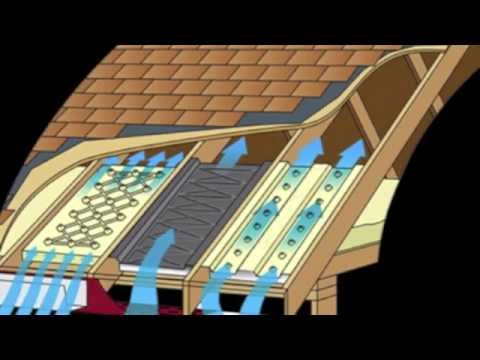
A vented attic can tolerate basic materials. It won't tolerate careless geometry at the eaves.
This part should be stated plainly. Attic foam baffles are a waste of money when the attic design does not need a soffit-to-ridge airflow path.
The clearest example is an unvented attic with spray foam applied at the roofline. Neutral guidance from PNNL says baffles are needed when insulation is on the attic floor and soffit vents must remain open, but not when spray foam is applied at the roofline in an unvented attic system, as explained in PNNL's guide to attic vent baffles.
Ask one question. What air path is this baffle protecting?
If the answer is vague, or if the same contractor also says the attic will be sealed from outside air, the recommendation doesn't hold together. A baffle only adds value when it protects a real ventilation path that the assembly depends on.
That's the homeowner-friendly filter. It cuts through upselling fast.
In a vented attic, they may be required as part of keeping the soffit intake open above the insulation layer. In an unvented attic, the question changes because the assembly no longer depends on that vent channel. What matters is matching the detail to the attic type, not assuming one rule covers both.
That question usually signals a confused design. A vented attic and a roofline spray foam plan are different strategies. In South Florida, moisture behavior matters enough that mixing concepts casually is risky. If someone proposes open-cell foam near a vented roof assembly, ask them to explain exactly where the foam goes, what remains vented, and how the assembly manages humid air.
If a contractor can't draw the air boundary and the insulation boundary, the recommendation isn't ready.
Yes, but retrofit work is harder than doing it before insulation goes in. Existing insulation at the eaves often has to be pulled back so the installer can see the soffit area, fit the baffle correctly, and keep the airway clear. In tight attic spaces, that can be slow and messy.
Not directly. A baffle doesn't insulate the house the way spray foam, fiberglass, or cellulose does. Its job is to help a vented attic function as intended by keeping insulation from blocking airflow. The savings, if any, come indirectly because the insulation and ventilation system can do their jobs properly.
Not automatically. Fit, durability, and installation quality matter more than the label. A well-secured plastic baffle can outperform a poorly fitted foam one, and the reverse is also true.
No. Some homes are better candidates than others depending on roof design, budget, existing ventilation layout, and renovation scope. But in this climate, it makes sense to evaluate the unvented option seriously instead of assuming the old vented approach is always best.
Look at where the insulation boundary is supposed to be.
If the plan is insulation on the attic floor with open soffit vents, baffles likely matter. If the plan is spray foam at the roof deck with a sealed attic, they usually don't.
If you're in Jupiter, Palm Beach Gardens, West Palm Beach, Wellington, or Stuart and want a clear answer for your attic, Airtight Spray Foam Insulation can help you sort out whether you need a vented attic with properly installed baffles or a sealed roofline system that makes baffles unnecessary. The value isn't just in the material. It's in getting the assembly right for South Florida humidity, heat, and real-world roof conditions.