Your basement might not look flooded, but the warning signs are usually there long before standing water shows up. The air feels heavy. Cardboard gets soft. Paint near the lower wall starts to bubble. You run the AC all day, and the house still feels sticky. In South Florida, that combination usually points to the same problem. Moisture is getting into the basement assembly, and the wrong insulation can make it worse instead of better.
A lot of generic advice about the best insulation for basements comes from colder, drier markets. That advice breaks down fast in Jupiter, West Palm Beach, Wellington, and Stuart. Concrete below grade behaves differently here. Humid air pushes inward. Soil moisture stays active. Heavy rain events expose every weak point in the wall system. If the insulation can't manage vapor, air leakage, and damp conditions at the same time, it won't hold up.
A South Florida basement usually doesn't fail all at once. It starts with small signs homeowners live with for too long. A musty smell after rain. Cold, clammy wall surfaces. Storage that never quite feels dry. Then someone finishes the space, adds batt insulation or a framed wall, and the basement gets worse.
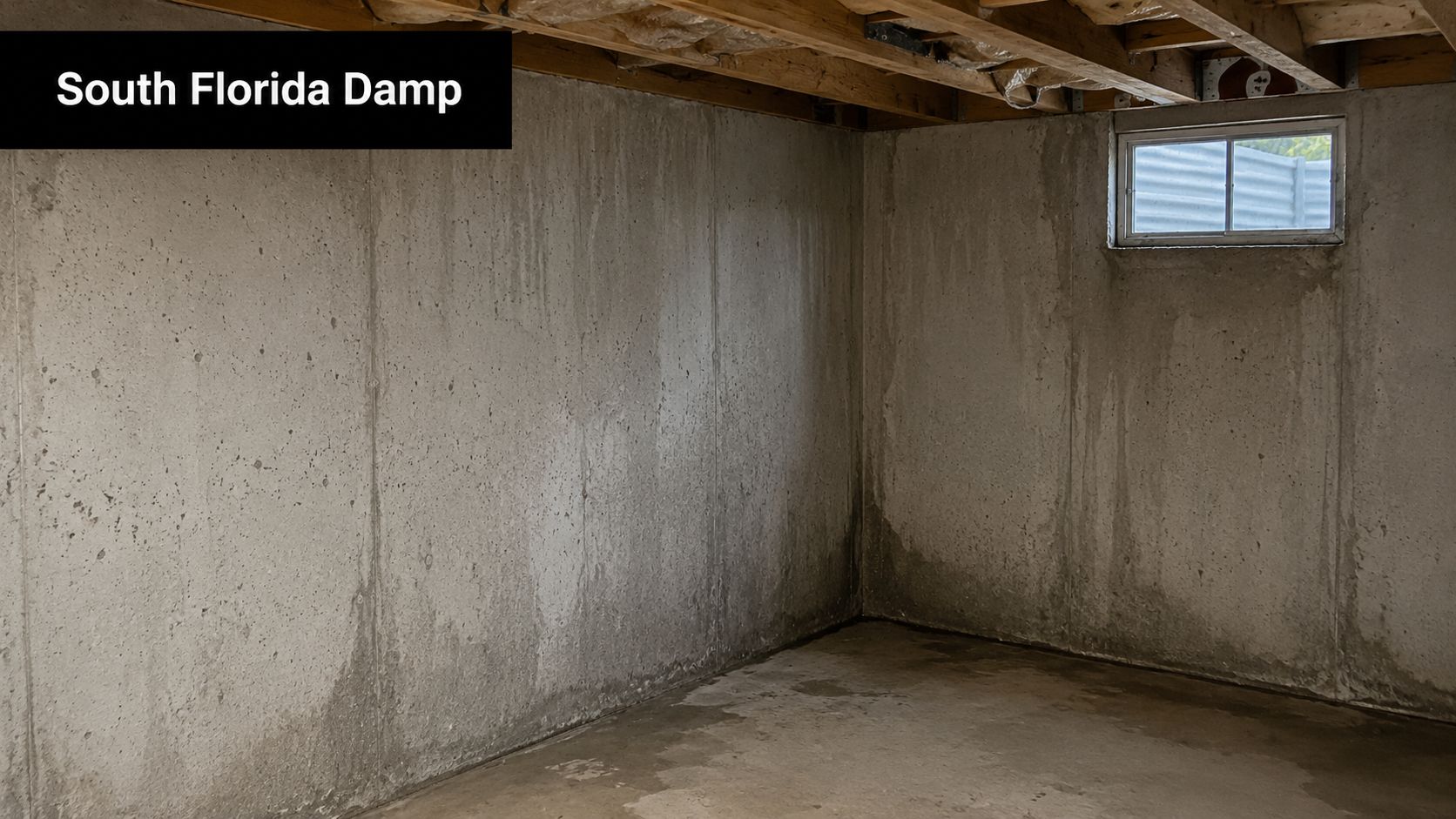
That's the part many homeowners miss. Basement insulation isn't just about temperature control. In this climate, it's a moisture-management decision first. If the material absorbs water, lets vapor move too freely, or leaves air gaps against concrete, you're creating a hidden problem behind the finished wall.
Below-grade concrete is in constant contact with damp soil. Add Florida humidity, storm cycles, and occasional water intrusion, and the basement becomes one of the toughest areas in the house to insulate properly.
The right insulation helps with:
Basements in South Florida don't need insulation that only looks good on a spec sheet. They need insulation that keeps performing when the walls are cool, the air is wet, and the concrete never fully gets a break from moisture.
A material can perform fine in a dry climate and still be a poor choice here. That's why homeowners who search for the best insulation for basements often end up reading advice that skips the core issue. Below-grade walls in humid regions need a system that resists moisture and limits air movement against concrete. If you start with the wrong material, every finish layer you add on top becomes more vulnerable.
Before picking a product, it helps to understand what matters in a basement. The label on the insulation package doesn't tell the whole story. In South Florida, a basement assembly succeeds when it controls heat flow, air leakage, and moisture at the same time.
R-value measures thermal resistance. Higher R-value means the material slows heat transfer more effectively. That matters in a basement because concrete doesn't insulate well on its own.
But a high R-value isn't enough if the insulation gets damp or allows humid air to move through the wall assembly. Wet or vapor-open materials can undercut the whole reason you installed insulation in the first place. For baseline context on how builders think about code targets in other markets, these Kalamazoo basement insulation guidelines are useful to compare against, even though South Florida moisture conditions demand a different level of caution.
Vapor permeance, often discussed in perms, tells you how easily water vapor passes through a material. This is a huge deal below grade.
A basement wall can look dry on the surface and still be moving moisture through the concrete. If the insulation is too vapor-open, that moisture can travel into the framed wall or finished surface. If the material has low permeance, it does a much better job of separating the damp concrete from the interior side of the basement.
Here's the practical distinction:
Air leakage is where a lot of basement projects go sideways. Warm, humid air finds small openings around rim joists, penetrations, framing gaps, and uneven foundation surfaces. Once that air reaches a cool surface, condensation can follow.
Practical rule: If insulation doesn't also address air movement, the basement can still feel damp even when the nominal R-value looks adequate.
Homeowners often use these terms interchangeably, but they aren't the same in practice. A vapor barrier sharply limits moisture movement. A vapor retarder slows it down but doesn't stop it to the same degree.
For a South Florida basement wall, that distinction matters. Concrete is porous. Soil-side moisture pressure is real. The best insulation for basements here usually isn't the one with the cheapest installed price or the easiest DIY appeal. It's the one that keeps thermal performance, air control, and moisture resistance working together as one system.
A South Florida basement can look fine on the surface and still be setting up a failure behind the wall. I see that with finished basements that used the wrong insulation, usually a material that looked good on a price sheet but had no business sitting against damp concrete in a hot, humid climate.
That is the filter I use when comparing basement insulation. I am not just looking at stated R-value. I am looking at how the product reacts to humid air, occasional wetting, uneven masonry, flood exposure, and the kind of hidden moisture that shows up months later as odor, staining, or soft drywall.
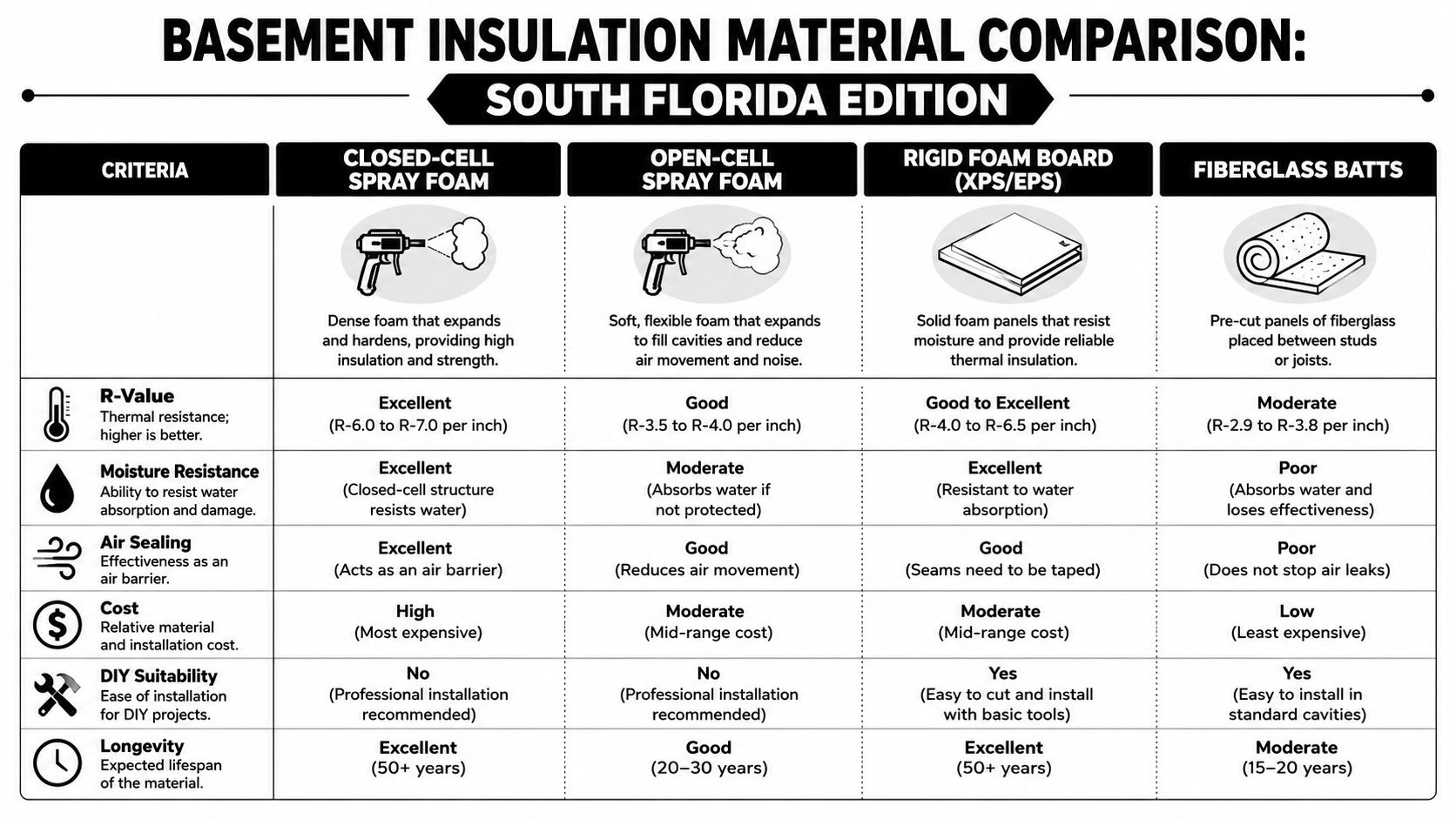
| Material | Typical R-Value/Inch | Moisture Handling | Air Seal | Best Use Case |
|---|---|---|---|---|
| Closed-cell spray foam | High per inch | Resists moisture well and works in direct contact with concrete better than other common options | Excellent | Direct application to basement walls where moisture control is a priority |
| Open-cell spray foam | Moderate per inch | Too vapor-open for direct contact with below-grade concrete in humid conditions | Good air seal, weak below-grade moisture profile | Above-grade assemblies, not basement walls |
| Rigid foam board (XPS/EPS) | Moderate to high, varies by product | Better than fibrous insulation, but seam detailing decides performance | Moderate if seams are taped and sealed well | Basement walls where boards can be installed tightly and protected |
| Fiberglass batts | Lower per inch than closed-cell foam | Performs poorly if exposed to damp conditions | Poor unless paired with separate air sealing | Framed cavities kept away from concrete and managed as part of a full wall system |
| Mineral wool | Moderate | Handles incidental moisture better than fiberglass, but still should not sit against concrete by itself | Poor without added air control | Secondary layer in a wall system that already controls moisture and air |
For a broader contractor-style overview of assemblies and material choices, this guide to basement insulation is a useful supplementary read.
Closed-cell spray foam is the material I trust most for South Florida basement walls. It gives you insulation, air control, and much better moisture resistance in one layer. That combination matters when the wall is below grade and the climate stays wet for much of the year.
It also handles irregular surfaces well. Concrete basement walls are rarely flat, and spray foam fills voids that would leave board products with hidden air channels. If the installer misses thickness in corners or at rim areas, performance drops fast, so the crew quality matters.
As noted earlier, closed-cell foam also carries strong R-value per inch and low permeance, which is why it outperforms softer, more vapor-open products on basement walls.
Open-cell foam has good uses in above-grade walls and rooflines. I would not put it against a South Florida basement wall.
The problem is simple. It air seals reasonably well, but it does not control moisture well enough for below-grade concrete. In a humid basement, that is the wrong trade-off. If the wall ever sees persistent dampness or minor water intrusion, open-cell foam is far less forgiving than closed-cell.
Rigid foam board can work well in a basement if the wall is reasonably flat and the installer is disciplined. Boards need tight joints, sealed seams, careful treatment at penetrations, and a clean connection at the floor, corners, and top of wall. Miss those details and humid air gets behind the insulation.
That is where board jobs often lose ground in practice. The product itself can be a solid choice. The weak point is the installation. I have opened finished basements where the boards looked fine from the room side, but damp air had been slipping behind them at gaps for a long time.
If you are comparing materials, it helps to understand what happens when insulation gets wet before choosing a board assembly for a flood-prone or high-humidity basement.
Fiberglass is the product I see misused most often in basements. Contractors frame a wall, drop batts into the cavities, and the basement looks finished and clean. Then the complaints start. Musty smell. Sweating surfaces. Drywall staining. Sometimes rot.
The issue is not that fiberglass never belongs in a basement. The issue is that fiberglass does nothing to stop air leakage, and it does not protect the assembly from moisture coming through concrete. If it is used at all, it needs a proper moisture-controlled layer between the concrete and the stud wall. Direct contact with basement masonry is a bad bet in this climate.
Mineral wool is better than fiberglass in damp conditions, and I like it in the right assembly. It does not slump the same way, and it handles incidental moisture better. But it still is not an air barrier, and it is not the first layer I want against below-grade concrete in South Florida.
I treat mineral wool as a supporting material, not the lead material. If the wall already has a continuous layer that controls moisture and air, mineral wool can add thermal value inside the framed cavity. By itself, it does not solve the basement wall problem.
One more point matters here. Homeowners often hear bad advice about insulating the basement ceiling instead of the walls. In South Florida, that usually leaves the basement damp, humid, and disconnected from the conditioned space while doing nothing to address the wall assembly that is directly in contact with wet soil and concrete. For this region, wall insulation strategy matters far more than trying to isolate the basement overhead.
South Florida basements deal with pressure from every direction. Humid outdoor air, damp soil, heavy rain, and below-grade concrete all work against the interior finish. A material that survives in a northern dry basement can fail fast here because the moisture load is different and more persistent.
A lot of homeowners think moisture damage starts with water running down the wall. It often doesn't. Concrete can pass moisture vapor even when the wall looks sound, and humid air can find its way into tiny gaps around framing and penetrations. Once that moisture gets trapped behind an interior finish, the damage stays hidden.
That's why basement assemblies in this region have to be judged by what they do in daily damp conditions, not just after a storm.
Below-grade walls don't just face indoor humidity. They can also face moisture pressure from surrounding soil. After heavy rain, that pressure can push moisture through weak points in the foundation assembly. If insulation is absorbent or too vapor-open, it gives that moisture a place to go and a place to stay.
Homeowners who want a plain-language overview of how moisture changes insulation performance can review what happens when insulation gets wet. It's one of the most important realities to understand before finishing a basement wall.
South Florida adds another layer of risk that many national articles barely mention. Flooding and storm-related water events change what “durable” really means. A material might perform adequately in normal conditions and still become a liability after one water event.
That's why I'm cautious about any basement insulation system that relies on fibrous products, unsealed cavities, or interior assemblies that can trap moisture against framing.
In South Florida, the wrong basement insulation usually doesn't fail on day one. It fails quietly behind the finished wall.
A South Florida basement can look fine in the morning and smell damp by the evening after a hard rain. This is the situation below grade here. High humidity, flood exposure, and pressure against the foundation punish insulation choices that might hold up in milder climates.
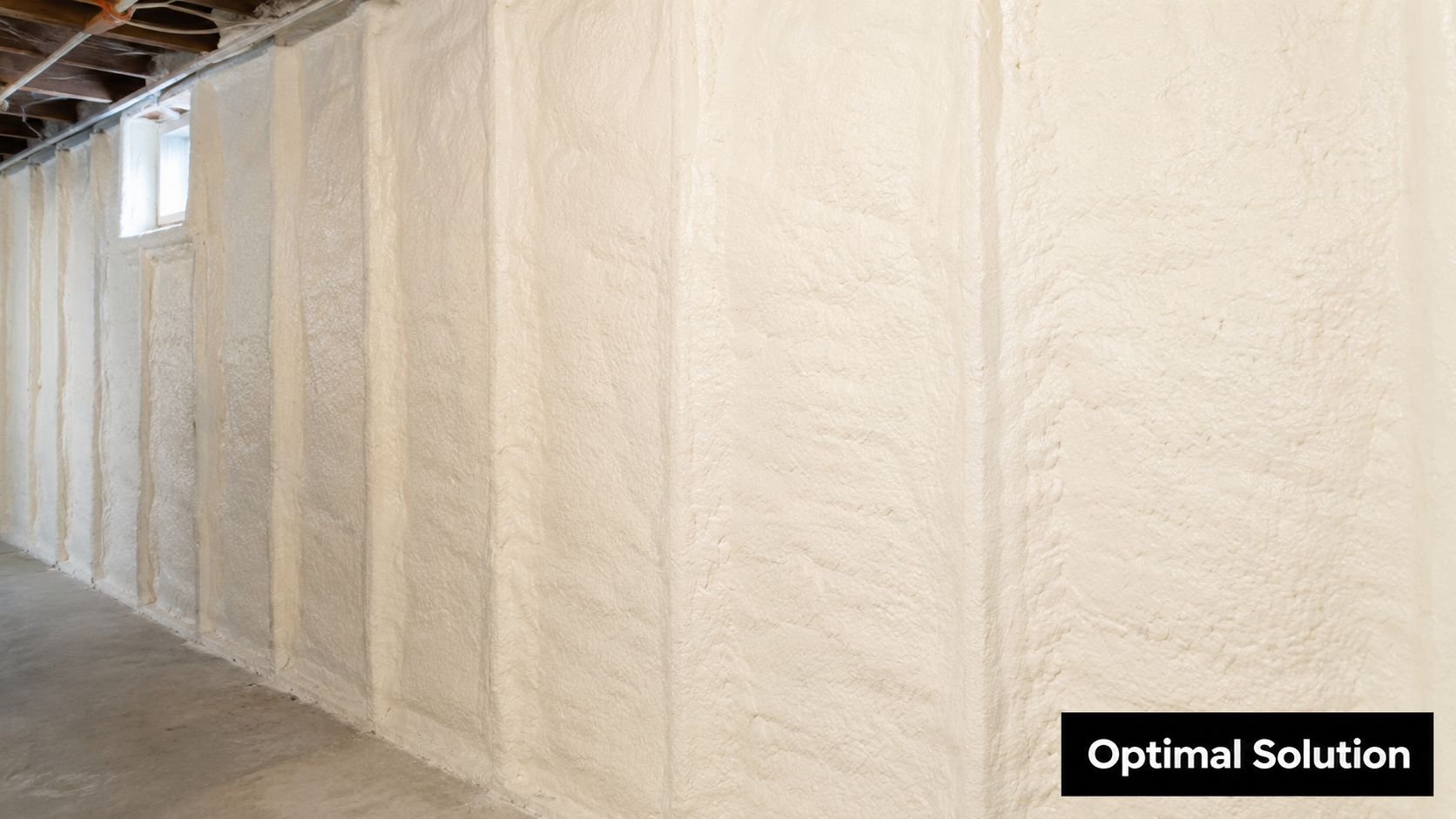
For most South Florida basements, closed-cell spray foam on the walls is the best answer. It gives you insulation, air sealing, and strong resistance to moisture in one layer. That combination matters more here than chasing the cheapest material or the highest lab rating on paper.
Concrete walls are rarely uniform. They have surface irregularities, penetrations, cold joints, and spots where humid air or moisture finds a path. Closed-cell spray foam adheres directly to those surfaces and covers details that board products often struggle to handle cleanly.
It also keeps the assembly simpler.
A simpler wall usually performs better in a South Florida basement because there are fewer cavities to trap damp air, fewer seams to miss, and fewer places for hidden mold to start. If you want to see what that kind of wall-first approach looks like, this guide on how to insulate basement walls with spray foam lays out the assembly clearly.
I see this mistake all the time. Someone insulates the basement ceiling because it seems easier than dealing with the walls. In a humid climate, that shortcut can turn the basement into a cooler, damper pocket that stays wet longer and smells musty faster.
The better target is the foundation wall, not the ceiling.
The U.S. Department of Energy discusses this in its Basement Insulation Systems. Building America Top Innovation article. The guidance separates wall insulation from ceiling insulation for a reason. In South Florida, insulating the ceiling while leaving the walls exposed usually ignores the actual moisture source.
If the walls are still taking on humidity and the ceiling is insulated, the basement often gets more isolated, not more protected.
That is how homeowners end up with a finished space upstairs and a mold problem downstairs.
The best-performing basement assemblies here usually follow the same logic:
For readers who want a visual look at how spray foam behaves in basement applications, this overview is worth watching.
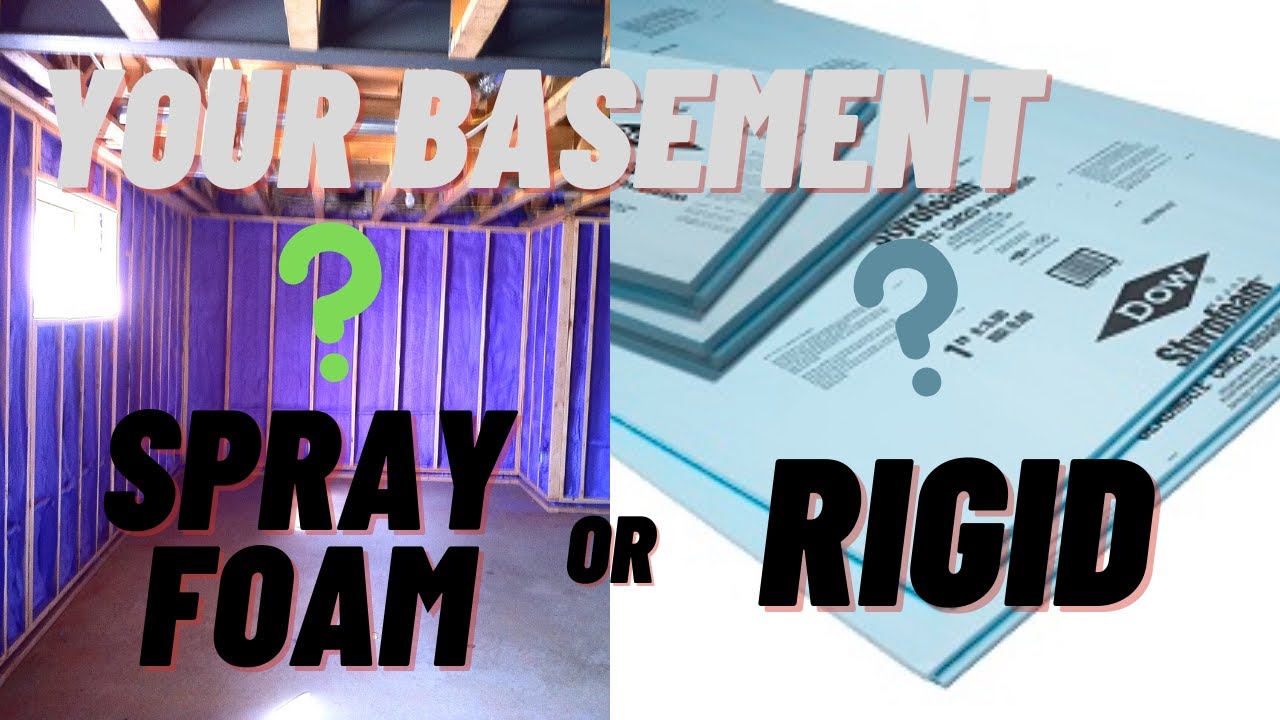
Rigid foam board can work if the wall is flat enough, the seams are sealed well, and the detailing is done carefully around penetrations and slab transitions. I would still call it less forgiving than closed-cell spray foam in older basements or anywhere the wall surface is uneven.
Mineral wool has uses in basement assemblies, but I do not recommend it as the primary answer against a below-grade wall in South Florida unless the full system is designed to keep it dry. Once fibrous materials get involved near damp concrete, the margin for error gets tight.
If you want the shortest honest answer, use closed-cell spray foam on the basement walls. Avoid treating ceiling insulation as the main fix. In South Florida, that is the difference between a basement that stays manageable and one that keeps developing the same moisture problems behind the finish.
A South Florida basement can look fine on a dry day and still be one missed detail away from trapped moisture, swollen trim, or peeling paint after the next stretch of rain. That is why installation quality matters as much as material choice.
Rigid foam board is the only basement insulation option I would put in the realistic DIY category for most homeowners. You can cut it, fit it, and seal it with basic tools. The catch is the wall has to be prepped well, the surface has to be reasonably flat, and every seam, penetration, and slab transition has to be sealed carefully. In older basements, that is where DIY jobs usually go off track.
Closed-cell spray foam is less forgiving to install and more forgiving after it is installed correctly. That trade-off matters in this climate.
The installer has to control surface prep, temperature, lift thickness, adhesion, and coverage at corners and penetrations. Miss one transition behind framing or at the slab edge, and humid air finds the gap. On a South Florida basement wall, small misses do not stay small for long.
This is also why I do not recommend treating basement ceiling insulation as the DIY shortcut in humid climates. It does not solve the wall moisture problem. In some homes, it makes the basement harder to control by separating the space from the conditioned house while the below-grade walls keep pulling in moisture.
A good insulation crew is not just there to spray foam. They are there to build a wall assembly that survives real basement conditions.
If you want to see what that wall-first approach looks like, this guide on how to insulate basement walls is a practical reference.
A basement insulation job works because the wall is sealed, adhered properly, and able to dry or resist moisture the way the assembly was designed to.
DIY makes sense for cleanup, minor prep, and some board-foam jobs in lower-risk basements with flat walls and no history of water entry.
Professional installation makes more sense when the concrete is uneven, the basement has had damp spots after storms, or you are using spray foam. In South Florida, those are common conditions. If the wall has ever shown staining, musty odor, or water pressure signs, I would not gamble on a first-time install.
If your basement feels musty, damp, or hard to cool, don't start by shopping for insulation based on price alone. Start by looking at the wall conditions. Check for staining, peeling paint, soft trim, odor after rain, and any sign that humid air is lingering near the concrete.
A smart next step is to think in this order:
Maintenance matters too. Keep the space clean, monitor any changes after major storms, and address bulk water entry quickly. If you already have insulation in place and suspect moisture problems, don't ignore the signs. Hidden damage usually gets more expensive the longer it sits.
For homeowners who want to improve wall performance before finishing the space, this guide on how to seal basement walls is a practical place to start.
The best insulation for basements in this region is the one that matches the climate, not the one copied from a dry-market checklist. If your home is in Jupiter, West Palm Beach, Stuart, Palm Beach Gardens, or Wellington, get the basement evaluated with local moisture conditions in mind.
If you want a basement insulation plan built for South Florida conditions, contact Airtight Spray Foam Insulation for a free, no-obligation estimate. Their team works with homeowners, builders, and property managers across Jupiter, Palm Beach Gardens, West Palm Beach, Wellington, and Stuart to recommend the right wall-focused solution for humidity, air leakage, and long-term performance.