Your air conditioner runs most of the day, but some rooms still feel sticky. After a heavy South Florida rain, there's a faint musty smell that never fully leaves. The floors feel off, sometimes cool, sometimes damp, and no thermostat setting seems to fix it.
A lot of homeowners look up at the attic first. That makes sense. But in many raised-floor homes, primary trouble starts below your feet. The underside of the house can pull in humid air, hold moisture around the subfloor, and let outside air leak into the living space through every gap around plumbing, wiring, and framing joints.
Spray foam insulation under house assemblies can solve a big part of that problem. The key is knowing where foam helps, where it doesn't, and why South Florida homes need more than a quick spray job to stay dry and efficient.
In South Florida, the area under a house often gets ignored until the house starts talking back. You notice the smell first. Then the uneven floors. Then the AC that seems to work harder than it should.
That under-house space is part of the building envelope whether you pay attention to it or not. If outside air moves freely through the crawl space or under the floor system, the house above it feels the effects. Humidity rises into the subfloor assembly. Condensation can form where warm damp air meets cooler surfaces. Small cracks at rim joists, plumbing penetrations, and floor framing become open doors for air leakage.
Homeowners rarely say, “I think my crawl space has a moisture-control problem.” They say things like:
The underside of the house doesn't have to look dramatic to cause comfort problems. A few persistent wet areas and a lot of small air leaks are enough.
Spray foam changed how building professionals treat foundations and under-house assemblies. Building Science Corporation notes that spray foam can be applied directly to interior concrete foundation walls and under basement floor slabs, but only high-density closed-cell spray foam should be used under slabs. The same guidance says open-cell foam should never be used under basement floor slabs and should only be used over a granular capillary break, with climate-specific recommendations for higher zones as well. That matters because it shows how under-house insulation is now treated as a moisture-sensitive system, not just a way to add R-value (Building Science Corporation residential spray foam guide).
In renovation work, I always tell people to identify what's already in place before covering anything. If you're dealing with an older property and aren't sure what kind of insulation you have, this guide on how to identify asbestos insulation in homes is worth reviewing before any removal or encapsulation decisions.
Under-house insulation works best when it starts with a clean diagnosis. If the problem is moisture intrusion from the ground, a plumbing leak, or damaged framing, foam has to be part of the fix, not a shortcut around it.
A homeowner calls after noticing cupped wood floors and a musty smell that gets worse after heavy rain. The usual assumption is “the house needs more insulation.” Under a South Florida house, the primary question is what kind of foam belongs there, and what the rest of the crawlspace assembly is doing with that moisture.
Open-cell and closed-cell spray foam do different jobs. Under a house, that difference shows up fast.
The U.S. Department of Energy Building America guide states that open-cell spray polyurethane foam is typically about R-3.6 per inch and remains vapor-permeable, while closed-cell spray foam is typically about R-6.0 to R-6.5 per inch and is much more vapor-resistant, with examples of less than 1 perm (DOE spray foam guide).
Here's the practical comparison for under-house use:
| Feature | Open-Cell Foam | Closed-Cell Foam (Recommended) |
|---|---|---|
| Insulating value per inch | About R-3.6 per inch | About R-6.0 to R-6.5 per inch |
| Density | Lower density | Higher density |
| Vapor behavior | Vapor-permeable | Much more vapor-resistant |
| Best use case | Sound control and some interior air sealing | Crawl spaces, foundations, rim joists, moisture-prone areas |
| Performance under a house | Riskier where ground moisture is present | Better fit for humid, damp conditions |
| South Florida suitability | Limited for exposed under-house conditions | Usually the safer choice |
Closed-cell usually wins below the floor because it handles two jobs at once. It insulates, and it slows moisture movement into the framing and subfloor. In Palm Beach and Martin County crawlspaces, that second part often matters more than the R-value.
Open-cell still has uses. I use it where drying potential and sound control matter, and where the assembly is protected from chronic damp air. If you want a broader explanation of where it fits, this guide to open-cell expanding foam applications gives a good overview.
Under a house, though, foam choice cannot be separated from the rest of the system. A vapor-permeable foam installed over a crawlspace with exposed soil, torn ground cover, or poor ventilation can trap a homeowner in a cycle of damp insulation, sweating ducts, and musty air. Closed-cell is more forgiving, but it is still not a fix for standing water, bulk intrusion, or a crawlspace that was never detailed correctly.
That is the trade-off homeowners need to understand. Open-cell can cost less, but it leaves more room for moisture to move through the assembly. Closed-cell costs more, yet it gives the installer a better chance of controlling humid air at the underside of the house.
The best results come from matching the foam to the crawlspace conditions. If the area below the home has high humidity, visible condensation, or regular moisture exposure, closed-cell is usually the safer product. If a contractor talks only about foam thickness and price, and says nothing about the ground vapor barrier, drainage, and whether the crawlspace should be vented or conditioned, the job is being evaluated too narrowly. In South Florida, under-house spray foam works as part of a moisture-control system, not as a stand-alone product.
South Florida punishes weak under-house assemblies. The heat is one thing. The humidity is the bigger issue. If the floor system isn't protected, the house can feel uncomfortable even when the AC is working hard.
Closed-cell foam helps because it doesn't just slow heat flow. It also limits humid air movement into vulnerable framing and subfloor areas. That makes it one of the few insulation products that addresses comfort and moisture at the same time.
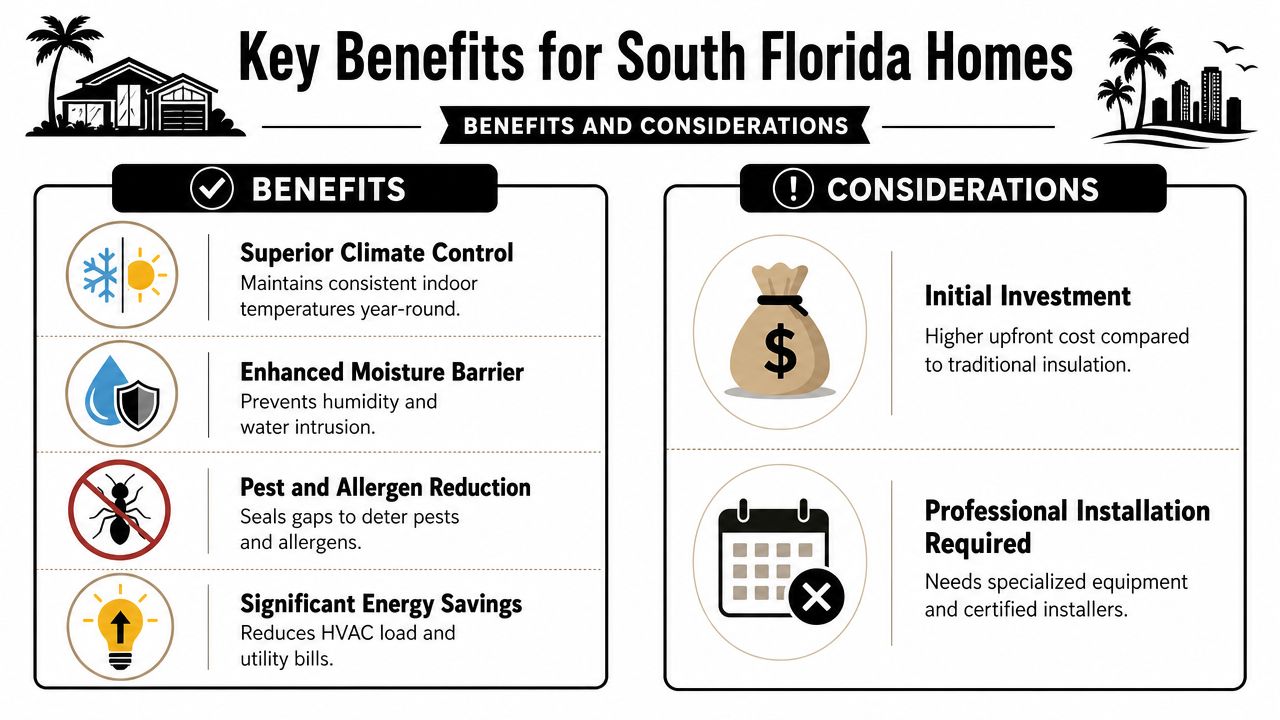
When outside air leaks through the underside of the house, your HVAC system has to condition that extra heat and moisture. Foam seals irregular gaps that batt insulation leaves open. That changes how the house feels day to day.
ENERGY STAR states that homeowners can save an average of 15% on heating and cooling costs by air sealing their homes and adding insulation in areas like crawl spaces (ENERGY STAR Seal and Insulate guidance). The savings vary by house, but the principle is consistent. Tighten the envelope, and the AC has less extra work.
A lot of articles stop at “spray foam creates an air seal.” That's not enough for South Florida. If you only spray the underside of the floor and ignore the crawl space itself, you can still end up with a wet, humid environment below the house.
Independent guidance on crawl-space applications notes that spraying the underside of a floor alone does not control crawl-space humidity. In humid climates, the better assembly often includes a sealed ground vapor barrier and foam applied to the foundation walls rather than the floor joists, creating a conditioned or semi-conditioned space (crawl-space moisture discussion).
That's the difference between a controlled system and a moisture trap.
A good under-house foam job in South Florida isn't just insulation. It's part of a moisture-control strategy.
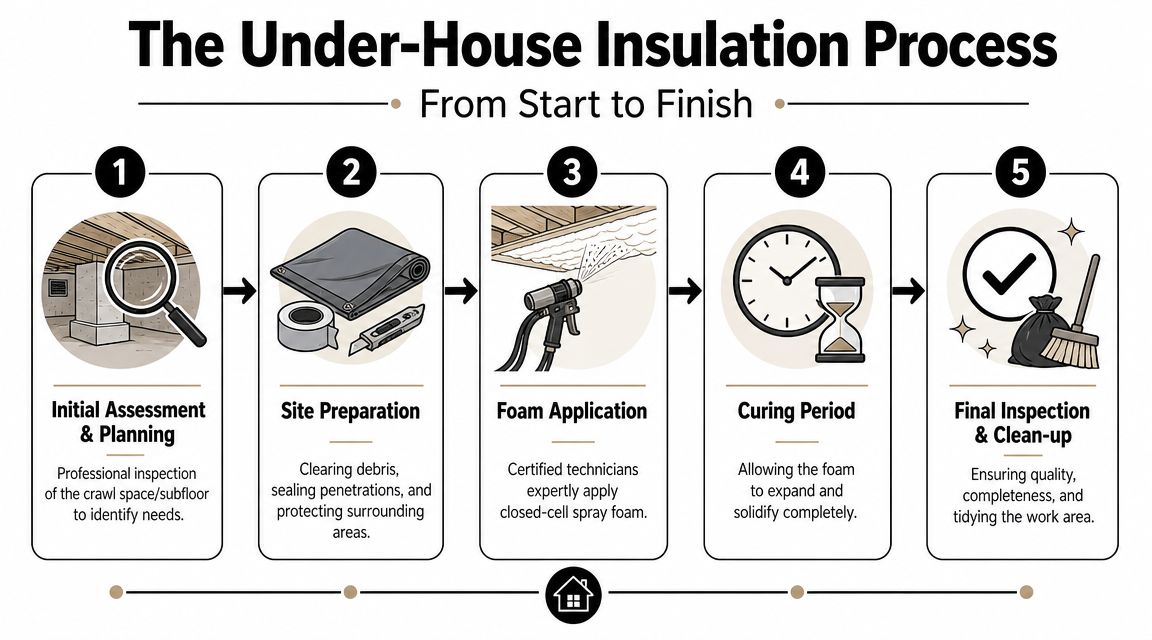
A South Florida crawl space can look dry at a glance and still be carrying enough humidity to cause problems after the crew leaves. That is why a good under-house foam job starts with diagnosing the whole assembly, not just pricing a spray day.
If the plan is wrong, foam can lock in a bad moisture pattern instead of fixing it.
The first visit should answer a few specific questions. Is bulk water getting in during storms. Is the ground exposed or already covered with a vapor barrier. Are vents bringing in outside humidity that will stay trapped below the house. Are the joists, subfloor, and rim areas dry enough to accept foam properly.
That inspection shapes the scope. In some homes, spraying the floor system makes sense. In others, the better approach is sealing the crawl space, addressing the ground first, and insulating the perimeter so the space works as part of the house instead of fighting it.
Debris gets removed. Loose or failing material comes out. Wet surfaces, active leaks, and drainage issues get addressed before any foam is applied. If a contractor skips that step, the foam may still stick, but the assembly can still fail.
For homeowners comparing application areas, this guide on spray foam insulation for floor joists shows where crews typically focus coverage and air sealing.
Foam thickness matters, but consistency matters just as much. Installers need enough material to create a continuous air seal across the intended surface, with special attention at seams, corners, penetrations, and rim sections where outside air usually gets in.
Under a house in South Florida, crews also need to match the foam type to the moisture conditions. Closed-cell is often chosen because it adds a stronger moisture barrier and handles damp, demanding environments better than open-cell. Open-cell can still have a place in some assemblies, but only when the rest of the moisture strategy is correct.
A helpful installation visual is below.
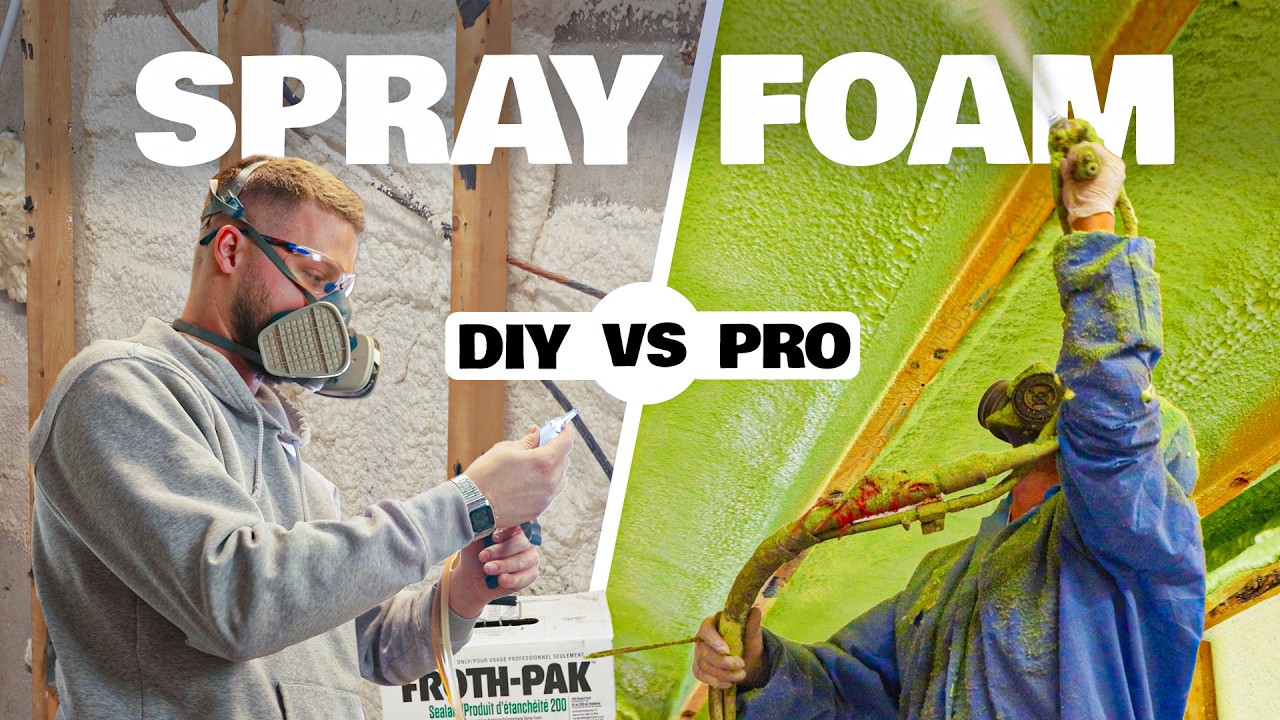
Good application is deliberate. The crew should spray in lifts that allow proper expansion and adhesion, keep the substrate within the right temperature range, and avoid leaving thin spots behind utility lines or tight framing. Under-house work is slow for a reason.
Once the foam sets, the job is not finished. The crew needs to trim excess material where needed, remove masking, clear job waste, and inspect the full area for misses. I pay close attention to plumbing cutouts, band joists, transitions between materials, and any place where humid air can still bypass the foam layer.
The final review should also confirm that the crawl space moisture plan matches the foam work. That may include checking the ground cover, confirming how vents are being handled, and identifying repairs that still need to happen if the house has drainage or structural issues. This is the part many homeowners never see, and it is often the difference between a system that stays dry and one that starts smelling musty in six months.
A clean finish usually includes:
If you are comparing quotes, it helps to see how contractors discuss labor, access, and material choices in markets outside Florida too. This overview of GTA spray foam insulation pricing is a useful example of how scope changes the number.
A professional under-house installation is a system. Foam is one part of it. Vapor control, ventilation strategy, drainage, and careful detailing decide whether that system works.
Cost matters, but under-house spray foam pricing isn't one flat number. The price changes based on the size of the area, how accessible the crawl space is, the condition of the surfaces, and whether the job includes related moisture-control work like ground vapor barriers or sealing details.
Closed-cell foam also changes the investment level. It's a denser product, and it's usually chosen under houses because the performance demands are higher there. If the house has active moisture issues, prep and repairs can affect the project even more than the insulation itself.
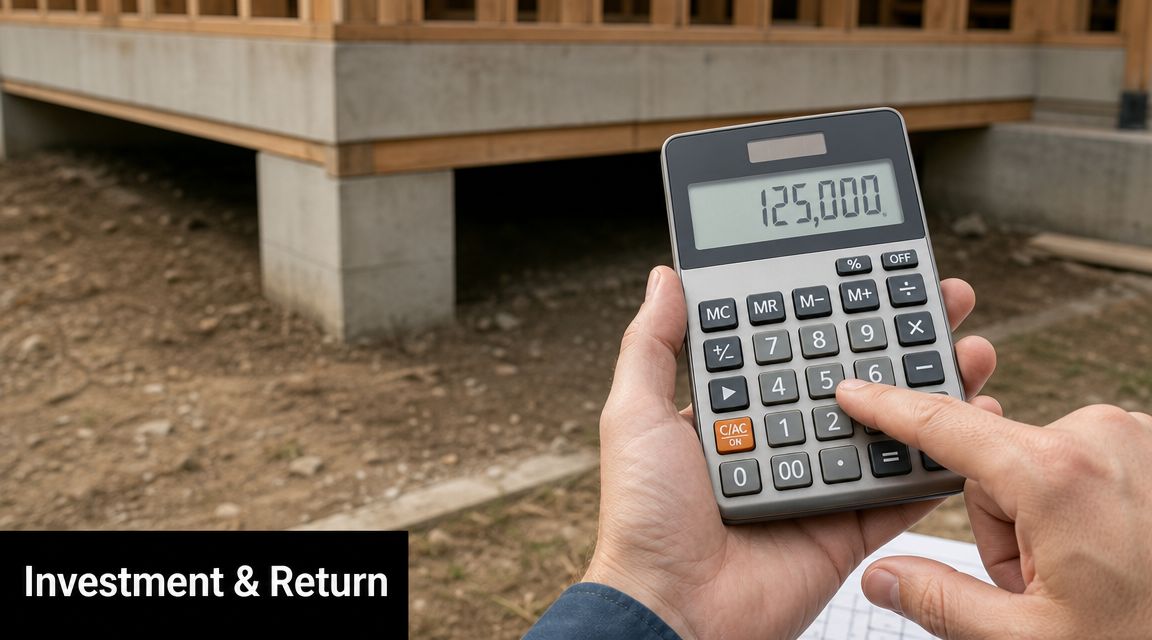
A serious estimate should account for more than square footage.
If you want a general example of how contractors break down regional pricing, this resource on GTA spray foam insulation pricing is useful as a comparison point for quote structure, even though local South Florida conditions and scope can differ.
ENERGY STAR says homeowners can save an average of 15% on heating and cooling costs when they air seal and add insulation in areas like crawl spaces, as noted earlier in the article. That's the direct financial case.
The less obvious return comes from reducing strain on the home itself. A drier, tighter under-house assembly can mean fewer comfort complaints, less risk of moisture-related damage, and fewer situations where the AC runs constantly without solving the problem.
The cheapest bid often skips the work that keeps the assembly dry. Under a house, that shortcut can get expensive later.
A quote has value when it answers the hard questions. What foam type is being installed? Is the installer addressing ground moisture? Are they spraying the right surfaces for this crawl-space design? Are they preparing the substrate correctly?
A low number without those answers isn't a savings. It's a guess.
The biggest mistake homeowners make is thinking spray foam under a house is a standalone fix. It isn't. Foam works when the whole assembly makes sense.
In humid climates, that usually means thinking in terms of a sealed or conditioned crawl space instead of an old-school vented one. If humid outside air keeps washing through the crawl space, insulation alone won't control what the space is exposed to every day. The house needs a strategy for moisture, ground vapor, and air movement.
Spray foam can seal leaks, improve thermal control, and help limit moisture migration when it's used in the right assembly. It cannot fix active water intrusion, structural movement, or hidden plumbing problems.
That distinction matters because foam can hide defects once they're covered.
According to practical guidance on spray foam installation, you should not use foam to cover plumbing leaks or foundation cracks because it can trap water and hide or worsen mold growth and structural damage. The same guidance says wood moisture content should be tested and confirmed below 19% before installation (spray foam do's and don'ts).
If any of these conditions are present, the installer should slow down and address them first:
If the wood is wet before the foam goes on, the job is already headed in the wrong direction.
Spray foam itself doesn't need much day-to-day attention, but the crawl space still does. Homeowners should inspect periodically for new plumbing leaks, pest activity, standing water after storms, and damage to any ground vapor barrier. If the crawl space is part of a sealed system, maintaining that system matters just as much as the insulation.
A good under-house project doesn't end with cured foam. It stays successful because the moisture conditions under the house stay controlled.
In Jupiter, Palm Beach Gardens, West Palm Beach, Wellington, and Stuart, under-house insulation has to be designed for humidity first. That's the local filter I'd use when hiring a contractor. If they talk only about R-value and never about moisture, keep looking.
The contractor should be able to explain why they're recommending a specific foam, where they plan to apply it, and how they'll deal with any crawl-space moisture concerns before spraying. If they can't describe that clearly, they probably don't work in enough South Florida crawl spaces.

For homeowners comparing companies, this guide to spray foam insulation contractors is a helpful reference for what professional standards should look like.
A good contractor doesn't promise that foam fixes everything. They explain the trade-offs. They tell you when closed-cell is the better fit. They mention vapor barriers and crawl-space design. They identify what has to be repaired before insulation starts.
That kind of answer usually saves homeowners from the expensive version of this job.
If you're in Jupiter, Palm Beach Gardens, West Palm Beach, Wellington, Stuart, or nearby areas and want a professional evaluation of your under-house insulation needs, Airtight Spray Foam Insulation can help. Their team understands how South Florida humidity affects crawl spaces, floor systems, and foundations, and they can recommend the right combination of spray foam, moisture control, and installation detail to keep your home more comfortable, efficient, and protected.