If you're searching closed cell foam near me, there's a good chance you're dealing with the same South Florida pattern most local homeowners run into. The AC runs hard, some rooms still feel sticky, the attic is brutally hot, and your monthly cooling cost never seems to line up with how uncomfortable the house feels.
That problem usually isn't just about “not enough insulation.” In Jupiter, Wellington, Stuart, and the surrounding coastal areas, the bigger issue is that heat and moisture move together. If humid outdoor air keeps sneaking into the house, or your attic turns into a hot, damp buffer zone above the ceiling, standard insulation often doesn't solve the whole problem. It may slow heat flow, but it won't always stop the air movement and moisture migration driving the discomfort.
Closed-cell spray foam gets attention locally for a reason. It doesn't act like a simple fill material. In the right assembly, with the right installer, it can help control air leakage, reduce moisture movement, and improve thermal performance in the same step. That matters in a region where comfort, durability, and cooling costs are tied directly to humidity control.
A common local scenario goes like this. The house looks fine from the outside, the AC is newer, and there's already insulation in the attic. But by midday, the second floor feels warmer, supply vents sweat, and the indoor air has that faint damp feel that tells you the system is working harder than it should.
In South Florida, fiberglass and other traditional insulation products often struggle when the primary problem is air leakage mixed with moisture. An attic can hold extreme heat. Wall cavities can allow humid outside air to move through weak points. Ducts and equipment can sit in hostile conditions for most of the year. The result is a house that feels inconsistent even when the thermostat says everything is under control.
Coastal homes deal with humidity, wind-driven rain, and salt-air exposure. Those conditions punish assemblies that rely on insulation alone without a serious air and moisture strategy. If the house is pulling in humid air, the AC doesn't just cool. It also has to remove latent moisture, and that's where many homes start losing efficiency.
That's one reason closed-cell foam keeps showing up in more projects. The material is part of a market that has grown from $2.60 billion in 2024 to a projected $4.01 billion by 2030, reflecting wider adoption for energy efficiency and moisture resistance in demanding environments, according to the closed-cell foam market forecast from Research and Markets.
A South Florida insulation decision also sits inside a bigger property-protection conversation. If your home is near the coast or in a flood-prone area, building envelope choices matter, but so does understanding your broader risk. Homeowners reviewing insulation upgrades often also review flood insurance coverage options so they know what protection starts where.
Good insulation helps your house perform better. It doesn't replace a full moisture-risk plan.
What works here is a system approach. You're not just trying to make the attic less hot. You're trying to control how heat, air, and moisture move through the structure so the house stays more stable day after day.
Closed-cell spray foam is a two-part material that expands into a rigid foam made up of tiny sealed cells. The easiest way to think about it is a tight honeycomb of gas-filled bubbles. Those cells are packed together, and unlike open-cell foam, they don't stay soft and porous.
That structure is why the material does more than one job at once. It insulates, it limits air movement, and it resists bulk moisture better than softer foam products. In the field, that matters because South Florida houses don't fail from one issue alone. They fail when heat, humidity, and uncontrolled air leakage keep feeding each other.
The physics behind closed-cell foam are straightforward once you strip away the jargon. Heat moves by conduction, convection, and radiation. Foam mainly addresses the first two. Its small cell size sharply limits internal air movement, which helps stop convective heat transfer inside the material itself.
An Oak Ridge National Laboratory review notes that convective heat transport is eliminated by the foam's small cell size, and in new foam the gas inside the cells can account for roughly 40% of the total thermal conductivity behavior. The same review also explains that the solid conductive portion changes significantly with density, which is one reason formulation and installation quality matter so much in real projects. That analysis appears in Oak Ridge National Laboratory's review of foam thermal behavior.
Practical rule: In South Florida, insulation that only slows heat but doesn't help control humid air movement usually leaves part of the problem unsolved.
Once installed correctly, closed-cell foam adheres to the substrate and forms a continuous layer in places where batt insulation often leaves gaps, edges, and irregular coverage. That makes it useful in roof decks, wall cavities, rim areas, and other parts of the house where geometry is awkward and leakage paths are hard to seal with separate materials.
Here's what homeowners usually care about most:
Closed-cell foam isn't magic, and it isn't the answer to every assembly. It has to be installed at the right thickness, in the right location, and with a plan for the entire building envelope. If a contractor treats it like a one-size-fits-all product, performance can fall short.
That's why the “near me” part of the search matters. Local climate changes how this material should be used. In South Florida, the value comes from matching the foam's physics to the region's constant heat and moisture load.
In a dry climate, the choice between open-cell and closed-cell foam can be more flexible. In South Florida, the decision is tighter because moisture control is not optional. If you're insulating a roof deck, exterior wall, garage conversion, or metal structure anywhere near the coast, the wrong foam can leave you with a house that's air sealed but still vulnerable to moisture problems.
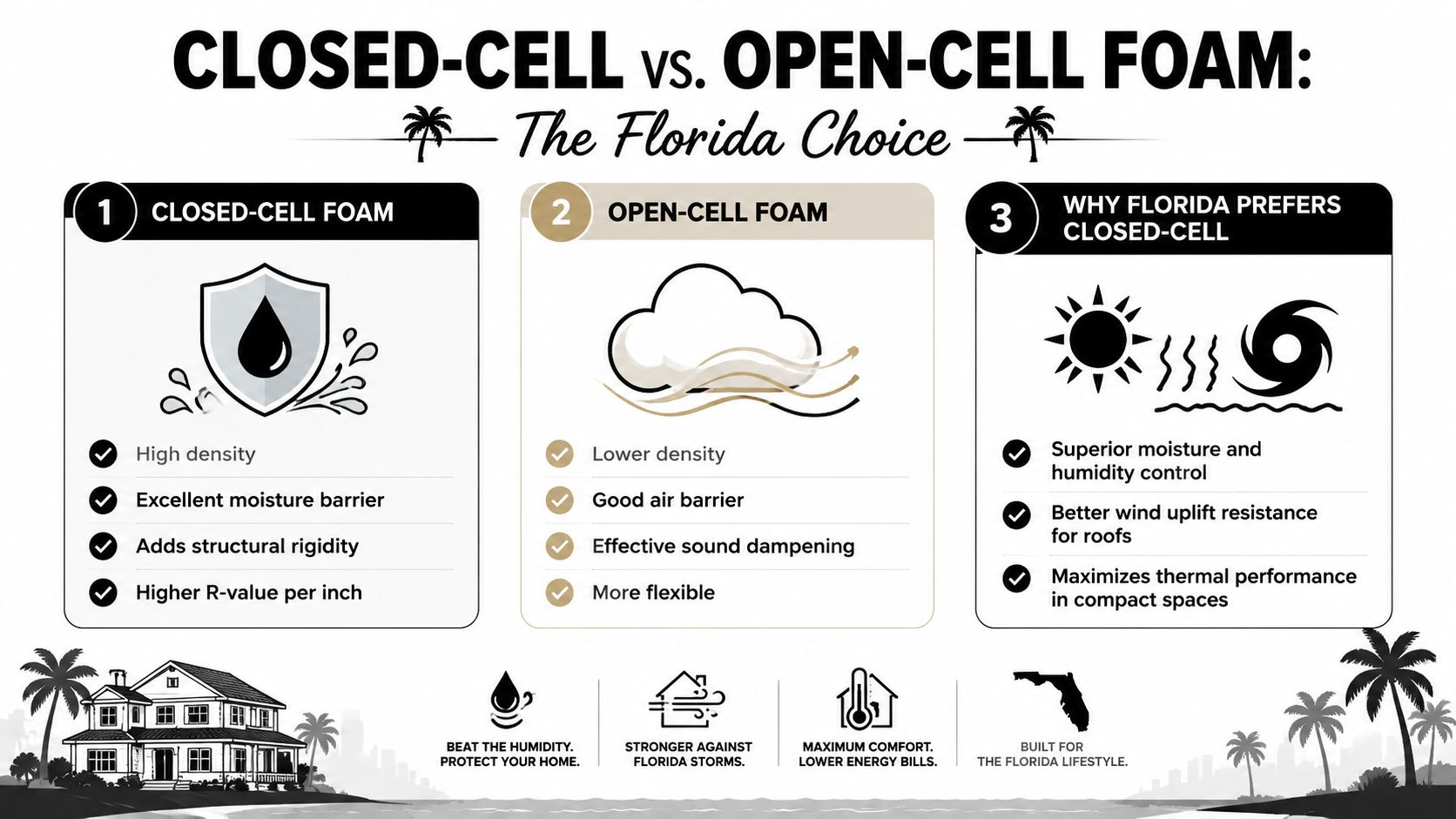
Open-cell foam is lighter and more vapor open. It can work well in some interior applications where sound control and expansion are priorities. Closed-cell foam is denser, more rigid, and more resistant to vapor movement. In Florida assemblies, that difference often decides which product gives you longer-term control over humidity.
A useful side-by-side summary:
| Feature | Closed-cell foam | Open-cell foam |
|---|---|---|
| Density | Higher | Lower |
| Texture after cure | Rigid | Softer |
| Moisture behavior | More vapor-resistant | More vapor-open |
| Best fit in Florida | Moisture-sensitive assemblies, compact cavities, coastal conditions | Select interior uses where vapor openness is acceptable |
Manufacturer data for 2.0 lb closed-cell foam shows water vapor permeance around 0.8 perms at 1 inch, which makes it a Class II vapor retarder. That same data set also reports core density around 2.0 lb/ft³, closed-cell content greater than 90%, water absorption under 2% by volume, and air impermeability below 0.02 L/s-m² at 1 inch, all of which explain why this product type is often the more technical choice in humid coastal conditions. Those specifications are listed in Carlisle's closed-cell spray foam product data.
Many people ask which foam has the better “R-value feel.” That's not the first question I'd ask on a South Florida job. I'd ask where the moisture is coming from, whether the assembly needs drying potential in a particular direction, and what part of the house is under stress.
For a helpful breakdown of how contractors look at these two materials in residential projects, see this guide on closed-cell vs open-cell spray foam.
Closed-cell is often the stronger choice when you're dealing with:
If a home has persistent humidity issues, a soft, vapor-open material in the wrong location can create a problem that doesn't show up right away.
Open-cell still has legitimate uses. But in South Florida, closed-cell is frequently the product that fits the climate risk better, especially when moisture resistance is carrying as much weight as thermal performance.
The best use of closed-cell foam depends on where your home is losing control of heat and humidity. In South Florida, three areas come up again and again: the attic or roof deck, exterior wall assemblies, and metal outbuildings or workshops. Those are the spots where the material's density and moisture resistance usually pay off fastest in day-to-day comfort.

A vented attic with conventional insulation can still leave your ductwork and air handler sitting in punishing conditions. When that attic stays superheated and humid, the HVAC system works in a space that fights it all day. Applying closed-cell foam at the roof deck changes that relationship by bringing the attic closer to the conditioned envelope.
That doesn't automatically make every attic perfect. The installer still has to account for ventilation strategy, equipment layout, and the rest of the building envelope. But when the design is right, this approach can reduce heat load on ducts and limit the damp, hostile environment that shortens comfort and efficiency.
Closed-cell foam makes sense in walls when you want insulation and tighter moisture control in one layer. In new construction, that can help builders simplify cavity insulation while improving envelope performance. In renovations, it can be useful where wall depth is limited and every inch matters.
It also adds rigidity compared with softer foams. That doesn't mean it replaces structural design, but it does mean the cured material becomes part of a tougher assembly.
On many Florida jobs, the wall isn't failing because it lacks insulation. It's failing because humid air keeps moving through it.
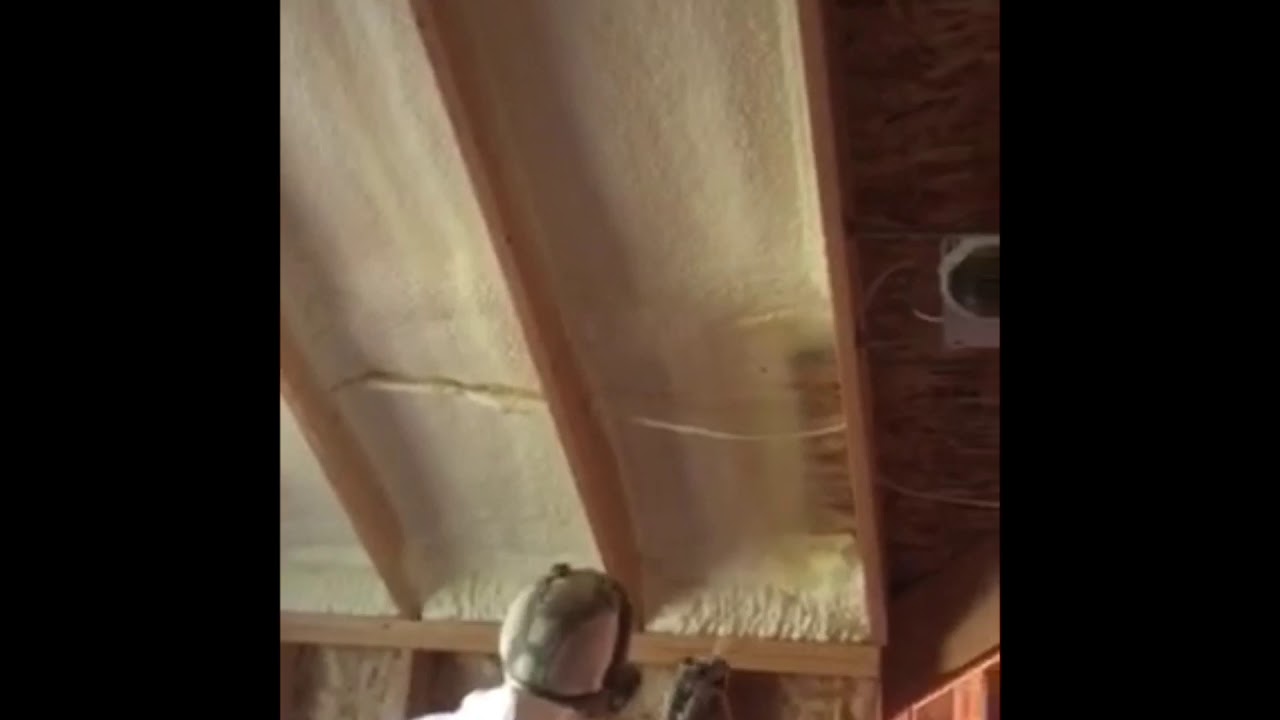
A quick visual can help if you want to see how spray foam is applied in the field:
Metal structures are a separate category because condensation is usually the primary enemy. Owners often think the building is just hot. In practice, the bigger issue can be interior surface conditions that let moisture collect when warm, humid air meets cooler metal.
Closed-cell foam is a strong fit here because it adheres directly to the surface and creates a continuous insulating layer that also helps reduce moisture-related condensation risk. That makes a real difference in workshops, storage spaces, detached garages, and utility buildings where people want more stable indoor conditions.
Not every problem calls for spraying the whole house. Sometimes the smarter play is targeted work:
That's where an honest site evaluation matters. Good closed-cell projects solve a specific building problem. Bad ones just put expensive material where it isn't needed.
Closed-cell foam usually costs more up front than simpler insulation options. That part surprises nobody. The question is whether the added cost solves a problem that cheaper materials won't solve, especially in a climate where cooling runs most of the year and indoor comfort depends heavily on moisture control.
South Florida changes the ROI conversation because AC demand stays high for long stretches. Generic articles often talk about “energy savings” in abstract terms, but local owners need a practical framework: what part of the house is being upgraded, what problem is being fixed, and whether the foam is replacing insulation alone or acting as insulation plus air sealing plus moisture control.
One of the biggest information gaps online is the lack of region-specific ROI guidance. That matters here because heavy AC usage for 9+ months can shorten the payback period for high-performance insulation compared with milder climates, as noted in this discussion of spray foam installation cost and ROI gaps.
That doesn't mean every project pays back quickly. If the house already has a tight envelope and the main issue is an undersized AC system, insulation won't solve the root problem. But if the home has a hot roof deck, leaky attic boundaries, or moisture-prone wall assemblies, closed-cell foam can address multiple cost drivers at once.
Cost depends less on a generic “per square foot” number and more on job conditions. The variables that move pricing are usually straightforward:
For homeowners comparing bids, a local contractor should be able to explain those variables clearly. If you want a more detailed look at the factors that shape project pricing, this page on spray foam insulation installation cost is a useful starting point.
A smart ROI review in South Florida should include more than utility bills. Look at the full outcome:
| ROI factor | Why it matters locally |
|---|---|
| Cooling efficiency | Long AC seasons magnify envelope weaknesses |
| Humidity control | Better air sealing can reduce damp indoor conditions |
| Durability | Moisture control can protect assemblies over time |
| Comfort | More stable room temperatures matter every day |
If you're searching closed cell foam near me because your house feels humid or inconsistent, the best ROI often comes from fixing a building-envelope problem that standard insulation never addressed in the first place.
Closed-cell foam is one of those products that can perform extremely well or disappoint badly depending on who installs it. The material itself doesn't guarantee the result. The installer controls surface prep, lift thickness, substrate conditions, job sequencing, trimming, ventilation during application, and whether the foam is being used in the right assembly at all.
That's why hiring the right contractor matters more here than in many other trades. A sloppy paint job looks bad. A sloppy foam job can hide behind drywall while causing comfort or moisture problems for years.

When I talk to property owners, I tell them to listen for how a contractor thinks, not just what they promise. A good installer should ask where the humidity problem shows up, what type of roof or wall assembly is involved, whether ducts are in the attic, and what the homeowner is trying to fix first.
They should also be able to explain why they recommend closed-cell in one area and not another. If every answer sounds like “spray foam fixes everything,” keep looking.
Here's a practical checklist.
Bad spray foam bids often reveal themselves in the estimate conversation. If the contractor doesn't inspect the actual site conditions, the quote is probably too generic. If the price is dramatically lower than everyone else's, there's usually a reason, and it may involve rushed prep, inconsistent thickness, or lower-grade materials.
Field advice: Cheap foam work can be expensive to correct because removal is messy, time-consuming, and avoidable.
Another warning sign is vague language around thickness and coverage. The contractor doesn't need to bury you in jargon, but they should explain what they're spraying, where they're spraying it, and what problem that specific scope is meant to solve.
Use questions that force a real answer:
What building problem are you solving in this house?
Comfort complaint, humidity load, duct losses, wall condensation risk, or something else?
How do you handle prep and protection?
Masking, staging, cleanup, and occupant planning tell you a lot about professionalism.
What happens if you find hidden issues?
Rotten decking, wet material, or unexpected leakage paths should change the plan, not get buried.
Who is performing the work?
Some companies sell the job with one person and send a different crew with less experience.
Can you explain your process from estimate to final walkthrough?
If they can't describe the sequence, they may not have a repeatable system.
For homeowners evaluating local providers, this page on spray foam insulation contractors outlines the kind of contractor information you should expect to review. One local option serving South Florida is Airtight Spray Foam Insulation, which provides open-cell and closed-cell applications for homes and commercial properties.
Online presence matters, but not because slick marketing proves installation skill. It matters because established contractors usually document their work, explain their services clearly, and communicate consistently. If you're curious how trade companies build that visibility, HelloMail's 2026 growth playbook gives a useful look at how local service businesses present themselves online. Use that as background, then verify the installer's actual process, job photos, and communication quality.
The best hire is rarely the fastest talker. It's the contractor who can explain the building science in plain English and then apply it cleanly on site.
Homeowners usually worry about installation-day exposure, not the cured product itself. The practical point is simple: the crew should follow proper safety procedures during application, isolate the work area as needed, and give clear guidance about when it's appropriate to re-enter the space. If a contractor brushes off that question, that's a hiring problem.
Sometimes yes, sometimes no. It depends on where the existing insulation is, what condition it's in, and whether leaving it in place interferes with the assembly you're trying to create. In many attic and roofline projects, old material may need to come out so the installer can seal the correct boundary and inspect the substrate properly.
Ask the contractor to explain what stays, what goes, and why. You want an assembly plan, not a shortcut.
The schedule depends on project size, access, prep, and how much masking or removal is involved. A straightforward job moves much faster than a retrofit with limited attic access or complicated roof geometry. What matters more than speed is control. Good crews don't rush substrate prep, trim work, or cleanup just to finish early.
Closed-cell foam is generally chosen as a long-term building material, not a short-cycle upgrade. Its lifespan depends on correct installation, the condition of the surrounding assembly, and whether the foam is being used in the right place. If the roof leaks, if moisture is entering from another pathway, or if the substrate was compromised before application, those issues still need to be addressed.
Look beyond ads and reviews. Ask for a detailed scope, product information, safety steps, and a clear explanation of why closed-cell is being recommended for your house. If you're researching how strong local contractors build online credibility in the first place, this guide on how to rank local construction businesses can help you understand what you're seeing when you compare companies online.
If you want practical guidance on whether closed-cell spray foam makes sense for your attic, walls, garage, or metal building, Airtight Spray Foam Insulation serves South Florida properties with project-specific recommendations based on the actual moisture, heat, and air-leakage issues in the building.