If you're standing in a South Florida pole building at midday, you already know the problem. The air feels heavy, the metal shell radiates heat, and the moment you start thinking about storing tools, feed, equipment, vehicles, or inventory inside, humidity becomes just as big a threat as temperature.
That’s why pole building insulation in this region can’t follow the same advice you’d use in a dry inland climate or a cold northern market. A metal building in Jupiter, Wellington, West Palm Beach, or Stuart deals with a different set of pressures. Heat moves fast through steel. Moisture hangs in the air. Condensation can show up when the building is closed up, when it’s air conditioned, or sometimes both. If the insulation plan doesn’t account for that, you can spend good money and still end up with a sweaty roof, stale air, and rust where you least want it.
A pole building in South Florida doesn’t fail slowly. It usually tells on itself right away.
You walk in early and the roof feels damp. Metal tools get a film on them. Cardboard softens. Tack rooms smell musty. A workshop that looked fine on paper turns into a place you avoid during the hottest part of the day. That isn’t bad luck. It’s building physics.
Pole buildings, also called post-frame structures, lose and gain heat faster than traditional stick-framed buildings because of their large metal panel surfaces, which conduct thermal energy rapidly. Proper insulation slows that heat transfer, reduces air infiltration, and helps prevent condensation on cold metal surfaces, as explained in this pole barn insulation guide. In South Florida, that moisture-control piece matters just as much as the temperature-control piece.
A lot of generic articles treat moisture like a seasonal side note. That’s not how South Florida works.
Generic online guides often overlook the unique challenges of high-humidity environments like South Florida, where condensation can form year-round. That gap matters because conductive metal panels plus heavy moisture load require a different strategy, especially if you want to avoid rust, mold, and long-term structural decay, as noted in this hot-climate pole barn insulation discussion.
Practical rule: In South Florida, if your insulation plan only talks about R-value and never talks about condensation, it’s incomplete.
That’s also why owners of metal buildings often need to think beyond the walls and roof alone. Doors, slab edges, ventilation paths, and interior use all affect how the building performs. If you’re trying to create a space that works day to day, it helps to review how complete metal building insulation systems are put together instead of choosing one material in isolation.
In this climate, insulation has to handle several jobs at once:
Even support systems around the building deserve attention. Cold snaps are rare here, but exposed plumbing in utility areas can still become vulnerable during unusual weather. For property owners who want to protect the whole structure, this guide on Blue Gas Express pipe freezing advice is worth bookmarking.
South Florida pole building insulation isn’t about making the building a little less hot. It’s about making the building usable, drier, and far more predictable.
A South Florida pole building can look fine on paper and still perform poorly once summer settles in. I see it all the time. Owners pick insulation by price per bag or price per sheet, then spend the next few years fighting sweat on the metal, hot afternoon interiors, and a constant damp feel that never quite goes away.
The right insulation choice depends on how you use the building. A tractor shed, an air-conditioned workshop, a horse barn, and a storage building for tools or inventory do not need the same assembly. In our climate, the key question is not only how much R-value you buy. It is whether the system also controls humid air before it reaches the metal skin.
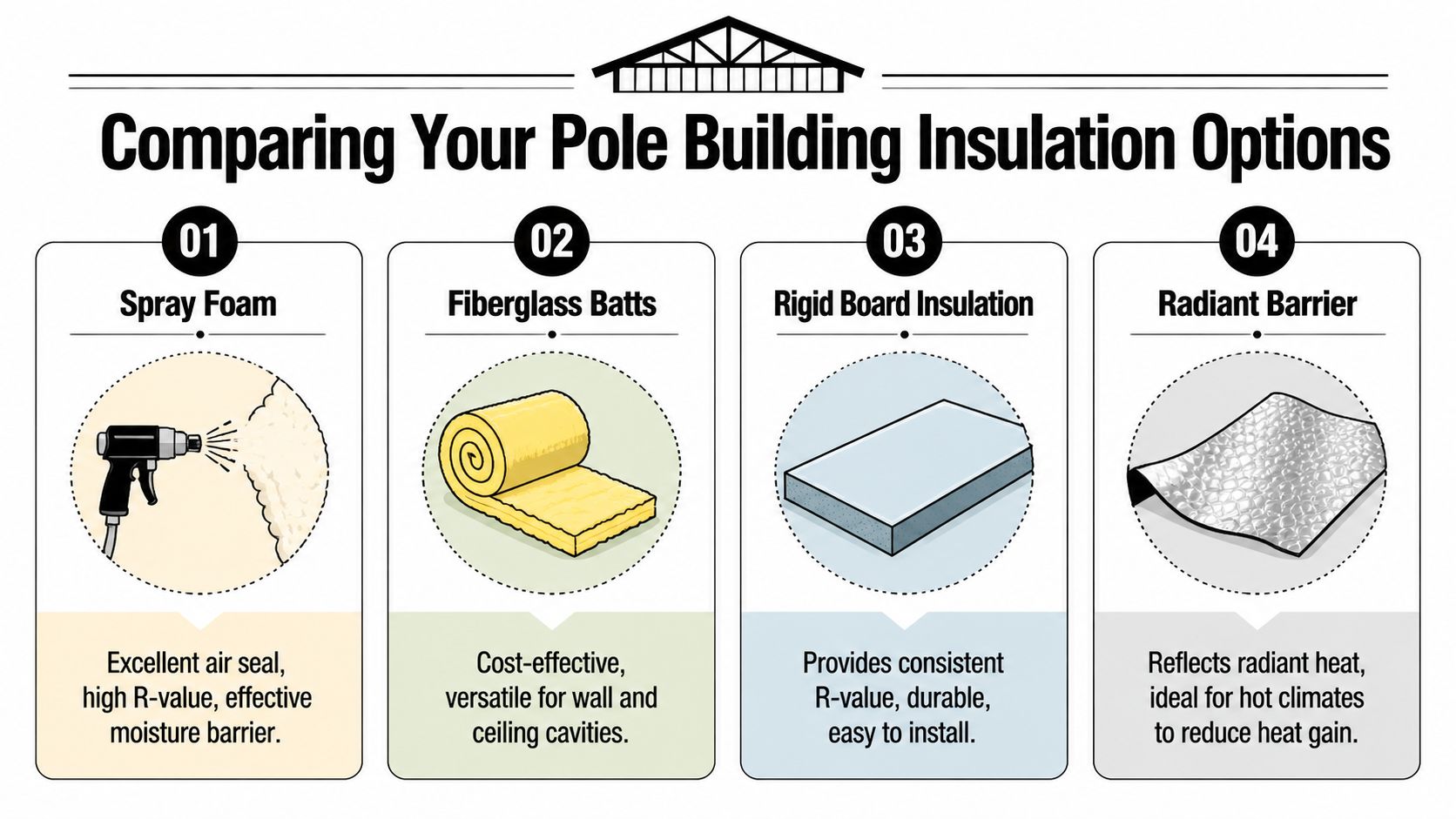
The U.S. Department of Energy notes that fiberglass batts provide roughly R-3.1 to R-3.4 per inch, while spray foam delivers higher R-values per inch and can also serve as an air barrier depending on the product and thickness, as explained in DOE guidance on insulation materials. That difference matters in pole buildings because thin metal shells and lots of joints leave little room for sloppy detailing.
Here’s the field-level comparison.
| Insulation type | What it does well | Where it struggles in South Florida | Best fit |
|---|---|---|---|
| Closed-cell spray foam | High R-value per inch, air sealing, moisture resistance, bonds to metal | Higher upfront cost, requires trained installation | Conditioned shops, garages, equipment buildings, enclosed workspaces |
| Open-cell spray foam | Air sealing, sound control, fills irregular cavities | Not the first choice where low permeance is needed against metal | Interior partitions and assemblies where drying potential matters |
| Fiberglass batts | Lower material cost, easy to source, familiar to many crews | Loses effectiveness when air moves through it, needs separate air and moisture control | Budget-driven wall cavities with a well-planned liner and moisture strategy |
| Rigid foam board | Predictable performance, useful at slabs and specific wall details | Harder to detail around posts, girts, and irregular metal framing | Slab edges, door perimeters, selective retrofit upgrades |
| Radiant barrier | Helps reduce radiant heat gain under the right roof conditions | Does not air seal, does not replace real insulation | Supplemental roof upgrade, especially under hot metal roofing |
Fiberglass still has a place. In a basic storage building with no air conditioning and no moisture-sensitive contents, it can be the low-cost option if the wall and roof assembly are built correctly. The problem is not the fiberglass itself. The problem is that many pole buildings in South Florida are full of small air paths at trim, ribs, laps, eaves, and penetrations, and fiberglass does not stop that airflow.
Rigid board earns its keep in targeted areas. I like it around slab edges, at overhead door jambs, and in retrofit situations where full cavity work is not practical. If you are comparing full-building systems for a metal shell, this guide to spray foam insulation for metal buildings shows why air sealing becomes part of the insulation decision, not a separate afterthought.
Radiant barriers are often oversold in Florida. They can help under the right roof assembly with proper air space, but they do not solve condensation risk and they do not make a building comfortable by themselves. Owners who rely on a radiant barrier alone usually end up adding more insulation later.
The overhead door often becomes the weakest part of the envelope.
A well-insulated roof and wall package will still struggle if the largest opening in the building is thin, poorly sealed, and exposed to direct sun all afternoon. If your project includes a service bay or roll-up door, Wilcox Door's insulated door solutions are worth reviewing because door performance affects heat gain, air leakage, and day-to-day comfort.
The best option for South Florida owners is usually the one that handles more than heat flow. It needs to fit the budget, the use of the building, and the humidity load you deal with for most of the year.
When a metal building is fighting both heat and humidity, spray foam solves problems that other materials leave behind.
That’s the practical case for it. Not hype. Just function.
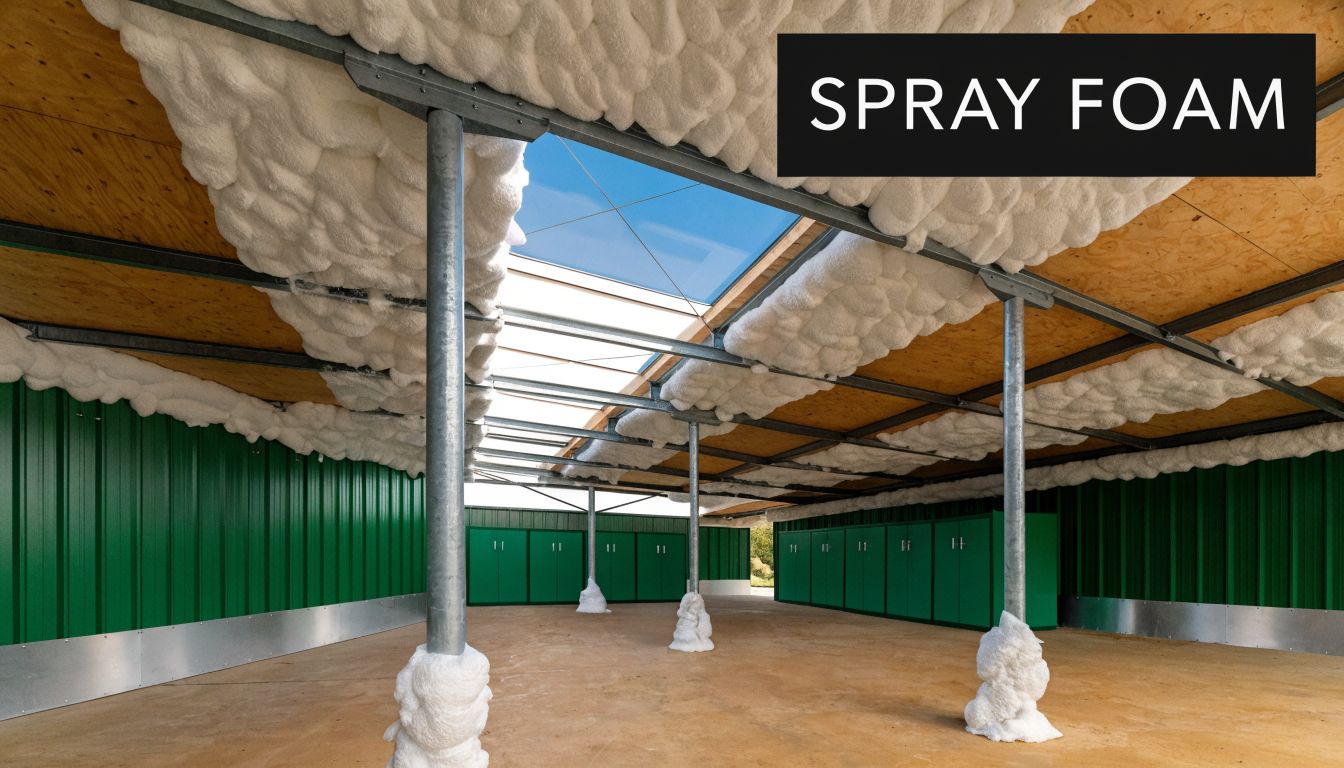
Closed-cell foam is especially strong in metal structures because it adheres directly to the building surface, seals gaps and ridges, and adds a layer of moisture resistance where the shell is most vulnerable. In demanding climates, it delivers R-6.5 to 7.0 per inch and acts as an air barrier, vapor barrier, and structural enhancer, according to this overview of spray foam for pole barn insulation benefits.
Batts can insulate a cavity. They can’t hunt down every seam, overlap, fastener line, and irregular pocket in a steel-clad building.
Spray foam expands into those transitions. That matters because a pole building doesn’t lose performance only through broad wall areas. It leaks around edges, penetrations, roof-to-wall joints, and all the little places humid air likes to travel.
A Department of Energy-backed ORNL study from 2022 found that buildings insulated with spray foam experience up to 50% less energy loss than buildings using traditional materials like fiberglass. In a metal building, where air leakage and conductive surfaces make every weakness more obvious, that’s a meaningful advantage, as noted in the source above.
Closed-cell spray foam isn’t just an insulation layer. In the right assembly, it becomes the air control layer and the moisture-control layer too.
If you want a deeper look at assemblies built specifically for this type of structure, this page on spray foam insulation for metal buildings lays out the applications clearly.
Both have a place. They just don’t do the same job.
This short walkthrough gives a good visual sense of how spray foam is applied in a metal building and why coverage quality matters.

Spray foam is usually the strongest fit for:
In South Florida, the biggest argument for spray foam isn’t that it’s trendy. It’s that metal buildings punish half-measures.
A good insulation project starts before anyone brings out hoses, batts, or boards. The planning stage decides whether the building will perform well or keep fighting you.
R-value is part of that discussion, but it isn’t the whole discussion. In pole building insulation, where you place the insulation can matter just as much as the number attached to the product.

The 2021 IECC provides insulation benchmarks, but the best assembly depends on application. In some climate zones, reaching R-60 at the roof with spray foam can become expensive, while adding a ceiling and using R-60 blown-in insulation can be the more economical route because it conditions a smaller space, as discussed in this article on how to insulate a pole barn roof.
That principle matters even in South Florida. If you don’t need the full volume of the building conditioned, insulating the ceiling plane can be smarter than insulating the underside of the roof throughout. On the other hand, if the roofline is part of the occupied enclosure, then roof-deck insulation becomes the right conversation.
A higher number isn’t automatically a better building.
What matters is how the whole assembly behaves:
If you want background on what R-value really means in a building enclosure, this guide on a good R-value for insulation is a helpful reference.
A code target tells you where to aim. It doesn’t tell you the best way to build the assembly.
A contractor should pin down these items early:
Those answers shape the system.
Insulation and ventilation aren’t enemies. They work together.
If a pole building is going to be tighter, the air movement inside needs to be intentional. That’s especially true in South Florida, where trapped humidity can linger if the building doesn’t have proper exhaust, dehumidification, or mechanical air movement. A building can be well insulated and still feel bad if stale, damp air has nowhere to go.
The installation path changes a lot depending on whether the pole building is still on paper or already full of shelves, tools, and wiring.
New construction gives you access. Retrofit work demands problem-solving.
On a brand-new build, the crew can work before interior finishes go up. That opens the entire shell.
For new builds, the biggest wins usually include:
Retrofitting an existing pole building is still very workable, but it takes more prep and more discipline.
Older buildings often have dust on the steel, clutter along the walls, exposed wiring added over time, and a mix of old repairs that no one documented. Before insulation starts, the interior has to be evaluated for access, surface condition, roof leaks, and any moisture issues already in play.
Retrofit work is rarely about just adding insulation. It’s often about correcting the weak points that made the building uncomfortable in the first place.
Typical retrofit prep includes clearing wall lines, protecting stored items, checking penetrations, and deciding what stays exposed after the work is done. In some buildings, the best move is a full-envelope approach. In others, owners get better value by insulating only the areas that need climate control.
New construction is usually simpler to schedule and less disruptive because the building is already in assembly mode. Retrofit work can cost more in labor because crews spend time preparing the site, protecting contents, and working around conditions they didn’t create.
That said, retrofit projects often deliver the biggest day-to-day quality-of-life improvement because the owner already knows exactly where the building fails. They’ve felt the afternoon heat. They’ve seen the sweating roof. They know which room goes stale first.
That kind of firsthand experience leads to better decisions.
Step into an uninsulated pole building in South Florida at 3 p.m. and the value question gets clear fast. Owners are not only trying to trim power costs. They are trying to keep tools from rusting, supplies from getting damp, and the space usable through long stretches of heat and humidity.
That matters here more than generic national advice suggests. In South Florida, insulation has to help control heat gain and moisture at the same time, or the building still feels like a metal box that sweats and bakes.
A detached workshop in Jupiter Farms is a common example. The owner uses it for weekend projects, stores tools and materials inside, and may run a small AC unit only when working in the space.
With bare metal walls and roof, the problems show up quickly. Afternoon heat pushes indoor temperatures up hard. Humid air lingers inside. On certain mornings or weather swings, the underside of the roof can collect condensation.
In that setup, the return usually shows up in three places:
For a lot of homeowners, that is the difference between owning extra square footage and using it.
On Wellington horse properties, the best return often comes from being selective. Insulating every part of a barn the same way can waste money, especially in open stall areas that are meant to stay ventilated.
The better move is often to focus on enclosed rooms that need a more controlled environment. Tack rooms, feed rooms, offices, and laundry areas usually benefit first. Those spaces hold leather goods, paper records, feed, cleaning supplies, and equipment that suffer when humidity stays high.
That targeted approach keeps the budget tied to how the barn works in real life.
In West Palm Beach, small warehouse owners usually judge return by operations, not by one line on a utility bill. They want to know whether staff can work inside without the building feeling oppressive, whether inventory stays in better condition, and whether the space feels consistent instead of hot in one bay and damp in another.
For that kind of property, the payoff extends beyond lower energy use:
A building that stays drier and more stable is easier to run. In South Florida, that has real value.
Price depends on the insulation system, the thickness required, and how much of the building needs to be controlled. Access matters too. So do tall walls, complicated rooflines, existing obstructions, and whether the job covers the full shell or only selected rooms.
Retrofit work usually costs more per square foot than new construction because crews have to work around stored contents, existing wiring, past repairs, and surfaces that may need cleaning or correction before insulation goes in.
That is why online price charts miss the mark so often. Two pole buildings can look nearly identical from the driveway and end up with very different scopes once you factor in building use, humidity exposure, and finish expectations.
The right cost discussion starts with what the building needs to do in South Florida conditions, then matches the insulation plan to that job.
Most owners don’t need a sales pitch. They need to know what the process looks like and whether the contractor runs a clean job.
A professional pole building insulation project should feel organized from the first visit. The building gets evaluated, the problem areas are identified, and the scope is matched to how the space is used.
The first step is a site visit and quote. That’s when the contractor looks at the building shell, framing, roof condition, current moisture issues, access, and whether the project is new construction or retrofit.
Good estimating conversations usually cover:
On install day, prep matters.
The crew should protect areas that need protection, set up the job so application is controlled, and work in a sequence that makes sense for the building. In a retrofit, that often includes isolating work zones and making sure stored contents aren’t exposed unnecessarily.
A good installer also pays attention to details owners notice later, such as edge transitions, trim lines, corners, and coverage consistency around framing and penetrations.
Clean setup and careful prep usually tell you as much about the final result as the insulation product itself.
Before the job wraps, the owner should be walked through the finished work. That includes what was insulated, what wasn’t, how the building should be ventilated or conditioned afterward, and what to expect from the material in day-to-day use.
That final conversation matters because insulation changes how a building behaves. A tighter shell may hold conditioned air better, but it also means ventilation and humidity management need to be used properly.
The right contractor doesn’t just spray and leave. They make sure the owner understands the building they now have.
During installation, spray foam can have an odor associated with the application process. A professional crew manages this with proper jobsite procedures, ventilation, and safe re-entry guidance. Once the installation is complete and the material has cured under proper conditions, the concern shifts from odor to normal building use and ventilation.
No. It’s often the strongest option for South Florida metal buildings because it combines insulation with air sealing and, in the closed-cell version, strong moisture resistance. But some projects are better served by a mixed approach, especially if only certain rooms are conditioned or the budget calls for insulating the ceiling plane rather than the entire roofline.
Yes, if the assembly is designed correctly and moisture control is handled separately. Fiberglass can work in wall and ceiling cavities, but on its own it doesn’t provide an air barrier or vapor barrier. In South Florida, that limitation matters more than many owners expect.
Yes. Spray foam can reduce sound movement, and open-cell foam is generally the better sound absorber. If noise reduction is part of the goal, that should be part of the planning discussion because the best acoustic strategy may not be identical to the best moisture-control strategy.
That depends on building size, access, scope, and whether it’s new construction or retrofit. A wide-open shell with easy access moves faster than a packed building with shelving, equipment, and existing finish materials. The right estimate should come with a realistic schedule based on the actual job, not a canned promise.
Simple tasks like basic prep or clearing the site are one thing. Full insulation installation is another.
Pole building assemblies are unforgiving when moisture control is handled poorly. DIY work often misses air-sealing details, creates inconsistent coverage, or traps problems behind finishes. In a South Florida metal building, those mistakes can show up later as condensation, rust, or mold.
They treat the building like a standard framed house and pick insulation based only on price per bag or price per roll. In a metal pole building here, the bigger question is whether the system handles humidity, condensation risk, and actual building use.
Not always. Many owners get better results by insulating the rooms or zones that need control, such as a workshop area, tack room, office, or storage room for sensitive contents. The best project scope follows how the building functions.
If your pole building feels hot, damp, or hard to control, Airtight Spray Foam Insulation can help you evaluate the shell, identify the moisture risks, and choose the right insulation strategy for South Florida conditions. Request a free quote to get practical recommendations for your workshop, barn, garage, warehouse, or new construction project.