A lot of people start looking into jacksonville electric authority rebates after the same moment. The JEA bill lands, the cooling season has been rough, and the number is higher than expected. Then the questions start. Is the attic the problem? Is the HVAC system running too long? Does insulation qualify for anything, or are rebates only for appliances?
That's the right time to dig into the rebate side, because rebates work best when they shape the project before you buy equipment, not after. In Florida homes, comfort problems and utility waste usually travel together. Hot rooms, long AC run times, humidity issues, and leaky attic assemblies are often the same job wearing different clothes.
JEA offers meaningful rebate paths for homeowners and businesses. Some are straightforward, such as residential attic insulation and qualifying HVAC replacements. Others are less obvious, especially regarding spray foam or other upgrades that do not fit neatly into a simple checkbox. That is where many applicants face difficulties. The public program pages explain what is clearly listed. They do not always explain how to frame a technical project so it has a real shot at approval.
A typical call starts with a homeowner opening a summer JEA bill at the kitchen counter and asking the wrong first question. They ask whether the thermostat is set too low. The better question is where the house is forcing the AC to lose the fight.

In Jacksonville, high electric bills usually trace back to heat gain, air leakage, duct problems, aging equipment, or a mix of all four. JEA rebates matter because they can offset part of the correction cost if the project fits the program rules. For homeowners, that usually means attic insulation, HVAC-related improvements, and qualifying efficiency products through approved retail channels. As of early 2026, JEA has announced its residential rebate program is scheduled to run through September 30, 2026, and applications generally need to be submitted within 90 days of purchase, based on the program details published by JEA.
The bill itself gives clues. A sharp jump during cooling season often points to attic heat, long AC run times, or conditioned air escaping into unconditioned space. A bill that stays high month after month can point to equipment problems, poor insulation levels, or a house that was never air sealed properly.
The houses that produce the best rebate-driven results usually fall into three groups:
That combination piece is where homeowners miss money.
I see it on spray foam discussions all the time. If a project does not fit neatly into JEA's standard checkbox categories, it may need to be framed as a custom or supporting measure instead of a simple retail-style rebate item. The public program materials tell you what is plainly listed. They do not do much hand-holding on how to document a more technical scope so the utility can evaluate it. For Florida homeowners trying to improve a vented attic, conditioned attic, or hybrid insulation assembly, that distinction matters.
Start with the house, not the form. An energy audit for your home gives you a cleaner read on attic conditions, duct losses, moisture risk, and where the actual waste is happening.
A rebate should follow a sound scope of work. If the attic is the main problem, fix the attic first or build the HVAC decision around that correction. If the project includes spray foam, air sealing, or another measure that sits outside the obvious rebate list, get the contractor's documentation lined up before installation. That is how you avoid the common mistake of finishing a good project that is hard to justify on paper.
A Jacksonville homeowner calls after a hot summer electric bill and asks the usual question: “What rebates are still on the table?” My answer starts with the house, then the rebate category. JEA does offer homeowner rebates, but the best value comes from choosing the right measure and documenting it in a way the utility can approve without a back-and-forth.
For 2026, the residential opportunities generally fall into three buckets: attic insulation, qualifying heating and cooling upgrades, and select retail product offers tied to approved efficiency products and participating sellers, as noted earlier in the article. That sounds simple on paper. In practice, each category has its own approval risk.
Here is the quick view homeowners usually need first.
| Rebate Category | Typical Incentive | Key Eligibility Requirement |
|---|---|---|
| Attic insulation | Per-square-foot rebate | New attic insulation must meet JEA program conditions and be documented clearly |
| HVAC replacement and heating or cooling upgrades | Equipment-specific rebate path | Installed system must match JEA efficiency requirements and submission rules |
| ENERGY STAR and WaterSense retail offers | Instant discount or mail-in or online rebate | Product and retailer must both fall within the current program terms |
Attic insulation is one of the cleaner rebate categories because JEA has long treated it as a standard residential efficiency measure. The catch is that insulation alone does not always solve the problem that drove the bill up in the first place.
I see this a lot in older Florida homes. The attic has low insulation depth, open penetrations around top plates and can lights, and ductwork sweating in a vented attic. If the paperwork only says “added insulation,” you may leave out the house conditions that explain why the upgrade matters and why the scope was built the way it was.
For a straightforward blown-in attic top-off, the rebate path is usually easier. For a project that includes air sealing, kneewalls, difficult access, or a change in attic strategy, the contractor should spell out the scope in plain language and keep photo records.
Heating and cooling upgrades are another common path, especially when the existing system is older, oversized, or struggling with humidity control. The main mistake here is buying equipment based on a sales flyer before confirming it fits the rebate requirements.
That matters with heat pumps. In Florida, a heat pump is often a practical choice, not a specialty upgrade. It handles cooling well and covers heating needs in our climate without adding much complexity for the homeowner. If you want a plain-English explanation of system operation and residential heat pump benefits, that overview is a useful primer.
A contractor should verify the exact match of indoor unit, outdoor unit, and efficiency rating before the order is placed. Close enough is not good enough on rebate paperwork.
Spray foam is the area where homeowners need better guidance than the public rebate summary usually provides. JEA clearly recognizes standard insulation improvements. It does not always spell out how a foam project should be categorized when the work changes insulation levels, air leakage, and attic behavior at the same time.
That distinction matters. Open-cell foam at the roofline, foam over an irregular ceiling plane, or a hybrid assembly that combines foam with other insulation products should not be described like a basic attic top-off. The project may still support energy savings, comfort, and HVAC performance, but the documentation needs to explain what was installed, where it was installed, and what building problem it was meant to fix.
This is the contractor playbook I use on projects that may fall outside the clean checkbox categories:
Homeowners across Florida can use the same approach, even outside Jacksonville. Utilities tend to approve clean, well-defined scopes more easily than jobs that save energy but are poorly described on paper.
Applications tend to go smoother when the measure is confirmed before installation, the invoice names the actual product or system, and the homeowner keeps model numbers, photos, and proof of purchase together.
Problems usually come from vague descriptions, last-minute paperwork, or assumptions that all insulation products qualify the same way.
The simple rebate wins are the listed measures. The bigger savings often come from a better project plan. If a home needs both envelope work and HVAC improvement, the rebate strategy should reflect the full scope instead of forcing everything into the easiest label.
A Jacksonville homeowner upgrades the attic, swaps equipment, and expects the rebate check to be the easy part. Then the invoice says only “insulation work,” the photos are missing, and nobody confirmed whether the job fit a listed rebate or needed custom review. That is how a good energy project turns into a weak application.
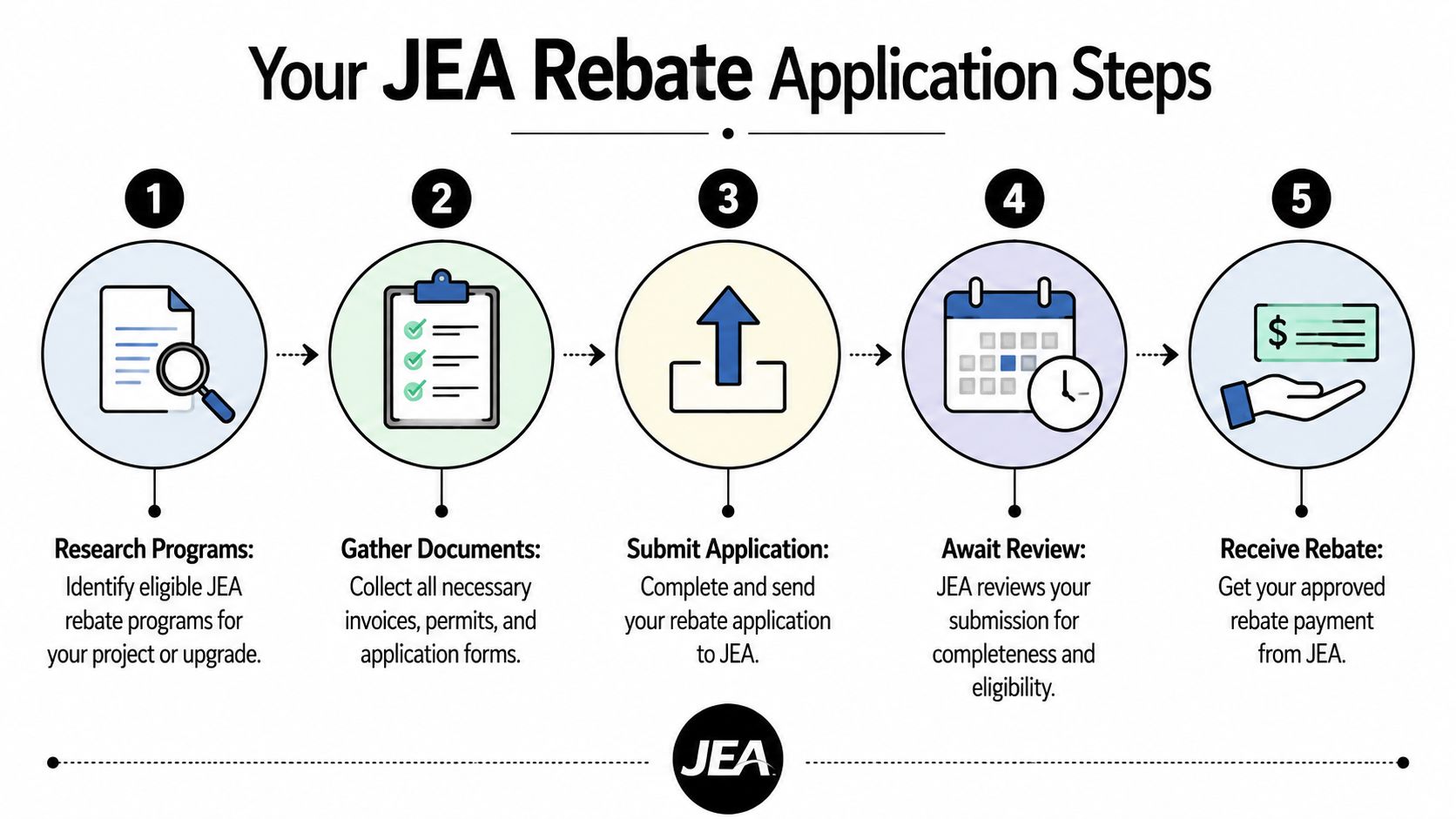
The best rebate file is built before material hits the jobsite. That matters even more for insulation and air-sealing projects, because the paperwork has to explain what changed in the house, not just what was purchased.
Confirm the rebate path
Start with the exact measure you want JEA to recognize. A standard attic insulation upgrade is usually easier to place than a roof deck spray foam job, a combined air-sealing package, or a project that improves comfort and HVAC performance without fitting a simple checkbox. If the scope is not clearly listed, treat it like a custom-type measure and ask for guidance before installation.
Verify whether contractor status matters
Some JEA rebate categories may call for a pre-qualified contractor. Others may not. Check that early, because changing contractors after the work is complete usually creates more trouble than the rebate is worth.
Record the starting condition
Baseline documentation is where strong applications separate themselves. Take clear attic photos, note existing insulation levels, show duct location, and document any obvious leakage or heat gain issues. If the project includes air sealing, a blower door test before insulation work can help show why the scope was chosen and support a custom-style review.
Homeowners lose time here. Contractors do too.
The common mistake is waiting until the end, then trying to rebuild the paper trail from texts, receipts, and a memory of what was installed. JEA applications go smoother when the file is assembled as the project moves.
Keep these items together from day one:
For spray foam or mixed-scope envelope work, I also recommend a short scope summary in plain language. For example: “Open-cell foam installed at roof deck to create conditioned attic. Existing ductwork located in attic.” That one sentence often explains the job better than a generic invoice line ever will.
A reviewer should be able to understand the project in a few minutes.
Use this checklist before you send anything:
Custom-type measures need extra care. If the project improved the home but does not fit neatly into a standard rebate lane, the application has to show the logic of the upgrade. That means clear descriptions, complete backup, and no guessing. A vague file can make a solid project look ineligible on paper.
One more point from the field. Do not oversell the scope. If the job was attic insulation, call it attic insulation. If it was roof deck foam with air sealing benefits, describe that exactly. Rebate reviewers are much more likely to approve a well-documented project with realistic language than a broad claim that tries to force the work into the highest-value category.
Commercial rebates are a different game. The dollar potential can be much better, but the rules usually demand tighter planning, stronger documentation, and a clearer project scope. Owners of multifamily properties, offices, warehouses, and mixed-use buildings should expect a more technical review than a typical homeowner would see.
One of the clearest business-side examples is the JEA Business Rebates Commercial Multifamily WET Program, which offers up to $300 per full bathroom retrofit and carries an annual cap of $100,000 per location, according to the program summary at the JEA multifamily water rebate guide. The same source states that eligible properties must be JEA-serviced commercial multifamily buildings where at least 90% of units receive new WaterSense® fixtures.
That matters for two reasons. First, JEA is willing to support large-scale efficiency work when the project is structured correctly. Second, the utility expects consistency across the property, not scattered piecemeal upgrades.
Commercial customers often focus on lighting or HVAC first, and for good reason. JEA's business framework also distinguishes between prescriptive measures and custom measures, with retrofit lighting and occupancy sensors identified as categories that require pre-approval in the business application materials. That tells you something important about how the utility thinks. Standardized upgrades move through one lane. More specialized projects need a stronger technical case.
For owners and managers, that creates a practical checklist:
Commercial insulation projects, especially in Florida, don't live in a vacuum. A warehouse with humidity problems, a multifamily building with hot top-floor units, or a metal building with condensation issues may need a scope that combines thermal control and moisture management. That kind of project often sits outside the cleanest prescriptive lane.
The best commercial rebate jobs start with building problems, not product preferences.
When a property manager brings a comfort complaint, rising utility costs, or recurring moisture issues, the right next step isn't to “add more insulation.” It's to frame the building issue in a way that matches the rebate structure JEA is willing to support.
This is the part most online guides miss. If you install standard products only when they're explicitly named on a rebate sheet, you'll leave value on the table. In Florida, some of the most effective upgrades solve several building problems at once. That's exactly why they don't always fit neatly into a prescriptive rebate line.

JEA's business rebate framework allows custom rebates for “certain retrofits, infrastructure upgrades, and alternative technologies,” which creates a pathway for contractors to justify spray foam projects that deliver thermal, moisture, and air-sealing benefits beyond standard insulation measures, according to JEA's prescriptive business energy upgrades application.
That language is more important than it looks. It means a contractor doesn't have to force every spray foam job into the wrong category. If the project behaves like a custom energy improvement, document it that way.
Contractors lose their advantage when they reduce spray foam to one metric. In practice, spray foam is often chosen because it can:
When you describe the project only as “insulation added,” you flatten the argument. JEA may see a generic insulation scope. A stronger file shows how the work affects the building as a system.
For custom-oriented projects, the prep work is where the rebate value is won or lost.
Document:
If the project is in a metal building, warehouse, or high-humidity environment, say that plainly. If moisture control is part of the reason for the upgrade, include it. Contractors sometimes avoid those details because they think the utility only cares about pure energy math. That's usually a mistake when the project's real value comes from combined performance benefits.
A custom rebate file needs a story backed by evidence. The story is the building problem. The evidence is your documentation.
Weak custom applications usually fail for one of three reasons:
The contractor frames the job too loosely
“Installed spray foam in attic” doesn't tell a reviewer enough.
The file lacks baseline proof
No photos, no condition notes, no explanation of why this measure was selected.
The project is submitted too late in the process
If pre-qualification or engineering review is needed, waiting until after installation can box everyone in.
The contractors who do this well act more like project managers than installers. They connect building science, paperwork, and utility logic. That's how more technical jobs become rebate-worthy instead of rebate-adjacent.
JEA rebates shouldn't be the only layer you look at. The smarter move is to treat them as one part of the project budget and then ask what else can legally sit on top of them.
The useful point here is straightforward. JEA's website explains its own incentives, but it doesn't clearly explain how those incentives interact with federal programs, and that leaves a real gap for homeowners. The available guidance indicates that savvy applicants can often stack JEA rebates with federal tax credits, including credits available through the Inflation Reduction Act, for a single project, as noted on JEA EV incentives.
Stacking doesn't mean claiming the same cost twice in a sloppy way. It means reviewing each incentive's rules and seeing whether a utility rebate, a federal tax credit, a manufacturer promotion, or another program can apply to different parts of the same project.
For example, a homeowner replacing HVAC equipment and improving insulation may be able to combine:
That's why it helps to compare local utility programs, not just JEA. If you're weighing service territories or trying to understand how Florida utilities handle insulation incentives, this guide to Florida Power & Light insulation rebates shows how another utility approaches the same broad goal.
Don't assume stacking is automatic. It isn't. Every program has its own timing, product standards, documentation requirements, and definitions of eligible cost.
Use this checklist:
The homeowners who get the best total result don't chase the biggest advertised rebate. They build a compliant package across all available programs and keep the paperwork clean from the start.
No. JEA's materials indicate that some upgrades marked with an asterisk require a pre-qualified contractor, but not every rebate falls into that category. The safest move is to verify that requirement for your exact measure before signing a contract.
Possibly, but it depends on the measure, who owns the equipment, and whether the applicant has authority to make the upgrade. In practice, renters should expect to coordinate with the property owner before assuming any rebate is available.
Not based on the public guidance alone. The available JEA materials don't clearly spell out whether spray foam qualifies as a listed residential measure, what performance threshold applies, or what documentation JEA expects for that specific product type. That's why pre-project confirmation matters.
JEA reviews submissions after they're received and checks them for completeness and eligibility. Timing can vary, so the practical focus should be on submitting a clean, complete application quickly. Missing forms or vague invoices slow things down more than most homeowners expect.
If you're planning insulation work and want experienced help identifying whether your project fits a standard or custom rebate path, Airtight Spray Foam Insulation can help you evaluate the building, define the right scope, and document the job properly before paperwork mistakes cost you money.