You feel it before you see it on the bill. The AC runs all afternoon. One room stays cold, another feels sticky, and the house never quite dries out after a stormy day. In South Florida, that usually gets blamed on the air conditioner.
A lot of the time, the AC isn’t the main problem. The house is.
When a home can’t hold conditioned air and can’t block hot, damp outdoor air, the system has to keep cooling and dehumidifying the same space over and over. That’s where energy efficient home insulation stops being a nice upgrade and starts acting like a core part of comfort, moisture control, and monthly operating cost.
A common South Florida pattern goes like this. The thermostat says one number, but the house feels warmer than it should. The AC keeps cycling. Supply vents blow cold air, yet the ceiling near the attic hatch feels hot and the guest room by the west wall never catches up.

That usually points to a weak building envelope. Think of the envelope as the shell of the home. Roof, attic, walls, penetrations for plumbing and wiring, recessed lights, top plates, garage connections, and window perimeters all have to work together. If that shell leaks, your cool air slips out and hot, humid air slips in.
A lot of homeowners assume they’re dealing with an aging AC unit when the bigger issue is air movement through the house itself. If you’ve ever wondered why one home with a similar floor plan feels drier and quieter than another, envelope performance is often the answer. This is also why broad strategies to reduce electricity bills usually work better when insulation and air leakage are part of the conversation, not just thermostat settings and appliance use.
A major study found that 89% of U.S. single-family homes are under-insulated relative to modern energy codes, and the EPA estimates that targeted air-sealing and insulation upgrades can save homeowners an average of 15% on heating and cooling costs according to the NAIMA insulation report. That matters here because South Florida homes aren’t only fighting heat. They’re fighting moisture pressure, too.
Practical rule: If your house feels clammy even when the AC runs a lot, don’t look only at the equipment. Look at how the home is sealed and insulated.
If that sounds familiar, a closer look at why your electric bill is so high usually starts with the attic, the duct paths, and all the small leaks you can’t see from the living room.
A homeowner can buy insulation with a high advertised R-value and still end up with a hot second floor, long AC run times, and that damp feeling that never quite leaves the house. In South Florida, that usually points to one problem. The insulation may be slowing heat, but the house is still leaking air.
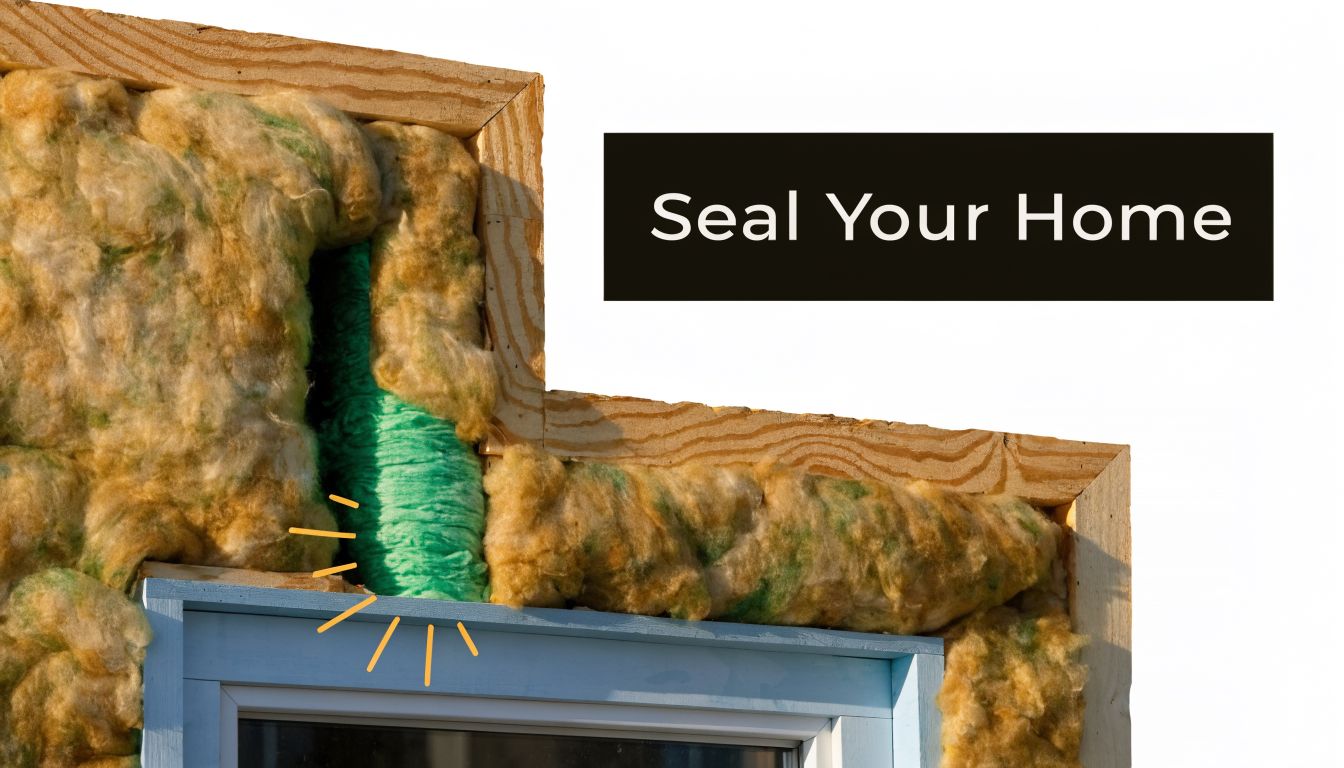
R-value measures how well a material resists heat moving through it. Higher R-value means better resistance, inch for inch. That matters in any hot climate, but especially here, where roof decks, attic floors, garage ceilings, and west-facing walls take a beating for much of the year.
A simple way to picture it is a cooler. Thicker insulation slows heat from working its way inside. If your attic assembly has weak thermal resistance, the heat above the ceiling reaches the living space faster, and the AC has to keep removing it.
The catch is that R-value only describes one part of the job.
In South Florida, air leakage is not just an energy problem. It is a moisture problem.
Hot outdoor air carries a heavy moisture load. When that air slips through recessed lights, top plates, plumbing openings, duct chases, attic access panels, or framing gaps, your AC now has two jobs instead of one. It has to lower the temperature and remove the extra moisture. That is one reason a home can feel cool enough on the thermostat but still feel sticky.
Insulation that allows air to move through or around it does not control that load very well. You can have decent R-value on paper and disappointing performance in real conditions.
Insulation that only slows heat, without stopping air leakage, is like closing the blinds but leaving the window cracked open.
A blower door test shows where your home is leaking air by pressurizing or depressurizing the house and exposing the leakage paths. That gives homeowners something better than guesswork. It shows whether the problem is mostly low insulation levels, air leakage, or both.
Here’s a quick visual explanation before getting into materials:

Good insulation plans in Florida do two things at the same time:
That pairing is why spray foam gets so much attention in our climate. It does not just add thermal resistance. It also expands into cracks, joints, and irregular cavities that other insulation types often leave exposed. In the right location, that lets one product handle two jobs at once.
I tell homeowners to be careful with generic insulation advice for that reason. In a drier climate, you can get away with focusing mostly on R-value. In South Florida, air movement can undo a lot of the benefit if moisture keeps riding in with that air.
People usually do not call asking about building envelope performance. They call because the house feels off.
The important conversation is not just, “What insulation has the highest R-value?” It is, “What insulation gives this house enough R-value and also closes the leakage paths that drive up humidity, discomfort, and AC costs?”
At 3 p.m. in August, two houses on the same block can have very different AC bills. One has enough insulation on paper but still pulls hot, wet attic air through gaps around top plates, can lights, and duct penetrations. The other controls both heat flow and air movement, so the AC is cooling the house instead of fighting infiltration all day.
That distinction matters in South Florida more than many generic insulation guides admit. A material with decent R-value can still fall short here if it does not also control humid air.
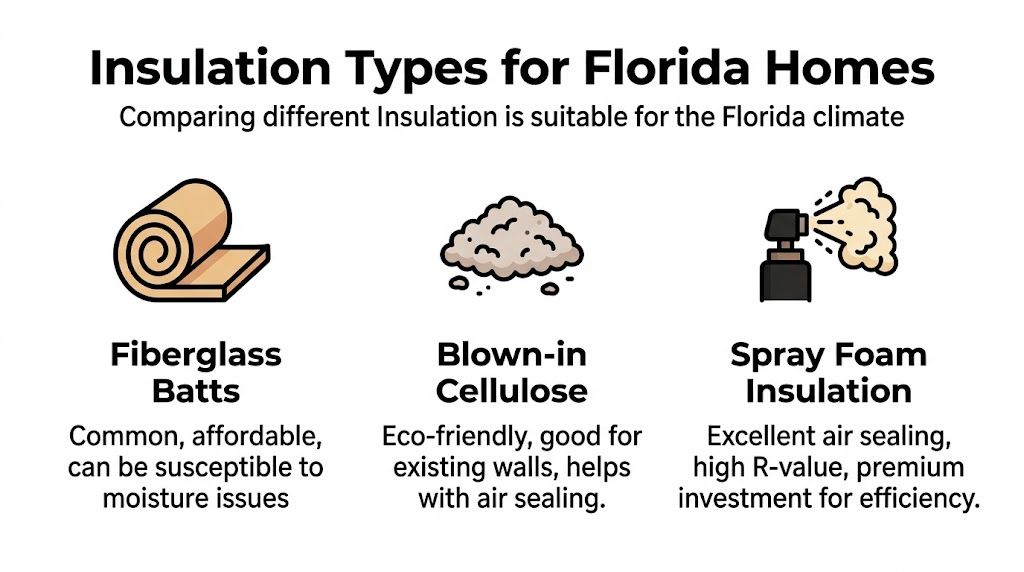
I compare insulation types in Florida by how they perform in real assemblies, not just by the label on the package. Four questions usually sort it out fast:
In this climate, R-value and air sealing work like sunscreen and shade. One slows heat gain. The other keeps exposure from getting worse in the first place. You need both if you want lower cooling costs and fewer moisture problems.
| Feature | Fiberglass Batts | Blown-In Cellulose | Open-Cell Spray Foam | Closed-Cell Spray Foam |
|---|---|---|---|---|
| R-value per inch | Lower than spray foam options | Moderate, but needs depth | Moderate | Higher than the other options listed |
| Air sealing ability | Minimal on its own | Better coverage than batts, but not a true air barrier | Good air sealing in many cavities | Strong air sealing with dense adhesion |
| Moisture behavior | Performance drops when installation is sloppy or the assembly gets damp | Needs the assembly to stay dry and be designed correctly | Can work well, but moisture control details matter | Better suited to areas with higher moisture pressure |
| Space efficiency | Needs more thickness | Needs more thickness | Fills irregular cavities well | Delivers more resistance in less space |
| Longevity concerns | Can sag, compress, or leave voids if poorly installed | Can settle depending on application | Adheres in place | Adheres in place and adds some rigidity |
| Best fit in South Florida | Budget-driven projects with careful prep work | Retrofits where loose-fill access makes sense | Selected walls and rooflines with a clear moisture plan | Roof decks, rim areas, garage boundaries, and tight cavities with heat and humidity stress |
Fiberglass batts still have a place, but they demand careful workmanship. If the batt is compressed, cut short, tucked poorly around wiring, or left with gaps at the edges, the installed performance drops fast. I see that often in attics and knee walls where the material exists but the house still feels hot.
The bigger limitation is air movement. Fiberglass slows conductive heat flow, but it does not stop humid air from sneaking through cracks around the assembly. In South Florida, that means the homeowner pays for insulation and still deals with uneven rooms, longer AC run times, and moisture drifting where it does not belong.
Batts make the most sense when the budget is tight, the framing is straightforward, and the contractor handles air sealing before insulation goes in.
Cellulose does a better job covering irregular areas than batt insulation, which helps in older homes and retrofit work. In wall cavities or attic floors with awkward framing, that coverage can improve thermal consistency.
Coverage is not the same as control. If the attic floor has bypasses around plumbing stacks, recessed fixtures, soffit chases, or partition walls, cellulose alone will not stop the humid air exchange driving comfort problems. It can be a sensible part of the solution, but it usually is not the whole solution in a hot, humid house.
Open-cell spray foam expands aggressively and fills odd-shaped cavities well. That makes it useful where the main challenge is leakage through cracks and irregular framing, and homeowners usually notice the sound reduction right away in bedrooms, offices, and street-facing walls.
The trade-off is moisture behavior. Open-cell foam is not the product I would treat casually in South Florida roof assemblies. It can work, but only when the roofline design, drying potential, and interior moisture conditions have been thought through carefully.
Closed-cell spray foam stands out because it handles the two jobs Florida homes struggle with most. It adds strong thermal resistance in limited space, and it seals the small leakage paths that carry heat and humidity into the house.
That combination is why it performs well in roof decks, rim joists, garage ceiling transitions, and other parts of the envelope where batts and loose-fill products often leave weak spots. The foam adheres to the substrate instead of sitting loosely in a cavity, so it keeps contact at corners, edges, and irregular transitions where real-world losses happen.
If a homeowner asks me why one insulation type costs more, this is usually the answer. Closed-cell is not just buying R-value. It is buying R-value plus air control in one application.
For attics, that changes the whole conversation. A homeowner deciding between a vented attic floor and an insulated roofline should look at the actual assembly, duct location, and leakage paths first. This guide to the best attic insulation for hot climates is useful if you want to compare those approaches based on performance in high-heat conditions.
Some choices perform better here because they match the climate.
I also tell homeowners to separate comfort upgrades into categories. Insulation handles one part of the load. Solar gain through windows is another. In rooms that get strong afternoon sun, cellular shades can help reduce interior heat gain at the glass, but they do not replace proper insulation and air sealing in the building shell.
The best result usually comes from choosing materials by assembly, not by brand loyalty or the cheapest line item. In South Florida, the winning approach is simple. Use enough R-value, stop the air leaks, and choose materials that can live with heat and humidity for the long haul.
You feel this section of the house before you understand it. The back bedroom stays warm after sunset. The hall near the garage always feels different. The ceiling under the attic radiates heat late into the evening even though the AC has been running for hours.
That pattern usually means the house is losing the insulation battle by location, not just by material.
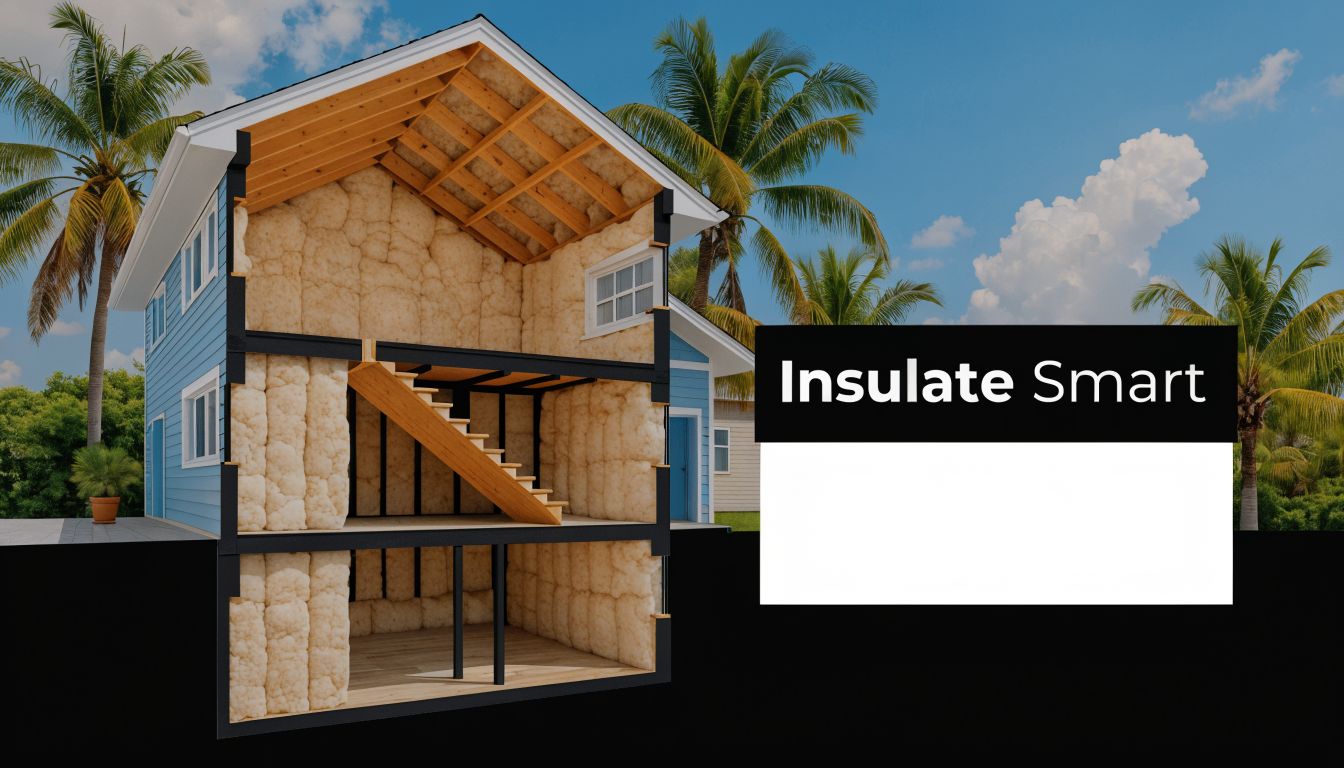
In South Florida, I do not look at insulation as a simple R-value upgrade. I look at where heat is entering, where humid air is leaking in, and which part of the house is making the AC work hardest. Good insulation slows heat flow. Good air sealing stops hot, wet outdoor air from sneaking into cavities and living space. You need both.
That is why placement matters so much here. A high R-value product that leaves leakage paths open can still leave you with uneven rooms, long AC run times, and moisture trouble. Spray foam stands out because it adds insulation and air sealing in the same step, which is a practical advantage in a hot, humid climate.
The attic is still the first place to focus, but the decision is less about brand and more about how the house is built. If ducts and the air handler are up there, a vented attic with insulation only on the attic floor often leaves mechanical equipment sitting in extreme heat. That raises system strain and usually shows up on the power bill.
Insulating at the roof deck changes the working conditions around that equipment. It also reduces humid air movement through gaps and cracks at the top of the house. In many homes, that makes the attic a more controlled buffer zone instead of a heat reservoir above the ceiling.
I have seen plenty of homes where comfort fix was not adding more material to the attic floor. It was stopping attic air from communicating with the house in the first place.
Exterior walls matter most at their weak points. The usual culprits are window perimeters, top plates, bottom plates, plumbing openings, electrical penetrations, and the wall shared with the garage. Those joints behave like tiny holes in a cooler. The insulation value on paper may look fine, but air leakage keeps feeding heat and humidity into the assembly.
For wall cavities, the product choice should match the job.
Open-cell foam can work where sound control is useful and the assembly is designed to manage moisture correctly. Closed-cell foam is often the better fit where space is tight, added rigidity helps, or you want stronger resistance to humid air movement. One practical option used in South Florida is Airtight Spray Foam Insulation, which installs open-cell and closed-cell systems in attics, walls, garages, and rooflines based on the assembly.
If one room gets hot every afternoon, the wall on that exposure may be part of the problem. If the whole house feels sticky, I usually expect bigger leakage paths above the ceiling, around duct connections, or at transition areas.
These are some of the most overlooked parts of the house, and they create some of the clearest comfort complaints.
Closed-cell foam is often a strong choice in these areas because it adheres directly to irregular surfaces and handles awkward framing better than materials that rely on a perfect cavity fit.
Insulation inside the walls and roof does not stop direct solar gain at the glass. West-facing rooms can still overheat in late afternoon even when the rest of the envelope is performing well. In those cases, interior shading helps cut radiant heat at the source. If you are comparing options, cellular shades can add a useful insulating layer at the window.
A practical upgrade plan usually follows this order:
That sequence usually solves the house as a system. It also helps avoid spending money on scattered upgrades that never address the main source of the heat and humidity load.
Homeowners usually ask the right question first. Is this worth the money?
The honest answer is that insulation isn’t the cheapest line item in a home upgrade, especially when spray foam is part of the plan. But treating it like a simple purchase misses the point. It behaves more like an operating-cost improvement. You pay once, then the house works differently every day after that.
The return comes from lower run time, better humidity control, and fewer comfort problems that trigger workarounds like dropping the thermostat lower than necessary. That doesn’t mean every home gets the same result. A leaky older house with weak attic insulation has more room to improve than a tighter home with fewer envelope defects.
The strongest data point for homeowners is persistence. According to a large-scale insulation study summarized in this home insulation returns analysis, insulation retrofits provide stable energy savings of 18-19% that persist for at least 10 years after installation. The same source notes that the U.S. Department of Energy says a properly insulated attic alone can slash energy bills by 10-50%.
Two homes on the same street can see very different financial outcomes because the assemblies and leakage paths are different.
| Factor | Why it changes ROI |
|---|---|
| Current insulation quality | Homes with weak or poorly installed insulation usually improve faster. |
| Air leakage level | The more outside air gets in, the more value there is in sealing the envelope. |
| Attic conditions | Ducts and air handlers in hot attics increase the payoff from better attic strategy. |
| Moisture load | Humid homes force the AC to do extra latent work, not just sensible cooling. |
| Problem areas | A focused upgrade in the attic or roof deck may outperform a scattered whole-home approach. |
The key trade-off is upfront cost versus long-term operating relief. Fiberglass generally costs less at installation, but it may leave more performance on the table if the assembly still leaks. Spray foam usually costs more upfront, but it solves multiple problems at once in the right application.
Homeowners don’t just buy insulation. They buy fewer hot spots, a drier house, and an AC system that isn’t fighting the structure all day.
ROI also shows up in ways that don’t fit neatly on a spreadsheet:
If you only judge insulation by the install invoice, it can look expensive. If you judge it by what the house costs to live in and how it feels every day, the math looks different.
A professional insulation job should feel organized, not chaotic. Homeowners get uneasy when they don’t know what’s happening, how long the work will take, or what kind of disruption to expect. Good crews remove that uncertainty early.
The process usually starts with a site visit and estimate. A contractor should ask about the symptoms, not just the square footage. High bills, uneven rooms, condensation concerns, musty odors, a hot garage-adjacent bedroom, or ducts in a brutal attic all point to different solutions.
A proper walk-through also looks at access, existing insulation, roofline conditions, recessed lighting, mechanical equipment, and where the biggest leakage paths likely are. These specific considerations enable an experienced installer to separate a real plan from a generic quote.
Before any foam is applied, the jobsite needs to be protected and staged correctly. That includes access paths, covering or isolating areas that need protection, and making sure the crew can work cleanly and safely. On attic jobs, it also means knowing where not to block critical components and how to preserve serviceability around equipment.
This part isn’t glamorous, but it matters. A rushed setup usually shows up later as overspray, missed areas, or poor finish quality.
Spray foam application is precise work. The installer is balancing thickness, adhesion, substrate conditions, and complete coverage around irregular penetrations and framing transitions. This isn’t a place for guesswork.
For the homeowner, the experience is usually simpler than the technical side. The crew arrives, prepares the space, installs the material in the planned areas, and then verifies coverage before cleanup. On straightforward residential projects, the visible transformation can happen quickly, but speed should never override proper application.
The quality of spray foam isn’t just in the material. It’s in whether the installer actually closes the gaps that were costing you comfort before the job started.
A professional closeout should include more than hauling debris away. The crew should leave the work area orderly and walk the homeowner through what was done. That final review is the time to ask where the material was applied, what problem areas were addressed, and whether any additional envelope issues were identified during the work.
A solid installation experience usually includes:
Christian Cates and his team have built their process around that kind of straightforward sequence. For homeowners, that matters because the project feels manageable when every step is explained and executed cleanly.
Some questions come up right before a homeowner decides. They’re less about theory and more about living with the result.
| Question | Answer |
|---|---|
| Does spray foam smell after installation? | During installation and curing, there can be an odor. That’s why professional handling, proper jobsite control, and clear occupancy guidance matter. Once the material is installed correctly and cured, the concern shifts from smell to long-term envelope performance. |
| Is spray foam safe? | It should be installed by trained professionals using the right equipment and process. Safety comes from correct product handling, site prep, application conditions, and following re-entry guidance. |
| Will insulation stop mold by itself? | No material fixes an active moisture problem by itself. What good insulation can do is reduce the humid air movement that often feeds condensation risk inside assemblies. In South Florida, that’s a major reason air sealing matters. |
| Does spray foam help with pests? | It can reduce the cracks and openings that pests use as pathways, and it doesn’t create the same kind of nesting conditions some loose materials can. It’s not a pest-control treatment, but it can remove easy access points. |
| Can I install spray foam myself? | That’s not a good idea for whole-home envelope work. Proper application depends on training, equipment, thickness control, and understanding how the assembly should dry and perform. DIY foam often misses hidden leakage paths or creates uneven coverage. |
| How long does spray foam last? | Properly installed spray foam is known for long service life because it adheres in place rather than settling like some other materials can. Longevity depends on correct installation and the condition of the surrounding assembly. |
Most homeowners asking about smell, safety, or longevity are really asking one thing. Will this solve the problem without creating a new one?
That’s a fair question. In this climate, bad insulation decisions can trap moisture, leave leaks untouched, or waste money on a product that doesn’t match the assembly. Good decisions improve comfort, reduce AC strain, and make the house feel more controlled.
A few warning signs should make you slow down:
The homeowner doesn’t need to become a building scientist. But you do want a contractor who thinks like one when it counts.
If your house feels humid, uneven, or expensive to cool, the answer usually isn’t turning the thermostat lower and hoping for the best. The answer is improving the shell of the home so the AC can finally work with the structure instead of against it.
That’s the core of energy efficient home insulation in South Florida. You need thermal resistance, yes. But you also need air sealing and moisture control. That’s why spray foam stands out in this climate, especially in the attic, roof deck, garage boundaries, and other leak-prone areas where ordinary insulation often leaves the underlying problem untouched.
A better envelope gives you a house that feels steadier. Rooms stay more consistent. Indoor air feels drier. The AC doesn’t have to run like it’s chasing a moving target. You’re not just buying insulation. You’re buying control over how the house behaves in heat and humidity.
If you live in Jupiter, Palm Beach Gardens, West Palm Beach, Wellington, Stuart, or nearby areas, it’s worth getting your home looked at with fresh eyes. The comfort problem you’ve been tolerating may be fixable at the source.
If you want a practical assessment of where your home is losing comfort and efficiency, contact Airtight Spray Foam Insulation for a free, no-obligation estimate. They serve South Florida homeowners, builders, and property managers with open-cell and closed-cell spray foam solutions designed for attics, walls, garages, roofs, and other high-impact areas.