TL;DR: Radiant barrier installation costs usually run $0.30 to $2.00 per square foot, and average attic projects typically land between $350 and $2,700 nationally, with a 1,000-square-foot attic averaging $1,600 according to HomeGuide’s 2026 cost data. In South Florida, that national baseline is useful, but humidity, attic access, and material choice often decide whether your quote lands near the low end or the high end.
You usually start looking into a radiant barrier after one of two things happens. Your upstairs never cools off, or your summer power bill comes in and makes you stop at the mailbox.
In South Florida, that problem usually starts above your ceiling. The roof bakes all day, the attic turns into a heat reservoir, and the AC keeps chasing heat that never really stops coming. A lot of homeowners assume the issue is only “not enough insulation.” Sometimes that’s true. But a hot roof deck radiating heat into the attic is a separate problem, and it needs a separate fix.
A common call goes like this: the house cools fine early in the morning, but by late afternoon the system runs longer, some rooms feel stuffy, and the bill is higher than expected. The thermostat may be set where it always is, but the house feels different. That’s usually the first clue that the attic is loading the home with heat.

In our climate, the sun hits the roof hard for months. Untreated attics can reach 140°F+, and roofs can absorb 70-90% of solar radiation, which is why the AC ends up fighting heat from above for most of the day, as described in Angi’s radiant barrier cost guide. That heat doesn’t need to touch you directly to make the house harder to cool. It behaves more like standing near a bonfire. You feel the heat radiating even if you’re not in the flames.
A lot of homeowners think attic heat is just “hot air.” It’s more than that. The underside of the roof gets hot, then it radiates that heat toward attic insulation, ductwork, framing, and the ceiling below.
That matters in South Florida because many homes have mechanical equipment or duct runs in the attic. Once those components sit in a punishing attic environment all day, your cooling system has to work harder to deliver the same comfort inside.
A radiant barrier isn’t a magic fix. It’s a targeted way to cut the heat your roof is throwing into the attic.
When people search for ways to cut cooling strain, they usually look at the thermostat, filters, duct cleaning, or general how to improve AC efficiency advice first. That’s a smart place to start. But if the attic is the main source of the heat load, AC tune-ups alone won’t solve the root problem.
Radiant barriers are built for that specific job. They reflect radiant heat instead of letting the attic absorb as much of it. In South Florida, that can make them worth considering, especially in homes with hot attics, dark roofs, ductwork overhead, and comfort issues that show up every summer.
The key question isn’t whether radiant barriers sound good in theory. The main question is what they cost to install properly, and whether that cost makes sense for your house.
A South Florida radiant barrier quote can look reasonable at first, then jump once the contractor sees the attic. That usually happens because the price is not just about square footage. It is about how much usable attic surface exists, how hard it is to work around ducts and air handlers, and whether the installer can mount the product the right way for a hot, humid attic.
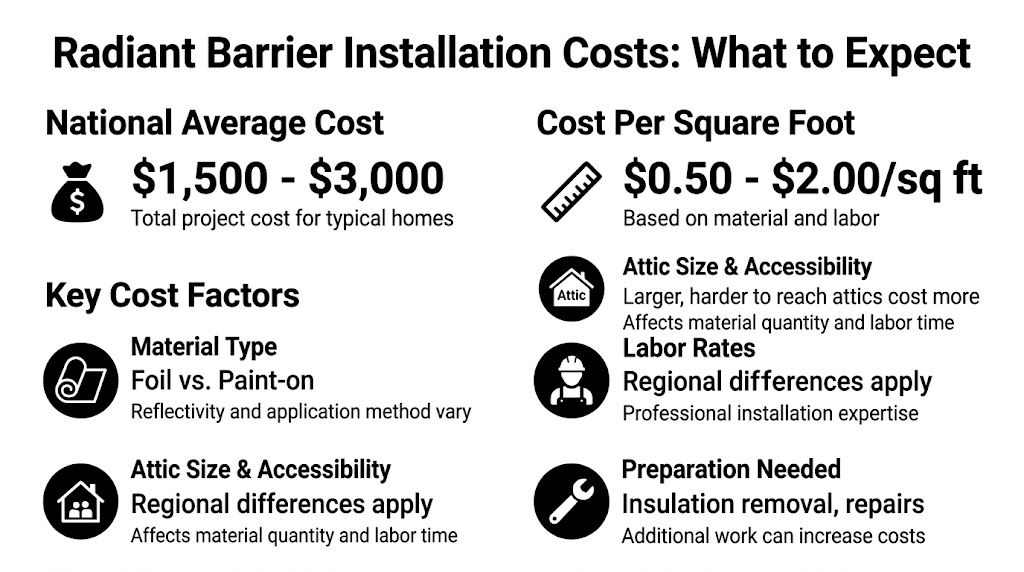
National averages are still useful as a rough benchmark. HomeGuide’s 2026 pricing data puts radiant barrier installation at $0.30 to $2.00 per square foot, with many attic projects landing between $350 and $2,700 and a 1,000-square-foot attic averaging about $1,600 nationally.
That number helps set expectations. It does not tell you what your house in Palm Beach County, Broward, or Miami-Dade will cost.
Radiant barrier jobs are usually built around two cost buckets: material and labor. Material prices are only part of the story. Labor often decides whether the quote stays near the low end or climbs fast.
In a clean, open attic, installation moves quickly. In a South Florida attic with flex ducts stretched across the trusses, an air handler in the middle, and limited headroom near the eaves, labor becomes the bigger line item because the crew has to cut around obstacles and keep the foil installed with the proper air gap.
HomeGuide’s cost breakdown lists materials at $0.10 to $0.60 per square foot and labor at $0.20 to $1.40 per square foot, with insulation contractors commonly charging $30 to $80 per hour.
Here is how that plays out in the field:
Attic size still affects price. A larger attic usually needs more material and more labor hours. But homeowners get in trouble when they assume a 1,500-square-foot attic will cost exactly 50 percent more than a 1,000-square-foot attic. That is not how many real jobs price out.
A smaller attic with poor access can cost more per square foot than a larger attic with good working room. I see that often in older coastal homes where crews spend half the job getting into position and working around mechanicals.
For a rough planning range, smaller attics usually land lower, mid-size attics tend to cluster around the national average, and large attics can rise quickly if the roofline is chopped up or the attic is crowded.
| Attic size | General cost expectation |
|---|---|
| 500 sq ft | Usually on the lower end of the overall project range |
| 1,000 sq ft | Often near the national average |
| 2,000 sq ft | Usually higher, especially with access or layout issues |
One more local point matters here. In South Florida, radiant barriers are often installed in attics that already run hotter because of strong sun exposure, dark roofing, and long cooling seasons. That makes proper installation more important than chasing the cheapest square-foot price. A lower quote is not a bargain if the foil is stapled in the wrong place, crushed against other materials, or installed in a way that traps moisture problems in an already humid attic.
Two South Florida homes with the same attic square footage can still price very differently. The gap usually comes from labor conditions, attic moisture risk, and how the installer plans to mount the product, not just from how many rolls of foil the job needs.
I see this on older homes in Broward, Miami-Dade, and the Keys all the time. Salt air, long cooling seasons, dark tile or shingle roofs, and air handlers packed into the attic all change how a radiant barrier job needs to be done. The quote should reflect that.
A straightforward attic is faster to cover. A cramped attic with low clearance, chopped-up framing, flex ducts everywhere, and one small scuttle hole is slower from the first roll to the final cleanup.
Labor usually climbs when the crew has to work around:
In South Florida, attic heat adds another layer. Crews often have a shorter safe working window in the middle of the day, especially in summer. That does not always mean the job becomes expensive, but it does affect scheduling and production.
Material cost matters, but product fit matters more here. A foil product that works fine on paper can become a bad buy if it is installed in a way that reduces airflow or creates condensation concerns in a hot-humid attic.
Single-sided foil is often the simpler and lower-cost option. Double-sided foil can make sense in some assemblies, but only if the installation method supports it. Spray-applied radiant coatings have their place too, though prep, surface condition, and application quality have to be right.
Homeowners should ask what the contractor is recommending and why. If the answer is vague, the bid is weak.
Radiant barriers need the right placement and an open reflective air space to do their job. If the foil gets pressed tight against other materials, draped carelessly, or installed where it interferes with attic ventilation, the lower quote can cost more later in poor performance or correction work.
A solid bid should explain:
That last point gets missed a lot. If the attic already has wet, compressed, or poorly distributed insulation, radiant barrier installation may not be the first fix. Homeowners comparing bids should pay attention to whether the contractor is looking at the whole attic system or just selling foil. If you need broader attic work, it helps to compare that recommendation with a contractor who also handles professional insulation installation services.
The lowest quote often assumes easy access, minimal prep, and no time spent solving attic-specific problems. In a South Florida house, those assumptions fall apart fast.
A good quote is specific. It tells you what product is being installed, where it is going, what prep is included, and what conditions could change the final bill. A weak quote gives one number and leaves the details blurry.
DIY radiant barrier installation looks simple when you see a roll of foil and a staple gun. In a real South Florida attic, it’s tougher than it sounds.
The first issue is heat. The second is access. The third is installation quality. A lot of homeowners can physically get some material up there. Far fewer can install it cleanly across a complicated attic without blocking airflow paths, crowding electrical work, or placing it in a way that reduces performance.
DIY can be reasonable if the attic is open, accessible, and simple. If you’re comfortable working overhead, measuring, cutting, fastening, and moving safely around framing, you may be able to handle a basic foil install.
That said, the job still demands care. You need to plan material layout, work around wiring safely, and avoid shortcuts that turn a reflective barrier into expensive clutter.
DIY tends to work best when:
Professional crews bring speed, consistency, and a system. That matters more than people think. An attic job gets expensive when people have to redo work, cut around obstacles twice, or deal with avoidable mistakes.
If you’re also weighing broader insulation work, it helps to look at complete insulation installation services rather than treating radiant barrier installation as a stand-alone decision. In many homes, the best answer isn’t “foil or insulation.” It’s figuring out which combination addresses heat, air leakage, and moisture together.
A short walkthrough helps show what proper installation really involves:
A professional install usually buys you fewer gaps, cleaner detailing around obstructions, and less chance of creating a moisture or access problem in the attic.
If the attic is brutally tight, heavily ducted, or you’re already uneasy about being up there, hire it out. The labor cost often saves you from wasted material, lost weekends, and a barrier that never performs the way it should.
If the attic is open and you know exactly how the product needs to be installed, DIY can be reasonable. Just don’t confuse “possible” with “easy.”
A radiant barrier has to do more than sound efficient. It has to justify the install cost.
In hot climates, the numbers can make sense. Energy savings from radiant barriers can yield payback periods of 5 to 10 years, with documented 10-17% reductions in cooling costs, according to the Florida research summarized in this FSEC-related payback source. That’s not a promise for every house, but it gives a realistic frame for what homeowners should expect when the attic is a major source of heat gain.
One example in that same source uses a $1,800 installation in a 2,500 square foot home. The expected savings are $165 per year from cooling reduction plus $50 per year from duct efficiency, for a total of $215 per year, which works out to an 8.4-year payback.
That example matters because it reflects how radiant barriers often pay off in real homes. The benefit isn’t just “the attic is cooler.” The benefit is that the AC doesn’t have to fight as much radiant heat, and attic ductwork loses less performance to the surrounding heat.
Not every house gets the same value from a radiant barrier. The better candidates usually share a few traits:
If you want to make the decision based on measured conditions rather than guesswork, start with an energy audit for your home. That gives context. Sometimes the attic is the clear problem. Sometimes the bigger issue is air leakage, poor insulation alignment, or duct loss.
Don’t judge ROI by one utility bill. Judge it by how much unwanted attic heat the house is dealing with every cooling season.
A radiant barrier is rarely the first thing I’d recommend if the attic has basic unresolved problems. If the house has obvious air leakage, disconnected ducts, or weak insulation coverage, those issues need attention too.
But when the attic assembly is otherwise decent and the roof is pouring radiant heat into the space all day, a radiant barrier can be a practical upgrade. In South Florida, where cooling season feels endless, that kind of improvement can hold value for a long time.
Homeowners often ask the wrong question. They ask, “Which is better, radiant barrier or spray foam?” The better question is, “What problem am I trying to solve?”
A radiant barrier and traditional insulation don’t do the same job. Radiant barriers address radiant heat. Fiberglass, cellulose, and spray foam deal with conductive heat, and spray foam also helps with air sealing. If you treat them like interchangeable products, you’ll make a weak decision.
In South Florida attics, a radiant barrier works best when the main issue is roof-driven heat gain. Spray foam makes more sense when the house also has major air leakage and needs a tighter building envelope. Fiberglass and cellulose still have a place, but they won’t reflect heat the way a foil barrier does.
For homeowners comparing options, this guide to the best attic insulation for hot climates is useful because it frames the choice around climate performance instead of product hype.
| Insulation Type | Primary Function | Typical R-Value | Air Seal | Best For |
|---|---|---|---|---|
| Radiant barrier | Reduces radiant heat gain | Not applicable in the same way as bulk insulation | No | Hot attics with strong roof heat load |
| Fiberglass batts or blown insulation | Slows conductive heat flow | Varies by product and depth | No | Standard attic floor insulation layers |
| Closed-cell spray foam | Insulates and air seals | Qualitatively high per inch | Yes | Attics and rooflines needing insulation plus moisture-resistant air sealing |
| Open-cell spray foam | Insulates and air seals | Qualitatively lower per inch than closed-cell | Yes | Assemblies where air sealing matters and design allows it |
The strongest results usually come from combining strategies instead of forcing one product to do everything. Radiant barrier for roof-driven heat. Proper insulation for thermal resistance. Air sealing where the house leaks.
That’s why these projects need diagnosis, not guesswork. A foil barrier won’t fix a leaky attic floor. Spray foam won’t change the fact that a roof deck is radiating heat downward. Each has a role.
The best-performing attic systems usually layer solutions. They don’t ask one material to solve every heat and moisture problem by itself.
A South Florida attic in August is a different animal than an attic in a drier market. The roof deck gets brutally hot, the air stays humid, and that combination changes both how a radiant barrier should be installed and what the job is likely to cost.
Local pricing often runs higher or lower than a national average for practical reasons. Crew availability shifts during peak summer and storm-repair season. Coastal homes often need slower, more careful work because attics are tighter, older roof framing is less uniform, and corrosion around fasteners or metal components can complicate installation.
In this climate, product selection is not just about reflectivity. It is also about moisture behavior.
A radiant barrier installed in a hot-humid attic needs to fit the assembly. That usually means paying attention to whether the material and installation method allow the attic space to dry properly. If a contractor cannot explain how the foil choice relates to condensation risk, attic ventilation, and your existing insulation, that quote needs a closer look.
I see homeowners focus on the foil itself and miss the labor detail that drives price. A simple open attic with good access is one number. A low-slope roof with cramped edges, ductwork in the way, and uneven truss spacing is another. In South Florida, those conditions are common.
Salt air does not ruin every radiant barrier project, but it does make material handling and fastening details more important, especially near the water. Older homes in places like Jupiter, Stuart, and West Palm Beach also tend to have a mix of repairs, additions, and patchwork attic conditions. That slows the job down.
The house-to-house differences are real. Two homes with the same square footage can price very differently if one has a clean, walkable attic and the other has limited access, recessed lighting to work around, or existing insulation that has to be protected during installation.
Before approving a quote, ask:
Those answers matter more than a generic national price range. In South Florida, a good quote should reflect your roof design, attic access, duct location, humidity exposure, and how close the home is to the coast.
If you want a local recommendation based on your attic, roof layout, and humidity conditions, get a quote from Airtight Spray Foam Insulation. Their team serves South Florida homeowners and contractors with customized attic and insulation solutions, so you can find out whether a radiant barrier, spray foam, or a combined approach makes the most sense for your property.