Blog
Your Guide to the Insulation R Value Calculator


An insulation R-value calculator is a handy tool that helps you figure out the thermal resistance of different building materials. You just plug in the material type and its thickness, and it does the rest. Put simply, the higher the R-value, the better that material is at keeping the intense South Florida heat out of your home.
Quickly Calculate Your Insulation R-Value

Welcome to your first step toward a cooler, more energy-efficient home. In the relentless South Florida heat, your home's insulation is the main line of defense against scorching temperatures and sky-high energy bills. But how strong is that defense? The answer is in its R-value.
Think of R-value as the "sunscreen rating" for your home. A higher number means greater resistance to heat flow, which is exactly what you need to keep your cool, conditioned air inside and the oppressive, humid heat outside. This one number has a huge impact on your comfort and your monthly budget.
Why R-Value Matters in South Florida
Understanding your home's R-value isn't just for building science nerds; it's a practical necessity in our climate. Having the right insulation directly translates to real-world benefits:
- Lower Energy Bills: When you minimize heat transfer, your air conditioner doesn't have to run constantly to keep you comfortable. This drastically reduces its runtime and your energy consumption.
- Consistent Indoor Comfort: High R-value insulation helps get rid of those frustrating hot spots and temperature swings, creating a much more stable and pleasant environment all year.
- Reduced HVAC Strain: By easing the cooling load, effective insulation extends the lifespan of your expensive HVAC equipment, saving you from premature wear and tear.
To help you get started, we’ve put together a straightforward insulation R-value calculator. This tool lets you instantly see the R-value per inch for various materials, giving you a clear picture of what’s protecting your attic, walls, or crawlspace.
Your home's thermal performance is a direct reflection of its R-value. In a climate where cooling accounts for a massive portion of energy costs, optimizing this number is one of the most impactful upgrades a homeowner can make.
A Simple Tool for a Powerful Result
Using an R-value calculator takes the guesswork out of choosing the right insulation. Instead of just hoping for the best, you can make an informed decision based on hard data. For example, you can quickly see how five inches of traditional fiberglass stacks up against five inches of high-performance closed-cell spray foam. The difference in thermal resistance is often staggering.
As we continue through this guide, we'll dive deeper into the science behind how heat moves, the specific formulas used in these calculations, and the R-values we recommend for different parts of a South Florida home. You can explore a detailed comparison of different materials in our R-value of spray foam insulation chart. This foundational knowledge will empower you to conquer our region's intense heat and humidity and create a truly comfortable, efficient living space.
Understanding R-Value and How It Beats Florida Heat
Before we dive into any calculators, let's get a real-world feel for what R-value actually is. The easiest way to think of it is like the SPF rating on sunscreen, but for your house. A higher R-value means more powerful protection, blocking the relentless Florida sun from baking your home, especially during our brutal summers.
This simple number tells you how well an insulation material resists heat trying to move through it. Here in South Florida, that’s not just a nice-to-have detail; it's the single most critical factor in keeping your home comfortable and your FPL bill in check. A high R-value creates a strong thermal barrier, keeping your cool, conditioned air in and the sticky, hot air out.
The Three Ways Heat Invades Your Home
Heat is sneaky. It doesn't just knock on the front door; it finds its way inside through three distinct methods, and your insulation has to be ready to fight all of them.
Conduction: This is heat moving through direct contact. It’s why a metal spoon left in a hot cup of coffee gets hot. In your home, heat travels right through the solid wood studs, drywall, and siding, gradually warming up your interior spaces.
Convection: This is heat transfer through the movement of air. We all know hot air rises and cool air sinks, creating invisible currents that shuttle heat around. In a home with gaps and leaks, these convective loops are energy killers, letting hot attic air seep down while your expensive cool air escapes.
Radiation: This is heat traveling through electromagnetic waves, just like the warmth you feel from the sun. Your roof absorbs that solar radiation all day long, and that heat radiates down into your attic and, eventually, into the rooms below.
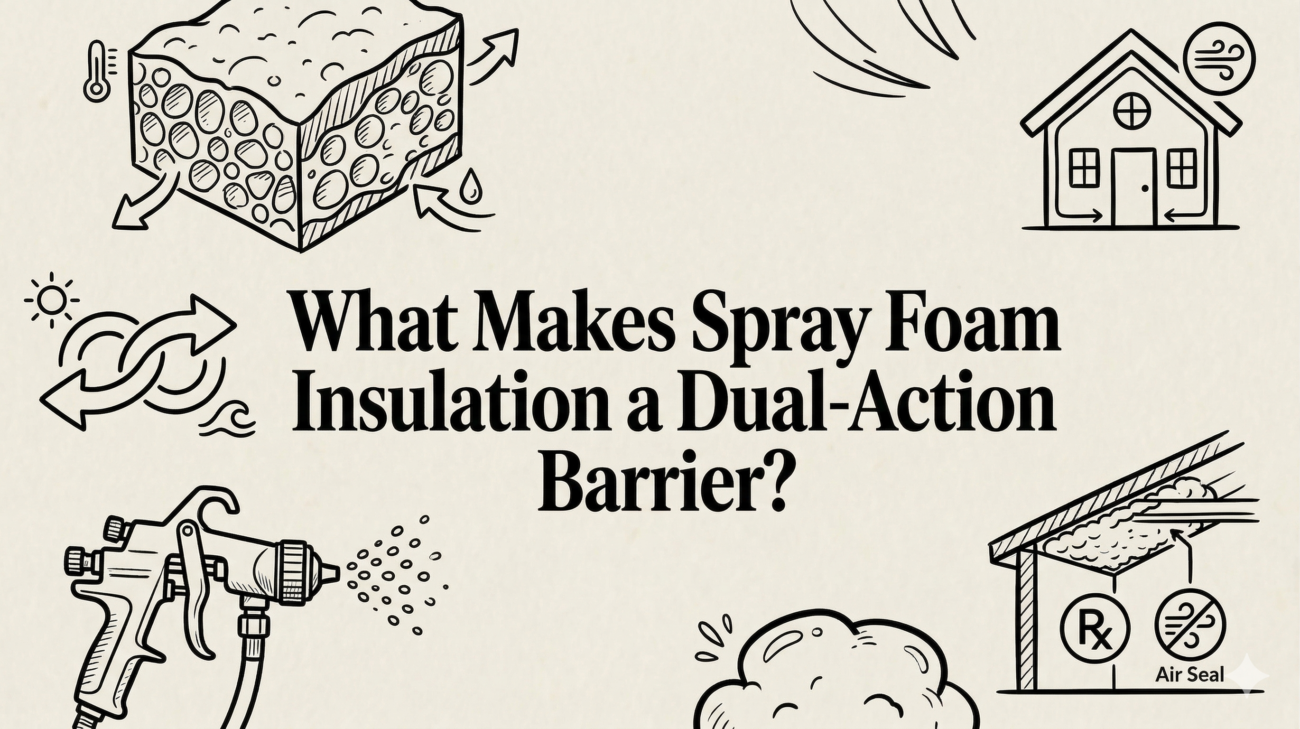
This is where high-performance insulation, especially spray foam, really shines. It's a comprehensive shield against all three. It doesn’t just resist conduction; its air-sealing quality stops convective currents cold—a huge advantage over traditional fiberglass batts, which do nothing to stop air movement.
"The 'R' in R-value stands for resistance to heat flow. Simply put, the higher the R-value – or the larger the number – the greater a product’s insulating power."
This resistance takes a massive strain off your air conditioner. When your home is properly insulated, your HVAC system doesn't have to work nearly as hard. It runs less often and more efficiently, which translates directly into lower energy bills and a home that stays cool and comfortable, no matter what the thermometer says outside. For a deeper look at the science, check out this excellent guide on Understanding R-Value Insulation.
The Market Demand for High R-Value Solutions
This push for better insulation isn't just happening in our backyard; it's a nationwide shift driven by sky-high energy costs and tougher building codes.
The U.S. spray foam insulation market—a critical solution for homeowners here in Jupiter and West Palm Beach—hit USD 750 million in 2024 and is expected to climb to USD 1.01 billion by 2030. This boom is largely fueled by homeowners who've discovered that spray foam can slash energy bills by up to 50% because of its incredible air-sealing capabilities.
North America makes up 42.5% of the global market, and that demand is getting a serious boost from building codes that now require higher R-values, like Florida's mandate for R-30 in attics. This is all about combating our signature heat and humidity. It's also why our closed-cell spray foam, with its high R-value of 6.5 per inch, is perfectly engineered for sealing walls and roofs in our climate. It reduces air leakage 24 times better than fiberglass, dramatically cutting AC costs during those punishing Wellington summers. You can read the full research about these market trends and their drivers to learn more.
How To Use An R-Value Calculator For Your Project
Figuring out the numbers behind your insulation doesn't have to be complicated. In fact, the power of an R-value calculator comes down to one simple formula that helps you compare materials and plan your project with real confidence.
The math is surprisingly straightforward: just multiply the material’s R-value per inch by how thick you plan to install it.
R-Value per Inch x Thickness in Inches = Total R-Value
This is the key to turning abstract ideas into hard numbers. It lets you see exactly how different choices will impact your home’s ability to fight off the Florida heat. Whether you're a homeowner looking to upgrade or a contractor framing a new build, this is where you start.
Putting The R-Value Formula Into Action
Let's walk through a few real-world examples you'd find right here in South Florida. Say you're insulating a standard 2×6 wall, which gives you about 5.5 inches of space to work with.
Here’s how a few common materials stack up using that formula:
- Fiberglass Batts: With an average R-value of R-3.2 per inch, a 5.5-inch cavity gets you a total of R-17.6. It's a common choice, but this number doesn't tell the whole story—it doesn’t account for costly air leaks.
- Open-Cell Spray Foam: This foam comes in at a higher R-3.7 per inch. In that same wall, it delivers a total of R-20.35 and brings superior air-sealing benefits that fiberglass just can't touch.
- Closed-Cell Spray Foam: As the highest-performance option, closed-cell boasts an impressive R-6.5 per inch. That same 5.5-inch space now achieves a powerful R-35.75, more than doubling the thermal shield of fiberglass.
Key Takeaway: The material you choose makes a massive difference. For the exact same thickness, high-density closed-cell spray foam creates a much stronger thermal barrier—a non-negotiable for battling Florida’s intense heat and humidity.
Now, let's think about an attic. If you have 10 inches of space to fill, using open-cell spray foam would give you an R-37 (10 inches x R-3.7). This meets modern energy codes and puts a robust thermal cap on your home, keeping the conditioned air where it belongs.
Understanding R-Value is the first step, but to truly maximize your energy savings and comfort, it's worth exploring all the ways you can reduce heating costs in your home.
Why Material Choice Is So Critical
The formula proves that two things dictate your final R-value: thickness and the material's built-in resistance to heat. But what is insulation actually fighting? Heat moves in three primary ways—conduction, convection, and radiation—and high-performance insulation has to stop them all.
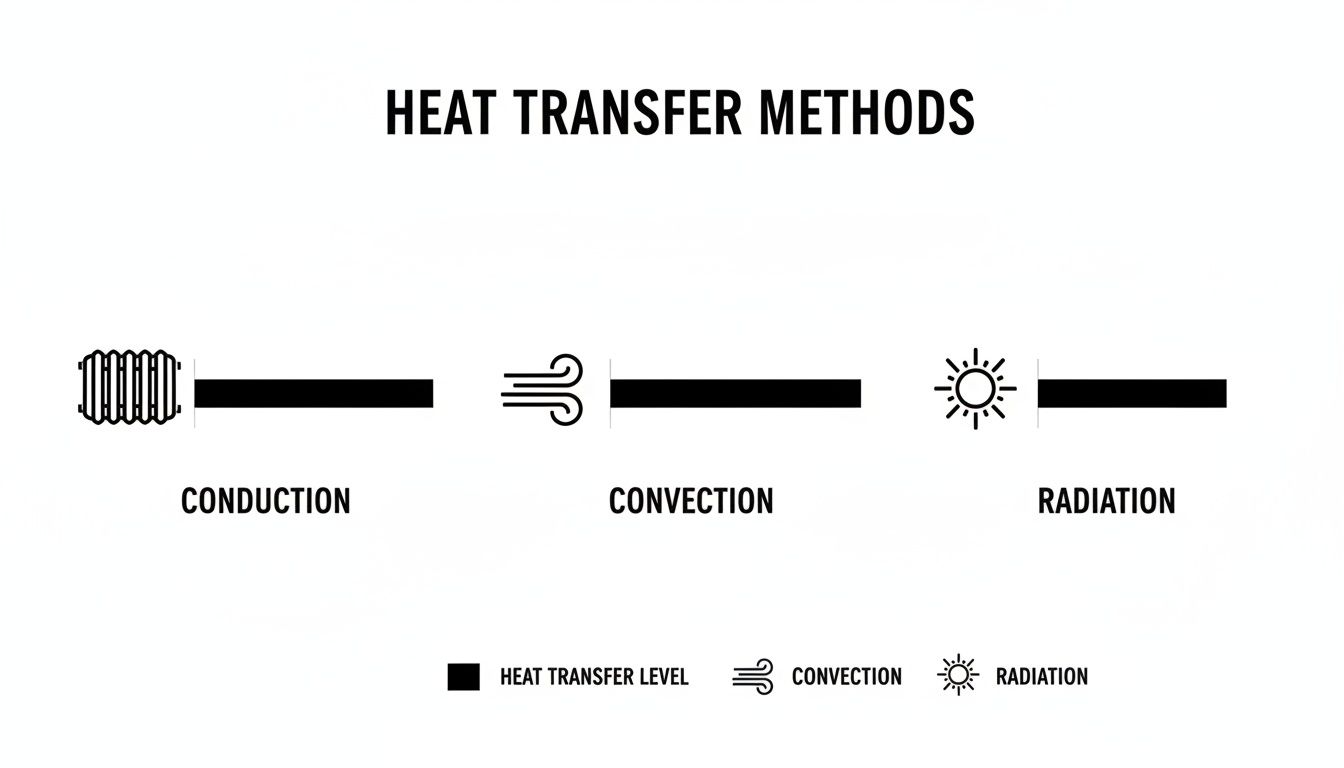
This visual makes it clear that truly effective insulation has to do more than just slow down heat transfer through solid objects; it has to stop air movement, too.
Material R-Value Per Inch Comparison
Choosing the right insulation involves more than just its R-value. You also have to consider how it handles moisture and air, which are major concerns here in South Florida. This table breaks down the key differences between the most common materials on the market.
| Material | R-Value Per Inch | Moisture Resistance | Air Sealing Capability |
|---|---|---|---|
| Fiberglass (Batts) | R-3.1 to R-4.3 | Poor (can hold moisture) | None (allows air to pass through) |
| Cellulose (Blown-in) | R-3.2 to R-3.8 | Poor (can absorb moisture) | Limited (settles over time) |
| Open-Cell Spray Foam | R-3.5 to R-4.0 | Good (allows drying) | Excellent (creates an air barrier) |
| Closed-Cell Spray Foam | R-6.0 to R-7.0 | Excellent (acts as a vapor barrier) | Excellent (creates a rigid air barrier) |
As you can see, spray foam insulation stands out not just for its high R-values but for its ability to create a genuine air and moisture seal, which is something traditional materials simply can't do.
This is why spray foam has become the go-to for performance. With open-cell offering R-3.5 to R-4 per inch and closed-cell reaching up to R-7, it’s perfectly suited for our climate. Here at Airtight Spray Foam, we specialize in getting these installations exactly right.
The demand for better insulation is growing, and for good reason. The residential sector is a huge piece of the puzzle, with a projected 49.3% share of the global market in 2025 as homeowners race to upgrade older properties. Modern codes often demand R-38 ceilings and R-13 walls, and making those upgrades can slash energy use by 20-30%.
With North America holding up to 42.5% of the global market, the push is on. Many homes built before 1980 are poorly insulated, leading to heating and cooling costs that are 40% higher than they should be. It’s a problem we see every day, and it’s one we know how to fix.
Recommended R-Values for South Florida Buildings
Knowing the science behind R-value is one thing, but applying it to your own home is where it really counts. Here in South Florida, we live in a unique climate—what the Department of Energy officially calls Climate Zone 1. Our battle isn't against freezing winters; it's a year-round fight against intense, relentless heat and suffocating humidity.
This means the R-values we aim for are all about creating a powerful thermal shield to block that solar heat gain. Following these guidelines is the first real step toward a comfortable home and lower energy bills. An insulation R-value calculator is a great tool to double-check that you’re hitting these crucial targets.
Your R-Value Targets for a Florida Home
Building codes and energy experts have set clear benchmarks for different parts of a home. Think of these targets as a roadmap to creating a continuous thermal barrier, protecting every spot where heat tries to sneak in.
Here are the R-value goals you should be aiming for in any new construction or major renovation project in South Florida:
- Attics: The target is R-30 to R-38. Your attic gets blasted by the sun all day, making it the single most important area to insulate correctly.
- Exterior Walls: Aim for R-13 to R-15. This is what stops heat from radiating right through the walls and turning your living spaces into an oven.
- Floors Over Unconditioned Spaces: You'll want to hit R-13. This applies to floors above garages, vented crawlspaces, or open porches where hot air can easily rise and warm your home from below.
Hitting these numbers makes a world of difference. A properly insulated attic, for example, can stop that blistering rooftop heat from radiating down into your living room—a problem that sends countless AC units into overdrive. You can learn more about the specifics of upgrading your attic insulation in Florida and see just how much it can transform your home.
Why Meeting Minimum Code Is Not Enough
It’s critical to understand that building codes represent the absolute bare minimum for safety and performance, not the gold standard. Hitting the code is a legal requirement, but it often leaves a lot of room for improvement in both comfort and long-term energy savings.
Think of the building code as a C-minus grade—it's passing, but you wouldn't be thrilled with it. In a climate as tough as ours, aiming for an A+ pays off for decades. Exceeding the minimums is how you create a high-performance home that’s truly built to last.
For instance, while R-30 might be the minimum for an attic, stepping up to R-38 gives you a much stronger thermal break that significantly lightens the load on your HVAC system. This is especially true during those brutal summer months when the temperature in your attic can be double that of your living space. A higher R-value means less heat gets through, which translates directly to lower power bills and a home that stays consistently cool.
Creating a High-Performance Building Envelope
The real goal isn't just to stuff insulation into your walls; it's to create a complete, airtight system. This is where the type of insulation you choose becomes every bit as important as its R-value. Traditional materials like fiberglass might have a decent R-value on paper, but they do absolutely nothing to stop air leakage.
That movement of hot, humid air through thousands of tiny gaps and cracks—known as convective heat transfer—is a massive energy killer in Florida. Spray foam insulation is in a class of its own because it provides a high R-value and creates a seamless air seal. It expands to fill every single void, effectively shutting down drafts and forming a superior barrier against both heat and moisture.
By going beyond the minimum R-value with an air-sealing insulator like spray foam, you aren't just checking a box. You're making a smart investment in a healthier, quieter, and far more efficient home.
Why Spray Foam Delivers More Than Just R-Value
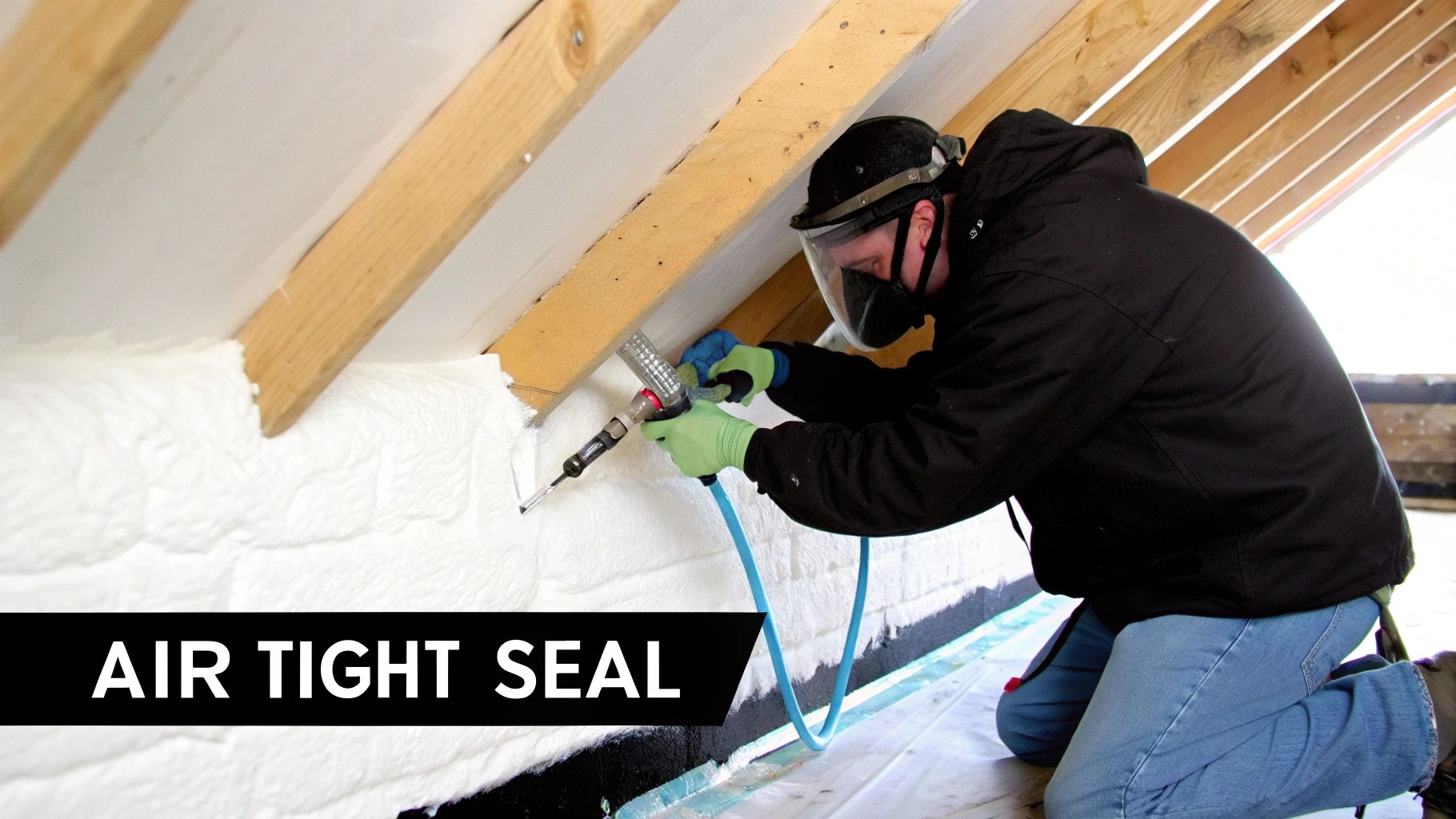
Hitting a high R-value is a fantastic goal, and an insulation calculator gets you started on the right path. But as any experienced building pro in South Florida will tell you, that number is only half the battle. True home performance, especially against our brutal heat and humidity, demands a solution that creates a complete, unbroken air seal.
This is where spray foam insulation is simply in a league of its own. Traditional insulation like batts or rolls are just placed between studs, often leaving tiny gaps. Spray foam, on the other hand, is applied as a liquid that expands on contact, flowing into every crack, gap, and awkward corner before curing. It bonds directly to the structure, forming a seamless, airtight barrier that other materials just can't match.
The Power of a True Air Seal
Think of your home like a boat. A high R-value is like having a thick hull—great for protection. But if that hull is riddled with tiny holes, you're still going to take on water. In your home, those "holes" are air leaks, and they're the real culprits behind massive energy loss and the relentless humidity problems that plague Florida homeowners.
Spray foam permanently plugs those leaks. This airtight barrier stops convective heat transfer, which is just the technical term for hot, humid air moving from your attic or the outdoors into your cool, conditioned living space. By stopping these drafts cold, you get some pretty powerful benefits:
- Drastically Lower Energy Bills: Air leaks can force your HVAC system to work up to 40% harder. When you seal them, your system runs less often, saving you real money every single month.
- Superior Humidity Control: Blocking that sticky outdoor air helps maintain a stable, comfortable indoor humidity level. This takes a huge load off your air conditioner's dehumidifying function.
- Consistent Indoor Temperatures: An airtight seal gets rid of those frustrating hot and cold spots, creating a far more even and comfortable environment from room to room.
More Than Just an Insulator
The unique way spray foam works delivers benefits that go way beyond simple thermal resistance. When you choose spray foam, you’re investing in a complete upgrade for your home's performance—creating a healthier, stronger, and quieter space.
An airtight home is an efficient home. Spray foam insulation doesn't just add R-value; it fundamentally changes how your building performs by creating a complete air barrier that traditional materials can't replicate. This is the key to conquering Florida's heat and humidity.
Just look at the other advantages that come with this advanced solution:
Improved Indoor Air Quality
That airtight seal doesn't just keep your cool air in; it keeps outdoor pollutants out. By blocking unfiltered air from seeping through cracks and gaps, spray foam helps cut down on the dust, pollen, and other allergens that can make life miserable.
Enhanced Structural Strength
Closed-cell spray foam, in particular, adds a serious structural boost. As it cures, it becomes a rigid, dense material that actually bonds building components together. This adds racking strength to your walls and can increase the overall resilience of your home—a huge plus in a region known for high winds. Digging into the specifics of closed-cell foam R-values shows just how powerful this dual benefit really is.
Significant Noise Reduction
The same properties that make spray foam a great air barrier also make it a fantastic sound dampener. Both open-cell and closed-cell foams absorb airborne sound waves, dramatically cutting down on noise from outside traffic, loud neighbors, or even from one room to the next. The result is a much quieter, more peaceful home.
What's the Next Step? From Numbers to Real-World Results
You’ve got a handle on R-value and how it protects your home from the relentless South Florida heat. You've seen how tools like an insulation R-value calculator can give you a baseline and why spray foam delivers such a high level of thermal resistance. That's the foundation.
But numbers and formulas are just the starting point. The real goal is to turn that knowledge into a cooler, more comfortable home with lower energy bills. And that means taking action.
Why a Calculator Isn't Enough
While a calculator is a great tool for understanding the basics, every home has its own quirks. A simple formula can't spot the hidden air leaks around pipes, the complex angles in your roofline, or the early signs of a moisture issue. Those are the details that make a huge difference in performance.
This is where hands-on expertise comes in. A professional assessment goes far beyond the math.
From Calculation to a True Consultation
An expert evaluation from a trained specialist pinpoints the exact sources of energy loss in your house. We can recommend the right type of spray foam for specific areas and determine the precise thickness needed to hit your efficiency goals. It’s a tailored approach that ensures you get the most out of your investment.
A professional consultation will help you:
- Find and Fix Critical Air Leaks: We’ll hunt down the hidden gaps that let humid, hot air in and drive up your cooling costs.
- Assess Your Current Insulation: Is what you have in your attic and walls actually working? We'll find out.
- Get a Custom Plan: You'll get a solution designed for your home, whether it’s an older build or brand-new construction.
A home’s energy performance is a complete system. R-value is a huge piece of the puzzle, but an expert ensures all the parts—air sealing, insulation, and moisture control—are working together perfectly.
Get Your Free, No-Obligation Quote
The best way to understand your home’s potential is to talk to the people who solve these problems every single day. The team at Airtight Spray Foam Insulation is ready to help you take that crucial next step. We offer a free, no-obligation quote that gives you a clear, actionable plan to transform your home.
We’ll come out, inspect your property, listen to what you’re dealing with, and give you a detailed recommendation based on our decades of experience in the South Florida climate. Let us show you how a professional installation can make your home quieter, healthier, and way more energy-efficient.
Request your free quote from Airtight Spray Foam Insulation today and get started on the path to a better home.
R-Value Questions We Hear All the Time
Even with a calculator in hand, it's natural to have questions about how all this R-value stuff actually applies to your home here in South Florida. Let's tackle some of the most common ones we get from homeowners.
Can You Have Too Much Insulation or an R-Value That's Too High?
In a hot, humid climate like ours, it's almost impossible to "over-insulate" an attic. Think of it this way: a higher R-value means more resistance to the brutal sun beating down on your roof. More resistance means your air conditioner doesn't have to work nearly as hard, which translates directly into lower energy bills. The real question is about finding the sweet spot between the upfront investment and your long-term savings.
For walls, it's a bit different because you're limited by the depth of the studs. Getting a professional assessment is the only real way to figure out the perfect R-value for your home's unique construction and your budget.
How Does Insulation R-Value Hold Up Over Time?
This is a huge one, because not all insulation is created equal for the long haul. Traditional materials like fiberglass and cellulose have a bad habit of losing their effectiveness over the years. They just can't stand up to the forces of time and our climate.
- Compaction: Gravity is relentless. Loose-fill materials inevitably settle and compress, leaving thin spots that compromise the overall R-value.
- Moisture: This is the big killer for fiberglass. The moment it gets wet—a constant threat in our humidity—its R-value takes a nosedive.
- Pest Damage: Rodents and insects absolutely love to nest in soft, fluffy insulation, tearing it apart and destroying its insulating power.
This is where closed-cell spray foam completely changes the game. It's a rigid, solid material that won't sag, settle, or absorb a drop of moisture. It maintains 100% of its R-value for the entire life of your home, ensuring you get consistent, reliable performance forever. No replacements needed.
Do I Need to Rip Out My Old Attic Insulation Before Adding Spray Foam?
Not necessarily. If your existing insulation (like that common pink fiberglass) is still dry and in decent shape, we can often apply spray foam directly over it. We call this "encapsulation," and it can be a smart, cost-effective way to give your R-value a massive boost.
However, if that old insulation is damp, moldy, or full of pest droppings, it has to go. No exceptions. Insulating over a problem just seals it in, creating a serious health and performance issue. An expert inspection is the only way to know for sure which path is right for your attic.
Is R-Value the Only Thing That Matters for Insulation?
R-value is absolutely critical for measuring how well insulation resists heat, but it's only one piece of the puzzle. To truly tame the South Florida climate, you need an insulation that checks three essential boxes.
The Performance Trifecta: For maximum efficiency and comfort in Florida, your insulation must deliver a high R-value, create a perfect air seal, and block moisture. If you're missing even one of these, your home is losing the battle against high energy bills and humidity.
Spray foam is the only insulation material on the market that masters all three. It completely stops air leaks (convection) and, especially with closed-cell foam, creates an impenetrable moisture barrier. Those two factors are just as important as R-value for achieving real-world energy savings and preventing mold in our swampy environment.
Ready to see what a real plan for your property looks like? The experts at Airtight Spray Foam Insulation can give you a free, no-pressure assessment to pinpoint exactly what your home needs.