In South Florida, the need for home insulation contractors near me often arises from a common pattern many homeowners experience. The AC runs hard all day, certain rooms never feel right, the garage is brutal by midafternoon, and the house still feels sticky even when the thermostat says it should be comfortable.
In this climate, insulation isn't just about slowing heat. It's about controlling air movement, managing moisture, and making sure the material matches the way South Florida homes perform. A decent-looking job can still be the wrong job if the contractor ignores humidity, attic conditions, roof exposure, or the need to seal leaks before insulating.
South Florida punishes weak insulation work fast. Heat loads are constant, humidity hangs around most of the year, and small air leaks don't stay small problems for long. They turn into comfort issues, condensation risk, and higher cooling demand.
That matters because this isn't a market where homeowners are choosing from a short list of national names. The U.S. insulation contractors industry has over 28,000 businesses, according to IBISWorld's insulation contractors industry data. In plain terms, you're usually comparing local crews, local sales processes, and local installation quality. One contractor may understand venting, roof decks, and moisture behavior in coastal Florida. Another may just be selling whatever material they install most often.
A generic insulation pitch often misses what matters here:
The first nearby listing isn't the safest choice. In a crowded trade, process tells you more than proximity.
The right contractor doesn't start by pushing a product. They start by figuring out where your house is losing performance. That means looking at attic conditions, transitions, existing insulation, and any signs that moisture is part of the problem.
A strong bid in South Florida should answer practical questions. What area are they insulating. What material are they using there, and why. What prep work is included. Are they addressing air leakage or just adding insulation over it. If those answers are vague, move on.
South Florida homeowners usually end up comparing two categories first. Spray foam and fiberglass batts. Both can be useful, but they don't solve the same problems the same way.
Fiberglass mainly slows heat transfer. Spray foam insulates too, but its bigger advantage in many Florida applications is that it can also help limit unwanted air movement. In a hot, humid region, that difference matters.
A lot of homeowners ask which one is "better." That's too broad. The better question is which material fits the location, the moisture risk, and the performance goal.
If you're insulating a simple interior assembly with predictable conditions, fiberglass may be adequate when it's installed carefully. If you're dealing with an attic, roofline, garage ceiling, wall cavities with leakage paths, or a house with persistent humidity and hot spots, spray foam usually deserves a serious look.
For a closer side-by-side breakdown, this spray foam vs. fiberglass comparison is a useful starting point.
| Feature | Spray Foam (Closed-Cell) | Fiberglass Batts |
|---|---|---|
| Air sealing | Helps seal gaps and limit air movement | Does not air seal on its own |
| Moisture behavior | Better suited for areas where moisture control is a concern | Can lose effectiveness if installation is sloppy or air leakage is ignored |
| Fit in irregular spaces | Expands to conform to cavities and penetrations | Works best when cavities are regular and unobstructed |
| Installer precision | Requires trained application and jobsite controls | Still requires care, especially around gaps, compression, and voids |
| Best fit in South Florida | Strong option for roof decks, walls, garages, and problem areas with heat and humidity | Better for budget-driven projects where air sealing is handled separately |
Homeowners also hear "spray foam" as if it's one thing. It isn't.
Open-cell foam is lighter and is often used where expansion and cavity fill are the priority. Closed-cell foam is denser and is often chosen when a tighter, more sturdy assembly is needed. In South Florida, that distinction affects where each product makes sense.
A contractor should be able to explain why they're recommending one over the other in your attic, walls, or roofline. If the answer is just "that's what we always use," that isn't enough.
Good material in the wrong location is still a bad recommendation.
What works is matching the product to the building. Spray foam tends to make the most sense where air leakage and humidity control are part of the comfort problem. Fiberglass can still be the right call when the assembly is straightforward, the budget is tighter, and the contractor is also addressing leakage details separately.
What doesn't work is treating all insulation like it's interchangeable. In South Florida, it isn't. The house needs a system approach, not a product-only answer.
A polished website doesn't tell you much. Neither does a low bid. If you're serious about hiring the right company, you need to look at how they inspect, how they write scope, and how they protect you if something goes wrong.
Start with this checklist and use it on every company you're considering.
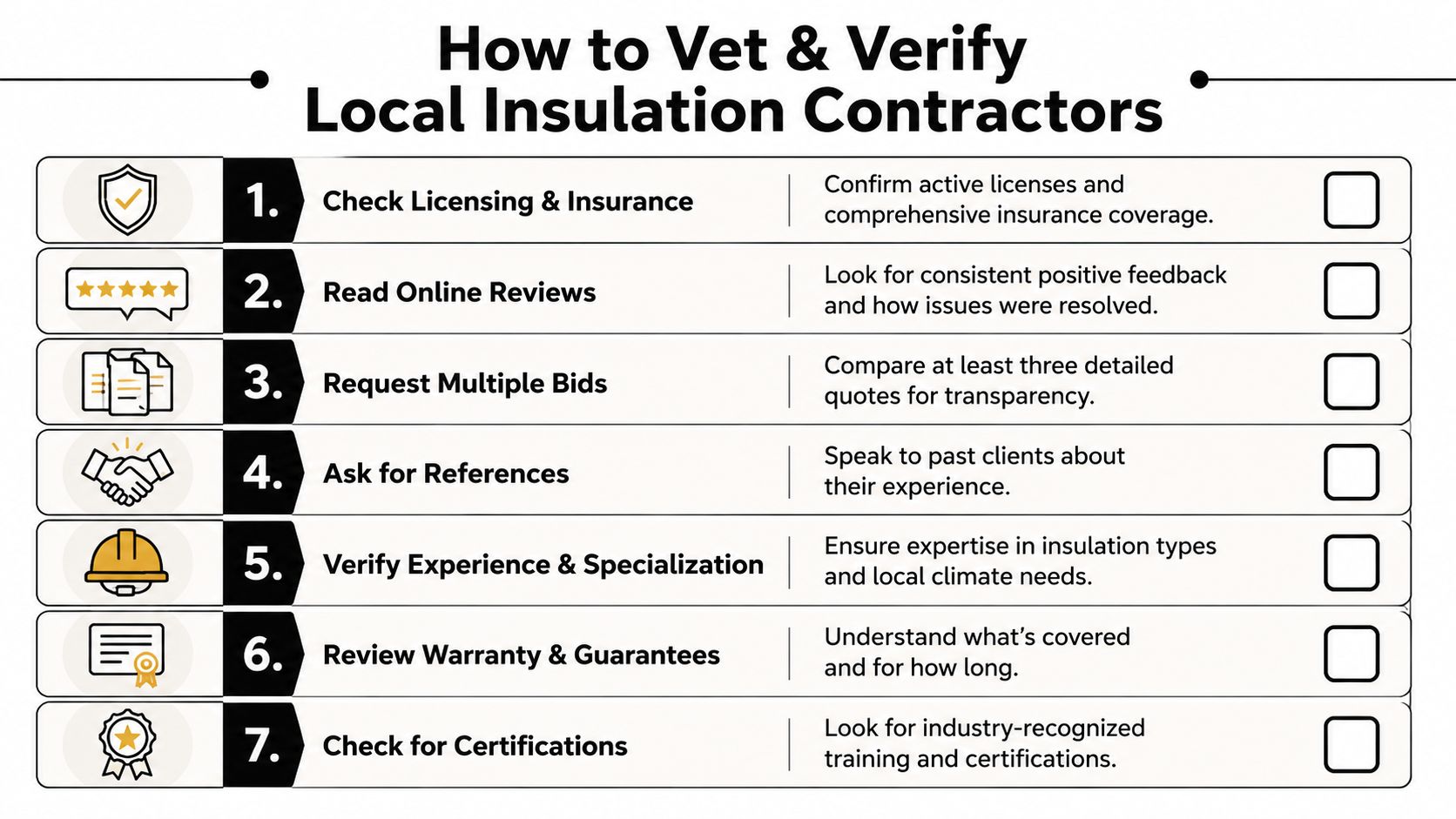
A high-performing contractor should physically inspect the home before estimating. The Insulation Institute describes this as a walk-the-frame approach, and notes that relying only on plans, blueprints, or phone descriptions often leads to bad estimates and change orders in its guidance on estimating insulation jobs with an in-person walkthrough.
That advice lines up with what experienced homeowners eventually learn the hard way. If someone gives you a firm number without seeing the attic, access points, existing conditions, and problem areas, they're guessing.
Practical rule: If the contractor won't inspect the job in person, don't expect the quote to stay accurate once work begins.
A proper visit should include questions about comfort issues, moisture concerns, prior renovations, and where the house feels hardest to cool. It should also include a look at the areas they plan to insulate, not just a quick sales conversation in the driveway.
For homeowners comparing installers, this page on spray foam insulation contractors is a useful benchmark for the kind of contractor qualifications and process details you should expect to discuss.
A quick video overview can also help you think through what to ask before signing anything.

A South Florida insulation quote can look simple and still miss half the job. The number may cover material and install, but leave out attic prep, old insulation removal, access issues, or the air sealing work that helps the house hold cooled air.
That is where homeowners get burned on price comparisons.
A quote you can trust spells out the scope in plain language. It identifies the area being insulated, the product being installed, the target thickness or coverage, and any prep required before the crew starts. In this climate, it should also show whether the contractor plans to address leakage around top plates, penetrations, hatches, or duct runs. If those details are missing, the bid is incomplete even if the price looks attractive.
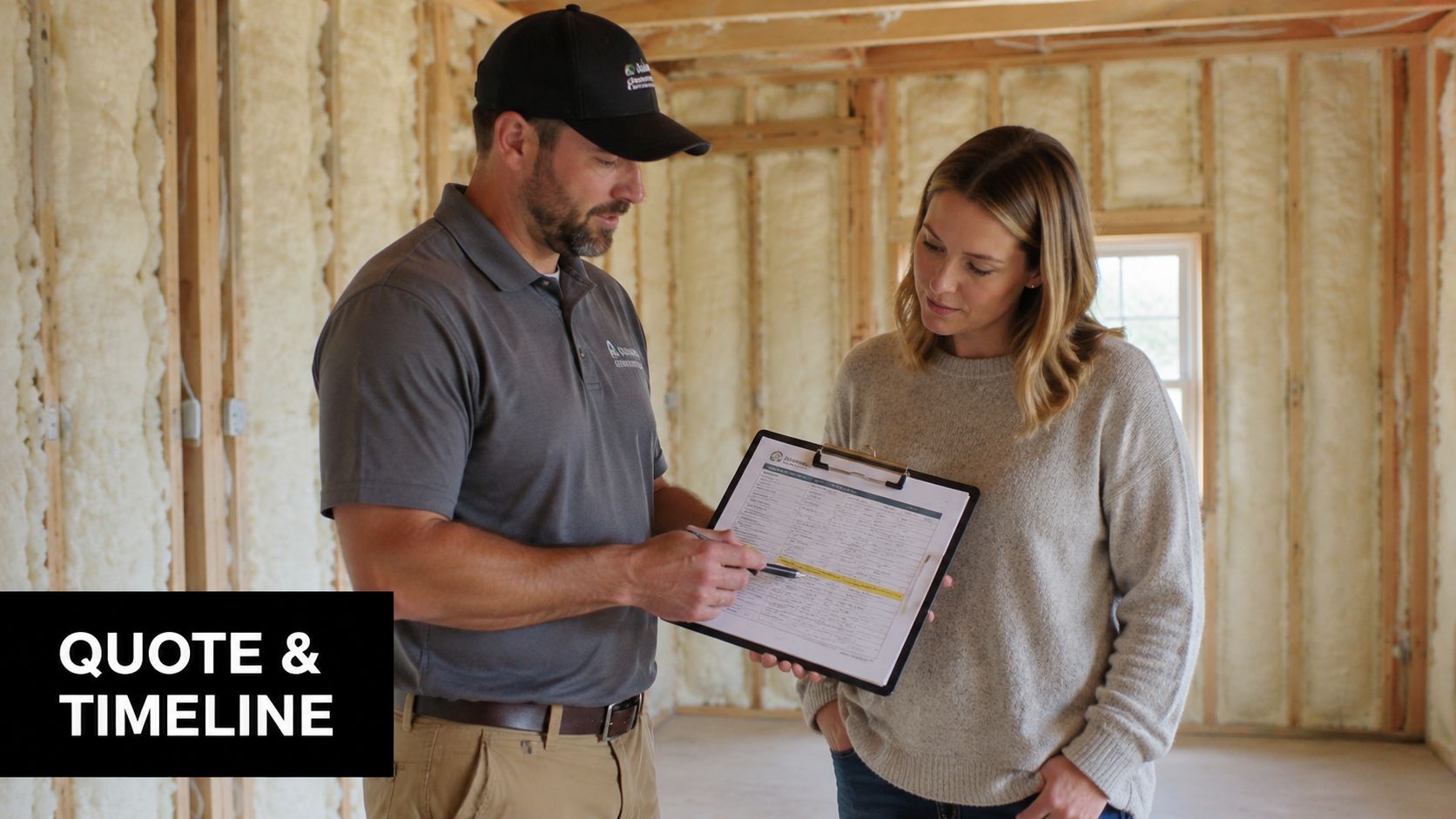
Use this checklist before you compare numbers:
If you want a practical pricing reference, this guide to spray foam insulation installation cost shows the variables that tend to move a quote up or down.
A small, open attic with easy access can move quickly. A tight attic in an older South Florida home usually does not. Low rooflines, existing ductwork, moisture-stained insulation, limited access openings, and post-storm repairs can all slow the job down.
Good contractors account for that before they schedule the work. They explain how long prep takes, whether the install happens in one day or multiple visits, and whether you need to stay out of the home for part of the process. Spray foam projects, especially, should come with clear expectations on ventilation, curing, and re-entry timing.
Watch for quotes that promise a fast turnaround but do not show the steps. Speed is fine. Missing scope is expensive.
Insulation installed over obvious leakage paths rarely performs the way people expect. In a hot, humid climate, that can mean uneven rooms, longer AC run times, and moisture problems that were never addressed at the source.
A solid proposal reflects the sequence of work. Seal the openings that are part of the agreed scope. Handle prep. Install the insulation. Clean up. Walk the job with the homeowner.
A short quote often means a short scope.
That does not always mean the contractor is dishonest. Sometimes it means the estimator rushed the visit, copied a template, or assumed conditions that do not match your house. Either way, vague paperwork usually turns into change orders, delays, or a result that looks finished but does not solve the comfort problem.
A South Florida homeowner gets three insulation quotes. One is dramatically cheaper, one is vague, and one asks a lot of questions about the attic, ducts, soffits, and moisture. The third contractor is usually the one taking the house seriously.
Hiring mistakes usually happen before any insulation is installed. They start with a rushed site visit, a price that looks good on paper, or an installer who talks only about R-value and never about humidity, air movement, or how this climate punishes sloppy work.
A low bid can be legitimate. It can also mean the contractor left out prep, skipped air sealing, uses less material than discussed, or sends a crew that is learning on your house. In this trade, labor, training, and safety cost money. Cheap pricing often shows up later as callbacks, comfort complaints, or material that has to be removed and replaced.
South Florida adds another layer. An installer who does not ask about indoor humidity, attic ventilation, duct leakage, or signs of past roof leaks is missing the part that causes trouble here. Homes in this region do not just battle heat. They battle heat plus moisture, and that changes how insulation should be chosen and installed.
Watch for these warning signs:
As noted earlier, insulation work is specialized labor. Companies that train crews well, carry proper insurance, and follow product-specific installation steps usually do not come in as the bargain-basement option.
That does not mean the highest quote wins.
It means homeowners should ask why one number is far below the others. Sometimes the answer is simple. The contractor quoted a different scope. Sometimes it is a problem. They priced the job like basic blow-in work when the house really needs air sealing, careful prep, or a foam crew that knows how to handle South Florida conditions.
The most expensive insulation job is the one you have to remove and redo because the first installer cut corners.
I see this one a lot. A homeowner decides on spray foam before anyone evaluates the house, or rules it out because a neighbor had a bad experience with a completely different application.
Material choice should follow the problem. A hot bonus room, a humid garage ceiling, a vented attic with leaky ducts, and a low-slope roofline do not all call for the same approach. Good contractors start by diagnosing where the home is gaining heat, where humid air is getting in, and what assembly they are insulating. Then they recommend the material that fits that location and budget.
In South Florida, that order matters. The wrong material in the wrong place can trap moisture, leave comfort problems untouched, or give you an expensive install that never delivers the result you were promised.
By the time most homeowners search for home insulation contractors near me, they're past the casual research stage. They want the upstairs cooler, the humidity lower, the AC workload lighter, and the quote to make sense.
In South Florida, the right path is pretty consistent. Choose a contractor who understands local heat and moisture, insists on an in-person inspection, explains material choices clearly, and writes a scope you can evaluate. If they also talk through prep, ventilation, cleanup, and final walkthrough, you're usually dealing with a more reliable operation.
For homeowners in Jupiter, Palm Beach Gardens, West Palm Beach, Wellington, and Stuart, Airtight Spray Foam Insulation is one local option that focuses specifically on spray foam applications for the climate conditions discussed here. The company is led by Christian Cates, who brings 25+ years of hands-on experience, and the work centers on sealing gaps, reducing air leakage, and helping control moisture in South Florida homes.
If your house feels hot, uneven, or hard to keep dry and comfortable, the smartest next step is a thorough on-site evaluation. A real inspection will tell you whether the issue is attic insulation, roofline strategy, wall leakage, garage heat transfer, or a combination of problems.
If you're ready to get clear answers and a job scope built around your home, contact Airtight Spray Foam Insulation for a free on-site evaluation. You'll get a closer look at where your home is losing comfort, which insulation approach fits the space, and what it takes to make the house tighter, cooler, and easier to live in year-round.