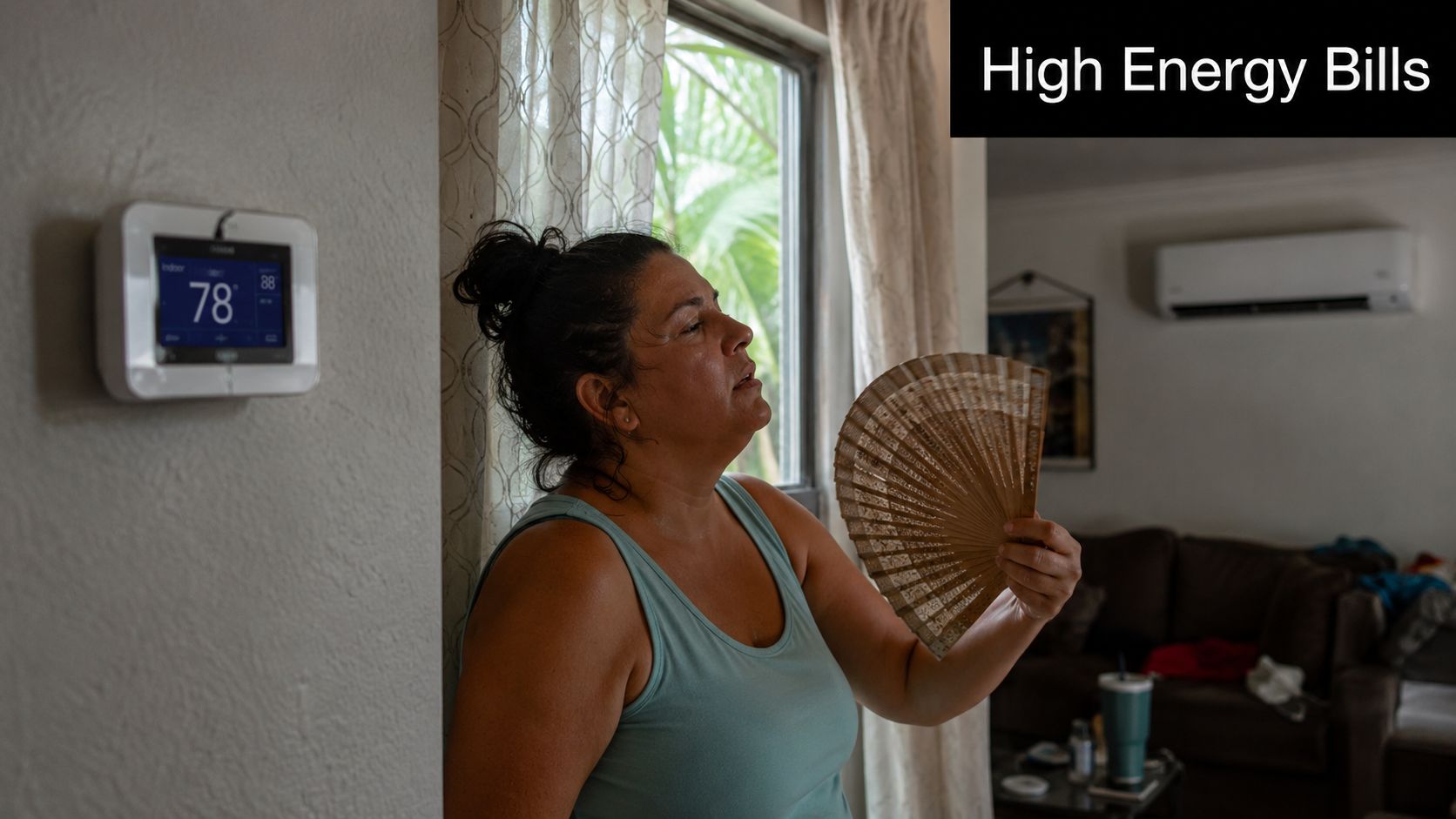
If your AC seems to run all day, certain rooms still feel sticky, and the garage wall feels like a toaster in the afternoon, you're dealing with a South Florida insulation problem. While often called an insulation problem, that's only half right. In this climate, it's usually an insulation, air leakage, and moisture problem working together.
That's why the phrase all weather insulation gets misunderstood. Homeowners hear it and picture one miracle product that handles heat, humidity, cool nights, wind-driven rain, and storm season all at once. Real buildings don't work that way. A house performs as a system, and in South Florida that system has to control heat flow, stop humid air from sneaking in, and avoid trapping moisture where it can do damage.
South Florida doesn't give your house much downtime. The cooling season feels constant, humidity stays aggressive, and even when temperatures ease up a bit, moisture pressure on the building doesn't. If the attic is venting hot air into the house, or wall cavities are full of gaps around wiring and framing, your HVAC ends up fighting the outdoors every day.
A lot of homeowners assume insulation is just a fluffy layer that slows heat. That's true in a basic sense, but all weather insulation in a place like Jupiter, West Palm Beach, or Stuart has to do more than add resistance. It needs to help the house stay stable when outdoor heat, indoor cooling, salty air, and high humidity all hit the same assembly.
The larger problem is widespread. The U.S. Department of Energy notes that about 9 out of 10 U.S. homes are under-insulated through its guidance on home insulation and energy savings. In other words, if your home struggles to stay comfortable, you're not the outlier.
In a cold climate, people often focus on keeping indoor heat from escaping. In South Florida, the pressure usually comes from the opposite direction. Heat wants in. Humidity wants in. Air moves through cracks, top plates, can lights, duct penetrations, soffits, rim areas, and poorly detailed roof-to-wall transitions.
That's why I don't treat all weather insulation as a product label. I treat it as a performance goal.
Practical rule: If insulation doesn't address the way air and moisture move through the house, it won't perform like “all weather” insulation for long.
The warning signs are familiar:
When those symptoms show up, the fix usually isn't “add more insulation and hope.” The effective fix is choosing an assembly that holds up under hot-humid conditions.
People shop for insulation the way they shop for coolers. They ask for the highest rating and assume that settles it. That's understandable, but it leaves out two things that matter just as much in Florida: air control and moisture behavior.
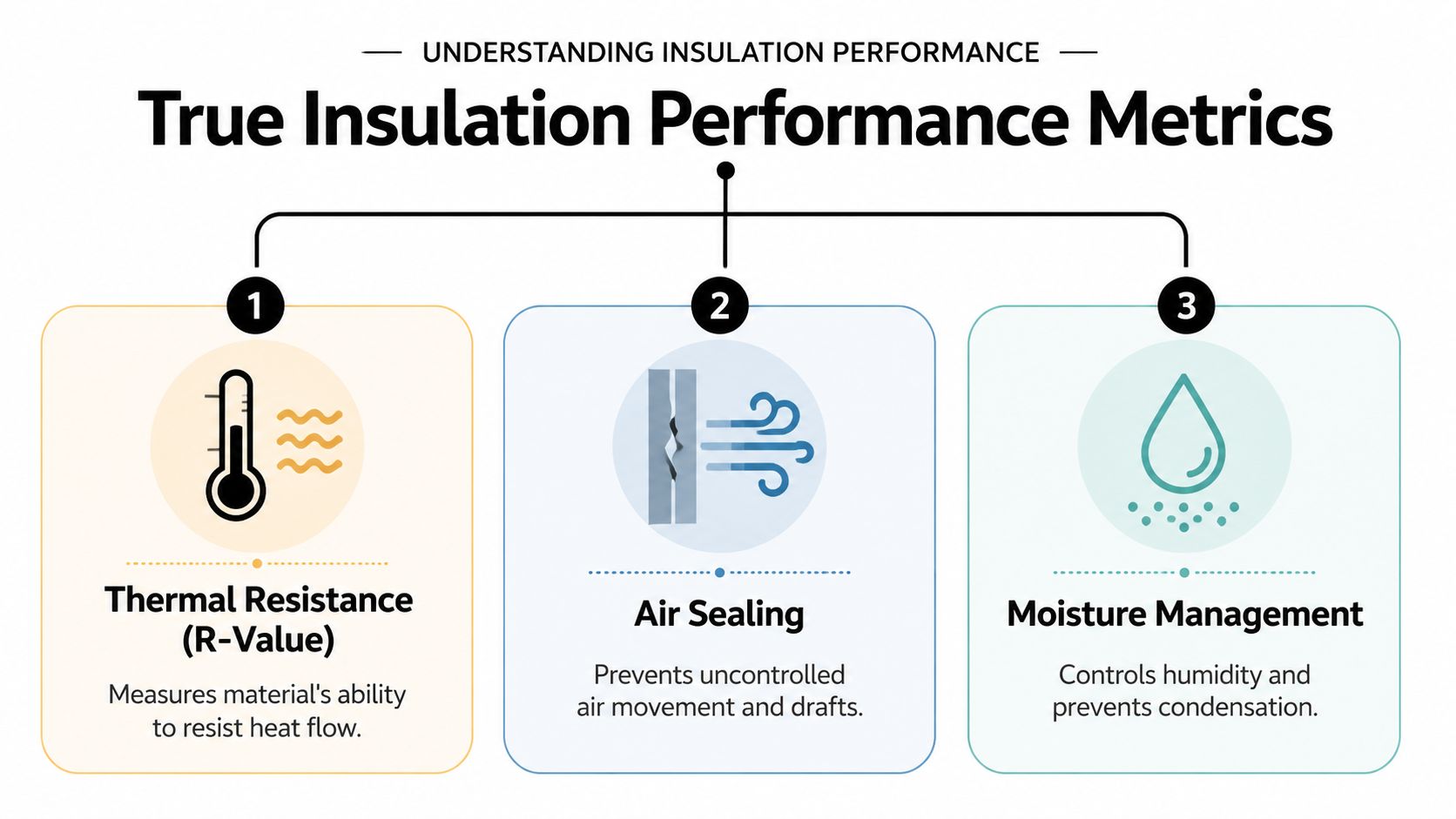
A good way to think about it is clothing. A wool sweater gives you warmth. That's R-value. But if you walk into a storm wearing only a sweater, wind cuts right through it and moisture starts working against you. A high-performance jacket handles insulation, wind, and moisture together. Building assemblies work the same way.
R-value measures resistance to heat flow. Higher numbers mean better thermal resistance. That matters. It's the baseline metric, and it's useful for comparing materials.
Per inch, R-value guidance for insulation materials commonly places open-cell spray foam at about R-3.6 to R-3.8, closed-cell spray foam at roughly R-5.5 to R-6.5, and fiberglass batts around R-2.75 to R-5.25. Those ranges explain why closed-cell foam gets attention when space is limited and thermal performance matters.
If you want to estimate assemblies more carefully, a useful starting point is this insulation R-value calculator.
Here's the framework I use when evaluating all weather insulation in South Florida:
The mistake is treating those as separate conversations. They overlap every day.
A wall can test well on paper and still disappoint in real life if humid air keeps bypassing the insulation layer.
A high R-value product installed with gaps is like wearing an expensive rain jacket with the zipper open. The material might be strong, but the assembly is weak. That's why homeowners get confused when they pay for insulation and still have hot spots or muggy rooms.
The same issue shows up in attics and rooflines. A material can have a respectable thermal rating, but if air moves around it instead of through the intended control layers, comfort suffers and HVAC runtime climbs. In hot-humid conditions, performance comes from the full package, not the label on the bag or drum.
Most South Florida projects come down to a few common choices: closed-cell spray foam, fiberglass batts, and cellulose. Each can play a role, but they don't behave the same when you put them in a humid coastal environment with strong solar gain and year-round cooling loads.
The key technical distinction is that spray-applied polyurethane foam recognized under ASTM C1029 can serve as both thermal insulation and an air-sealing layer when installed properly. That dual role is a big reason it shows up in high-performance assemblies.
Closed-cell spray foam earns its keep where you need insulation and air control in one layer. It conforms to irregular surfaces, helps limit air movement, and works well in roof decks, walls, rim areas, and metal buildings where condensation risk can be stubborn. In South Florida, those details matter more than brochure claims.
Fiberglass batts can work, but only when cavities are clean, dimensions are consistent, and installation is careful. Batts don't stop air movement on their own. If the surrounding assembly leaks, the batt becomes part of a leaky system. That's why a batt job can look fine from the room side and still underperform badly.
Cellulose can be useful in some assemblies, particularly when dense installation helps fill voids better than a loosely fitted batt. But material choice has to match the assembly and moisture conditions. If you're weighing those two options specifically, this breakdown of foam versus cellulose insulation is a practical comparison.
| Feature | Closed-Cell Spray Foam | Fiberglass Batts | Cellulose |
|---|---|---|---|
| Heat resistance in limited space | Strong because of high R-value per inch | Moderate, depends on thickness and fit | Moderate, depends on installation depth and density |
| Air sealing | Strong when properly installed as part of the assembly | Weak on its own | Better cavity fill than batt in some cases, but not a standalone air barrier |
| Humidity resilience | Useful in demanding assemblies where moisture control matters | Can lose practical effectiveness when air moves through gaps around it | Assembly-dependent, needs careful moisture planning |
| Irregular cavities and penetrations | Handles odd shapes and obstructions well | Harder to fit neatly around wiring, pipes, and framing interruptions | Fills better than batts in some retrofit conditions |
| Roof deck and metal building applications | Often a good fit | Usually less effective where air leakage and condensation are concerns | Depends heavily on enclosure design |
| Installation sensitivity | High, requires trained application | High, requires precise cutting and fitting | High, requires correct density and coverage |
Spray foam isn't the answer to every problem, and fiberglass isn't automatically wrong. The trade-off is about assembly performance.
If a contractor is insulating a straightforward interior partition for sound control, the conversation might be very different than insulating a coastal roof assembly over conditioned space. In Florida, roofs, attics, exterior walls, garages, and metal structures usually reward systems that reduce air leakage, not just systems that fill space.
The best insulation choice isn't the one with the nicest label. It's the one that still performs after heat, humidity, and air pressure work on it every day.
It is 3 p.m. in August. The thermostat says 74, but the house still feels sticky, the guest bedroom is warmer than the hallway, and the supply vents are sweating. In South Florida, that usually points to air leakage and moisture movement before it points to a missing inch of insulation.
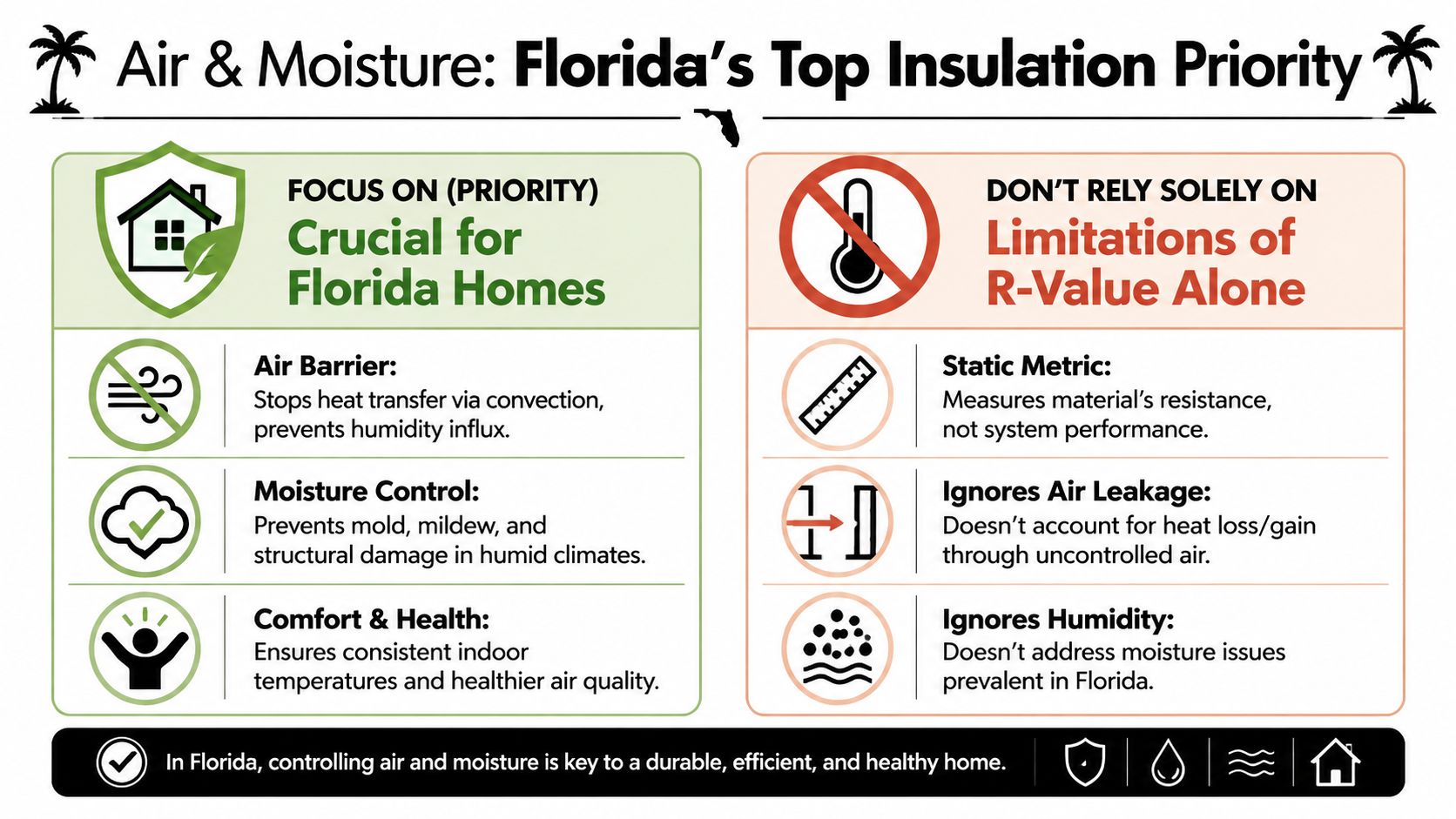
R-value still matters. It measures resistance to heat flow, like the thickness of a cooler wall. But a high R-value does not stop humid outdoor air from slipping through cracks at top plates, recessed lights, soffits, duct chases, and framing joints. The U.S. Department of Energy makes that point in its guidance on types of insulation and installation fit. In Florida, those leaks often do more damage to comfort and moisture control than a modest difference in labeled R-value.
The weak points are usually small, but they add up fast. Attic bypasses around wiring and bath fans, rough openings at windows and doors, plumbing penetrations under sinks, and leaky return plenums all let hot, damp air get where it should not be. I see plenty of homes with decent insulation in the cavities and ongoing comfort complaints because the air boundary was never cleaned up.
That is why "all weather" performance here means the whole assembly has to work together. Insulation slows heat. Air sealing controls infiltration. Moisture control keeps the building from turning into a condensation experiment during a long cooling season.
Thermal bridging also deserves attention, especially in roof and wall assemblies that take hard sun all day. Framing members conduct heat across the assembly even when the cavities are insulated, so heat does not politely stay between studs. Exterior continuous insulation can help address that, but it works best as part of a larger air and water control plan, not as a standalone fix.
Moisture problems in Florida rarely announce themselves early. They show up as a musty closet, swollen trim, stained drywall near a soffit line, or an air handler fighting to pull down indoor humidity after every rain cycle. Hurricanes and wind-driven rain raise the stakes. When pressure changes across the house, weak details around the enclosure get tested hard.
Some homeowners start with solar load reductions, and that can help at the edges. If you are improving the exterior as part of a broader comfort plan, this guide on reduce utility bills with efficient screens adds useful context. But shading does not fix humid air moving through the enclosure, and it does not stop condensation inside a poorly detailed wall or roof system.
For assemblies where moisture risk is a major part of the decision, it helps to understand how moisture barrier insulation systems fit into the wall or roof and how they interact with the local climate.
In South Florida, insulation lasts longer and performs closer to its label when air leakage is controlled and moisture has a planned path to stay out or dry safely.
A South Florida house can look fine on paper and still feel wrong by 3 p.m. The back bedroom runs hot, the air handler never seems to catch up after a rainstorm, and the electric bill climbs even though the thermostat stays in the same place. In that situation, the best insulation investment is the one that fixes how the house behaves in heat, humidity, and storm season.
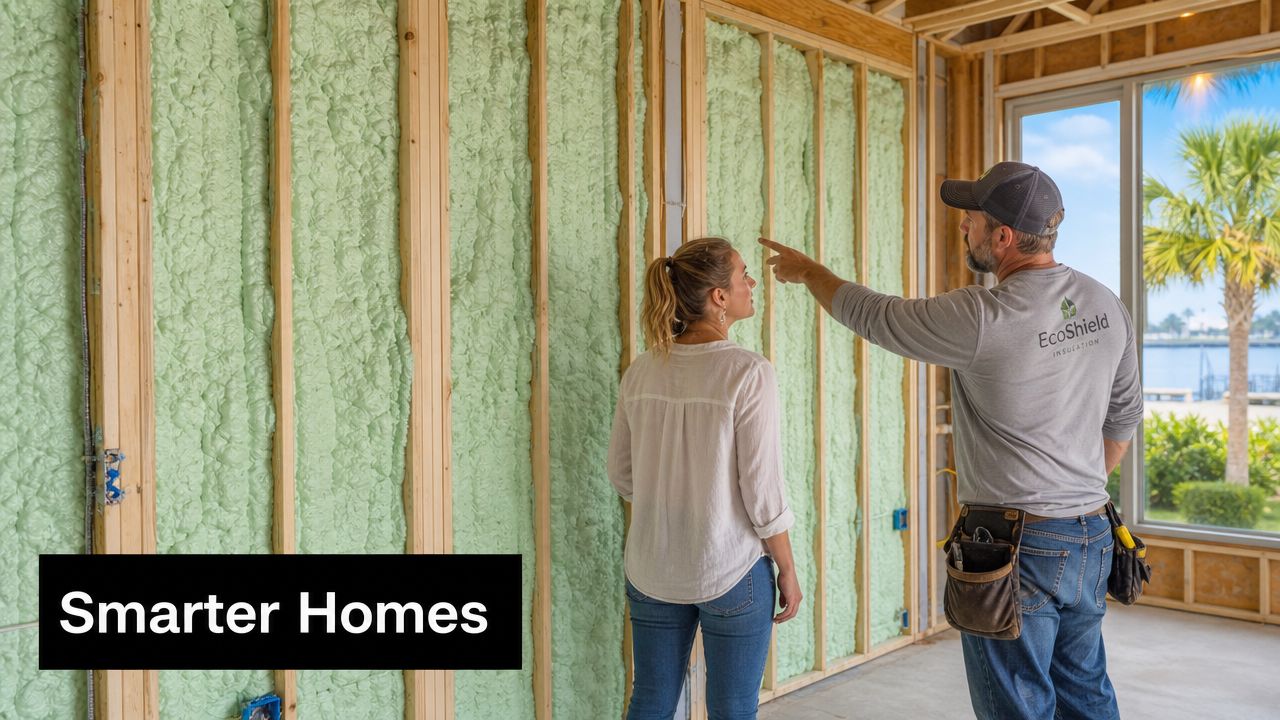
Price per square foot matters, but it is not the main decision. In Florida, I would rather see a homeowner spend money on the right assembly and cleaner installation than chase a higher advertised R-value while leaving leaks, humid attic air, and bad transitions in place. R-value works like the thickness of a cooler wall. If the lid does not seal, the ice still melts fast.
That is why smart spending usually starts with the problem area, not the product brochure. A house with ducts in a brutal attic needs a different strategy than a block home with a hot west-facing wall or a garage ceiling that dumps heat into the rooms above. Some properties benefit most from roofline insulation and attic air control. Others get better returns from targeted retrofit work during a remodel, especially where comfort complaints line up with known weak points in the enclosure.
Homeowners should judge an insulation upgrade by three outcomes. Better room-to-room comfort, steadier indoor humidity, and less strain on the HVAC system. If a lower bid skips detail work around penetrations, soffits, attic hatches, or top plates, that savings often disappears in higher runtime and ongoing discomfort.
Contractors and builders should evaluate the whole assembly. Good windows and efficient equipment do not rescue a house with poor transitions between wall, roof, and openings. In new construction, continuous insulation can be a strong option because it reduces heat flow through framing. In Florida, the value is not just more thermal resistance. It is a cleaner exterior control layer when the detailing is done right.
Property managers and landlords should focus on durability and complaint reduction. Tenants rarely call to discuss insulation levels. They call because a room smells damp, the HVAC is loud, or one side of the unit never gets comfortable.
Installation quality separates a good plan from an expensive disappointment.
I have seen high-end insulation underperform because the crew treated the job like cavity fill and ignored the joints, chases, and odd little gaps where outside air gets in. Florida homes have plenty of those. Recessed lights, bath fan housings, attic access panels, rim areas, duct boots, block-to-frame transitions, and garage separations all deserve attention.
Use these checkpoints before approving the work:
Airtight Spray Foam Insulation is one local contractor homeowners may encounter for projects involving open-cell or closed-cell spray foam. The material choice matters, but the bigger question is whether the proposed assembly fits the house and addresses the moisture and air-leakage issues driving the complaint in the first place.
If you are weighing insulation against other upgrades, this roundup of proven ways to lower Florida utility bills helps frame the decision alongside HVAC performance, shading, and day-to-day energy use.
A quick visual overview helps if you're comparing installation scenarios and applications:

A South Florida house can feel fine in January, then turn sticky and expensive to cool by August. That swing is why "all weather" insulation questions here usually come back to one issue. Keeping hot, wet air out of the building assembly in the first place.
It can be, if the crew follows the product instructions and the re-entry window without shortcuts.
Occupants and pets should stay out of the work area for the recommended period. The installer also needs to manage ventilation, isolate the space, and treat mixing and application like a controlled process, not a quick add-on service. Poor installation creates odor and indoor air quality complaints faster than the material itself.
It helps with heat flow, air leakage, and moisture control. Those are useful during storm season, especially after wind-driven rain and pressure changes stress the building enclosure.
Closed-cell foam can stiffen some enclosed assemblies, but that does not replace proper structural connections, roof fastening, impact protection, or code-required storm prep. In hurricane country, insulation is one part of the system, not the storm strategy by itself.
Yes, but metal buildings are unforgiving in Florida.
Metal moves heat fast and cools surfaces below the dew point, so condensation can show up quickly if the assembly is wrong. That is why air sealing and condensation control usually matter more than chasing a high advertised R-value. A metal building with gaps can sweat like a cold drink set outside in July.
In the right house, yes.
If the ductwork and air handler sit in the attic, bringing that space inside the conditioned envelope often improves comfort and reduces the penalty from superheated attic air. The assembly still has to be designed carefully. Roof condition, indoor humidity control, combustion safety, and code details all matter, and a sloppy unvented attic can trap problems instead of solving them.
Start with the area causing the biggest heat gain, air leakage, or moisture trouble.
In South Florida, that is often the attic or roofline. After that, I look hard at garage connections, recessed lights, plumbing and wiring penetrations, and rooms that never seem to hold temperature. The best first step is not always the biggest surface area. It is the weakest part of the enclosure.
Higher R-value helps, but it is only one part of performance.
R-value works like the thickness of a cooler wall. It slows heat flow. If humid outdoor air is slipping through gaps around that cooler wall, comfort drops and moisture risk rises anyway. In hot-humid climates, an assembly with good air control and decent R-value often outperforms one with a higher number on paper and poor sealing.
If your home or building in South Florida feels harder to cool than it should, a targeted evaluation can usually show where the enclosure is underperforming. Airtight Spray Foam Insulation works on attics, walls, roofs, garages, metal buildings, and new construction across the region, with recommendations based on air sealing, moisture control, and how the full assembly is put together.