Blog
Your Guide to High Temp Spray Foam Insulation

Think of high temp spray foam as the ultimate thermal shield for your home, specifically engineered to perform where other insulation types just can’t handle the heat. It creates a seamless, airtight barrier that dramatically cuts down on energy use and protects your home from the punishing temperatures we see here in South Florida. It’s a game-changing upgrade for any property in a hot climate.
Understanding Your Home’s Thermal Shield
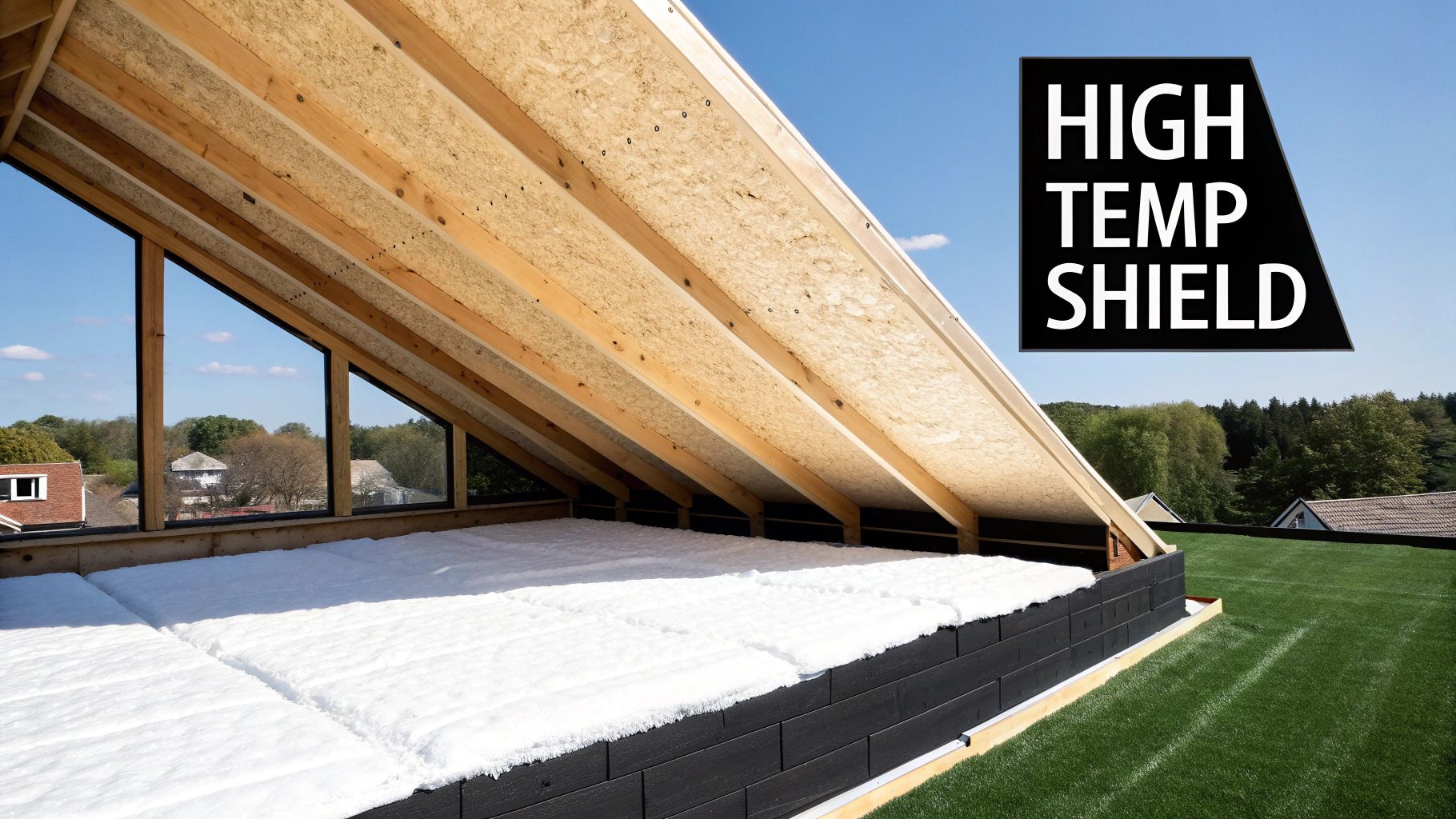
Imagine your house is a high-end thermos. On a scorching summer day in South Florida, you want the inside to stay cool and comfortable, no matter what. Standard insulation is more like a cheap plastic cooler—it works for a little while, but eventually, the heat wins.
High temp spray foam, on the other hand, is the vacuum-sealed wall of that premium thermos. It forms a nearly impenetrable barrier that stops heat transfer in its tracks.
This specialized foam creates a rigid, continuous layer that seals every single crack, gap, and crevice. Unlike traditional materials that are notorious for leaving gaps, spray foam expands to fill every void, putting a stop to air leakage. That air-sealing quality is just as crucial as its ability to resist heat.
The Science Behind the Performance
So what makes this foam “high-temp”? It all comes down to its unique chemical makeup. When the two liquid parts are mixed and sprayed, they trigger a chemical reaction, expanding in seconds and hardening into a dense material with a closed-cell structure. This structure is incredibly good at slowing down the movement of heat.
The result is a home that feels more stable and comfortable year-round. The key benefits are real and immediate:
- Reduced HVAC Strain: Your air conditioner doesn’t have to battle the heat 24/7, which means less wear and tear and a longer lifespan for your system.
- Significant Energy Savings: By creating an airtight seal and providing top-tier thermal resistance, it can seriously lower your monthly cooling bills.
- Enhanced Structural Integrity: The rigid nature of closed-cell foam actually adds strength to surfaces like roof decks and walls.
A Growing Market for Efficiency
This focus on real-world performance is why demand is skyrocketing. The global market for spray foam insulation is projected to jump from USD 2.18 billion in 2025 to USD 4.45 billion by 2035. This shows that homeowners are catching on to the long-term value of investing in superior building materials. You can read more about spray foam industry growth and its market trends to see where things are headed.
In a climate like South Florida’s, where attic temperatures can easily top 150°F, high temp spray foam isn’t just an upgrade—it’s a foundational part of an energy-efficient home. It gets to the root cause of high energy bills: heat intrusion.
By blocking radiant heat right where it starts, this insulation keeps your home a comfortable sanctuary, protecting both your wallet and your peace of mind.
Understanding Spray Foam Types and Temperature Ratings
Not all spray foam is created equal, and when you’re dealing with the brutal South Florida sun, choosing the right material is everything. The two main players are open-cell and closed-cell spray foam. Their names give a hint to their structure, which completely changes how they perform under extreme heat.
Think of open-cell spray foam like a big kitchen sponge. Its microscopic cells are left open, which makes the foam soft, flexible, and fantastic for dampening sound. But just like a sponge, it can also let air and moisture pass through, making it a less-than-ideal shield against our intense heat and humidity.
Closed-cell spray foam, on the other hand, is a different beast entirely. Imagine its cells are all sealed up, packed tightly together to form a dense, rigid, and waterproof barrier. That solid structure is exactly what makes it the champion for high-temperature jobs.
Why Closed-Cell Foam Excels in High Heat
When it comes to performance, closed-cell foam is the clear winner for hot climates. Its densely packed, sealed cells create a formidable barrier that stops heat in its tracks—whether it’s trying to conduct through your roof, convect through air leaks, or radiate down into your living space. This powerhouse performance is reflected in its R-value, which is simply a score of how well insulation resists heat flow.
Here’s a quick breakdown of what makes it the go-to high temp spray foam:
- Exceptional Thermal Resistance: Closed-cell foam boasts an R-value of R-6 to R-7 per inch. That’s nearly double what open-cell offers, meaning you get far more insulating power without sacrificing space.
- Air and Moisture Barrier: Because its cells are sealed, it’s practically impermeable to both air and water. In Florida’s swampy climate, this is a game-changer for stopping moisture intrusion and preventing mold before it starts.
- Structural Reinforcement: Once it cures, closed-cell foam becomes incredibly strong and rigid. When we apply it to the underside of a roof deck, it actually adds structural integrity—a nice bonus during hurricane season.
A South Florida attic can easily top 150°F on a summer afternoon. In that kind of environment, the robust, multi-layered defense of closed-cell spray foam isn’t just a good idea; it’s essential. It doesn’t just slow heat down—it stops it cold, along with the oppressive humidity.
To really see the difference, let’s compare the two side-by-side.
Comparing Open-Cell and Closed-Cell Spray Foam
| Characteristic | Open-Cell Foam | Closed-Cell Foam (High Temp) |
|---|---|---|
| Structure | Soft, flexible, sponge-like | Rigid, dense, solid |
| R-Value per Inch | R-3.5 to R-4 | R-6 to R-7 |
| Air Barrier | Yes, but breathable | Yes, airtight seal |
| Moisture Barrier | No (permeable to vapor) | Yes (impermeable) |
| Structural Strength | Minimal | Adds significant rigidity |
| Best Use Case | Sound dampening, interior walls | Roofs, attics, metal buildings |
As you can see, for any application where intense heat and moisture are the primary enemies, closed-cell foam is built to win.
Matching Temperature Ratings to Your Project
Beyond just picking closed-cell, we also have to look at its service temperature rating. This number tells us the maximum temperature the cured foam can handle day in and day out without breaking down. For most residential attics, a standard foam rated for up to 180°F is more than enough.
But for tougher jobs—think commercial metal roofs baking in the sun or certain industrial facilities—we need to bring in the true high temp spray foam. These specialized formulas are engineered to withstand continuous temperatures of 250°F or even higher, ensuring they never lose their insulating power or structural integrity. You can see more examples of these unique jobs in our articles on specialty insulation.
Choosing the right product isn’t about grabbing the one with the highest temperature rating. It’s about a professional assessment to determine the actual peak temperatures your surfaces will face. We match the foam’s capabilities directly to the real-world conditions of your property, guaranteeing you get the performance and energy savings you were promised for decades to come.
Where High Temp Spray Foam Works Best
Knowing the science is one thing, but seeing where high temp spray foam truly shines is what brings its value home. This isn’t just another insulation product; it’s a targeted solution for the most challenging, heat-prone areas of a building. Here in South Florida, where the sun is relentless, certain spaces act like heat traps, driving up your energy costs and making comfort feel impossible.
Let’s walk through the three key battlegrounds where this insulation makes the biggest impact. We’ll look at the common problem in each area and then see how spray foam delivers a definitive, long-lasting solution.
Transforming Scorching Hot Attics
Picture a typical South Florida attic on a July afternoon. Outside, it might be 95°F, but up there, it’s a blistering 150°F or even hotter. Your roof shingles soak up solar radiation, transferring that intense heat directly to the roof deck. That deck then radiates heat downward, turning the entire attic into a giant oven sitting right on top of your living space.
This is the classic “before” picture. The old, often inadequate, insulation on your attic floor is fighting a losing battle. Heat steadily seeps through the ceiling, forcing your HVAC system to run nonstop just to keep up. It’s an exhausting and expensive cycle.
Now, imagine the “after.” A professional applies high-temp closed-cell spray foam directly to the underside of the roof deck. Instantly, the attic is transformed from a vented, oven-like space into a semi-conditioned, sealed part of your home’s thermal envelope.
The results are dramatic:
- Heat is stopped at the source. The foam blocks radiant heat before it can even enter the attic, preventing the space from superheating in the first place.
- Attic temperatures plummet. Instead of 150°F, the attic might now be only 10-15 degrees warmer than your home, drastically reducing the thermal load on your ceiling.
- HVAC systems get a break. With the primary source of heat intrusion neutralized, your air conditioner can finally cycle off more often, saving you money on energy and extending its lifespan.
This single application doesn’t just insulate; it fundamentally changes how your home manages heat, leading to immediate comfort and savings.
Fortifying Under-Deck Roofing
The underside of a roof deck is the front line in the war against solar heat gain. When we apply high-temp spray foam here, it creates an unbroken, monolithic barrier. It’s not just about adding R-value; it’s about creating a seamless air and moisture shield that traditional insulation simply can’t replicate.
This is especially crucial in our humid climate. The foam’s closed-cell structure is impermeable to moisture, which prevents condensation and the potential for mold growth that loves to thrive in hot, damp attic environments. Even better, the rigid foam adheres directly to the decking and rafters, adding significant structural strength—an invaluable benefit during Florida’s hurricane season.
By creating a sealed and insulated roof deck, you’re not just cooling your attic. You’re building a stronger, healthier, and more resilient roof system from the inside out.
The demand for robust solutions like this is growing. The global market for high-temperature insulation materials is expected to grow from USD 6.55 billion in 2024 to USD 6.91 billion in 2025, driven by the need for materials that deliver superior performance and safety in extreme conditions. To learn more, discover insights about the high temperature insulation market on einpresswire.com.
Taming Metal Buildings
Metal buildings—whether they’re workshops, warehouses, or barndominiums—are essentially giant metal boxes that are incredibly efficient at absorbing and conducting heat. The phenomenon known as thermal bridging, where heat travels easily through the metal framing, makes them notoriously difficult and expensive to keep cool.
An uninsulated metal roof can become painfully hot to the touch, radiating immense heat downward and turning the interior into a sauna. This makes the space uncomfortable for work or storage and leads to astronomical cooling costs. It’s a common headache for building owners all across South Florida.
High-temp spray foam is the perfect fix. It’s applied directly to the interior of the metal panels and framing, creating a complete thermal break.
- Eliminates Thermal Bridging: The foam covers the metal studs and purlins, stopping heat from conducting through the frame and into the building.
- Stops Condensation: Metal buildings are famous for “sweating” as temperatures change. The foam’s moisture barrier prevents this condensation, protecting the structure from rust and its contents from water damage.
- Provides Superior Insulation: The high R-value of closed-cell foam drastically cuts down the amount of heat that enters the building, making climate control achievable and affordable.
This is similar in concept to insulating block walls, though the material properties are quite different. If you’re interested, you can check out our guide on the insulation value of concrete block walls to compare approaches. For metal structures, however, spray foam’s ability to adhere perfectly and stop condensation is what truly sets it apart, turning an inefficient metal shell into a comfortable, energy-smart building.
The Installation Process and Safety Measures
Applying high temp spray foam isn’t a weekend DIY job—it’s a precise science. It involves a controlled chemical reaction that absolutely has to be handled by trained experts from start to finish. Knowing how the pros do it should give you confidence and make it crystal clear why hiring a certified team is the only way to go.
The whole thing breaks down into a few key phases, and each one is critical for creating that seamless, high-performance thermal barrier your property deserves.
Site Preparation and Masking
First things first, we prep. Meticulously. Before a single drop of foam is sprayed, our technicians protect every surface that isn’t getting insulated. We’re talking about carefully covering windows, doors, floors, light fixtures, and your HVAC unit with heavy-duty plastic sheeting and tape.
Think of it like a professional painter getting a room ready, but the stakes are much higher. We create a completely contained work zone to make sure the foam only sticks where it’s supposed to. This step is non-negotiable for a clean, professional job.
Precise Application and Curing
Once the area is fully prepped and sealed, the real technical work begins. The two chemical components of the foam are heated and pumped through separate, high-pressure hoses to a specialized spray gun. It’s only at the very tip of the nozzle that they finally mix, creating a reaction that causes the foam to expand in just seconds.
This infographic shows some of the most common spots where this detailed process is absolutely essential.
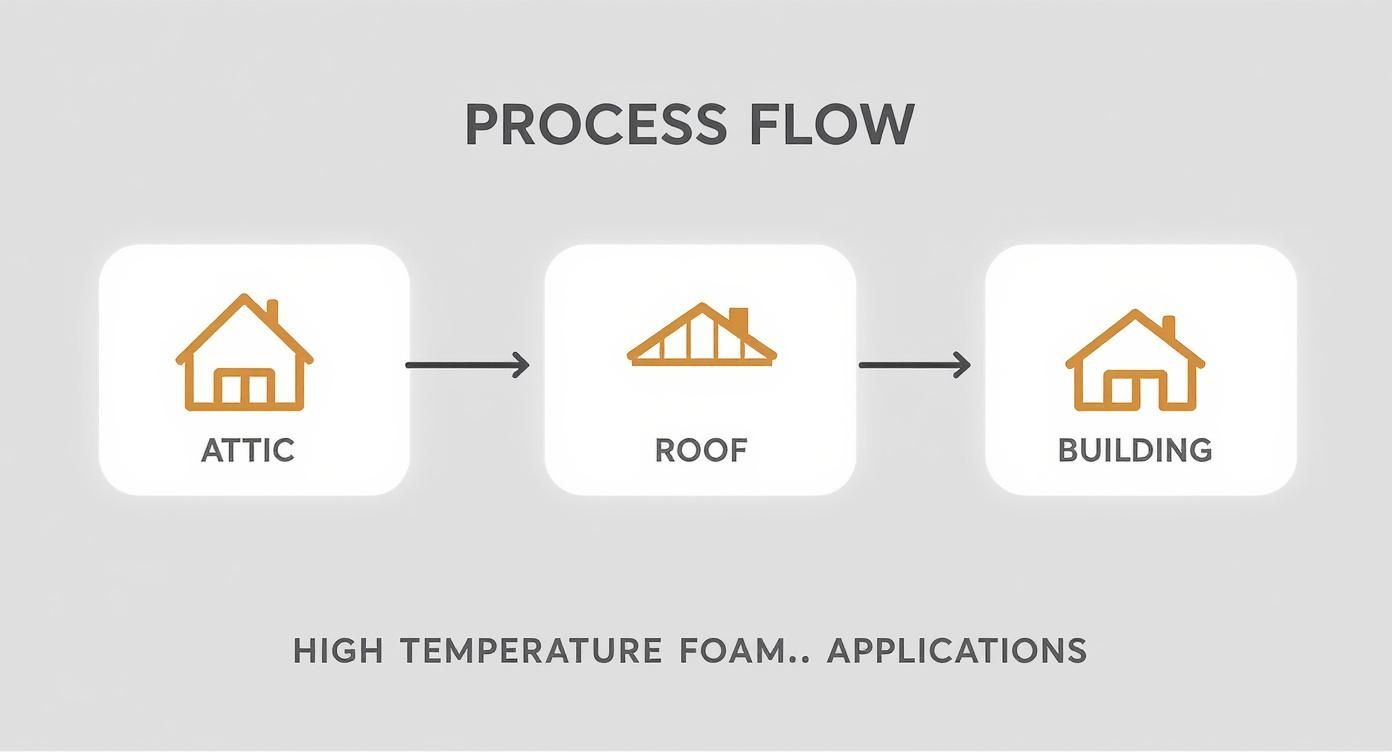
Whether it’s an attic, roof, or metal building, the application has to be methodical to create a uniform layer that completely seals the building envelope.
Our installers apply the foam in smooth, even layers, letting it expand to fill every tiny crack, crevice, and cavity. After it’s sprayed, the foam has to cure. This is when it hardens up and off-gasses, a process we manage with powerful ventilation systems to keep the air moving and clear everything out.
The Critical Role of Safety Protocols
Nothing is more important than safety during a high temp spray foam installation. The chemical reaction that creates the foam releases vapors that you definitely don’t want to breathe. This is exactly why professional installation isn’t just a recommendation—it’s essential for keeping everyone safe.
Our technicians follow strict safety protocols, which always include:
- Full Personal Protective Equipment (PPE): This means full-body disposable suits, gloves, eye protection, and—most importantly—a fresh-air-supplied respirator. This gear keeps our installers completely isolated from any chemical exposure.
- Active Ventilation: We use high-powered fans to create negative air pressure in the work zone, which pulls all fumes and vapors directly outside. This stops odors from lingering and makes sure the air quality is safe for re-entry later on.
- Restricted Re-Entry: Nobody is allowed back into the area without the right PPE until the foam has fully cured and the space has been thoroughly aired out. This usually takes about 24 hours. After that, the foam is completely inert, stable, and safe.
Hiring a certified professional is the only way to guarantee the job gets done right and safely. An expert team has the right training, specialized equipment, and knowledge of safety protocols needed to protect your property and your family, delivering a final product that will perform flawlessly for decades.
Seeing the Savings in South Florida Climates

This is where the investment in a high-performance insulation system really starts to pay for itself. Upgrading to high temp spray foam isn’t just about managing extreme attic heat—it’s about seeing a real, measurable drop in your monthly energy bills, especially here in South Florida’s relentless climate.
The magic is in how it tackles energy waste from two different angles. First, the superior R-value of closed-cell foam is a beast at slowing down heat transfer. At the same time, its ability to create a perfect air seal stops all those little leaks that let superheated attic air sneak into your living space.
This one-two punch delivers immediate results you can feel. Your AC unit, which used to run nonstop trying to keep up with the Florida heat, finally gets a break. That means shorter run times, less wear and tear on your equipment, and a serious drop in your energy use.
Putting Numbers on Your Return
For homeowners in West Palm Beach, Jupiter, and across our region, this translates directly into money back in your pocket. While every home is unique, it’s not uncommon for properties with professionally installed spray foam in the attic and roof deck to see a huge reduction in cooling costs.
It’s realistic for homeowners to see savings of up to 40% on their cooling expenses. That isn’t just a marketing number; it’s the result of fundamentally changing how your home deals with heat. Instead of constantly paying to re-cool your home, you’re holding a stable, comfortable temperature with far less effort from your AC. To see how this stacks up against other common materials, our guide on spray foam vs. blown-in insulation breaks down the performance differences.
In a climate where air conditioning is the single biggest slice of the energy pie, a 40% reduction is a financial game-changer. It’s what helps the initial investment pay for itself over time.
This powerful combination of efficiency and savings is why the demand for spray foam keeps growing. In fact, the U.S. accounts for a massive 83.36% share of the spray foam market in North America. The market is projected to expand to over USD 1.25 billion by 2033, which just shows how many homeowners are catching on to the long-term financial benefits.
More Than Just a Lower FPL Bill
While the energy savings are what get most people’s attention, the benefits of high temp spray foam go way beyond your monthly bill. For Florida homeowners, these extra perks are just as important for protecting your home and giving you peace of mind.
- A Serious Moisture Barrier: Our humidity is no joke, and it creates the perfect breeding ground for mold and mildew in a traditional attic. Closed-cell spray foam is non-permeable, creating a powerful barrier that helps keep your attic dry and your home healthy.
- A Stronger Roof Deck: When applied directly to the underside of the roof deck, the rigid foam acts like a super-strong glue, bonding the sheathing to the rafters. This extra structural integrity can make a real difference in how your roof holds up against the high winds we see during hurricane season.
- Cleaner Indoor Air: By sealing every last crack and gap in your attic, spray foam helps block dust, allergens, and outdoor pollutants from getting into your home. The result is a cleaner, healthier living environment for your family.
When you add it all up, high temp spray foam is one of the smartest upgrades a South Florida homeowner can make. It delivers immediate comfort, big-time savings, and tough protection against the unique challenges our climate throws at us.
How to Choose the Right Spray Foam Contractor
Picking the right high temp spray foam is just the start. The real magic—or the potential for a real headache—is in the installation. A flawless application from a pro crew means you get every ounce of energy savings and protection you paid for. A bad one? That can lead to gaps, poor adhesion, and even serious safety issues.
Honestly, choosing your contractor is the most important decision you’ll make in this whole process. You’re looking for a team with proven expertise, the right paperwork, and a non-negotiable commitment to doing things safely and correctly.
Vetting Your Potential Installers
Before you sign on the dotted line, it’s time to do a little homework. A great contractor won’t hide anything and will have all their ducks in a row.
Here’s a simple checklist to get you started:
- License and Insurance: First things first. Make sure they have a valid Florida contractor’s license and carry both general liability and worker’s compensation insurance. This is non-negotiable—it protects you from any liability if an accident happens on your property.
- Manufacturer Certifications: The best installers are often certified directly by the foam manufacturers themselves. This is proof they’ve been professionally trained on the specific products they’re putting in your home and know the right way to apply them.
- Proven Local Experience: Ask to see a portfolio of their recent work, especially jobs involving high temp spray foam in attics or metal buildings like yours. Check out their Google reviews and testimonials to get a feel for their reputation and the quality of their work.
Don’t be shy about asking direct questions. A confident, experienced contractor will be happy to show you their credentials and put your mind at ease. Your home is your biggest investment, and you deserve to know it’s in good hands.
Critical Questions to Ask Your Installer
Once you’ve narrowed it down to a few companies, it’s time for a quick interview. How they answer these questions will tell you everything you need to know about their standards and professionalism.
- What specific safety gear and protocols do you use during and after the job?
- How do you prep the area to protect our home and belongings from overspray?
- What’s your plan for getting complete, even coverage, especially in those tight corners and hard-to-reach spots?
- Can you walk me through the ventilation process and tell me exactly when it’s safe for my family to be back in the space?
- What kind of warranty or guarantee do you provide on the installation itself?
Getting the right team on board is the final step toward a cooler, more efficient home. With this checklist and these questions, you can hire with confidence, ensuring your high temp spray foam investment pays off for decades to come.
Common Questions About High Temp Spray Foam
Choosing to upgrade your insulation is a big step, and it’s completely normal to have a few questions. Especially when it comes to a specialized product like high temp spray foam, getting straight answers helps you feel confident about where your money is going. We get these questions all the time from homeowners here in South Florida, so let’s clear them up.
These insights should put any lingering concerns to rest and show you the real, long-term value this type of insulation brings to the table.
How Long Does High Temp Spray Foam Last?
One of the biggest wins with this insulation is its incredible lifespan. Unlike old-school materials that sag, settle, and break down over the years, professionally installed high temp spray foam is a lifetime solution. It doesn’t just sit in your attic; it becomes a rigid, permanent part of your home’s structure.
Because it chemically bonds to the surfaces it’s applied to, it won’t lose its shape or R-value. It’s a true one-and-done upgrade that will last for the life of your building, delivering the same energy savings and protection for decades without ever needing a replacement.
Is There a Strong Smell After Installation?
This is a great question and a totally valid concern for any homeowner. During the actual spraying and curing process, there is a distinct odor as the two components react and expand. That’s just the chemistry at work. However, our professional crews manage this with powerful ventilation systems, making sure all fumes are pulled directly outside your home.
The smell completely disappears once the foam is fully cured, which usually takes about 24 hours. After that, the foam is totally inert, stable, and odorless. It leaves your home’s air quality safe and clean, with no lingering chemical scent.
Can This Insulation Be Installed in an Existing Home?
Absolutely. In fact, retrofitting existing homes is one of its most common and powerful applications. It’s the perfect upgrade for older homes with worn-out or underperforming insulation, especially in critical spots like attics, crawl spaces, and even inside walls.
The process is pretty straightforward for an experienced team. We start by removing the old, inefficient insulation—which is often a nasty source of dust, allergens, and trapped moisture. Once we have a clean, prepped surface, we apply the new spray foam. The result is a seamless, high-performance thermal barrier that completely transforms your home’s comfort and energy bills. It’s one of the best ways to bring an older home up to modern efficiency standards.
Ready to stop fighting the Florida heat and start seeing real energy savings? The experts at Airtight Spray Foam Insulation are here to help. Get a free, no-obligation quote to find out how our high-performance insulation can transform your South Florida property. Visit us online at Airtight Spray Foam Insulation to schedule your assessment today.
Homeowners in Palm Beach Gardens can benefit from professionally installed spray foam insulation that improves comfort and energy efficiency.