Let’s get straight to the point: yes, the plastic that makes up spray foam insulation can burn. But that’s only a tiny part of the story. The real-world answer to whether spray foam is a fire hazard is far more nuanced—and reassuring—once it’s installed correctly.
Modern spray foam is engineered with fire retardants and is designed to resist catching fire as part of a complete, code-compliant system.
While the raw foam material is technically combustible, its fire safety profile changes completely when it’s installed according to strict building codes. The key isn’t the foam itself but the system built around it.
Think of it like the gasoline in your car. The fuel is highly flammable, but when it’s sealed inside a properly engineered tank and engine system, it’s perfectly safe to drive around town.
Spray foam insulation works the same way. Its safety depends on it being just one component of a larger fire protection strategy. It’s never meant to be left exposed in living areas. This is where thermal and ignition barriers come in—they are non-negotiable safety requirements mandated by building codes everywhere, including right here in South Florida.
To give you a clearer picture, here’s a quick breakdown of what makes a spray foam installation truly safe.
Here’s a quick overview of the crucial elements that make spray foam a safe insulation choice, from its chemical makeup to mandatory installation standards.
| Safety Factor | What It Means for You | Why It’s Critical |
|---|---|---|
| Chemical Formulation | The foam contains fire-retardant additives. | These chemicals are designed to slow down combustion and reduce how quickly a fire can spread, giving you more time to react. |
| Professional Installation | An expert knows how to apply the foam correctly. | Applying foam too thick or too fast can create excessive heat. Proper technique is the first line of defense for a safe, stable product. |
| Mandatory Barriers | The foam must be covered with a protective layer. | In living spaces, this is usually 1/2-inch drywall. In attics or crawlspaces, it’s often a special fire-retardant paint called an intumescent coating. |
Ultimately, a code-compliant spray foam system is a layered defense against fire, not just a single material.
A code-compliant installation is the single most important factor in ensuring the fire safety of a spray foam insulation system. The foam is not designed to be a standalone product but part of a layered defense against fire.
So, when you ask, “is spray foam insulation flammable?” the answer really depends on the entire installation. A professionally installed system that meets all local South Florida building codes is designed from the ground up to be a safe, effective, and incredibly energy-efficient solution for your home.
When you’re trying to figure out if spray foam is flammable, fire ratings can seem like a foreign language. But once you get the hang of it, you’ll see these codes are your home’s first line of defense in a fire. They take the question “is spray foam flammable?” and turn it into a clear set of safety benchmarks we can all understand.
To make sure everything is standardized, materials like spray foam go through some pretty intense lab tests. The most common one is the ASTM E84 test, which measures two key factors that tell us exactly how a material will behave when things heat up.
Think of these ratings like a safety report for your car. They give you clear, standardized data on how the product performs under pressure. The goal isn’t just to stop a fire from starting, but to control how it behaves and buy you precious time to get to safety if one ever does.
That ASTM E84 test spits out two numbers that are crucial for classifying a material’s fire performance.
These two scores work together to give the material its final fire rating. For spray foam insulation, the gold standard is a Class 1 (or Class A) Fire Rating. This is the highest and safest classification a building material can get.
This infographic really breaks down the three pillars of spray foam safety: the fire retardants in the foam itself, sticking to building codes, and having a pro do the installation.
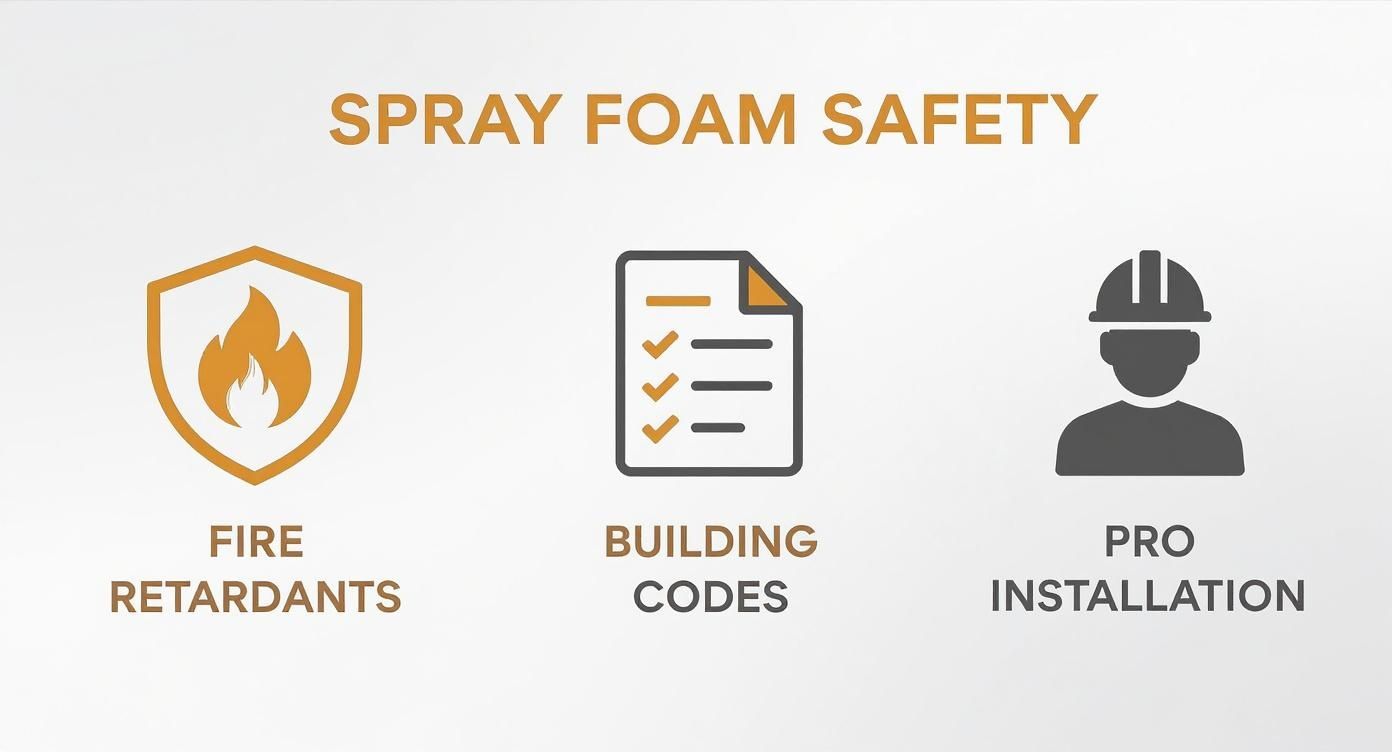
As you can see, true fire safety isn’t just about the product. It’s a complete system where the foam’s chemistry, strict code compliance, and an expert installation all have to work together perfectly.
Those fire ratings aren’t just suggestions from a lab—they are written into law through building codes designed to keep people safe. Spray foam insulation has been held to these strict fire safety standards for decades, and its flammability characteristics have always been front and center for regulators.
The International Building Code (IBC) is crystal clear: foam plastics must achieve a Flame Spread Index of less than 25 and a Smoke Developed Index of less than 450. These aren’t random numbers; they are specific thresholds that guarantee the material won’t dangerously fuel a fire or fill a home with thick smoke. If you want to dive deeper, you can read more about the fire code requirements for foam insulation.
In South Florida, where our building codes are already some of the toughest in the country thanks to hurricanes, these fire safety rules are enforced without exception. A code-compliant installation isn’t just a good idea—it’s absolutely non-negotiable for the safety and insurability of your home.
When you follow these codes to the letter, every installation provides a consistent, predictable level of safety. It turns spray foam from just another product into an integral part of a fire protection system designed to protect your family and your property.
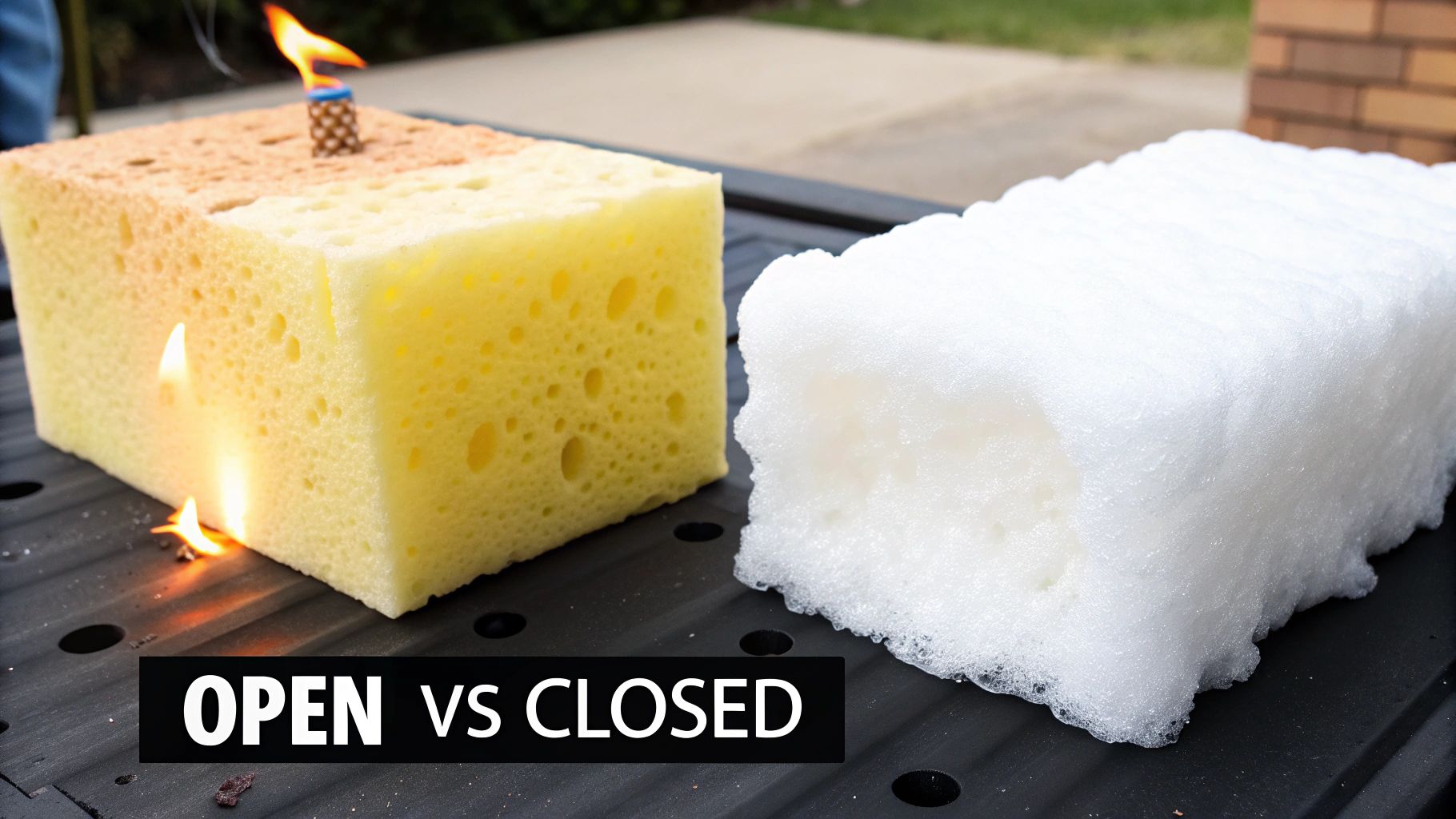
When we talk about whether spray foam is flammable, it’s crucial to know that not all foam is created equal. The two main players, open-cell and closed-cell, have completely different physical makeups that dictate how they behave when things heat up.
Think of it like this: open-cell foam is like a kitchen sponge—soft, light, and full of tiny, interconnected air pockets. Closed-cell foam, on the other hand, is more like a solid block, made of countless individual gas bubbles sealed off from each other. This one structural difference changes everything when it comes to fire performance.
Because open-cell foam is lighter and less dense, its air-filled pockets make it a bit more vulnerable to ignition. It’s a simple matter of physics: with less mass, it takes less heat to reach its combustion point.
In contrast, closed-cell foam is significantly denser and more rigid. Those tightly packed, sealed cells create a formidable barrier against heat transfer. To put it plainly, you have to hit closed-cell foam with a lot more heat for a longer period to get it to burn.
The lab tests back this up. Closed-cell foam generally offers greater fire resistance, needing temperatures around 800°F to ignite. Open-cell foam can ignite at temperatures as low as 600°F, a considerable difference.
Key Takeaway: The dense, compact structure of closed-cell foam makes it inherently harder to ignite compared to the lighter, airier structure of open-cell foam.
To make this even clearer, here’s a quick side-by-side look at how their fire-related properties stack up. This can help you decide which is the right fit for your project.
| Characteristic | Open-Cell Foam | Closed-Cell Foam |
|---|---|---|
| Density | Low (spongy) | High (rigid) |
| Ignition Temperature | Lower (approx. 600°F) | Higher (approx. 800°F) |
| Flame Spread | Tends to char and self-extinguish | Chars and melts, often self-extinguishing |
| Moisture Permeability | Permeable (can hold water) | Impermeable (blocks water) |
| Common Use Cases | Interior walls, sound dampening | Roof decks, crawlspaces, high-moisture areas |
While both are safe when properly installed with a thermal barrier, knowing these differences is key to making the right call for your home’s safety and performance.
So, what does this all mean for your South Florida home? The choice between open-cell and closed-cell often comes down to the job at hand and your budget.
Here’s a practical guide to help you decide:
Both types of foam are safe and effective when installed correctly behind an approved thermal barrier. But understanding their core differences helps you make a smarter, more informed decision. For a deeper dive into how spray foam stacks up against other materials, check out our comparison of spray foam vs. blown-in insulation.
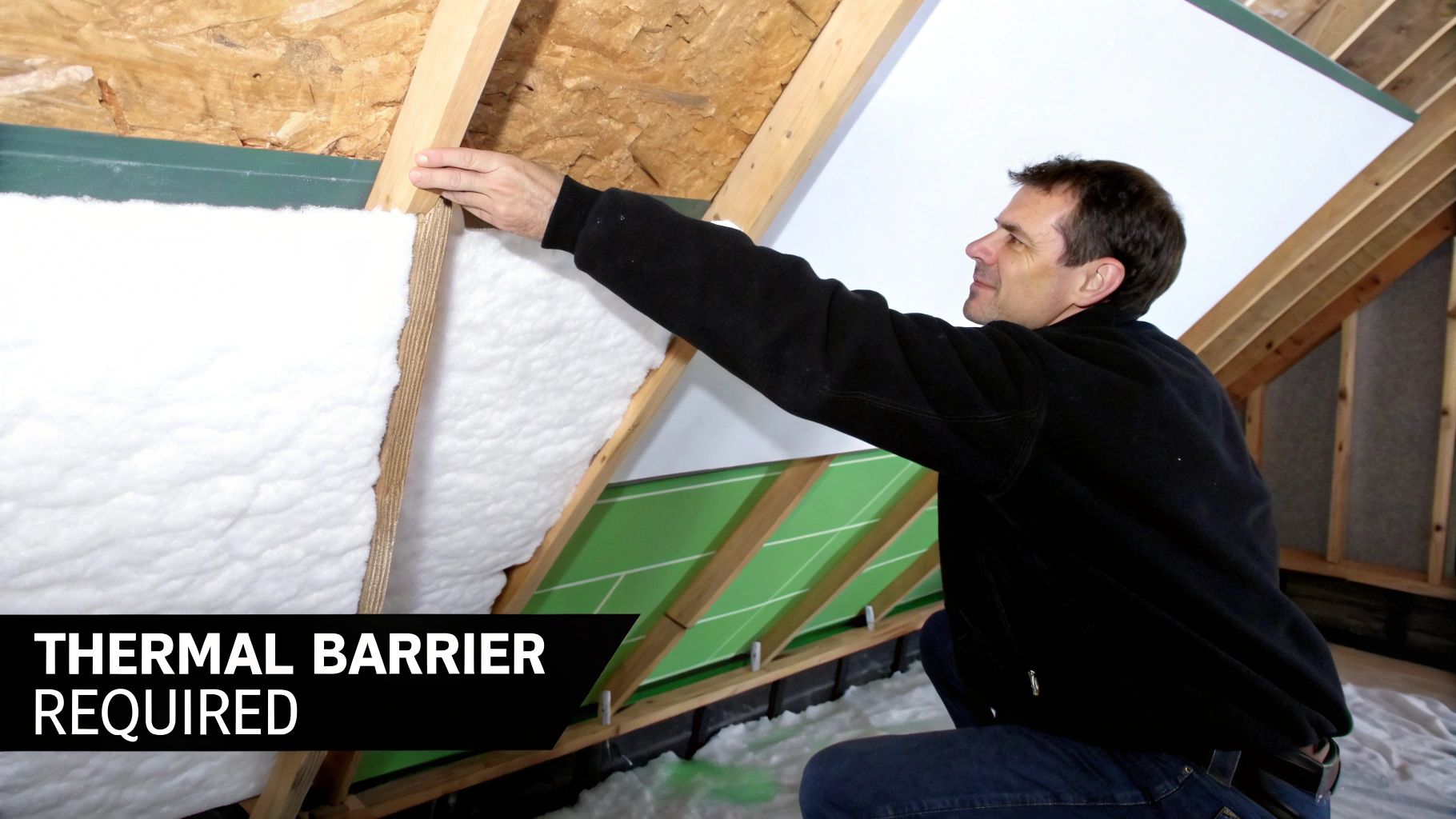
The secret to spray foam safety isn’t just about the foam itself—it’s about the complete system. While modern foam is formulated with fire retardants, it’s never designed to be the final, exposed surface in your home. This is where thermal and ignition barriers come into play as the unsung heroes of fire protection.
Think of these barriers as the foam’s bodyguard. Their one and only job is to stand between the insulation and any potential heat source, giving the foam a critical layer of defense. Skipping this step isn’t just cutting a corner; it’s a serious building code violation and a dangerous gamble with your home’s safety.
While they sound similar, thermal and ignition barriers serve slightly different purposes based on where the foam is installed. Both are legally required, but their application varies.
Even with its fire-resistant properties, spray foam can become a hazard if it’s not installed and protected according to code. The International Building Code is crystal clear on this: foam plastic insulation must be covered with a 15-minute thermal barrier to prevent direct exposure to flames. You can find more information on the dangers of unprotected foam insulation to fully grasp the risks.
Here in South Florida, these barriers are especially important. Our attics are often home to major ignition sources like HVAC units, which work overtime in the intense heat. An ignition barrier in the attic isn’t just a “nice-to-have”—it’s an essential safety measure that protects your insulation from the very equipment it’s helping run more efficiently.
A proper installation means creating a holistic, sealed, and protected building envelope. The barriers are just as crucial as the foam itself for achieving a safe and effective result.
Ensuring your insulation is properly covered is a core component of a high-performance system. Creating this protected and sealed environment is a key part of our Airtight Comfort System, which focuses on safety, efficiency, and long-term durability. Ultimately, these barriers ensure that the answer to “is spray foam insulation flammable?” is a confident and resounding “no,” because the complete system is designed to prevent that from ever becoming a reality.
https://www.youtube.com/embed/BYltWFjS5D0
The best insulation product in the world can become a liability if it’s installed incorrectly. When it comes to spray foam, the answer to “is it flammable?” often comes down to the skill and diligence of the installation crew. A professional who puts fire safety first isn’t just a good choice—they’re your essential partner in protecting your home.
The installation process itself introduces temporary risks that must be managed by an expert. As the two chemical components mix, they kick off an exothermic reaction that generates significant heat. A trained installer knows exactly how thick to apply each pass, preventing the foam from overheating—a rare but serious fire risk that can happen with a sloppy application.
During the application and curing phase, the work area effectively becomes a controlled industrial zone. A professional team will enforce strict protocols to protect the property, the crew, and anyone else in the building.
This controlled environment isn’t just best practice; it’s the only way to do the job right.
The installation day is when your contractor’s commitment to safety is put to the test. A true professional manages the temporary chemical risks of the curing process with strict ventilation, ignition source control, and site access rules to ensure a perfect, stable final product.
Once the job is done and the crew has packed up, your oversight is key. A reputable South Florida contractor will do a final walkthrough with you, but it pays to know what you’re looking for.
Your main task is simple: confirm that no foam is left exposed in any accessible area. Check that all the required thermal and ignition barriers are properly installed, especially in places like attics, basements, or crawlspaces.
When you’re vetting a contractor, don’t be shy. Ask direct questions:
Choosing an installer is the most critical decision you’ll make in this process. A qualified, experienced professional ensures your spray foam system isn’t just energy-efficient but is fundamentally safe from day one.
Let’s bring this all together into a practical game plan. For homeowners here in South Florida, high attic temperatures and tough hurricane codes are just a part of life. That makes a safe spray foam installation absolutely non-negotiable.
The bottom line is simple: spray foam is a phenomenal insulator for our climate, but its safety is a direct result of a professional, by-the-book installation. This checklist will help you make sure every critical step is covered, ensuring your investment makes your home safer, not the other way around.
Before a single drop of foam is sprayed, doing your homework is your best defense. A legitimate, safety-conscious contractor will be totally transparent and happy to show you their paperwork.
Once the job is done, a final walkthrough is essential. This is your chance to physically see that every fire safety requirement has been met.
In South Florida, code enforcement is no joke. An installation that fails to meet fire code isn’t just unsafe—it can create huge headaches with insurance claims and future home inspections.
Here’s what to look for:
Ultimately, the right way to think about this is to see your spray foam project as an investment in a complete safety system—not just a product. By following this checklist, you ensure your home is cooler, more efficient, and fundamentally safer for years to come.
Even after reviewing the codes and test results, it’s natural for homeowners to have a few more questions. Let’s tackle some of the most common concerns head-on, so you can feel completely confident about your decision.
This is an extremely rare event, and when it does happen, it’s almost always the result of a botched, unprofessional installation. The chemical reaction that cures spray foam generates heat, and if an installer applies it way too thick or mixes the chemicals incorrectly, that heat can build up to dangerous levels.
A certified, experienced professional knows this and follows strict guidelines for how much foam to apply in a single pass. This is one of the biggest reasons why hiring a qualified installer isn’t just a good idea—it’s non-negotiable for a safe, successful project.
Yes, but only when it’s installed the right way. Modern closed-cell foam is perfectly safe to apply directly over most types of electrical wiring.
The one major exception is recessed lighting. Any can light or high-hat fixture must be “IC-rated,” which stands for “Insulation Contact.” This rating means the fixture is designed to be safely buried in insulation. Covering a non-IC-rated light with any type of insulation is a serious fire hazard. Your installer should always confirm that all your fixtures are IC-rated before they even think about spraying.
Modern spray foam formulations use advanced flame retardants that are chemically bonded into the foam. Once fully cured and covered by a thermal barrier, the potential for occupant exposure is considered minimal.
The spray foam industry has come a long way. The flame retardants used in today’s products are chemically bonded right into the foam’s structure. This makes them incredibly stable, so they don’t “off-gas” or leach out once the foam has cured.
When the insulation is properly installed and covered with a thermal barrier like drywall, any exposure for the people living in the home is minimal. If you want to dive deeper into the different types of foam and what they’re made of, you can check out our other spray foam insulation topics. You can also ask your installer for the product’s Safety Data Sheet (SDS), which provides detailed information.
At Airtight Spray Foam Insulation, we put safety and code compliance at the forefront of every single job. If you’re ready to make your South Florida home more comfortable and efficient with a system installed by experts who do it right, request your free, no-obligation estimate today.
If you live in Jupiter, our team provides reliable, code-compliant spray foam insulation designed for South Florida homes.