You hear the term "net zero" thrown around a lot these days, but what does it actually mean for your home here in South Florida? Let’s cut through the buzzwords. It’s not about buying some magical new product; it’s a strategy. It's about getting your home so well-sealed and insulated that it barely needs any energy to stay cool.

Think of it like this: you wouldn't take a cheap styrofoam cooler to a Jupiter beach in July and expect your drinks to stay cold. You'd use a high-performance, sealed cooler that locks in the cold and keeps the heat out. That's exactly what net zero insulation does for your house. We're creating an incredibly efficient thermal barrier that practically eliminates the hard work your HVAC has to do.
This isn't some far-off environmental concept. For homeowners in Palm Beach Gardens and across our area, it’s a concrete plan with real, measurable results. By creating a nearly airtight building envelope, you get your home "net zero ready," laying the groundwork for massive energy savings.
A huge part of this is being able to reduce heating and cooling costs, which is the single biggest factor in your home's energy consumption.
For us here in South Florida, a top-tier building seal is non-negotiable. It's the most direct way to slash those FPL bills, keep your home comfortable all year, and defend it against our relentless humidity. I’ve spent years fixing homes with poor seals, and the problems are always the same:
A net zero insulation strategy attacks these problems at the source. By creating a continuous air and thermal barrier, you stop energy loss before it even starts. Frankly, it's one of the smartest, most cost-effective upgrades you can make.
This isn't just a local trend; it's a global shift. The entire insulation market is projected to explode from USD 69.84 billion to USD 128.11 billion by 2034, and that growth is driven by the push for real energy efficiency.
This is where advanced materials like spray foam insulation become essential. Unlike old-school insulation that leaves gaps and settles over time, spray foam expands to seal every single crack and crevice. It creates that solid, monolithic barrier that a true net-zero home requires. By focusing on insulation first, you're building efficiency right into the bones of your house. To see how this works in practice, you can check out our guide on how advanced insulation improves energy-efficient homes. It's the foundational step toward making your home a fortress of comfort, durability, and energy independence.
When you're aiming for a net-zero home, you have to start with a perfectly sealed building envelope. It’s the foundation of the entire strategy, and there's no better way to achieve it than with spray foam insulation.
Think about it this way: trying to keep cool air inside a house with traditional insulation, like fiberglass batts, is a bit like trying to hold water in a net. Even when it’s installed perfectly, there are countless tiny gaps, seams, and holes where your expensive conditioned air—and your money—leaks right out.
Spray foam is completely different. It's applied as a liquid that expands up to 100 times its original volume, flowing into every single crack, crevice, and odd-shaped corner of your home’s structure. It doesn't just sit between your studs; it fuses with them to create a solid, continuous, and truly airtight barrier. This is the kind of perfect seal a net-zero home absolutely requires.
It's no surprise this technology is becoming the new standard. As energy codes get stricter, the demand for high-performance materials is exploding. The global market for building thermal insulation was valued at USD 31.5 billion back in 2025 and has only grown as more builders and homeowners see the benefits firsthand.
Not all spray foam is created equal, and choosing the right type for your South Florida project is critical. The two main options, open-cell and closed-cell, have very different properties and are suited for different applications. Here's a head-to-head comparison to help you decide.
| Feature | Open-Cell Spray Foam | Closed-Cell Spray Foam | Best Application in South Florida |
|---|---|---|---|
| Cell Structure | Cells are open and interconnected, like a sponge. | Cells are sealed, rigid, and tightly packed. | Closed-cell is ideal for exterior walls, roofs, and attics to block moisture. |
| Density | Low-density, soft, and flexible. | High-density, rigid, and strong. | Closed-cell adds structural integrity, important for wind resistance. |
| R-Value | ~R-3.5 per inch. | ~R-7.0 per inch. | Closed-cell offers double the insulation in the same space. |
| Moisture | Permeable to vapor; can absorb water. | Impermeable; acts as a vapor barrier. | Closed-cell is the only choice for preventing humidity and mold issues. |
| Soundproofing | Excellent sound absorption. | Good sound dampening, but less than open-cell. | Open-cell is perfect for interior walls, floors, and home theaters. |
Ultimately, while open-cell has its place for interior sound control, we almost exclusively recommend closed-cell foam for any application that faces the outside elements in our climate. Its ability to block moisture is non-negotiable here.
Imagine a dense, flexible kitchen sponge—that’s a good way to picture open-cell spray foam. The cells are intentionally left "open," which gives it that soft, pliable quality. While its R-value (a measure of thermal resistance) is lower than its counterpart, it’s an absolute champion at stopping air leaks and muffling sound.
Because of that spongy texture, it’s fantastic for soundproofing. We use it for interior walls between bedrooms, bathrooms, and especially home theaters to create a much quieter, more peaceful home. It still provides a great air seal, which helps keep temperatures consistent from room to room.
Now, if open-cell is the sponge, closed-cell spray foam is the hard-shelled turtle. Its cells are completely sealed and packed tightly together, creating a material that’s incredibly dense, rigid, and strong. This structure is what gives it a much higher R-value per inch, meaning you get more insulating power in less space.
But the real game-changer, especially for us here in South Florida, is that it's completely impermeable.
Closed-cell spray foam is an all-in-one insulator, air barrier, and vapor barrier. It flat-out stops air and moisture in their tracks, making it the ultimate weapon against our region’s brutal heat and relentless humidity.
This is precisely why we recommend closed-cell foam for roofs, attics, and exterior walls in our coastal climate. It does three critical jobs with a single application:
By creating this impenetrable shield, closed-cell foam doesn't just slash your energy bills. It actually adds structural strength to your home and protects it from the long-term damage that moisture inevitably causes. It perfectly addresses the core principles of how spray foam insulation works to deliver a healthier, more durable home. This is the key to a true net-zero insulation system built to handle South Florida for a lifetime.
Getting to net zero isn't a one-shot deal; it's a step-by-step strategy. Whether you're upgrading an older home or building from scratch, the path forward is clear. It all begins with finding out exactly where your home is bleeding energy.
For existing homes, we start with a professional energy audit. Think of it as a check-up for your house. We use tools like thermal cameras to pinpoint the weak spots where your cool, conditioned air is escaping and the oppressive Florida heat is sneaking in. Nine times out of ten, the biggest culprits are leaky attics, unsealed knee walls, and can lights.
With new construction, we bake the plan right into the architectural design. Insulation isn't just stuffing for the walls; it becomes a core part of the building's structure. By planning for a continuous spray foam envelope from day one, we can ensure every gap, joint, and potential thermal bridge is sealed tight before the drywall ever goes up.
For homeowners in West Palm Beach or Stuart looking to upgrade, our strategy is simple: go after the biggest problems first. We use a prioritized approach that you'll feel in your home's comfort and see on your energy bill almost immediately.
Seal the Attic and Roof Deck First: Down here, the sun is relentless. Applying closed-cell spray foam directly to the underside of the roof deck stops that intense radiant heat in its tracks, right before it can turn your attic into an oven. This one step often delivers the biggest bang for your buck and is the cornerstone of a net zero insulation upgrade.
Address Walls and Knee Walls: Many homes, especially those with vaulted ceilings, have "knee walls" in the attic that are basically superhighways for heat. They're often "insulated" with sagging old fiberglass that does next to nothing. Sealing these properly, along with any accessible exterior walls, is the next critical move.
Target Floors and Crawl Spaces: The final piece of the puzzle is sealing the floor, especially over a vented crawl space or hot garage. This stops humid, muggy air from seeping into your home from below, completing the airtight seal on all six sides of your home.
Building a new home in Jupiter or Palm Beach Gardens is the perfect chance to do it right from the ground up. When you integrate spray foam into the initial plans, you get a high-performance home that traditional insulation just can't compete with.
When you design a home with closed-cell spray foam from the beginning, you’re not just building a standard house. You’re engineering a high-performance machine that's more efficient, structurally stronger, and far more resilient to our humid climate and high winds.
This approach actually simplifies the build. You don't need separate vapor barriers or finicky air-sealing tapes because the closed-cell foam does it all in one shot. The house is built "net zero ready," meaning it can run on a smaller, more efficient HVAC system and guarantees lower energy bills for its entire lifespan.
This simple diagram shows how that powerful seal is created.
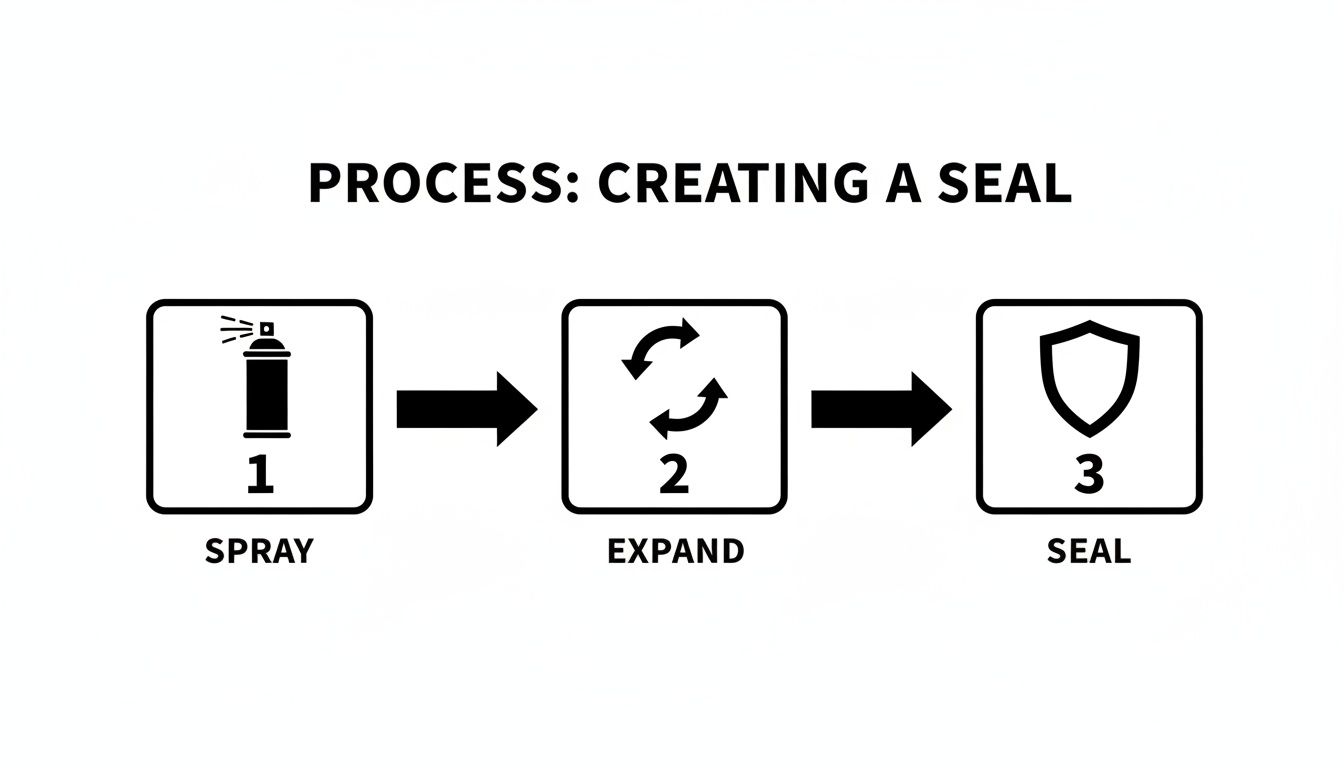
As you can see, the liquid expands to fill every crack and crevice, creating the solid, unbroken barrier that is the foundation of any real net zero insulation strategy. Whether you're retrofitting an old concrete block house or framing a brand new one, this is the roadmap to a truly efficient home.
Here in South Florida, we don't just have "weather." We have a relentless, two-pronged assault of blistering heat and suffocating humidity that puts every building to the test. Standard construction methods just can't keep up, leaving homeowners with sky-high energy bills and, worse, hidden moisture damage festering within their walls. A real net zero insulation strategy has to be built from the ground up to conquer our unique climate.
The two biggest enemies we face are radiant heat and uncontrolled moisture. While most people get fixated on the heat, I’ve seen firsthand that it's the constant, invisible attack from humidity that causes the most devastating long-term problems. This is where closed-cell spray foam isn’t just an option; it's a game-changer, acting as a true multi-functional defender for your home.
Think of the wood or metal studs inside your walls as "energy superhighways." Traditional insulation, like fiberglass batts, does a decent job of filling the empty space between those studs, but the studs themselves are left completely exposed. Since wood and especially metal conduct heat far more easily than insulation, you get a phenomenon called thermal bridging, where heat simply bypasses your insulation and pours right into your home.
During our long summers, your wall studs get incredibly hot and radiate that heat inward, forcing your A/C to run nonstop. It’s a massive energy leak that's literally built into the structure of most homes.
This is a problem that closed-cell spray foam solves beautifully. When applied, it creates a single, unbroken layer of insulation that can be installed right over the face of the studs. This completely severs that thermal bridge, shutting down the "superhighway" and establishing a consistent thermal barrier across the entire wall. The result? A massive reduction in unwanted heat gain.
In our climate, humid air is always looking for a way in. When this warm, moisture-packed air makes contact with a cooler surface—like the back of your drywall that’s being chilled by the A/C—it condenses. That vapor turns back into liquid water, and that's where the real trouble begins.
This condensation almost always happens inside your wall cavities, completely out of sight. It creates the perfect breeding ground for mold, mildew, and rot that can silently compromise your home’s structure and your family’s health. If you want to dive deeper into this critical concept, we've broken down exactly how a vapor barrier and insulation work together to protect your home.
This is where the properties of closed-cell spray foam really prove their worth. It's not just insulation; it’s a complete air and moisture barrier applied in one seamless step.
This trifecta of performance doesn't just make your home more energy-efficient. It creates a stronger, healthier, and far more durable structure that’s genuinely built to last in our demanding coastal environment. Given how brutal our climate is on building materials, understanding the best way to insulate a metal building for Southern Climates offers even more perspective, as metal structures are especially prone to these issues.
While spray foam is a clear leader, the push for green building is also bringing other sustainable materials into the conversation. Driven by consumer demand and new certifications, bio-based insulation is a growing part of the net-zero movement. In fact, this market is projected to expand from USD 563 million in 2024 to USD 764 million by 2034. You can find more analysis on this expanding market and its drivers on Future Markets Inc.
Ultimately, choosing the right net zero insulation is about more than just numbers—it’s about building a resilient home that’s ready for a lifetime in South Florida.
It's easy to look at the initial cost of spray foam and see it as just another expense. But after doing this for over 25 years, I can tell you that’s the wrong way to look at it. A high-performance net zero insulation upgrade is one of the smartest investments you can make in your property's value, your comfort, and your long-term finances.
Yes, the upfront cost is higher than old-school fiberglass. But the payback starts the second we're done with the installation.
The most obvious return you'll see is on your monthly FPL bill. Here in South Florida, it’s no secret that our air conditioners work overtime, often accounting for more than 50% of a home's total energy bill. Spray foam creates a true air seal that stops that expensive cool air from leaking out, which can slash your cooling costs by 30-50%, sometimes even more.
That isn't just a few bucks here and there. For a typical family in our area, those savings can easily add up to thousands of dollars every single year.
When you start doing the math on those energy savings, you realize the "payback period"—how long it takes for the insulation to pay for itself—is usually much shorter than people think. We see it all the time; many of our clients get a full return on their investment in just a few years.
Let's walk through a real-world example from a project we did in Jupiter:
Depending on the job's total cost, those savings put you on a clear path to getting all your money back. And once that payback period is over, the savings just keep coming, putting money back in your pocket for as long as you own the home.
On top of the direct energy savings, there are some great financial incentives that can bring the net cost of your insulation project down even further. The government and local utilities have put these programs in place to reward homeowners for making these kinds of smart, energy-saving upgrades.
Think of these incentives as an instant discount. They exist to make high-performance upgrades like net zero insulation more affordable and to speed up your return on investment.
Here are the main programs you need to know about:
Federal Energy Efficient Home Improvement Credit: This is a big one. It allows homeowners to claim a tax credit for 30% of the cost of the insulation project, up to a $1,200 credit annually. This is a direct, dollar-for-dollar reduction of what you owe on your taxes. The credit has been updated and is available through at least 2032.
Local Utility Rebates: Utility companies like FPL often have their own rebate programs for specific energy-efficiency jobs. While these can change, they frequently offer money back for things like sealing your ductwork and bringing your home's insulation up to modern codes. We make it our business to stay on top of all the current local rebates to make sure you get every penny you're entitled to.
These incentives slice a significant chunk off the initial price, which makes your payback period even shorter. When you combine that with the huge drop in your energy bills, the financial case becomes undeniable. A net zero insulation upgrade doesn't just pay for itself; it starts generating positive cash flow for decades to come, all while making your property more valuable.
Theory is one thing, but results are what really count. After more than two decades sealing homes and attics across South Florida, we’ve seen exactly how a smart net zero insulation strategy can completely change a property. These aren't just hypotheticals—they're real, measurable improvements our clients feel every day.
The proof is in the performance. We have a long track record of helping homeowners slash their energy use, finally get their homes comfortable, and even breathe healthier air. These successes show that a high-performance home isn't some far-off goal. It's happening right here, right now.
One of our most memorable projects was for a homeowner in Jupiter. His two-story house had a massive attic that essentially turned into an oven every summer, baking the second-floor bedrooms from above. His air conditioner just couldn't keep up, and the FPL bills were routinely hitting over $400.
It was a classic case of old, failing fiberglass insulation that did absolutely nothing to block the intense radiant heat coming off the roof deck. Our fix was to apply closed-cell spray foam directly to the underside of the roof, completely sealing the attic and turning it into a conditioned space.
The change was immediate.
This project perfectly illustrates a core principle for South Florida homes: tackling the attic—the number one source of heat gain—is the single most impactful step you can take in a net zero insulation upgrade.
We also get to work with builders who are ahead of the curve, the ones who know that getting the building envelope right from the start is non-negotiable. A custom home we recently worked on in Palm Beach Gardens is a perfect example of what happens when you design for efficiency from day one.
This builder didn't treat insulation as an afterthought. He made spray foam a central part of the construction plan. From the very beginning, the design called for a complete closed-cell spray foam envelope sealing all exterior walls and the roof deck.
This proactive approach paid huge dividends for the build and the eventual homeowner.
The finished product isn’t just a beautiful home; it’s a high-performance machine. It’s quieter, stronger, and guarantees the owners dramatically lower energy bills for decades. It’s no surprise this builder now uses spray foam on all his projects—it delivers a product his clients can truly feel the difference in.
Switching to a high-performance material like spray foam is a big decision, and it’s natural to have questions. When you're aiming for something as ambitious as net zero insulation, you need clear, honest answers from people who work with this stuff every day. We get it.
We've heard just about every question in the book from homeowners across South Florida. This isn't just about buying a product; it's an investment in your home's future comfort, efficiency, and health. So let's get right to it and address the most common concerns we hear.
Absolutely. Once modern spray polyurethane foam (SPF) is fully cured, it's as safe and stable as the other building materials in your home. The real key is professional installation. Our certified technicians follow non-negotiable safety protocols, which means setting up proper ventilation and using full personal protective equipment (PPE). The safety of everyone on-site is our top priority.
After the foam has cured—which usually takes about 24 hours—it becomes completely inert. That means it’s non-toxic and doesn't "off-gas." In fact, it starts working to improve your indoor air quality. By creating an airtight barrier, spray foam helps block the dust, pollen, and other allergens that trigger so many issues for families here in Florida, leading to a much healthier living space.
One of spray foam's biggest safety perks is the solid, seamless barrier it creates. It literally seals out the outdoor pollutants that can make allergies and asthma worse, giving you cleaner air inside your home.
Spray foam isn't just an upgrade; it’s a permanent solution. This is one of the biggest differences between spray foam and traditional materials like fiberglass or cellulose, which can sag, settle, or break down over the years. Spray foam is a rigid polymer that actually bonds to the structure of your house, so it holds its shape, R-value, and airtight seal for the life of the building.
Think of it as a one-and-done investment. It won’t lose its insulating power, need to be topped off, or ever require replacement. Its durability comes down to a few core strengths:
This means you get the same high level of performance on day one as you do decades later, with zero maintenance required.
Yes, and this is where we see some of the most dramatic improvements. Retrofitting an existing home is one of our specialties and a fantastic way to get your property on the path to net zero. While it’s simple to install during new construction, our crews are experts at upgrading older homes with very little disruption to your life.
The most common and impactful retrofit we do is in the attic. Applying closed-cell foam directly to the underside of the roof deck can deliver the single biggest energy efficiency boost your home will ever see. We also regularly insulate crawl spaces and can even inject foam into finished walls to create a complete thermal envelope. It makes net zero insulation a realistic goal for almost any home, no matter its age.
Ready to see what spray foam can do for your home's comfort and energy bills? The team here at Airtight Spray Foam Insulation is ready to put together a plan tailored specifically for your property.