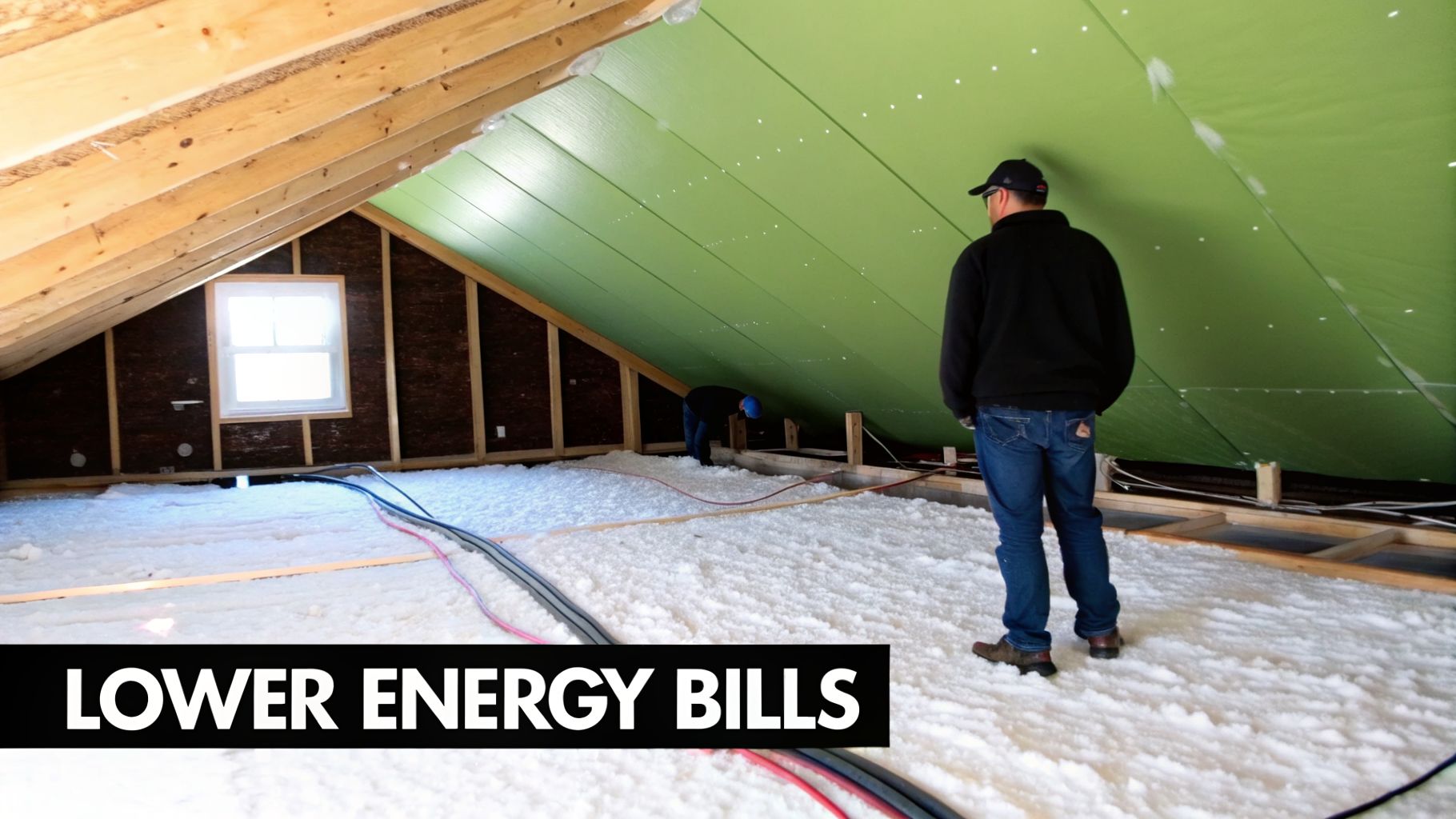
If you've ever been shocked by a summer energy bill here in South Florida, you know the feeling. It's not just another home improvement line item; installing the right roof insulation is one of the smartest investments you can make for both your comfort and your wallet. Modern solutions like spray foam aren't just about stuffing material in your attic—they create a complete air and moisture barrier that directly cuts down on A/C runtime and keeps your home at a stable, comfortable temperature.
Here in South Florida, we’re in a constant fight against heat and humidity. Your roof essentially acts like a giant solar panel, soaking up the sun's intense rays and radiating that heat straight into your attic. Without an effective thermal barrier, that superheated air makes its way into your living spaces, forcing your air conditioner to work overtime just to keep you comfortable.
This isn’t just about feeling a little warm. It means sky-high energy bills and a ton of unnecessary wear and tear on your HVAC system. A proper installation of roof insulation gets to the root of the problem.
I've seen it countless times: old-school fiberglass batts that have sagged, settled, and left massive gaps for heat to pour through. Spray foam insulation is a completely different game. It expands on contact, creating a single, solid seal that solves multiple problems at once.
Now, we don't have to worry about freezing winters, but the science is the same. Good insulation is key to preventing ice damming on your roof in cold climates because it keeps the roof surface temperature even. That same principle is what helps keep your South Florida home cool.
By creating a conditioned or semi-conditioned attic, spray foam dramatically shrinks the temperature difference between your attic and your living area. That stability is the secret to a consistently comfortable home and a much happier A/C unit.
Putting money into high-quality roof insulation isn't an expense—it’s an upgrade that pays you back. The global market for these materials is booming, expected to jump from $10.89 billion in 2025 to $13.68 billion by 2030. That growth is fueled by homeowners who see real savings, often cutting heating and cooling costs by up to 20-30%.
For anyone living in Jupiter, Wellington, or anywhere in Palm Beach County, getting a professional installation from a specialist like Airtight Spray Foam Insulation is your best defense against our brutal heat and humidity.
Ultimately, a professional job transforms your house. It becomes more resilient, far more comfortable, and much more energy-efficient. It’s the most effective way to win the war against South Florida’s climate, delivering results you can feel in your home and see on your power bill.
Picking the right insulation isn't just a box to check—it's the single most important decision you'll make for your home's performance here in South Florida. This isn't just about R-value; it's about creating a complete system that can stand up to our brutal heat and relentless humidity. The right material can transform your home's comfort and durability.
To win the battle against our climate, you need to understand the best roof insulation for hot climates. For us, that conversation almost always leads to spray foam. Let's break down the two main players: open-cell and closed-cell.
Think of open-cell spray foam like a thick, dense sponge. It’s light, expands like crazy when we apply it, and gets into every nook and cranny. Its biggest claim to fame is sound dampening. If you’re in West Palm Beach under a flight path or near a busy road, open-cell turns your attic into a sound-absorbing blanket. It's an amazing air barrier, but it is vapor-permeable, which means moisture can still pass through it.
Then you have closed-cell spray foam, which is a whole different animal. It cures into a hard, rigid plastic. It's incredibly dense, strong, and completely waterproof. If your home is anywhere near the coast—say, in Jupiter, getting blasted by salt air—closed-cell is the only way to go. It adds serious structural integrity to your roof deck, which is a huge plus during hurricane season. More importantly, it’s a true vapor barrier, blocking moisture cold. That’s non-negotiable for stopping mold in our climate.
Expert Insight: In our experience, the superior strength and moisture-blocking power of closed-cell spray foam make it the best long-term investment for most South Florida homes. It’s not just insulation; it's resilience.
The industry is catching on. New energy codes are demanding higher-performing materials, and we're seeing a massive shift away from old-school insulation. While some trends favor lightweight materials, spray foam consistently outperforms them with a superior R-value per inch—a solid 6-7 for closed-cell compared to 3-4 for fiberglass. For a Florida contractor, that translates into roofs that reduce air leakage by up to 50%, keeping your home's temperature stable and giving your AC a much-needed break.
So, how does spray foam really stack up against something like fiberglass batts? Honestly, it's a night-and-day difference, especially here. Fiberglass is just an air filter. It slows heat down but does nothing to stop air from moving right through it. After a few years in a hot, humid attic, it sags, gets compressed, and soaks up moisture—the perfect recipe for a mold problem.
When we're talking to homeowners, we often put it in a chart like this so they can see the facts side-by-side.
| Feature | Open-Cell Spray Foam | Closed-Cell Spray Foam | Fiberglass Batts |
|---|---|---|---|
| R-Value per Inch | ~3.8 | ~6.5-7.0 | ~3.0-4.0 |
| Air Seal | Excellent | Excellent | Poor (allows air leaks) |
| Moisture Barrier | No (vapor permeable) | Yes (vapor barrier) | No (absorbs moisture) |
| Sound Dampening | Excellent | Good | Fair |
| Structural Strength | Minimal | Adds significant strength | None |
| Longevity | Lifespan of the home | Lifespan of the home | Degrades over time |
The takeaway is pretty clear. Spray foam—especially closed-cell—is a far more robust, permanent solution for South Florida. It air-seals, waterproofs, and strengthens your roof all in one shot. Yes, the upfront cost is higher, but the energy savings and added protection make it a smarter investment in the long run.
If you're thinking about adding strength to your roof structure, you should check out our guide on applying rigid insulation on the roof. It’s a great way to understand how modern insulation does more than just control temperature. This is exactly why a professional installation of roof insulation with spray foam is now the standard for homeowners who are serious about protecting their biggest asset.
Lots of people wonder what really goes into a professional insulation job. It's more than just showing up with a spray hose. When done right, it's a systematic process that turns your attic into a high-performance barrier against South Florida's brutal heat and humidity. I want to walk you through how a true professional crew, like ours at Airtight, handles an installation of roof insulation from start to finish.
It all starts with a real assessment. We don't just glance at your attic; we get in there and figure out a precise game plan. We're looking at the roof's pitch, any tricky access points, existing ventilation, and what kind of insulation (if any) is already there. This is where experience kicks in—creating a custom strategy for your home, not just a generic one.
Once we have a plan, the real on-site work begins with meticulous preparation. This is what separates the pros from the amateurs. Think of it like a surgeon prepping an operating room—everything that isn't part of the procedure needs to be completely protected.
Our crew takes this phase incredibly seriously. We methodically cover every surface that isn't being sprayed—floors, walls, and any belongings in the attic are shielded with heavy-duty plastic. We also mask off all your mechanicals, like the air handler and water heater, along with any electrical boxes. Nothing gets left to chance.
At the same time, we're setting up powerful ventilation fans. This is a critical safety step, but it also helps manage odors and ensures the foam cures properly. If a contractor skimps on this, it's a huge red flag.
A Pro Tip From The Field: The amount of time a crew spends on prep work tells you everything you need to know. If they seem eager to rush straight to spraying, show them the door. Proper masking and ventilation aren't optional; they're essential for a clean, safe, and effective job.
With the site prepped and protected, it's time to apply the foam. This is where technique and a steady hand are everything. Our certified technicians apply the foam with a practiced, deliberate motion to build it up to the exact thickness needed. This isn't just about coverage; it's about achieving a consistent R-value across every square inch of your roof deck. No weak spots.
The goal is to create one solid, seamless air barrier. We methodically hunt down and seal every last crack and crevice where air could get in or out.
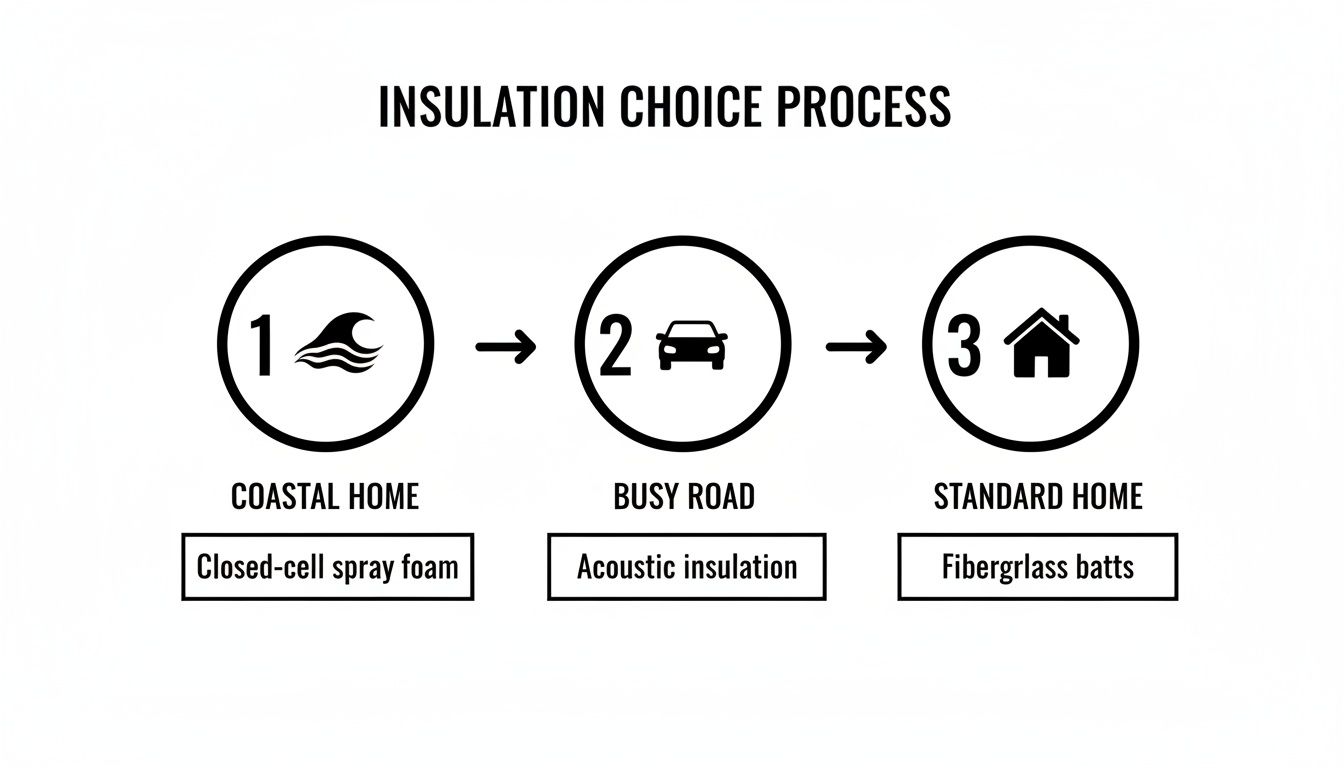
This chart gives a simplified look at how your home’s specific situation—whether it’s on the coast or near a busy road—can point to the best insulation choice. It’s a conversation we have with every homeowner.
This kind of precision is exactly what you’re paying for. A DIY job or a rookie crew might miss a few small gaps, but those small gaps can compromise the entire system, leading to hidden energy loss and moisture problems.
Once the foam has fully cured, we move into the final phase. Our team carefully removes all the plastic and masking, bundling it up to make sure no debris is left behind. We aim to leave your space cleaner than we found it.
But the job isn't over until the final inspection. A project manager does a complete walkthrough, often using a thermal imaging camera to hunt for any temperature inconsistencies that could indicate a gap. We double-check the foam depth to confirm it meets the R-value we promised and ensure every detail of the job was done to our exacting standards.
This thorough process is why a proper installation of roof insulation is such a game-changer, cutting summer heat gain by as much as 30%. The Airtight process, which you can read about in our complete insulation attic installation guide, delivers a 100% gap-free seal that can slash energy bills by 20-40% and make your home noticeably quieter.
We finish every job with a client walkthrough. We’ll show you the work we did and answer any questions you have, ensuring you see the value in your investment from day one.
Getting a spray foam job done right is about more than just the material itself. It’s about a safe, meticulously managed process that protects your family, our crew, and your home. When you're working with the chemical compounds in spray foam, there are absolutely no shortcuts.
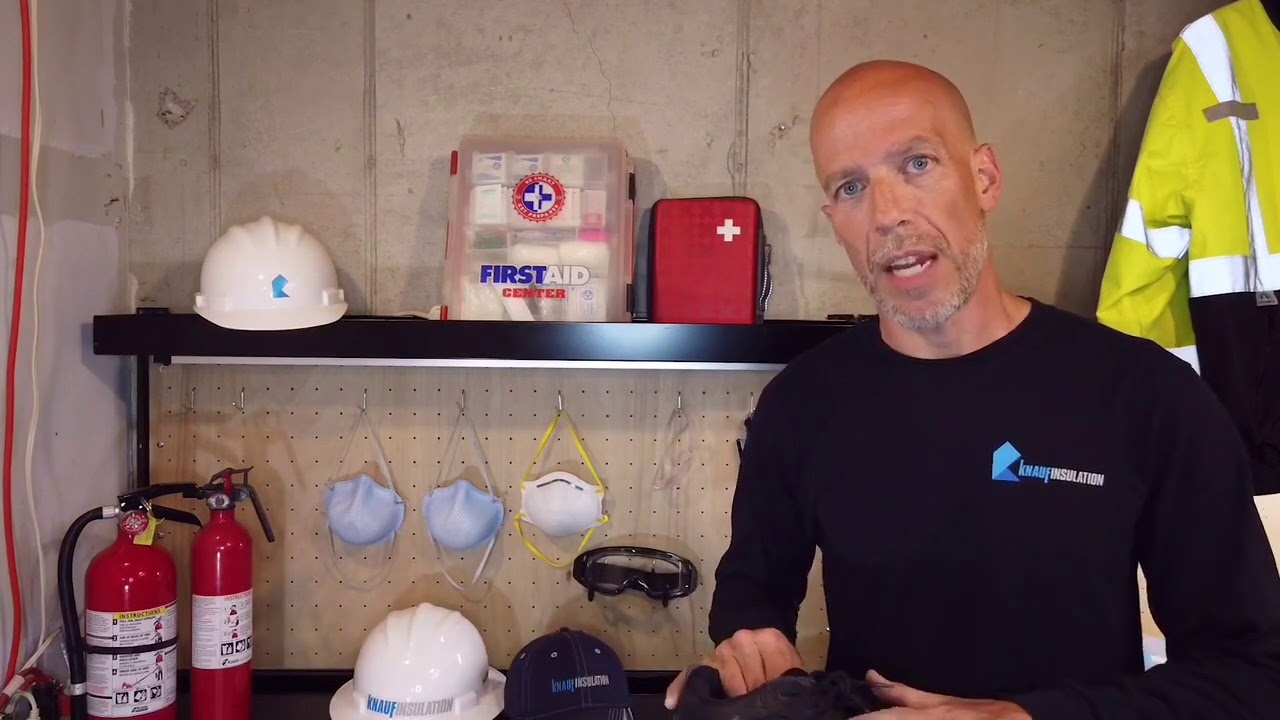
For our crew, safety is non-negotiable from the moment we pull up to your home. Every single technician suits up in full personal protective equipment (PPE). We’re talking full-face respirators, disposable coverall suits, gloves, and proper eye protection. This isn’t for show—it's an essential shield against the chemical compounds during application.
Just as important is managing the environment inside your home. We create a completely secure work zone, sealing the attic off from your living spaces to ensure no airborne particles drift where they shouldn’t. We also set up powerful ventilation fans to pull fumes and overspray out of the attic and direct them safely away from the house. This constant airflow is critical for our safety and for the foam to cure correctly.
One of the first questions homeowners always ask is, "When can we come back inside?" The answer all comes down to the foam's curing time. While we’re spraying and for a set period afterward, the home needs to be completely unoccupied by anyone not wearing PPE. This is when the chemical reaction is happening.
Typically, it takes about 24 hours for spray foam to fully cure. Once cured, it transforms into a solid, inert plastic that is completely safe and won't affect your home's air quality. We will always give you a firm, clear timeline for when you can safely re-enter, and we never cut that time short.
Here's a critical piece of advice: a professional insulation project requires you to be out of the house for a short time. If any contractor claims you can stay home while they're spraying, that's a massive red flag. They aren't following industry safety standards, and you should walk away.
Beyond the safety protocols, every roof insulation project has to meet South Florida's specific building codes. These aren't just bureaucratic hurdles; they're designed to make sure your home is structurally sound, fire-safe, and genuinely energy-efficient. Knowing these codes inside and out is a huge part of our job.
Here are a few key code requirements we handle on every project:
We also have to account for how this new conditioned attic will interact with your HVAC system. By bringing your attic "inside," your air conditioner no longer has to work against a pocket of 130-degree air. It runs more efficiently and for shorter cycles, which is a big part of the energy savings. Making sure everything is code-compliant guarantees your project passes inspection and performs exactly as it should.

Let’s get right to it—the first question on everyone's mind is always, "What's this going to cost?" And that's the right question to ask. But with an installation of roof insulation, thinking only about the initial price tag is like looking at just one piece of the puzzle. The real conversation is about the total investment and what you get back.
The truth is, there's no flat rate. The final cost is shaped entirely by the specifics of your South Florida home.
Several things will move the needle on your project's cost. The biggest factor, of course, is the total square footage we need to cover. But the type of spray foam you choose is just as important. Closed-cell foam is a premium product—it's denser, tougher, and a phenomenal moisture barrier, which means it costs more than its open-cell counterpart.
The job's complexity also plays a huge role. An accessible attic in a single-story Wellington home with a simple roofline is a straightforward job. It’s a whole different ballgame for a two-story home in Palm Beach Gardens with tight crawl spaces, complex roof angles, and other obstacles that require more time and technical skill from our crew.
Let's talk about a realistic scenario. For a standard 2,000-square-foot single-story house, a professional spray foam insulation job is a significant home improvement. The exact figure can vary, but it’s an investment that delivers a powerful payback.
We believe in full transparency, which is why we’ve put together a detailed guide on spray foam insulation installation costs. It breaks down exactly what you’re paying for—from the specific materials and labor to our meticulous site prep and cleanup.
The most important number isn't the initial cost, but the speed of your Return on Investment (ROI). Think of it less as an expense and more as a high-yield home upgrade that starts paying you back on day one.
This is where the real value of a professional insulation upgrade shines. The upfront cost is just one part of a much bigger, more rewarding financial picture. You're not just buying a product; you’re investing in a more efficient, valuable, and resilient home.
The most immediate return shows up on your monthly FPL bill. It’s not uncommon for homeowners to see their cooling costs drop by 20% to 40%. During a brutal South Florida summer, those savings stack up fast and continue for the life of your home, eventually paying for the entire project.
But the savings don't stop there.
When you add it all up, a professional installation of roof insulation is one of the smartest investments a South Florida homeowner can make. It’s not a sunk cost—it’s a strategic upgrade that pays you back in real dollars, boosts your home’s value, and delivers immediate, tangible comfort.
After more than 25 years in this business, I’ve heard just about every question a homeowner can think of when it comes to insulation. It's a big investment, and you deserve to have all the facts.
Let’s cut through the noise and get straight to the answers for the most common concerns I hear from folks here in South Florida.
I know you have a life to live, and the last thing you want is a crew camped out in your house for a week. The good news is, a professional spray foam job is surprisingly fast. For most homes, we are in and out in just one to two days.
Day one is all about prep. My crew is meticulous about this—clearing the attic, masking off everything that doesn't get sprayed, and setting up our ventilation systems. The actual spray application itself usually only takes a few hours.
We often use the second day for final quality checks, cleanup, and walking you through the finished work. If you have a particularly large or complex attic, it might take a little longer, but we'll give you a firm timeline upfront with our estimate.
Our Commitment to You: We respect your home and your time. Our mission is to do flawless work with the least possible disruption, getting your home back to you—only much more comfortable—as quickly as possible.
This is a big one, and the answer comes down to one thing: the quality of the installation. When it's done right by a certified pro, spray foam is perfectly safe for your roof and electrical systems. In fact, closed-cell foam actually adds significant structural strength to your roof deck—a massive plus when hurricane season rolls around.
A trained technician knows exactly how to work around junction boxes, recessed lighting, and all the wiring in your attic. We apply the foam strategically so everything remains accessible and—just as importantly—doesn't overheat.
The danger only comes from a botched job by an inexperienced or unqualified crew. This is why hiring a company that is properly trained, licensed, and insured, like Airtight Spray Foam Insulation, isn't just a good idea—it's essential for protecting your home.
Let's be direct: during the actual spraying process, there is a noticeable odor. The two liquid components are creating a chemical reaction to form the foam. That's precisely why we have a non-negotiable safety rule: the house must be empty during application. We use high-powered ventilation fans to push all fumes outside and away from your home.
Once the foam cures—which takes about 24 hours—it becomes a completely inert, rigid plastic. It's solid, stable, and has no odor whatsoever. Modern, professional-grade foam is designed not to "off-gas" any harmful compounds after that initial cure. We’ll always give you a clear, specific time when it’s perfectly safe for your family and pets to re-enter the home.
This might be the best part. Once installed, spray foam insulation is virtually maintenance-free. You can essentially set it and forget it.
About the only thing we suggest is taking a quick look in your attic every few years, maybe after a major storm, to make sure you don’t have a new roof leak. But the insulation itself? It just keeps on working, day in and day out, with no upkeep required.
Ready to take the next step? The team at Airtight Spray Foam Insulation is here to answer any other questions you have and provide a free, no-obligation estimate for your home. Find out how a professional installation can make your home more comfortable and slash your energy bills. Visit us at https://airtightsprayfoaminsulation.com.