Blog
Open Cell vs Closed Cell Foam A Guide to Choosing the Right Insulation

When you get down to it, the open cell vs closed cell foam debate boils down to one thing: how the foam is built.
Closed cell foam is dense, rigid stuff. Think of it as a solid barrier that blocks moisture and gives you a really high R-value, which is why we love it for exterior jobs. On the flip side, open cell foam is the soft, flexible cousin. It’s fantastic for absorbing sound inside your walls, but it’s not something you want getting wet.
Choosing the Right Spray Foam Insulation
Picking the right spray foam is one of the most important calls a property owner can make, especially here in South Florida where the humidity is no joke. The choice goes way beyond just keeping the house cool; it impacts your building’s structural health, the air you breathe, and how much you’ll spend on FPL bills for years to come. Getting a handle on their basic differences is the first step to a smarter, more comfortable building.
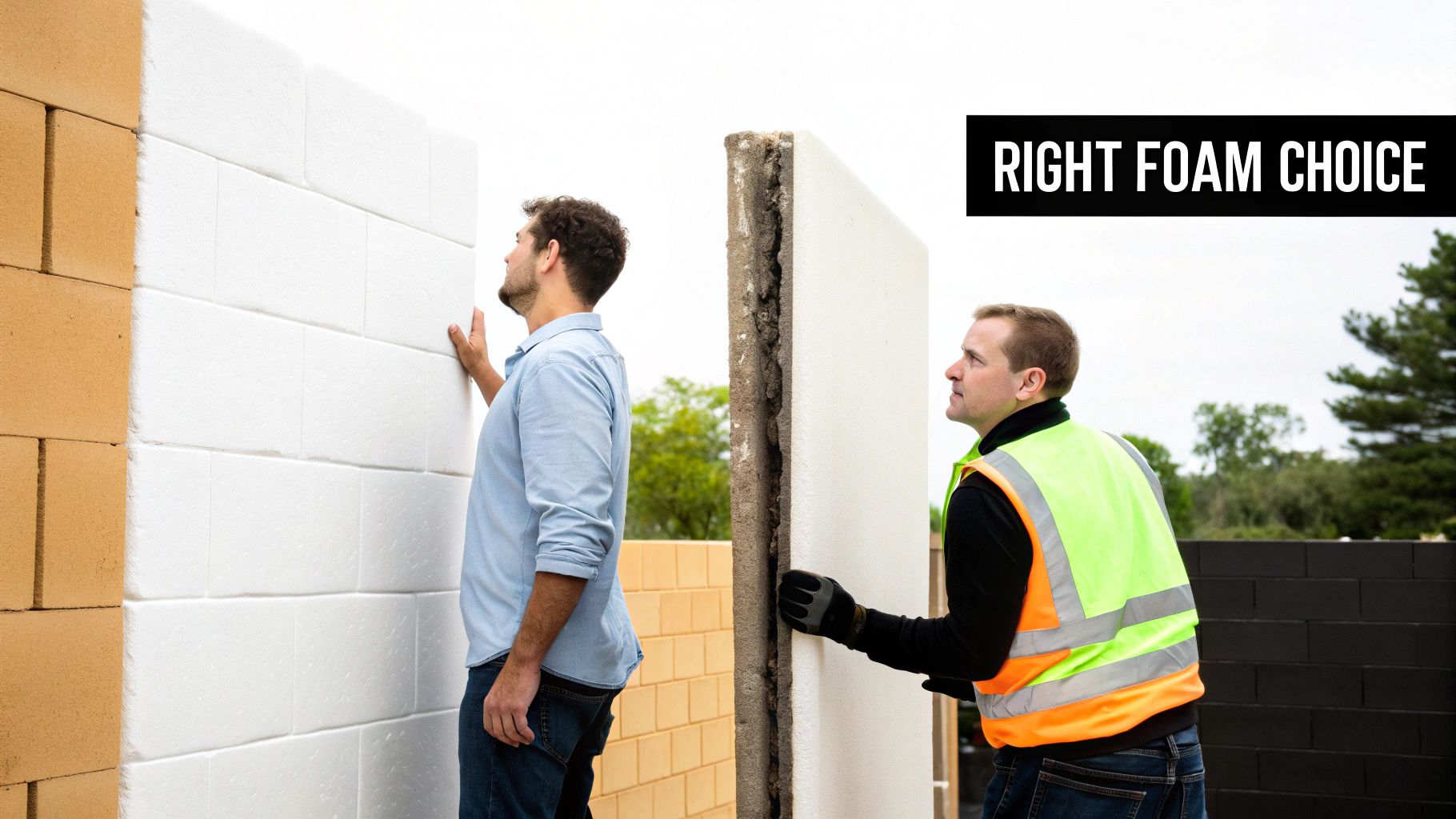
Key Distinctions at a Glance
Sure, both types of foam create a solid air seal that stops drafts and keeps your AC from working overtime. But where you use them is determined by their core properties. It all comes down to the tiny bubbles, or “cells,” that make up the foam.
Open cell foam is kind of like a sponge. Its cells are interconnected, which means air and moisture can find their way through. Closed cell, however, is made of tiny, sealed-off cells filled with gas. This is what makes it so rigid and completely impermeable to water.
That single structural difference drives everything else. Here’s a quick rundown:
| Feature | Open Cell Foam | Closed Cell Foam |
|---|---|---|
| Density | Low-density, soft, flexible | High-density, rigid, strong |
| R-Value | ~R-3.8 per inch | ~R-6.5 to R-7 per inch |
| Moisture | Vapor permeable (absorbs water) | Vapor barrier (resists water) |
| Sound | Excellent sound dampening | Poor sound dampening |
| Expansion | Expands up to 100x | Limited expansion |
Why This Choice Matters for Your Property
Getting this wrong can cause some serious headaches down the road. For instance, putting open cell foam in a damp crawlspace is asking for trouble—it can trap moisture and lead to mold and rot. At the same time, using dense closed cell foam just to soundproof interior walls would be overkill and less effective than its open cell counterpart.
The right foam isn’t just about insulation—it’s about creating a complete building envelope system that manages heat, air, and moisture effectively for your specific climate and application.
Making an informed decision ensures you’re getting real value for your money. People often compare spray foam to other materials, but understanding the differences within the spray foam family is just as crucial. If you’re curious how it stacks up against another common choice, check out our guide on spray foam vs. blown-in insulation.
In the next sections, we’ll dive deeper into the science, performance, and best uses for each type, giving you the confidence you need to make the right call.
The Science Behind Spray Foam: What’s Happening Inside
To really get a handle on the open-cell vs. closed-cell debate, you have to know what’s going on at the microscopic level. The core difference isn’t just about how it feels or how dense it is; it’s all about the chemical reaction and the tiny bubbles—or “cells”—that form when it’s installed. That basic science is what drives every single performance metric, from its insulating power to how it handles moisture.
Picture this: two liquid chemicals meet at the tip of the spray gun. As they mix and react, they expand like crazy, creating millions of tiny cells. It’s the nature of these cells that separates the two types of foam and dictates where each one truly shines.
The Anatomy of Open-Cell Foam
Open-cell foam gets its name from its interconnected cell structure. As the foam cures, the walls of the bubbles are designed to break, creating a soft, almost sponge-like material. Think of it as a microscopic honeycomb, but with open doorways between every single chamber.
This structure is great at trapping air, and that’s what gives it its insulating properties. But because the cells are open, it also means water vapor can pass right through it.
- Flexibility: Its soft texture lets it flex and move as a building naturally expands and contracts, which prevents cracking.
- Expansion: It expands massively—up to 100 times its liquid volume—making it a superstar at filling every last nook and cranny in odd-shaped spaces like attics and rim joists.
- Permeability: Because it’s “breathable,” it won’t trap bulk water from something like a roof leak. This can actually be a good thing, as it might help you spot a problem before serious damage occurs.
At its core, open-cell foam is an air barrier, not a moisture barrier. Its main job is to stop air leakage, which is one of the biggest culprits behind energy loss and high humidity in South Florida homes.
The Structure of Closed-Cell Foam
Closed-cell foam is a completely different animal. It’s made of tiny, individual cells that are totally sealed off from one another. Each of these cells is filled with a special gas, called a blowing agent, which is way better at resisting heat flow than regular air.
This dense, rigid structure is what gives closed-cell foam its most powerful traits. The sealed cells create an impenetrable wall, blocking not just air but also water and vapor. It’s like millions of tiny, independent barriers all working together to protect your home.
The market has taken notice. The global spray foam industry is growing, and closed-cell foam is leading the way thanks to its durability, higher thermal resistance (R-value), and its ability to shut down both water and vapor. Its tough, resilient nature makes it the go-to choice for commercial and industrial jobs where moisture control is absolutely critical. You can dive deeper into these market trends in this spray foam industry report.
This structural integrity also adds some muscle to the building itself. When you apply it to walls or a roof deck, it acts like a high-strength glue, making the whole structure more rigid and resistant to wind uplift—a must-have feature for any coastal property. It hardens into a solid, durable layer that adds serious protection against the elements, making it an essential tool in modern, resilient construction.
A Detailed Performance Comparison
When you’re trying to decide between open-cell and closed-cell foam, this is where the rubber meets the road. The performance metrics aren’t just numbers on a spec sheet; they explain exactly how these materials will work in your home to fight off South Florida’s heat, air, and moisture. Getting these details right is the key to a smart, long-term investment.
The biggest differences come down to R-value, air sealing, and how each foam handles moisture. Their unique microscopic structures are the reason they perform so differently. This diagram gives you a quick look at the science behind it all.

As you can see, open-cell foam has interconnected cells that create a soft, flexible matrix, perfect for trapping air. Closed-cell foam is the opposite—its cells are sealed tight and filled with an insulating gas, forming a rigid and impermeable barrier.
Thermal Resistance: The R-Value Showdown
The first thing most people look at is the R-value, which is simply a measure of how well insulation resists heat flow. On a per-inch basis, there’s a clear winner here.
- Closed-Cell Foam: This is the powerhouse, delivering an impressive R-value of R-6.5 to R-7 per inch. That high thermal resistance comes from its dense structure and the specialized gas trapped inside its cells. It means you get more insulating power in less space, a huge plus for wall cavities or vaulted ceilings where every inch counts.
- Open-Cell Foam: This foam offers a solid R-value of about R-3.8 per inch. While that’s lower, its real strength lies in creating a nearly perfect air seal, which often makes a bigger dent in your energy bills than R-value alone.
In a standard 2×4 wall, you can hit about R-13 with open-cell foam. In that same space, closed-cell can get you to R-21 or higher.
Air and Moisture Barrier Capabilities
Both types of foam create fantastic air barriers, which is crucial for stopping drafts and making your HVAC system’s job easier. But when it comes to moisture, they are worlds apart.
In South Florida, an insulation’s ability to manage moisture is just as important as its R-value. Closed-cell foam’s dual function as an insulator and a vapor barrier makes it a powerful tool for preventing moisture intrusion and mold growth.
Closed-cell foam is vapor impermeable. Its sealed structure won’t let water or water vapor pass through, making it a true moisture barrier. This is why it’s the go-to choice for crawl spaces, foundation walls, and any other area that might get damp.
On the other hand, open-cell foam is vapor permeable, which means it can “breathe.” This can be a major advantage in places like the underside of a roof deck. If you ever get a roof leak, water will pass through the foam, letting you know there’s a problem. With closed-cell, that water could get trapped between the foam and the roof sheathing, leading to hidden rot.
Sound Attenuation and Acoustic Performance
Insulation isn’t just about temperature and moisture; it’s also about creating a quieter, more peaceful home. In this category, the soft, flexible nature of open-cell foam gives it a serious edge.
Its spongy texture is fantastic at absorbing and deadening sound waves, especially mid-to-high frequency noises like chatter and TV sounds. That makes it the top pick for interior walls, home theaters, or home offices where you want to keep things quiet.
Closed-cell foam is rigid and dense, so it does very little to absorb sound. It can actually reflect it, making it a poor choice for sound control. To learn more, check out our guide on using insulation as a sound barrier for a deeper dive.
For a quick overview, here’s how the two stack up side-by-side.
Open Cell vs Closed Cell Foam At a Glance
This table breaks down the key performance differences to help you see the right fit for your project at a glance.
| Characteristic | Open-Cell Foam | Closed-Cell Foam |
|---|---|---|
| R-Value (per inch) | ~ R-3.8 | ~ R-6.5 to R-7.0 |
| Air Barrier | Excellent (at ~3 inches) | Excellent (at ~2 inches) |
| Vapor Permeability | Permeable (Breathable) | Impermeable (Vapor Barrier) |
| Sound Dampening | Excellent | Poor |
Ultimately, the “better” foam really depends on what you need it to do—whether that’s maximizing R-value in a tight space, blocking moisture completely, or just making your home a little quieter.
Analyzing the Financial Investment and ROI
When you’re weighing open-cell vs. closed-cell foam, the first thing everyone asks about is the price. But the real story isn’t just the upfront cost—it’s about understanding the total financial picture, from the initial quote to the long-term return you’ll get on your investment.
There’s no getting around it: closed-cell foam has a higher price tag. On average, you can expect to pay significantly more per board foot—the industry-standard measurement for a one-foot by one-foot square at one inch thick.
This price gap isn’t just for show. It’s a direct reflection of what goes into the material. Closed-cell foam is far denser, which means it requires a lot more raw material to make. Add in its complex chemical structure and specialized blowing agents, and the manufacturing cost naturally goes up, which ultimately gets passed on to you.
Breaking Down the Upfront Costs
The final quote for any spray foam job depends on more than just the material. We factor in the total square footage, how much insulation you need to hit your target R-value, and how tricky the installation will be. Still, the type of foam you choose is the biggest driver of the cost.
- Open-Cell Foam: This is your lower-cost option per board foot. Its light, airy structure and simpler water-based blowing agent keep production costs down.
- Closed-Cell Foam: The price is higher because of its dense, rigid structure, which requires a greater volume of materials and a more sophisticated chemical formula to produce.
For big, open spaces like an attic, the lower cost of open-cell foam can be really appealing, especially if your main goal is just to air-seal a massive area without breaking the bank.
Calculating Long-Term Return on Investment
While closed-cell foam asks for more money upfront, its long-term financial benefits often make it the smarter investment, especially here in South Florida’s tough climate. The real ROI comes from energy savings, a boost in property value, and even structural protection.
The best financial move isn’t always the cheapest one. Think of closed-cell foam’s higher cost as an investment in top-tier thermal performance, moisture defense, and structural integrity that pays you back for years to come.
With a powerful R-value of around R-7 per inch, closed-cell foam gives you more insulating power in less space. That superior thermal resistance means your AC won’t have to work nearly as hard to keep your home cool, which leads directly to lower monthly energy bills. Over time, those savings can easily make up for the initial price difference.
On top of that, its rigid nature actually adds structural strength to your walls and roof deck. In a region where high winds are a reality, that extra resilience is a huge selling point that can increase your property’s value and durability.
When Open-Cell Foam Delivers Better Value
Even with all the benefits of closed-cell, there are plenty of times when open-cell foam is the more practical and cost-effective choice. Its value really shines when its unique strengths are exactly what a project needs.
For instance, if your main goal is sound dampening, open-cell is the clear winner. For interior walls, home theaters, or quiet office spaces, its amazing acoustic-control properties make it the smart financial pick.
The market backs this up. Open-cell foam actually holds a huge share of the spray foam market revenue, thanks to its soft, flexible nature that’s perfect for residential roofs and walls. You can read more about these spray foam market trends to see just how widely it’s used. For any project focused on soundproofing and air sealing inside your home, choosing open-cell means you’re not paying extra for features, like a vapor barrier, that you simply don’t need.
Where to Use Each Type of Foam on Your Property
Knowing the difference between open-cell and closed-cell foam is one thing, but applying that knowledge is where the real value lies. Putting the right foam in the right place is the key to a project’s success, transforming your property’s comfort, energy bills, and resilience. Let’s move past the technical specs and get into real-world applications to see which foam fits best.

This isn’t about which foam is “better” overall. It’s about which one is built for the job at hand. An attic has completely different demands than a crawl space, and an interior wall’s needs are a world away from an exterior one.
Attics and Roof Decks
In South Florida, the attic is the frontline in the war against heat. Choosing the right foam here depends heavily on your home’s ventilation strategy and your budget.
Open-cell foam is our go-to for the underside of most roof decks in unvented attics. It expands up to 100 times its liquid size, making it a master at filling every last nook and cranny around trusses and rafters. The result is a nearly perfect air seal. Plus, its lower price point makes it a smart financial choice for covering such a huge area.
Another big advantage is its permeability. If a roof leak ever springs, water can pass through the foam, giving you a clear warning sign before moisture gets trapped and causes hidden wood rot.
Closed-cell foam brings a much higher R-value to the table, making it perfect for tight spaces like vaulted or cathedral ceilings. You can hit high insulation targets without dropping your ceiling height. It also adds serious structural integrity to the roof deck—a huge plus in our high-wind hurricane zones.
Crawl Spaces and Foundation Walls
For any area that’s below ground or constantly exposed to moisture, like a crawl space, there’s no debate. The choice is clear.
Closed-cell spray foam is the only correct choice for crawl spaces, basements, and foundation walls. Its dense, rigid structure is totally impermeable to water, acting as a powerful vapor barrier that stops dampness and mold in its tracks.
Putting open-cell foam here would be a disaster. Its soft, spongy structure would just soak up ground moisture, leading to rot, mold, and major structural damage. Closed-cell foam delivers both insulation and moisture-proofing in one tough application.
Exterior Walls and New Construction
When you’re insulating exterior walls, the mission is to create a rock-solid, high-performance building envelope.
Closed-cell foam is almost always the best call for exterior walls, particularly in new builds. With an R-value up to R-7 per inch, it packs incredible thermal resistance into a standard wall cavity, letting you meet or beat modern building codes without needing thicker walls.
It also acts as its own vapor barrier, which means you don’t need to install a separate plastic sheet, saving time and labor. The rigidity it adds is another bonus, providing extra racking strength to the entire wall assembly. This is especially critical for our common concrete block homes, where sealing out air and moisture is everything. You can read more about its performance in our guide on the insulation value of concrete block walls.
Interior Walls and Sound Control
For walls inside your home, the game changes from thermal performance to acoustic comfort. This is where open-cell foam really shines.
Open-cell foam is hands-down the best option for dampening sound between rooms. Its soft, flexible texture is fantastic at absorbing airborne noises like conversations, TVs, or music.
Think about these common uses:
- Home Theaters: To keep the sound in and create a true cinematic feel.
- Home Offices: To block out household noise so you can actually focus.
- Bedrooms and Bathrooms: To add a layer of privacy and create a quieter, more relaxing space.
Since open-cell is much more affordable than closed-cell, it’s a cost-effective way to make your home significantly quieter without paying for features you don’t need, like a high R-value or a vapor barrier.
Common Questions About Spray Foam Insulation
When you’re trying to decide between open-cell and closed-cell foam, it’s natural to have a few final questions about performance, safety, and where each one truly shines. Getting straight answers is the last step to making a confident, well-informed choice for your South Florida property.
We’ve fielded hundreds of questions from homeowners and contractors right here in our community. Here are the most common ones, with practical answers to help you lock in your decision.
Can I Use Open Cell Foam in an Attic?
Yes, absolutely. In fact, installing open-cell foam on the underside of a roof deck is one of its most common and effective uses. This approach creates what we call an “unvented” or “conditioned” attic space.
The magic of open-cell foam is its incredible expansion—it swells up to 100 times its liquid size. This makes it perfect for completely sealing the awkward angles, gaps, and tight spots around your roof trusses and rafters. It forms a seamless air barrier that stops scorching hot attic air from seeping into your living space. Its lower cost is also a huge plus when you’re covering a large area like a roof deck.
But here in our humid climate, there’s one critical detail: because open-cell foam is vapor-permeable (it can breathe), your HVAC system must be properly designed to manage indoor humidity. The upside to this permeability? If you ever get a roof leak, water will pass through the foam, giving you a clear warning sign before it causes hidden, catastrophic rot.
Does Closed Cell Foam Add Structural Strength?
Without a doubt. This is one of the biggest—and most overlooked—advantages of choosing closed-cell spray foam. Once it cures, it becomes incredibly dense and rigid, almost like a high-strength adhesive that bonds your framing, studs, and sheathing into a single, rock-solid unit.
This added rigidity drastically increases the racking strength of your walls and improves the wind uplift resistance of your roof deck. For any property in South Florida, that’s a game-changer.
In a hurricane region like ours, the structural reinforcement from closed-cell foam can be just as valuable as its R-value. It helps fortify your entire home against extreme wind pressure, adding a layer of resilience that no other insulation can match.
This makes it a fantastic choice for new construction or major renovations where you want to maximize the structural integrity of your building from the inside out.
Which Foam Is Better for Soundproofing?
When it comes to hushing unwanted noise, there’s a clear winner: open-cell foam is far superior for soundproofing.
Its soft, flexible, sponge-like texture is fantastic at absorbing and deadening sound waves. It excels at knocking down airborne noises like conversations, TVs, and music, keeping them from traveling between rooms or floors.
Think about using it for sound control in places like:
- Interior Walls: Install it between bedrooms, bathrooms, and living areas to give everyone more privacy and a quieter home.
- Home Theaters: It helps contain sound for that immersive cinema experience without shaking the whole house.
- Home Offices: It’s perfect for creating a quiet, focused workspace by blocking out the daily household buzz.
Closed-cell foam, on the other hand, is too dense and rigid to be a good sound absorber. It tends to reflect sound waves rather than soak them up, offering very little acoustic benefit.
Is One Type of Foam More Eco-Friendly?
The environmental impact of spray foam is a nuanced topic with trade-offs for both types. There isn’t one “greener” choice; it really depends on which environmental factors you prioritize most.
Open-cell foam generally uses water as its blowing agent. This is a big plus because water has a very low Global Warming Potential (GWP), meaning it has a minimal impact on the climate during application.
Modern closed-cell foams have come a long way. They’ve moved on from older, high-GWP agents and now use hydrofluoroolefins (HFOs), which have a much lower environmental footprint. Plus, its higher R-value means you need less material to get the same (or better) insulating power. This efficiency, combined with its extreme durability and long service life, can lead to less material consumption and waste over the lifetime of the building.
Ultimately, the biggest environmental win for both foam types is their powerful contribution to energy conservation.
Choosing the right insulation requires real expertise and a deep understanding of local building science. At Airtight Spray Foam Insulation, we provide tailored recommendations to ensure your property gets the high-performance solution it deserves. Request a free quote today to see how our team can make your South Florida home quieter, stronger, and more energy efficient.