Blog
How to Insulate an Older Home in South Florida


If you live in an older South Florida home and can't seem to escape the feeling of a constantly running AC, hot spots in certain rooms, and that sticky, damp air, you're not alone. It's a classic problem rooted in how these homes were built. Many were constructed long before modern energy codes were a thing, leaving them unprepared for our unique brand of intense sun and oppressive humidity.
The culprits? Uninsulated concrete block walls and old-school vented attics. It seemed like a good idea at the time, but we now know it creates a cascade of comfort and efficiency problems.

These outdated building practices essentially turn your home into an energy sieve. Here’s a quick rundown of what’s likely happening:
- Concrete Block Walls: Concrete is a heat magnet. When the Florida sun beats down on those exterior walls all day, the heat passes right through into your living room. Your AC simply can't keep up.
- Vented Attics: On a summer day, a vented attic here can easily top 140°F. All that super-heated air radiates down through your ceiling, making the rooms below feel like a sauna.
- Air Leakage: Older homes are notoriously leaky. Tiny cracks and gaps around windows, doors, and where pipes enter the home create a pathway for hot, humid outdoor air to sneak in, bringing moisture with it and putting even more strain on your HVAC system.
The Real Cost of Doing Nothing
This isn't just about being uncomfortable; it's a major drain on your wallet. Poor insulation is one of the biggest reasons for sky-high energy bills in our region. With utility costs always on the rise, the financial case for an upgrade is stronger than ever.
It's no surprise that the global market for spray foam was valued at USD 2.4 billion in 2023 and is only expected to grow. Homeowners are catching on that creating a modern, airtight seal provides a real, measurable return on investment.
Keep in mind, insulation is just one piece of the puzzle. An old, inefficient air conditioner can sabotage even the best insulation job. Knowing when to replace your air conditioner is crucial for total home comfort and efficiency.
Tackling these old construction flaws is the first step toward making your home a place you actually want to be. It’s not just about stuffing insulation into walls; it’s about creating a complete system that manages heat, air, and moisture the right way.
Conducting a Pre-Insulation Home Energy Checkup
Before you even think about installing new insulation in an older home, you have to play detective. The real goal is figuring out exactly where your expensive, conditioned air is getting out and where that oppressive South Florida heat and humidity are getting in. Jumping straight into installation without this first step is like trying to fix a leaky boat without finding the hole first—you’ll just be bailing water forever.
A proper home energy checkup is your roadmap. It tells you where to spend your money for the biggest impact. You can actually start this yourself with a good old-fashioned visual inspection, which often reveals a lot more than you'd think. This initial walkthrough helps you understand your home's weak spots so you can ask smarter questions when the pros show up.
Your DIY Visual Inspection Checklist
Grab a bright flashlight and a notepad. It’s time to look for the subtle clues your house is giving you about where it's losing energy. In older homes, the problem areas are usually pretty consistent.
In the Attic:
- Take a look at what’s already there. Is the insulation patchy, compressed, or just plain thin? If you can easily see the tops of your ceiling joists, you almost certainly don't have enough.
- Look for dirt. Dark, dirty-looking spots on fiberglass batts are a dead giveaway for air leaks. That's a sign that hot, dusty attic air is being pulled right through the insulation and into your house.
- Check around anything that pokes through the ceiling. Gaps around recessed lights (can lights), plumbing stacks, and exhaust vents are classic culprits for major air leakage.
Throughout Your Living Space:
- Feel the outlets and light switches on any wall that faces the outside. Do you feel a draft? Little dust streaks around the cover plates are another clear sign that air is moving where it shouldn't be.
- Check your windows and doors. Look closely at the caulking and weatherstripping. If it’s old, cracked, or falling apart, you’ve got a direct highway for air to travel in and out.
The biggest energy drains in a home are almost never the ones you can see easily. They come from countless tiny air leaks, a problem we call infiltration. You absolutely have to seal these leaks before adding insulation, or the new material just won't be able to do its job properly.
When to Call in a Professional Energy Auditor
A DIY check is a great start, but a professional energy audit gives you the hard data. Certified auditors use specialized gear to find hidden problems and actually measure how leaky your house is.
Their most important tool is the blower door test. This involves fitting a powerful, calibrated fan into an exterior doorway to pull air out of the house, lowering the pressure inside. This forces outside air to rush in through every crack and gap. The auditor can then use tools like smoke pencils or an infrared camera to pinpoint exactly where those leaks are—many of which you’d never find on your own. To see how this critical diagnostic works, you can learn more about what a blower door test is and why it’s a non-negotiable step for older homes.
An audit provides you with a number called air changes per hour (ACH), which tells you precisely how leaky your home is. Armed with this data, you and your insulation contractor can build a game plan that targets the biggest problems first. It turns guesswork into a strategic investment, ensuring every dollar you spend directly contributes to a more comfortable, efficient home.
Choosing the Right Insulation for Florida's Climate
When you're figuring out how to insulate an older home in South Florida, you quickly realize our climate asks a lot more from your insulation. It’s not just about blocking heat. It’s about fighting back against the relentless humidity that makes our homes uncomfortable and can cause serious damage.
Putting in the wrong material isn’t just ineffective—it can actually trap moisture, creating a perfect environment for mold, mildew, and even structural rot.
We’ve all seen the pink fiberglass batts or the fluffy blown-in cellulose in older homes. While they’re common, they have some major blind spots for our environment. These materials slow down heat, sure, but they do almost nothing to stop air from moving. In a place as humid as South Florida, that’s a huge problem. Humid air leaks into your walls and attic, condenses on cooler surfaces, and creates moisture issues that fiberglass and cellulose just can't handle.
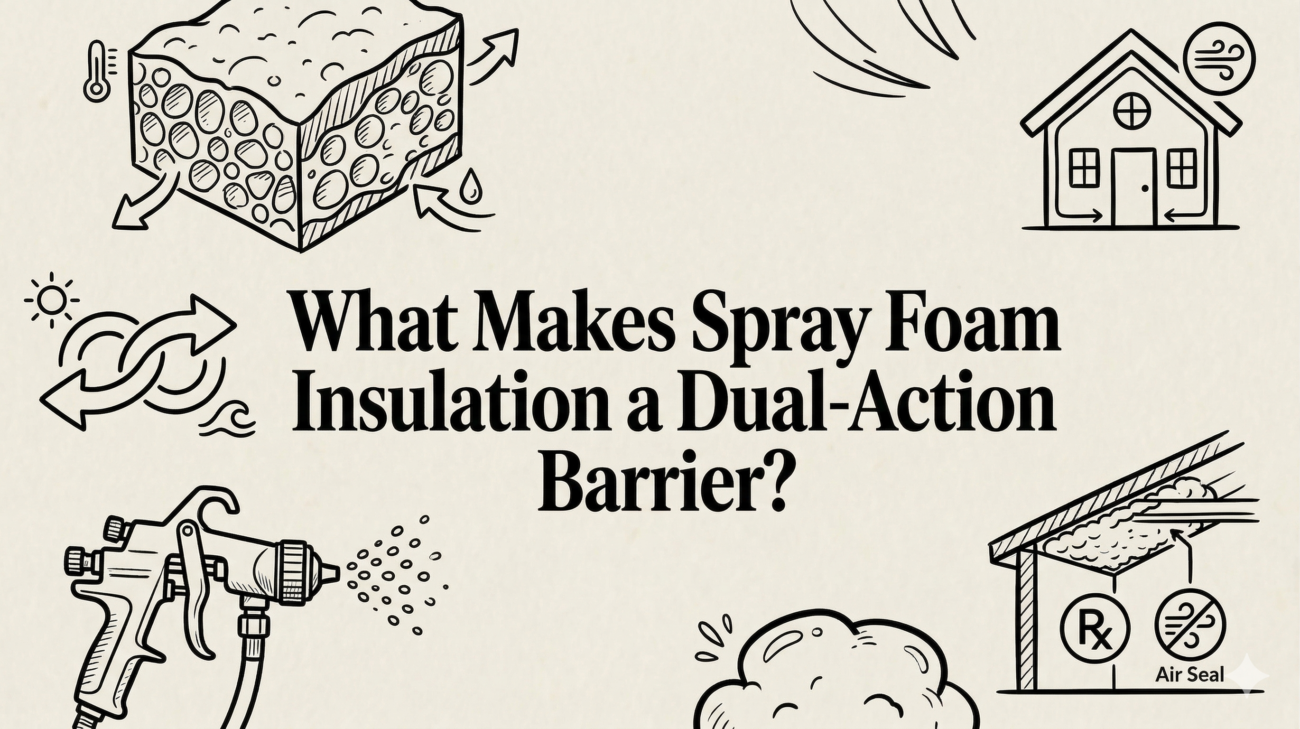
This is exactly why modern solutions like spray polyurethane foam (SPF) have become the go-to for insulating older homes down here. Spray foam is a game-changer because it doesn't just insulate; it creates a seamless air and moisture barrier, tackling the root cause of our biggest comfort and durability problems.
Understanding Spray Foam: Open-Cell vs. Closed-Cell
Spray foam isn't a one-size-fits-all product. You've got two main types, open-cell and closed-cell, and they have very different properties. Picking the right one for the right spot in your home is critical to getting the results you want.
Open-cell spray foam is the lighter, spongier of the two. Think of it like a dense sponge filled with tiny, open pockets of air. When we spray it, the foam expands like crazy—up to 100 times its liquid size—to fill every single nook, cranny, and gap. This makes it an absolutely fantastic air sealer.
A perfect real-world use for it is on the underside of an attic roof deck. By sealing the attic this way, you create what we call an "unvented" or "conditioned" attic. Suddenly, your attic isn't hitting a blistering 140°F on a summer day. Instead, it stays within 10-15 degrees of your living space temperature. This stops that intense heat from radiating down into your house and gives your HVAC system a much-needed break.
Closed-cell spray foam, on the other hand, is dense, rigid, and tough. Its cell structure is completely sealed, like a mass of microscopic, airtight bubbles. This structure makes it a beast against both air and water vapor. It’s your heavy-duty solution for heat and moisture.
Imagine a home in a flood-prone area near the coast. Applying closed-cell foam to the subfloor or the first few feet of the exterior block walls creates a waterproof, non-absorbent barrier that can stand up to direct water contact. On top of that, its rigidity adds serious structural strength, helping brace older walls against high winds during a hurricane.
For a more detailed breakdown, you can dive deeper into the differences between spray foam insulation closed-cell vs open-cell to see what fits your project best.
A Quick Comparison for South Florida Homes
To make it even clearer, here’s a straightforward look at how these two types of foam stack up for common applications in our climate.
Open-Cell vs. Closed-Cell Spray Foam for South Florida Homes
| Feature | Open-Cell Spray Foam | Closed-Cell Spray Foam |
|---|---|---|
| Air Barrier | Excellent. Expands massively to fill every gap. | Excellent. Creates an impermeable air seal. |
| Moisture Barrier | Not a vapor barrier. It allows moisture to pass through and dry out. | Excellent. Acts as a true vapor barrier, blocking moisture completely. |
| R-Value per Inch | ~R-3.5 to R-3.8 | ~R-6.0 to R-7.0 |
| Density | Low density, soft and flexible. | High density, very rigid and strong. |
| Expansion | High expansion (up to 100x). | Low expansion (around 30x). |
| Best For | Attics (roof decks), interior walls for soundproofing. | Crawl spaces, block walls, flood-prone areas, situations needing high R-value in thin spaces. |
| Cost | Less expensive per board foot. | More expensive per board foot. |
Ultimately, the best strategy often involves using both types of foam where they make the most sense for your home's specific challenges.
Making an Informed Decision for Your Home
Choosing between them really comes down to the specific job, your budget, and what you’re trying to achieve. This flowchart gives you a simple framework for where to start with your home energy checkup.

As the chart shows, a smart approach starts with a good visual inspection and can lead to a professional audit to pinpoint exactly where your insulation investment will pay off the most.
The best insulation strategy for an older Florida home is almost always a hybrid approach. You might use open-cell foam for the attic roof deck to get that perfect air seal at a lower cost, while spending a bit more on closed-cell foam for the robust moisture protection it offers in a crawl space or block walls.
This kind of strategic thinking is precisely why spray foam has become so popular. Homeowners are getting smarter about energy efficiency, moving away from outdated materials that just weren't designed for tough climates like ours. Upgrading your home’s insulation isn’t just an expense; it’s a direct investment in your comfort, your home's durability, and lower energy bills for years to come.
What a Professional Insulation Job Really Looks Like
Opting to bring in the pros for your older home’s insulation is a smart move. It can feel like a big project, but understanding what a professional crew actually does on-site can take a lot of the guesswork and worry out of the equation. You're not just paying for a truck full of foam; you're investing in a systematic process honed by years of experience to get the job done right, safely, and for the long haul.

It all starts well before the truck even shows up. The first step is a detailed on-site consultation where a specialist walks your property to get the lay of the land. This isn't just a quick look-around; they're diagnosing your home's weak points—peering into the attic, checking crawl spaces, and hunting for signs of air leaks or moisture problems.
This is your time to point out that one room that’s always a sauna in August or discuss your goals. A good consultation is a two-way conversation, not a sales pitch.
The Critical Prep Work
Before a single drop of new insulation goes in, the old stuff has to come out. In so many older South Florida homes, we find attics packed with decades-old fiberglass or cellulose that’s now just a compressed, dusty mat. Worse, it’s often contaminated with rodent droppings and other unpleasant surprises. Professional teams use high-powered, filtered vacuums to remove all of it without kicking that mess into your living space.
With a clean slate, the real work begins: air sealing. Honestly, this is the most important part of the entire job. The crew will go on a search-and-destroy mission for every crack, hole, and gap that lets your expensive conditioned air escape.
They focus on the usual suspects:
- Gaps around plumbing pipes and electrical wires that run into the attic.
- The notoriously leaky housings of recessed can lights.
- The top plates where your interior walls meet the attic floor.
- Openings around attic hatches and pull-down stairs.
Simply burying these air leaks under a mountain of new insulation is a rookie mistake that tanks performance. Sealing them first is what makes a home feel truly tight and comfortable.
Application Day: What to Expect
When installation day arrives, the crew’s first priority is protecting your home. They’ll lay down plastic sheeting and drop cloths to cover floors, furniture, and anything else nearby. The technicians themselves will be in full personal protective equipment (PPE), including hazmat suits and respirators. Applying spray foam is a chemical process, and safety is non-negotiable.
The application itself is a craft. A skilled applicator doesn’t just point and shoot; they apply the foam in precise, even lifts, letting it expand to perfectly fill every nook and cranny. They know how South Florida’s heat and humidity affect the foam’s curing time, adjusting their technique to ensure it bonds correctly and achieves its full R-value.
Professional installation isn’t just about spraying foam; it's about controlling the environment to ensure the chemical reaction happens correctly. This expertise is what separates a long-lasting, effective insulation job from one that can have problems down the line.
Wrapping Up and Quality Check
Once the foam has fully cured, the team shifts into cleanup mode, removing all their equipment and protective coverings. The last step is a final walkthrough with you. They’ll show you the finished work, point out key areas, and answer any questions. This is your chance to see exactly what was done and feel the difference firsthand.
A professional process, from that initial consult to the final handshake, ensures every detail is handled correctly. For a deeper dive into getting the most from your home’s thermal envelope, you can learn more about how to improve home insulation and lock in comfort and savings for years to come.
Balancing Airtightness with Healthy Home Ventilation
When we use spray foam to perfectly insulate an older home, we achieve incredible airtightness. That's a huge win for your energy bills, but it fundamentally changes how your house "breathes."
This is a point where a lot of homeowners get a little nervous, worried about making their home too tight. It’s a valid thought, but the answer isn't to leave intentional leaks. The real solution is to take complete control of your home's air.
An airtight home is a healthy home—but only when you pair it with intentional, mechanical ventilation. In those leaky old houses, "fresh" air is really just hot, humid, unfiltered outdoor air sneaking in through countless little cracks. By sealing those gaps, we stop the uncontrolled air exchange so we can introduce a controlled one.
If you don't bring in fresh air on purpose, the air inside can get stale. Everyday things like cooking and cleaning release pollutants, and moisture from showers or even just breathing can get trapped. This is why you have to look at the whole picture—insulation and airflow working together—when you're figuring out how to insulate an older home the right way.
Why Your HVAC System Needs a Little Help
Once your home is sealed up tight, your HVAC system's job gets a lot easier. It just doesn't have to run as often because the cool air you paid for finally stays put.
The catch is that most standard HVAC systems are only designed to recirculate the air that's already inside your house, not bring in fresh air from outside.
This is where specialized equipment becomes non-negotiable for maintaining great indoor air quality without killing your efficiency. In South Florida, just opening a window means letting in a wall of heat and humidity, which completely defeats the purpose of your new insulation.
Smart Ventilation Solutions for Sealed Homes
To get this right, we have to lean on a bit of building science. The goal is simple: bring in fresh air, kick out stale air, and do it all without making your AC work any harder than it has to.
Energy Recovery Ventilators (ERVs): For a hot, humid climate like ours, an ERV is the gold standard. This system is brilliant—it pulls fresh air in while pushing stale indoor air out. As the two air streams pass each other inside the unit (without ever mixing), the ERV transfers heat and moisture from the incoming fresh air to the outgoing stale air. This means the fresh air entering your home is already partially cooled and dehumidified, taking a huge load off your AC unit.
Properly Vented Exhaust Fans: It’s almost shocking how many older homes have kitchen and bathroom fans that just dump that steamy, greasy air right into the attic. That's a recipe for moisture and mold disasters. You have to make sure every single exhaust fan is ducted directly to the outside to get that moisture and odor out at the source.
An airtight building envelope doesn't trap you in; it gives you complete control over your indoor environment. You get to decide what air comes in, when it comes in, and how it's filtered—instead of letting random drafts make those decisions for you.
Think of it like upgrading from old, drafty single-pane windows to new high-performance ones. You wouldn't leave them cracked open 24/7. You open them when you want to. An ERV is like having a smart, energy-efficient window that’s always bringing in fresh air without the massive energy penalty.
You can dive deeper into how these systems work with your home's structure by reading more on the relationship between a vapour barrier and insulation. This complete system—a sealed envelope plus managed ventilation—is the true key to a comfortable, healthy, and genuinely efficient home.
Your Questions About Insulating an Older Florida Home, Answered
When you start thinking about a big upgrade like insulating an older home in Florida, you’re going to have questions. It’s a serious investment in your comfort and your property's value, so it’s only smart to get the facts straight before jumping in.
We've heard just about every question in the book from homeowners across South Florida. These are the real-world, practical concerns that come up again and again, from what it’s really going to cost to how long you’ll be displaced. Here are the direct, experience-based answers you need to plan your project with confidence.
How Much Will It Actually Cost to Insulate My Older House?
This is always the first thing people ask, and the honest answer is: it really depends. There's no one-size-fits-all price tag, because the cost to insulate an older home is shaped by a few key things.
The biggest factor is the type of insulation you go with. A high-performance material like closed-cell spray foam, which is incredible at blocking heat and moisture, will have a higher upfront cost than open-cell foam or old-school fiberglass batts.
Other things that move the needle on the final price include:
- The size of the space. A 1,200-square-foot attic is naturally going to cost less than a 3,000-square-foot one.
- How complex the job is. Homes with tricky rooflines, hard-to-reach crawl spaces, or other unique architectural details take more time and labor.
- The prep work involved. If we have to spend hours removing old, contaminated insulation from your attic and disposing of it properly, that will add to the project's cost.
While the initial investment for spray foam is higher than for outdated materials, the long-term savings on your power bill are what make it such a smart move. Many of our clients see their monthly FPL bill drop by 20% to 50%, which helps the investment pay for itself over time.
Do I Have to Leave My House During the Installation?
For most spray foam jobs, yes, but it’s usually for a very short time. When we apply spray polyurethane foam (SPF), the chemical reaction releases compounds into the air as it cures.
For your safety, our professional crews require everyone—people and pets—to be out of the house during the application and for a specific "re-occupancy" time afterward. This is typically about 24 hours. This period allows the foam to fully cure and lets us ventilate the space properly, ensuring the air inside is perfectly safe when you return.
Your crew leader will give you a very clear timeline so you can plan ahead. It’s a small, temporary inconvenience for the long-term health and safety of your family.
How Long Does the Whole Insulation Process Take?
The project timeline depends on the scope, but most residential jobs are finished much quicker than homeowners think.
For a typical attic insulation job on an average-sized South Florida home, we can often get it all done in just one to two days.
Here’s how that timeline usually breaks down:
- Day 1: The crew arrives, preps the area by laying down protective coverings, and gets to work removing any old insulation. If the removal is a big job, this might take up the full day.
- Day 1 or 2: The foam is sprayed, and we set up ventilation to help it cure. Afterward, the team does a full cleanup of the work site.
Of course, a bigger project—like insulating the entire building envelope, including walls and crawl spaces—will naturally take a bit longer. Any reputable contractor will walk you through a detailed schedule so you know exactly what to expect from start to finish. We work hard to minimize the disruption to your life.
Is Spray Foam a Good Choice for Soundproofing?
Absolutely. This is the "bonus benefit" that homeowners rave about all the time. Both open-cell and closed-cell spray foams are fantastic at dampening sound.
Because spray foam expands to fill every last crack, gap, and crevice, it creates a solid, airtight barrier that's incredibly effective at blocking airborne noise. Open-cell foam, with its softer, sponge-like texture, is especially good at sound attenuation.
Clients often tell us they can't believe the difference. The noise from traffic, neighbors, and lawn crews is dramatically reduced. It also cuts down on sound traveling between floors or rooms inside the house, creating a much quieter, more peaceful home. That added tranquility is a huge perk you get when you choose spray foam.
Ready to turn your older Florida home into a comfortable, quiet, and energy-efficient retreat? The team at Airtight Spray Foam Insulation has the hands-on expertise to deliver a perfect installation designed for our unique climate. Request your free, no-obligation quote today and discover the difference the Airtight Comfort System can make.