If you live in South Florida, you've probably had the same summer conversation more than once. The AC runs, the house still feels heavy, the upstairs never quite cools off, and the electric bill reminds you that comfort and efficiency aren't the same thing. In older roof assemblies, especially unvented ones, the problem usually isn't one thing, it's heat, air leakage, and humidity working together.
That's why closed cell spray foam roof insulation keeps showing up in conversations from Jupiter to Stuart. It's not just about chasing a lower bill. It's about building a roof assembly that handles our climate, where afternoon storms, salt air, and long cooling seasons punish weak insulation choices.
A homeowner in Palm Beach Gardens calls after another month of uneven temperatures. The downstairs feels fine, the guest room runs warm, and the attic smells damp after a storm. That's the kind of job where closed cell spray foam roof insulation starts making sense, because the roof system needs more than loose-fill coverage or a thin blanket of batting.
Closed-cell foam has become a major part of the insulation market because it combines thermal performance with moisture resistance, and that matters in hot, humid, storm-prone housing. One industry forecast puts the closed-cell spray foam segment at about USD 2.0 billion in 2025, rising to USD 3.4 billion by 2035, while another estimates USD 1,966.0 million in 2025 growing to USD 3,385.85 million by 2034 (Global Market Insights). That same source says closed cell represented about 65% of global installed volume in 2023, which tells you it's not a specialty curiosity, it's the dominant installed format worldwide.
For South Florida, the appeal is straightforward. Roof decks are often shallow, HVAC systems work hard, and humidity never really leaves the conversation. Closed-cell foam gives owners a way to get high insulation value in a tight profile, which is especially useful when roof depth is limited or when the assembly needs to do more than slow heat flow.
Practical rule: In South Florida, a roof product has to manage heat and moisture at the same time. If it only does one of those jobs well, it usually disappoints later.
The same logic applies in places like Wellington, where inland heat can be relentless, and coastal communities like West Palm Beach, where moisture pressure never takes a day off. A good installation can also improve the roof's resistance to wind uplift by stiffening the deck, which is one reason contractors keep specifying it in hurricane country.
What closed cell spray foam is is worth understanding before you sign anything, because the material behaves very differently from traditional insulation.
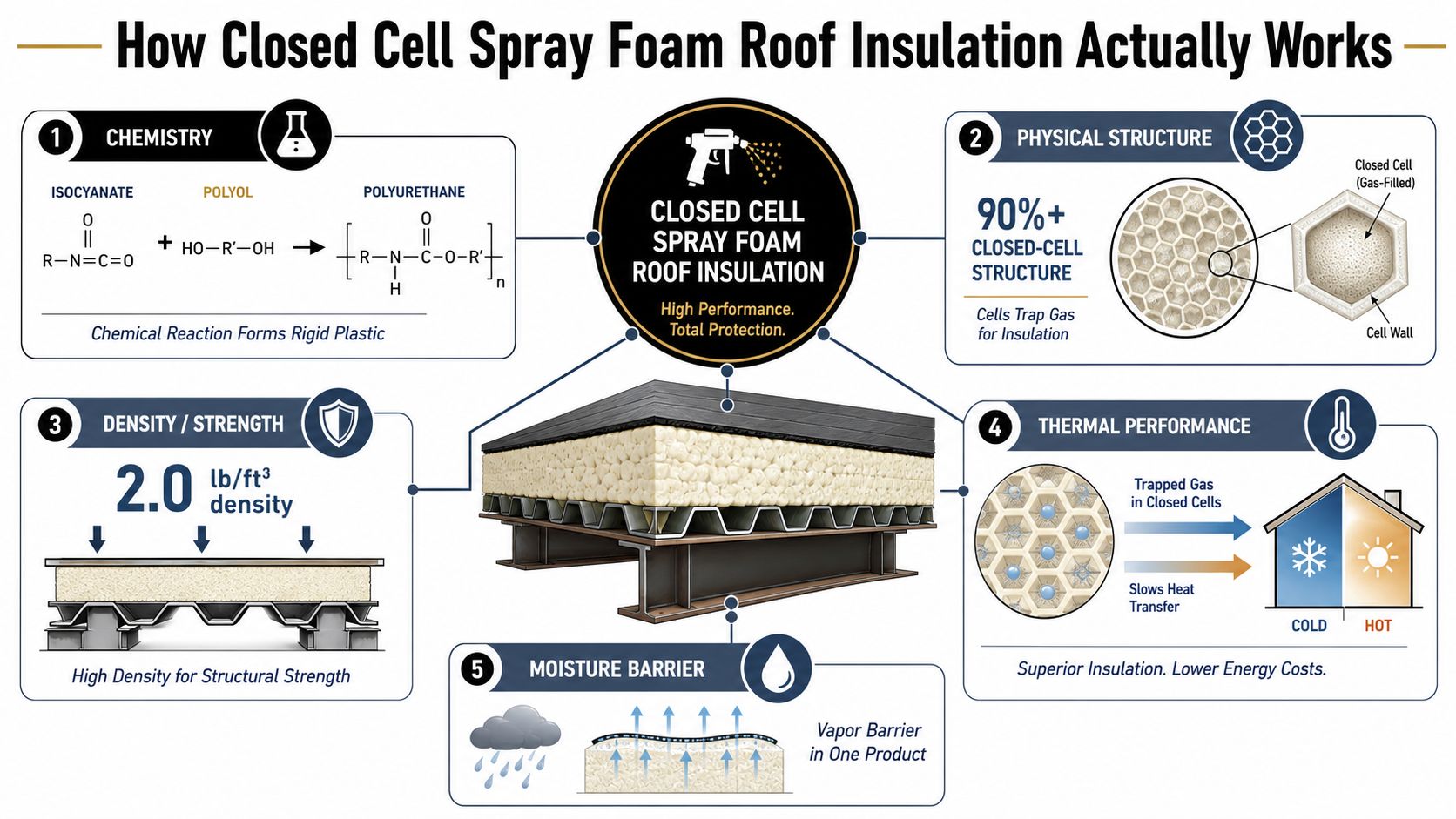
Closed-cell foam is a rigid, high-density material. In roof assemblies it's typically about 2.0 lb/ft³ with more than 90% closed-cell content, which is why it acts like insulation, an air barrier, and a vapor retarder in one product (JM Corbond III product data). It performs like a sealed thermal layer instead of a loose fill. The closed structure holds insulating gas in place and makes it much harder for heat and moisture to move through the material.
The main number homeowners notice is R-value. The U.S. Department of Energy's Building America guide puts typical closed-cell spray polyurethane foam at about R-6 per inch, with aged performance commonly around R-6.0 to R-7.0 per inch and some water-blown formulations around R-5.5 per inch (DOE Building America spray foam guide). In roof work, that matters because many assemblies do not have much depth to spare.
That same guide says a 2-inch application can deliver about R-13, while 1.5 inches delivers about R-9.75 (DOE Building America spray foam guide). In plain English, you get strong thermal performance without needing a thick build-up. That matters in South Florida, where roof assemblies often have to balance insulation value, ceiling height, and the realities of an unvented attic or conditioned attic plan.
Closed-cell foam is not soft or fluffy. Independent technical data show compressive strength around 32 psi for 2-lb closed-cell SPF (Gaco closed-cell SPF spec). On a roof deck, that stiffness helps the assembly resist deformation and adds useful rigidity under load. That is a real advantage when the roof faces wind, vibration, and repeated thermal cycling, which is common in hurricane-prone, high-humidity climates.
The vapor numbers matter too. At sufficient thickness, closed-cell foam can function as a Class II vapor retarder. One manufacturer data sheet lists 0.61 perms at 1.5 inches, plus very low air infiltration and water absorption, which is why the product can help control moisture movement as well as heat flow (JM Corbond III product data). That moisture control can be helpful in South Florida, but it also creates inspection risk if the roof assembly above it has a leak, because the foam can hide wet sheathing until damage has already spread.
When a contractor talks about closed-cell foam, ask what thickness they are proposing, what R-value that thickness yields, and whether the assembly still meets vapor-control goals at that depth. The material only performs as designed when the installed thickness matches the design assumption.
A roof spec should say more than “spray foam.” It should say how thick, where, and why that thickness was chosen. The same is true when you compare a roof package against any energy-efficient home insulation option, because the assembly decision has to fit the climate, the roof geometry, and the moisture risk.
The first mistake I see is homeowners shopping by price alone. Closed-cell foam, open-cell foam, fiberglass batts, and blown-in cellulose all provide insulation, but they behave very differently in a South Florida roof assembly.
Closed-cell foam is the densest option, and it gives the strongest resistance to moisture and air movement. Open-cell foam is lighter, more vapor-open, and usually less expensive, but it does not match the same vapor control or added stiffness. Fiberglass batts and blown-in cellulose can be part of the right roof system, but neither one gives the same air sealing or roof-deck support that spray foam provides.
Industry guidance on insulation comparison also points to the trade-off homeowners feel in real projects. The higher upfront cost of closed-cell foam buys more than thermal resistance, it buys tighter air control and better performance in assemblies that have little room for error. That matters in unvented South Florida roofs, where heat, humidity, and storm exposure make weak detailing show up fast.
For homeowners comparing options, this energy-efficient home insulation resource from C & C Windows & Doors is useful because it treats insulation as part of the whole roof assembly, not just a product choice.
| Feature | Closed-Cell SPF | Open-Cell SPF | Fiberglass Batts | Blown-In Cellulose |
|---|---|---|---|---|
| R-value per inch | Higher than open-cell, and less thickness is needed | Lower than closed-cell, and more thickness is needed | Lower per inch than spray foam | Lower per inch than spray foam |
| Moisture resistance | High, rigid, and moisture-resistant | More vapor-open | Limited | Can absorb moisture if exposed |
| Air sealing | Excellent | Excellent | Weak unless carefully detailed | Weak unless carefully detailed |
| Structural contribution | Adds stiffness and compressive strength | Minimal | None | None |
| Best fit in South Florida roofs | Unvented, moisture-sensitive, space-limited assemblies | Some vented or lower-risk assemblies | Budget-driven retrofits with careful detailing | Budget-driven retrofits with careful detailing |
The choice is not just thermal performance. It is whether the material fits the roof geometry, the humidity load, and the way the assembly has to dry if a leak shows up later.
A roof can be insulated well and still be the wrong assembly if the material choice fights the building's moisture behavior. That is why I review roof insulation as a system, not as a line item. When I compare closed-cell foam against other options, I also look at how the assembly is supposed to manage leaks, condensation, and the inspection access that gets lost after the foam goes in. The same point shows up in a spray foam insulation and mold guide, because moisture control only helps when the substrate starts dry and stays dry.
More insulation thickness is not automatically better if the product choice is wrong. A thick layer of the wrong material can still leave you with moisture migration, air leakage, or poor roof drying behavior.
A closed-cell roof assembly can look perfect from the living room side and still hide a moisture problem above the deck. In South Florida, that matters because a roof can be exposed to indoor humidity, air-conditioning cycles, and storm-driven leaks, all at the same time. I've seen owners assume the foam solved everything, then discover the core issue was trapped moisture in a deck that never had a chance to dry.
Closed-cell foam blocks vapor movement well, which is one reason contractors use it in unvented roof assemblies. The trade-off is that the same vapor resistance can keep moisture in place if the substrate went in damp or if water gets behind the foam later. RICS notes that moisture may not escape properly when closed-cell insulation is used, and that can raise decay risk in battens or rafters (RICS on spray foam insulation). That warning lines up with what I see in hot, humid, hurricane-prone roofs, where drying potential is already limited.
The foam resists vapor, but the roof assembly still has to manage whatever moisture is already in the wood, sheathing, or framing. If the deck starts out wet, or if a future leak enters from above, that moisture can sit in place far longer than homeowners expect.
If the substrate isn't dry at installation, closed-cell foam can preserve the problem instead of fixing it.
That is why I check the deck before any application starts. I want the substrate inspected, measured, and reviewed for stains, soft spots, prior repairs, and any sign of hidden intrusion. If a roof cavity shows unexplained humidity or the sheathing has already been exposed to water, that needs correction before the foam covers it.
The inspection issue matters too. Once the foam is in place, later roof leaks can be harder to trace, and that creates headaches during appraisals, sales, and insurance conversations. The material is not automatically the problem, but it can make hidden damage harder to confirm once the assembly is sealed.
A good moisture plan starts with the wood below the foam. The spray foam insulation and mold discussion covers that hidden-risk side well, because mold and decay usually start where the structure stays wet and nobody can see it.
Owners also need to treat roof foam as part of the whole assembly, not a stand-alone fix. If the roof has past water intrusion, poor flashing, or recurring condensation issues, the foam will not erase those failures. It only performs well when the roof deck is sound, dry, and detailed correctly for the climate.
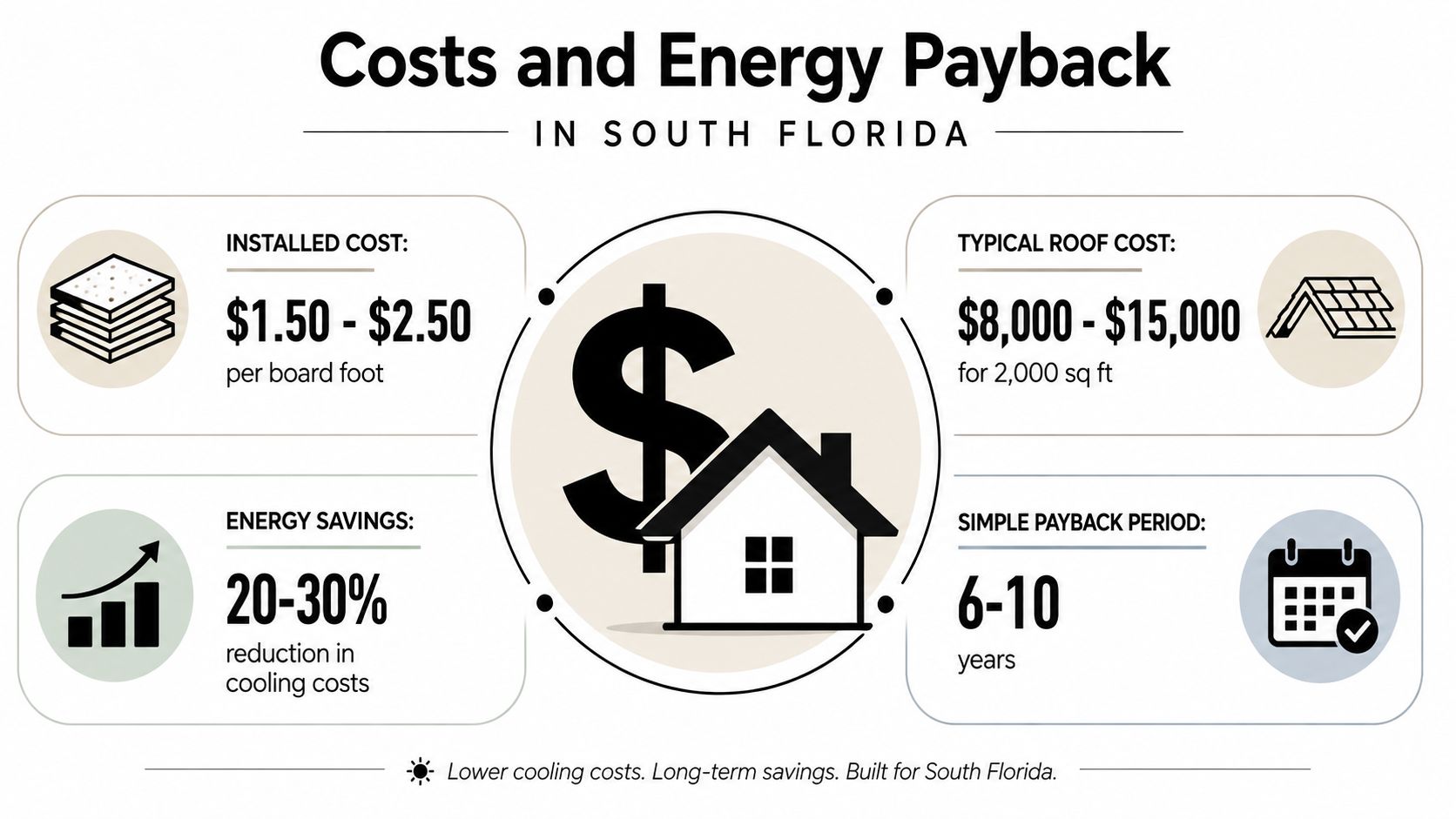
Homeowners usually ask about payback before they ask about brand names, and that is the right order. Closed-cell foam is an investment, and the math has to work in a climate where cooling equipment runs hard for much of the year.
Installed pricing is often discussed by square footage, thickness, and access conditions because those variables change the scope so much. For a practical budgeting reference, the compare house build expenses resource from New American Funding, LLC helps owners see how envelope choices affect total ownership cost, not just the first invoice. A more specific cost breakdown for roof foam is available in this closed-cell foam spray insulation cost guide, which is useful when you want to understand what drives pricing in real projects.
Closed-cell foam can cost more at the start than fiberglass or cellulose, but South Florida homes spend long stretches under heavy cooling load. Air sealing and thermal control can matter just as much as nominal R-value in that setting. Market analysis also shows steady demand for spray foam across building applications, which helps explain why contractors continue to see interest in roof insulation across the region (Global Market Insights).
The bigger issue is not just utility bills. It is also how the roof is received during refinancing, insurance review, or resale. Surveyors and lenders can get cautious when spray foam makes roof defects harder to inspect, and code-compliant thickness and condensation control matter as much as thermal performance. In practice, documentation carries a lot of weight.
Keep every moisture reading, scope sheet, and photo set. The paper trail often matters long after the foam cures.
South Florida owners do not buy foam for comfort alone. They buy it to reduce risk. If the documentation is thin, the investment becomes harder to defend later.
A closed-cell roof job can fail before the first pass if the deck is damp or the crew treats South Florida like any other market. In this climate, I want a dry substrate, clear access, and installers who understand how heat and humidity change foam behavior on an unvented roof. If those basics are ignored, the problem may stay hidden until a stain, a smell, or an inspection raises questions.
Moisture in the roof deck needs to be checked before any foam goes on. A deck can look sound and still hold residual moisture from an old leak, a recent repair, or construction exposure, and that trapped water can get sealed in once the foam cures. Temperature and humidity also affect spray behavior, so a crew should adjust timing, pass size, and application pace to the day's conditions instead of spraying by habit.
Thickness control matters because the foam has to meet the intended thermal target and support vapor control where the assembly calls for it. In a hurricane-prone area, adhesion and continuity matter too, because closed-cell foam is part of the roof assembly and can help resist wind uplift when it is installed correctly. If the installer sprays too thin, leaves soft spots, or ignores transitions, the roof may still look finished while the assembly is underbuilt.
A safety note belongs here as well. Roofing work brings fall exposure, and proper harness setup is part of disciplined field work. This Growth 4 Trades safety guide is a practical reminder that good installation starts with safe access and controlled movement on the roof.
The technical details matter because roof foam is part of the roof system, not just insulation stuffed into a cavity. A rushed install, a wet deck, or guesswork on thickness can leave hidden defects that may not show up until someone inspects the roof later. In South Florida, that can mean moisture concerns, inspection delays, or questions during a sale or claim.
For homeowners who want to see the process visually, this video is a useful reference point.
The contractor matters as much as the product. In South Florida, a crew that understands coastal humidity, roof aging, and storm exposure will make different calls than a generalist who sprays the same way in every market.
Airtight Spray Foam Insulation is a useful benchmark because the company is built around South Florida conditions, not generic national talking points. Founder Christian Cates brings over 25 years of hands-on experience, and the company's process runs from free estimate to final walkthrough with attention to moisture control, safety, and finish quality. That kind of local focus matters in Jupiter, where coastal humidity feels different than inland Wellington, and it matters again in Stuart after long storm seasons.
The best proposal should be specific. It should say what assembly is being insulated, how thickness is verified, and how the contractor will document conditions before and after installation. A vague price with no discussion of deck condition, vapor control, or access is a warning sign.
Ask these questions before you sign:
Airtight's step-by-step approach, from estimate to walkthrough, is the kind of process that helps homeowners compare proposals on more than just price. In roof work, the cheapest quote often leaves out the very details that protect the assembly later.
If you're weighing closed-cell foam for a South Florida roof, talk to a team that understands moisture, inspection risk, and hurricane-season realities, not just insulation thickness. Visit Airtight Spray Foam Insulation to request a free quote and get a roof evaluation that's built around South Florida conditions.