Spray foam insulation is supposed to improve comfort, control air movement, and help create a more stable indoor environment. But when spray foam is installed incorrectly—or when the building itself was never properly evaluated—the result can be high humidity, sweating ductwork, musty odors, uncomfortable rooms, moisture problems, and an attic that simply does not perform the way it should.
At Airtight Spray Foam Insulation, we specialize in identifying and correcting failed or underperforming spray foam installations throughout South Florida. We do more than add another layer of foam. We evaluate the building as a complete system to determine why the spray foam is failing and what needs to be corrected for long-term performance.
Schedule a Building Performance Evaluation to find out what is really happening in your attic.
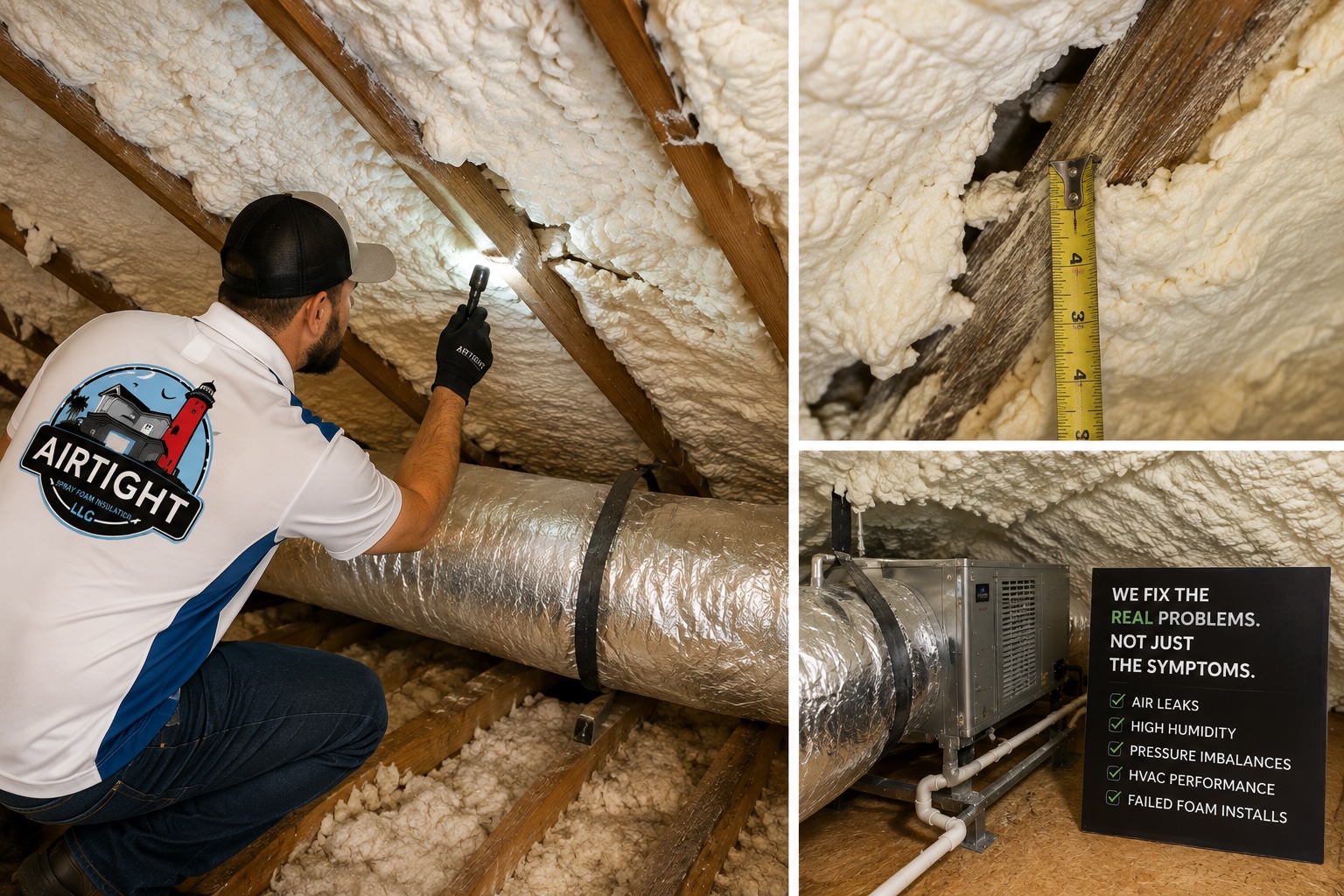
A common mistake is assuming that every problem in a spray-foamed attic can be solved by adding more foam.
It cannot.
Spray foam is only one component of a building’s overall performance. The insulation, air barrier, HVAC system, ductwork, attic pressure, indoor humidity, and moisture movement all interact with one another.
If those systems are not working together correctly, even an attic with spray foam can develop problems.
That is why Airtight begins with diagnosis—not installation.
We don’t recommend more spray foam until we understand why the building is underperforming.
Not every failed installation looks obvious. Sometimes the foam itself appears intact while the attic continues to experience moisture, pressure, or comfort problems.
Common warning signs include:
High Attic Humidity
A spray-foamed attic should not consistently feel excessively damp or humid. Elevated humidity can indicate uncontrolled moisture, air leakage, pressure issues, HVAC problems, or an improperly designed attic system.
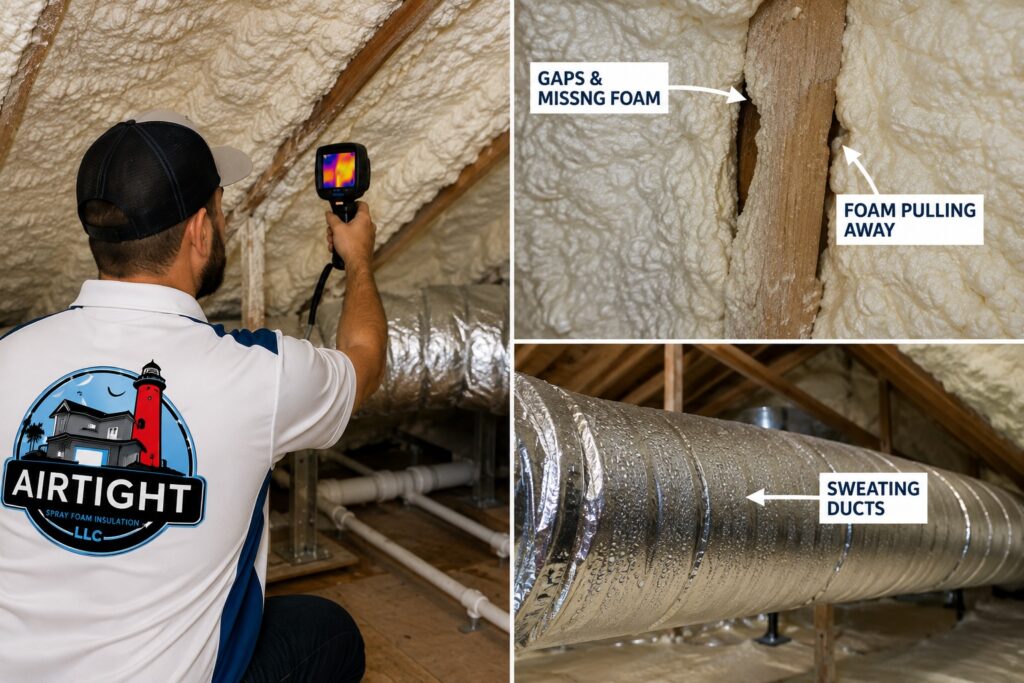
Sweating AC Ducts
Condensation forming on ductwork, air handlers, or HVAC equipment means warm, humid air is reaching a surface below the dew point.
Simply adding more foam may not correct the cause.
Musty or Unusual Odors
Persistent attic odors may point to trapped moisture, microbial growth, contaminated materials, air leakage, or improper ventilation and conditioning.
Hot or Uncomfortable Rooms
If certain areas of the home remain hotter or more uncomfortable despite having spray foam, the issue may involve incomplete coverage, air leakage, duct losses, HVAC performance, or pressure imbalances.
Gaps or Missing Foam
Visible gaps around roof transitions, penetrations, framing connections, mechanical openings, or difficult-to-reach areas can compromise the air barrier.
Foam Pulling Away From Surfaces
Spray foam that separates from roof decking or framing can create pathways for uncontrolled air and moisture movement.
Uneven or Inconsistent Foam Thickness
Areas that are too thin or poorly applied may not provide the intended insulation or air-sealing performance.
Moisture or Condensation in the Attic
Water droplets, damp framing, staining, condensation, or microbial growth should never be ignored.
A failed spray foam attic does not always mean the foam product itself is defective.
The problem may originate from how the material was installed or from conditions elsewhere in the building.
Incomplete Air Sealing
Small gaps can have a major effect on attic performance.
Potential leakage points include:
If humid outdoor air continues entering the attic, moisture problems can persist even when most of the roof deck is covered with foam.
Improper Foam Application
Spray foam needs to be installed correctly to perform correctly.
Potential installation problems may include:
Airtight evaluates the entire installation instead of focusing only on the most visible areas.
HVAC and Attic Conditions Were Never Considered
Turning a vented attic into a spray-foamed or conditioned attic changes how the building behaves.
HVAC equipment located inside that space now interacts with a different temperature, humidity, and pressure environment.
If the mechanical system was never considered during the spray foam project, the attic may experience:
Excess Moisture
South Florida’s warm, humid climate makes moisture management especially important.
Moisture can enter or accumulate through:
Until the moisture source is identified, replacing or adding insulation may only treat the symptom.
Airtight takes a building-science approach to failed spray foam repair.
1. Building Performance Evaluation
We begin by understanding the problem you are experiencing and inspecting the relevant areas of the home.
Depending on the situation, we may evaluate:
Our objective is to identify the root cause, not simply find somewhere to spray more foam.
2. Identify Why the System Is Underperforming
Once the attic has been evaluated, we determine which factors are contributing to the problem.
There may be one cause—or several interacting issues.
For example, sweating ducts may involve a combination of:
Understanding those relationships allows us to develop a more complete solution.
3. Develop a Correction Plan
Every failed foam project is different.
Depending on what we find, the repair plan may involve:
We recommend only the work that makes sense for the conditions we find.
4. Repair the Spray Foam and Building Envelope
Once the underlying problems have been identified, our team completes the necessary corrections with careful attention to detail.
The goal is not simply to make the attic look better.
The goal is to make it perform better.
5. Verify the Results
After corrections are completed, we review the repaired areas and confirm that the system has been addressed according to the project plan.
Whenever appropriate, we compare conditions before and after the work so homeowners can understand what changed.
Not every failed spray foam installation needs to be completely removed.
In some homes, isolated deficiencies can be repaired.
In others, portions of the existing foam may need to be removed before the attic can be properly restored.
The correct approach depends on factors such as:
Airtight evaluates the existing installation before recommending repair, partial removal, or more extensive restoration.
This is where Airtight differs from a typical spray foam contractor.
A Typical Spray Foam Contractor May Ask:
“Where should we spray?”
Airtight Asks:
“Why isn’t this building performing correctly?”
We look beyond the insulation itself and consider how the home operates as a complete system.
That includes:
Only after understanding those conditions do we recommend the appropriate repair.
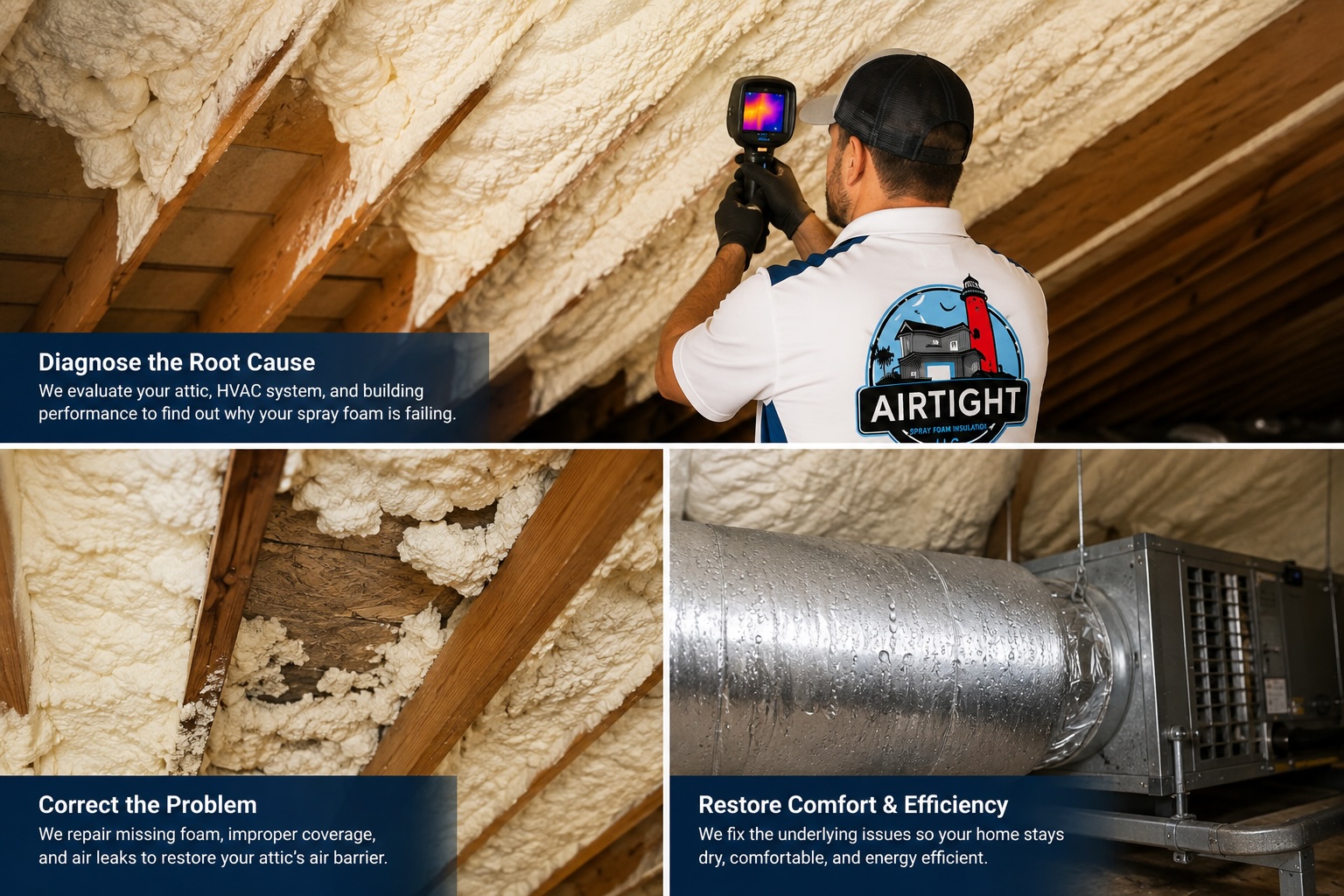
Failed spray foam projects are one of the reasons we developed the Airtight Comfort System™.
Our approach combines building-science principles with high-quality spray foam installation to address the conditions affecting the entire attic.
Rather than treating insulation, humidity, pressure, and HVAC performance as unrelated problems, we evaluate how they interact.
Diagnose
Identify the conditions causing the attic or home to underperform.
Engineer
Develop a correction strategy based on the building—not a one-size-fits-all package.
Solve
Implement the necessary spray foam, air sealing, moisture, pressure, and building-performance corrections.
Learn More About the Airtight Comfort System™
We Diagnose Before We Sell
We do not assume that more insulation is automatically the answer.
We Understand South Florida Humidity
Managing heat and moisture in South Florida requires understanding how humid outdoor air interacts with HVAC systems and the building envelope.
We Look at the Whole Attic
Foam, ductwork, HVAC equipment, humidity, air leakage, and pressure all matter.
We Repair Existing Installations
You do not necessarily need to start over simply because another contractor installed the original foam.
We Focus on Long-Term Performance
Our objective is to correct the underlying problem and create an attic that functions as part of the home—not simply cover surfaces with insulation.
Contact Airtight if your spray-foamed attic is experiencing:
Airtight provides spray foam inspection, repair, and building-performance solutions for homeowners throughout Palm Beach County and surrounding South Florida communities.
Our service area includes communities such as:
If another contractor installed spray foam and your attic still does not feel or perform correctly, you do not have to keep guessing about the cause.
Your attic should not have persistent humidity, condensation, uncomfortable temperatures, or moisture problems after a spray foam installation.
Before spending money on another layer of insulation, find out what is actually causing the problem.
We’ll evaluate the existing spray foam, attic conditions, HVAC environment, moisture, and other factors affecting the home and develop a solution based on what the building actually needs.
SCHEDULE A BUILDING PERFORMANCE EVALUATION
How do I know if my spray foam insulation was installed incorrectly?
Common signs include visible gaps, uneven foam thickness, foam pulling away from the roof deck or framing, excessive attic humidity, condensation, sweating ductwork, musty odors, or rooms that remain uncomfortable. However, some problems are caused by HVAC, pressure, or moisture conditions rather than the foam itself. A building performance evaluation can help determine the actual cause.
Can failed spray foam be repaired without removing all of it?
Often, yes. If the problem is limited to specific gaps, poorly detailed areas, or sections of inadequate coverage, targeted repairs may be possible. More extensive removal may be necessary when the foam is damaged, poorly adhered, contaminated, or preventing access to another underlying problem. Airtight evaluates the existing installation before recommending a repair strategy.
Why is my attic humid even though it has spray foam?
Spray foam can help create an air barrier, but it does not automatically control every source of humidity. Outdoor air leakage, attic pressure, HVAC operation, moisture sources, ductwork, incomplete foam coverage, or inadequate conditioning can all contribute to high attic humidity. The entire attic system needs to be evaluated before determining the solution.
Why are my AC ducts sweating after spray foam installation?
Duct condensation occurs when the surface temperature of the duct falls below the dew point of the surrounding air. In a spray-foamed attic, this can be related to excessive humidity, outside-air infiltration, pressure imbalances, incomplete air sealing, or HVAC conditions. Covering the ducts or adding more foam without identifying the cause may not solve the problem.
Can you repair spray foam installed by another contractor?
Yes. Airtight can evaluate existing spray foam installations completed by other contractors and recommend appropriate corrections based on the current condition of the attic. Depending on the findings, the work may involve repairing foam, correcting the air barrier, addressing moisture or humidity, improving pressure relationships, or coordinating additional building-performance improvements.
What happens during a building performance evaluation?
A building performance evaluation focuses on understanding why the home or attic is underperforming. Depending on the problem, Airtight may examine the existing spray foam, attic humidity and temperature, HVAC equipment, ductwork, moisture conditions, air leakage, penetrations, and pressure relationships. The findings are then used to develop a repair strategy based on the root cause rather than simply recommending additional insulation.