
South Florida noise has a way of finding the weak spot in a house. It comes through the front wall facing the road, through a bedroom shared with a loud bathroom, through a garage wall when the mower starts early, and through attic pathways most homeowners never think about. You close the windows, turn up the TV, and still hear traffic, voices, barking, and that constant outdoor hum.
A lot of people start looking at blown in insulation for soundproofing because they want one upgrade that solves everything. That’s understandable. But insulation is one of the most misunderstood parts of a quiet-home plan. Some materials absorb sound well. Some mainly help with temperature. Some leave gaps. Some handle humidity better than others. In South Florida, that last point matters more than most online guides admit.
The right approach isn’t just “add insulation.” It’s choosing the right material for the right assembly, then installing it tightly enough that sound and humid air don’t keep sneaking through the same paths. If you get that part wrong, you can spend good money and still hear the same noise.
A homeowner in Palm Beach Gardens usually calls for one of three reasons. The house backs up to a busy road. The neighbor’s patio has become a nightly event space. Or a once-quiet room now shares a wall with a nursery, TV room, or home office. The complaint sounds different each time, but the feeling is the same. “I just want the house to feel calm.”

That’s where insulation enters the conversation. Not because it’s magic, but because empty cavities inside walls and ceilings act like little echo chambers. Once those spaces are properly filled, a home often sounds more solid, less hollow, and much less exposed to everyday noise.
Many people assume all insulation does roughly the same thing. It doesn’t. One material might help with airborne noise between rooms. Another might be better at filling irregular cavities. Another may solve air leakage while also improving sound control. In a humid coastal climate, that same material also has to make sense from a moisture standpoint.
There’s also a difference between “quieter” and “soundproof.” If you’re trying to create a media room and achieve cinema-grade audio, insulation is part of the build, but it won’t carry the whole job by itself. If you just want less traffic noise in the bedroom, the strategy is different.
A quieter home usually comes from fixing the assembly, not chasing a single miracle product.
For South Florida homes in Jupiter, West Palm Beach, Wellington, and nearby areas, the best choice often comes down to three trade-offs. Sound performance, air sealing, and moisture behavior. Ignore any one of those, and the result won’t hold up the way you want.
Sound moves through houses in two ways. It travels through the air, and it travels through the building itself. Voices, TV audio, and traffic are airborne. Footsteps, door slams, and vibration from equipment can become structure-borne. Insulation helps most with the first category, and it helps best when the wall or ceiling assembly doesn’t have obvious leaks.
A simple way to understand this is to compare a thin bedsheet with a heavy quilt. Hold up a sheet and you still hear almost everything clearly. Put a dense quilt between you and the noise, and the sound becomes duller and softer. Insulation works on the same idea. More mass and more internal fiber structure give sound waves more material to push through, lose energy in, and scatter around.
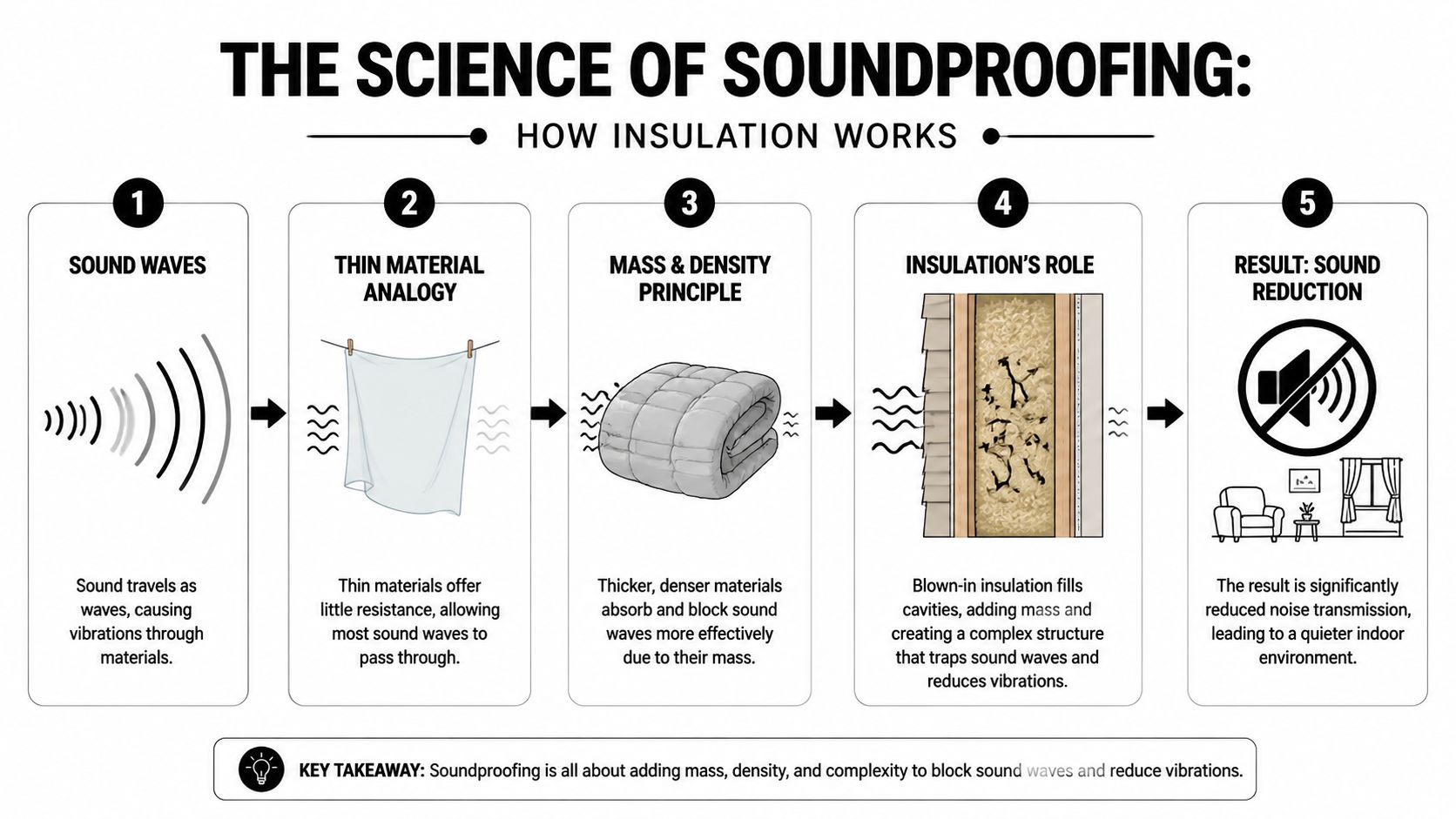
Inside a wall cavity, insulation doesn’t “cancel” sound. It reduces how easily sound pressure can bounce, resonate, and pass through the assembly. That’s why an insulated wall often sounds less tinny than an empty one.
For a practical primer on this idea, see insulation as a sound barrier. The key takeaway is simple. Sound finds the path of least resistance, and an empty cavity offers very little resistance.
A homeowner doesn’t need an acoustics degree to make a good decision. You just need to know what the assembly is trying to do.
Insulation mainly helps with the first two. Other parts of the wall system, like resilient channel or double framing, help more with separation.
Two acoustic terms show up often in product talk.
STC stands for Sound Transmission Class. It’s a practical way to describe how well a wall, floor, ceiling, or door assembly reduces sound traveling from one side to the other. If you’re trying to stop bedroom noise from reaching a hallway, STC is part of the conversation.
NRC stands for Noise Reduction Coefficient. It tells you how well a material absorbs sound rather than reflecting it back into the room. If you’ve ever walked into a bare room that sounded sharp and echoey, that room lacked absorption.
Practical rule: STC is about sound getting through. NRC is about sound getting soaked up.
Improper installation often causes projects to go sideways. A material can test well and still disappoint in a real house if the installer leaves voids, compresses insulation where it shouldn't be compressed, or ignores the small openings around outlets, top plates, can lights, ducts, and framing transitions.
A wall assembly is only as quiet as its weakest opening. One unsealed gap can do more damage than people expect. In South Florida, those same gaps also move humid air. So the acoustic conversation and the moisture conversation are often the same conversation.
If a homeowner asks me which insulation gives the best value for sound control, I don’t answer with one product name right away. I ask where the noise is coming from, whether the wall is open or finished, and how much humidity risk the assembly sees. Material choice changes with those answers.
One verified set of data gives a clear picture of the acoustic gap between common materials. According to research summarized here, cellulose blown-in insulation provides sound reduction ranging from 50-60%, while fiberglass batts deliver 30-40% sound reduction. The same source notes that cellulose reaches a density of 3.0-3.5 lbs/ft³ with an NRC of 0.80-0.90, compared with fiberglass batts at 0.5-1.0 lbs/ft³ and NRC ratings of 0.50-0.70. It also reports that rock wool delivers 55-65% sound reduction, with densities of 4.0-5.0 lbs/ft³ and NRC ratings of 0.85-0.95.
Those numbers line up with what contractors see in the field. Denser materials tend to do a better job with airborne noise because they add more mass and more internal friction inside the cavity.
| Material | Typical NRC | Air Sealing | Moisture Handling | Ideal Application |
|---|---|---|---|---|
| Cellulose | 0.80-0.90 based on the verified data above | Limited by itself | Needs careful use in humid assemblies | Interior walls, retrofit wall fills, cavities where sound absorption matters |
| Fiberglass | 0.50-0.70 based on the verified data above | Limited by itself | Can be workable, but air movement can still undermine performance | Budget-driven projects, some attic and wall applications |
| Open-cell spray foam | Qualitatively strong for sound absorption in practice | Excellent because it seals gaps as it expands | Often attractive in humid climates when the assembly is designed correctly | Walls, rooflines, and cavities where both sound control and air sealing matter |
For pure cavity absorption, cellulose is a serious option. It’s dense, it fills space well, and it generally outperforms basic fiberglass for sound control. In finished-wall retrofits, dense-pack cellulose can be a practical choice because it can be installed through access holes and packed into the cavity.
But South Florida homeowners should think beyond acoustics. If you’re dealing with humid exterior wall assemblies, roof complexity, or rooms that suffer from air leakage, cellulose doesn’t solve those problems by itself. It absorbs sound, yes. It doesn’t provide the same continuous air seal as spray foam.
That’s why a simple “best acoustic product” answer can be misleading. A material can be great on paper and still be the wrong move for a humid, leak-prone house.
Fiberglass remains popular because it’s familiar, available, and often the most budget-friendly option. In some projects, especially where budget is driving the decision, it’s still better than leaving a cavity empty.
Its weakness is consistency. Fiberglass depends heavily on a clean install. If it’s cut poorly, compressed around wiring, or left with gaps at the edges, sound slips right past it. It also doesn’t stop moving air well on its own. That matters because airborne sound often follows the same cracks that conditioned air escapes through.
If you can feel air movement through a wall or ceiling assembly, don’t expect great sound control from that assembly.
Open-cell spray foam is a different category because it doesn’t just sit in the cavity. It expands to fill irregular voids, edges, penetrations, and transitions that loose-fill and batt products can miss. For sound control, that matters in real houses more than homeowners realize.
For a side-by-side look at the practical trade-offs, this comparison of foam versus cellulose insulation is useful. The decision often comes down to this:
In an interior partition between bedrooms, bathrooms, offices, or media spaces, cellulose can make a lot of sense. In an exterior wall facing traffic, I look harder at air leakage and moisture behavior. In attic or roofline situations, the climate starts making decisions for you. South Florida houses don’t just need insulation that sounds good in a brochure. They need assemblies that stay dry, tight, and stable.
Cost still matters, of course. Spray foam usually carries a higher upfront price than basic fiberglass or some blown products. But when noise complaints are tied to drafts, hot spots, and humid infiltration, treating those issues separately often costs more in the long run and gives a worse result.
Open-cell spray foam stands out for one reason that homeowners can feel almost immediately. It doesn’t just insulate the cavity. It seals the cavity.
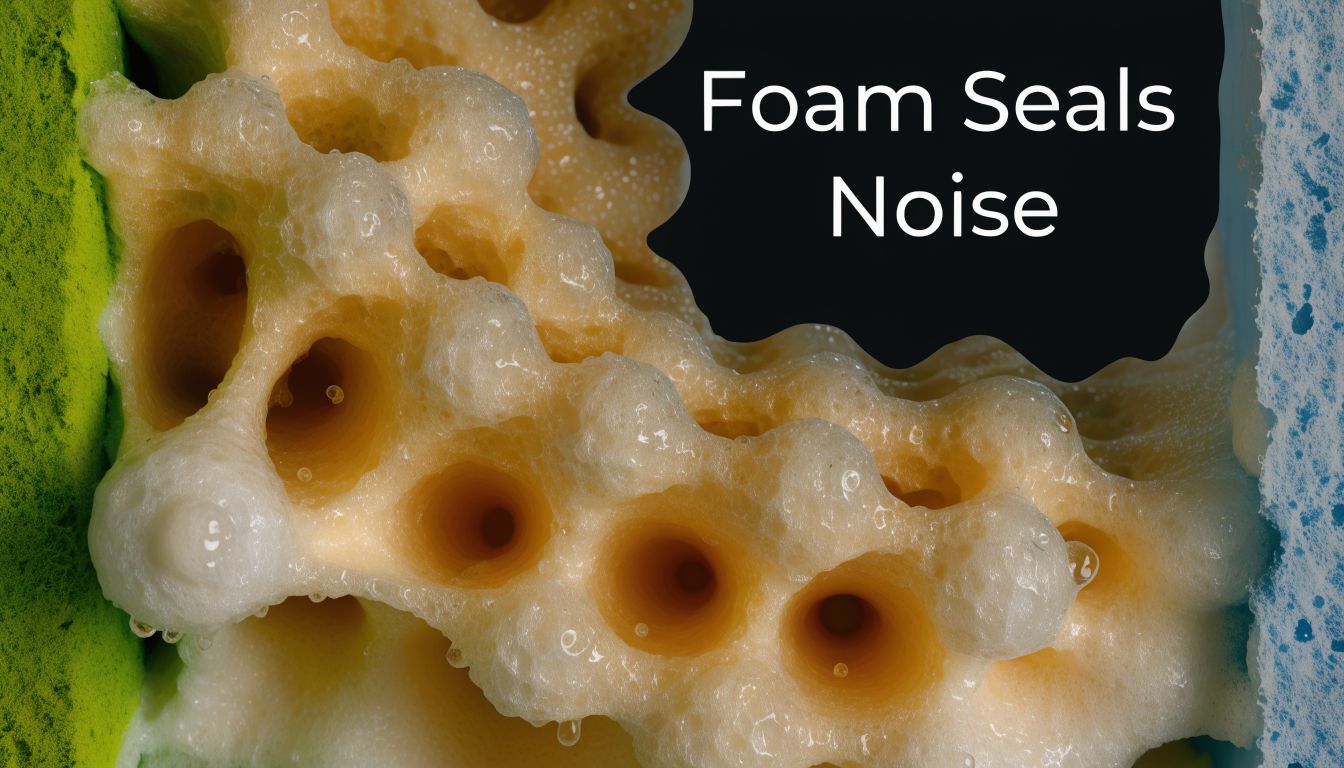
That distinction matters because sound rarely travels through the middle of a perfect wall only. It leaks through joints, wiring penetrations, small framing gaps, top plates, bottom plates, and all the little cracks that builders and homeowners don’t notice until the room is quiet enough to expose them. In South Florida, humid air uses those same routes.
This is the biggest practical difference between open-cell spray foam and conventional cavity fills. Fibrous insulation can absorb sound inside the cavity, but if air can still move around the insulation or through the perimeter of the assembly, noise keeps finding a path.
Open-cell foam expands into those irregular spaces and bonds into a continuous fill. That creates a more monolithic interior layer. In real-world soundproofing, that’s often more important than homeowners expect.
Here’s the field logic:
That doesn’t make open-cell spray foam a cure-all. Windows, doors, ductwork, and framing details still matter. But if the wall or roof assembly is full of small air pathways, spray foam addresses a problem other materials leave behind.
In Jupiter, Stuart, Wellington, and the rest of coastal South Florida, the house isn’t just battling noise. It’s battling humidity drive. Warm, damp outdoor air wants to move inward whenever the building enclosure gives it an opening. If that air leaks into wall cavities, attic transitions, or roof assemblies, comfort drops fast.
A material that helps reduce sound while also tightening the enclosure solves two homeowner complaints at once. Rooms feel less drafty, less muggy, and less exposed to outside noise.
A house that leaks humid air usually leaks sound too.
That’s why open-cell spray foam often makes sense in rooflines, exterior walls, bonus rooms, garage-adjacent spaces, and other spots where thermal comfort and acoustic comfort overlap. It’s not just about making a room quieter. It’s about making the room feel more controlled.
Open-cell foam performs best when the goal is to improve the whole assembly, not just stuff material into a cavity. Good examples include:
A short visual helps explain how the foam expands and fills irregular spaces:

Where homeowners sometimes overestimate it is impact noise. If the problem is footsteps from above or vibration from a slamming door, open-cell foam helps less than people hope. In those cases, the fix usually includes mechanical separation, subfloor work, better underlayment, or changes to the framing and finish layers.
That’s the honest trade-off. Open-cell spray foam is one of the strongest options for reducing airborne sound while addressing air leakage in humid climates. It still works best when paired with a good wall or ceiling design.
Placement matters as much as product choice. If you insulate the wrong part of the house, you can spend money and barely notice a difference. The most effective strategy is to target the assemblies that separate you from the noise source.
If road noise, lawn crews, barking dogs, or pool equipment are the main complaint, start with the exterior walls facing that exposure. Those walls are the first defensive line. A cavity fill can reduce the hollow, drum-like effect inside the wall, but the result depends heavily on what else is in that wall, especially windows, doors, and electrical penetrations.
In a finished home, contractors often use a drill-and-fill method to access the cavity without tearing out full sections of drywall. That can work well when the wall is suitable for retrofit filling. In new construction, the job is easier because the installer can see the entire cavity and verify complete coverage before drywall goes up.
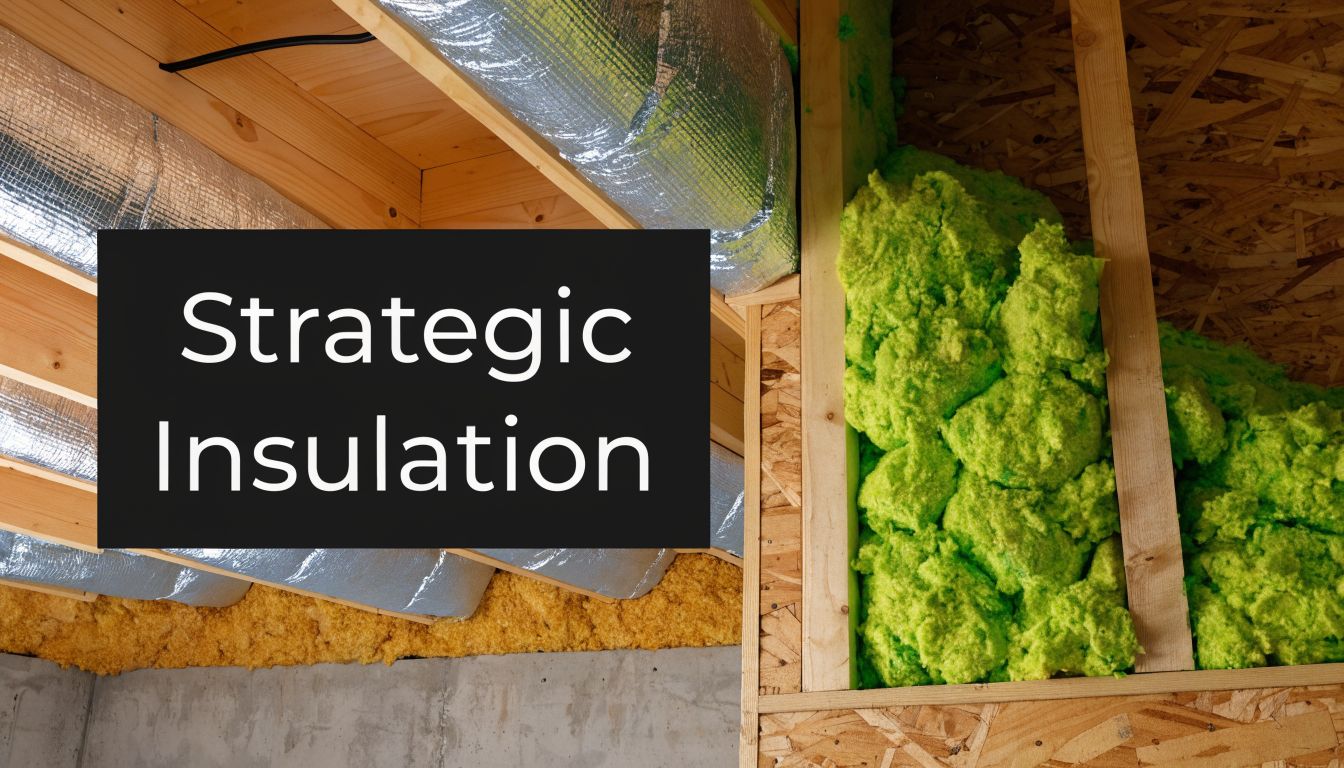
For homeowners comparing methods, this overview of blown insulation installation gives a practical sense of how retrofits are typically approached.
Interior partitions often give the fastest quality-of-life improvement. These are the walls between:
These walls don’t face sun and rain the way exterior walls do, so the material decision can focus more heavily on acoustics and installation access. If someone wants a quieter nursery, a less noisy bathroom wall, or better privacy around a workspace, this is often where I’d invest first.
Interior walls are usually the cheapest place to create a noticeable improvement in day-to-day noise.
Two-story homes create a different kind of complaint. People hear movement overhead, voices drifting through the floor system, and TV noise dropping into lower rooms. Insulating the floor or ceiling cavity helps with airborne sound moving between levels, especially voices and television audio.
But this is where expectations matter. If the noise is impact-based, such as footsteps or dropped objects, insulation alone won’t solve it. The joist cavity is still worth treating, but the best result usually combines insulation with other measures in the finish layers above or below.
If you’re trying to decide where to start, I’d usually rank the work this way:
That order changes if the house has a major enclosure problem. In some South Florida homes, the “noise problem” is partly an air leakage problem, and that shifts the best target area right away.
Insulation helps a lot with airborne noise. It doesn’t solve every kind of noise, and homeowners are better off knowing that before they commit money to the wrong fix.
Voices, TV audio, and traffic are classic airborne noise. Cavity insulation is useful here because it reduces the energy moving through empty wall and ceiling spaces.
Footsteps, chair impacts, door slams, and vibration are different. Those sounds travel through framing, sheathing, subfloors, and fasteners. If a ceiling joist or wall stud physically carries the vibration, insulation inside the cavity only does part of the job.
That’s why someone may insulate a ceiling and still hear the upstairs walk pattern. The cavity is better. The structure is still connected.
A strong sound-control plan usually stacks multiple layers of defense. Depending on the problem, that may include:
A homeowner looking at broader comfort upgrades may also find useful crossover ideas in these Blinds Galore energy saving tips, especially where window treatments and room comfort overlap. They aren’t a substitute for real soundproofing details, but they can complement a quieter-room strategy.
Practical diagnosis matters more than product loyalty. If the room sounds loud because exterior noise is coming through a leaky wall, insulation can help a lot. If the room sounds loud because the door is hollow and there’s a gap under it, insulation may help only a little. If footsteps are the issue, focus on decoupling and floor treatments.
Don’t ask one material to solve three different acoustic problems. Identify the dominant path first.
Blown in insulation for soundproofing is often a smart move. It can make rooms feel calmer, more private, and less exposed to everyday noise. But “quieter” is the right target for most homes, not “silent.” When homeowners understand that from the start, they make better decisions and avoid wasting money on partial fixes.
Sound control products are easy to oversimplify. Install quality is what decides whether they perform well or disappoint. In South Florida, that’s even more important because moisture and air movement are tied so closely to acoustic performance.
A wall can have the right product and still fail in the field. Common problems include voids in the cavity, missed corners, uneven depth, compressed insulation, and unsealed penetrations around pipes, wiring, and framing transitions. Each one gives sound a path. Each one can also allow humid air to move where it shouldn’t.
That’s why advertised performance and real-life performance often aren’t the same. The installer has to understand both building science and jobsite execution.
Homes in Jupiter, Palm Beach Gardens, West Palm Beach, Wellington, and Stuart deal with a climate that punishes sloppy work. If an installer ignores moisture behavior, the homeowner may end up with a room that’s only slightly quieter and still feels damp or unstable. That’s not a product failure. It’s a design or installation failure.
A professional should evaluate:
Two homes on the same street can need different solutions. One may benefit most from a dense-filled interior wall. Another may need open-cell spray foam because air leakage is driving both the sound complaint and the comfort complaint. A contractor with deep local experience can spot those differences before the work starts.
Christian Cates brings over 25 years of hands-on experience to South Florida insulation work, and that kind of field judgment matters when homeowners want results that last. The right recommendation isn’t about pushing one material everywhere. It’s about choosing what works for the house, the humidity load, and the type of noise you’re trying to reduce.
If you want a quieter, more comfortable home in South Florida, Airtight Spray Foam Insulation can assess where noise and humid air are getting in, recommend the right insulation strategy for your walls, attic, roofline, or garage, and provide a free quote based on your actual home, not a one-size-fits-all guess.