Insulating your garage attic isn't just another weekend project; it's a game-changer that turns a scorching, forgotten space into a powerful thermal shield for your entire home. For those of us in South Florida, this is a particularly huge win. It puts a stop to the relentless sun baking your garage and bleeding heat into the rest of the house.
The payoff? A more comfortable home, a cooler garage, and real, noticeable savings on your FPL bill.
Let’s be real. An uninsulated garage in South Florida is basically a giant oven attached to your house. It soaks up the sun all day long, and that intense heat radiates right into your living room, kitchen, or the bedrooms right next to or above it.
This constant heat gain forces your AC to run nonstop, fighting a battle it can’t win and sending your cooling costs through the roof.
By adding the right insulation, you completely flip the script. The garage attic goes from being a massive heat source to an effective thermal break, keeping that blistering outdoor heat exactly where it belongs—outside.
The first thing you'll notice is how much more comfortable your home feels. Those rooms that share a wall with the garage will no longer be the designated "hot spots" of the house. Everything just feels more even and pleasant.
For homeowners in places like Jupiter, West Palm Beach, and Wellington, this isn't just a minor perk; it's essential for surviving our year-round heat and humidity. When your home’s temperature is more stable, your HVAC system doesn't have to work nearly as hard, which means it runs more efficiently and is likely to last longer.
A well-insulated garage attic does more than just cool down the garage. It creates a critical buffer zone that protects your entire home's air-conditioned space, making life more comfortable and taking a huge load off your AC unit day in and day out.
To break it down, here's a quick look at the benefits you can expect.
This table summarizes the immediate and long-term advantages you'll see from this single home improvement project.
| Benefit Category | Impact On Your Home | What This Means For You |
|---|---|---|
| Home Comfort | Reduces heat transfer into adjacent living spaces. | No more "hot rooms" next to the garage; a more consistent temperature throughout the house. |
| Energy Savings | Your AC unit runs less frequently and more efficiently. | Lower monthly FPL bills and less wear and tear on your expensive HVAC system. |
| Usable Space | The garage becomes a cooler, more functional area. | You can now comfortably use the garage as a workshop, gym, or for temperature-sensitive storage. |
| Property Value | Enhances the home's energy efficiency and appeal. | A more attractive feature for potential buyers who understand the value of a well-insulated home. |
As you can see, the ripple effects of this one project touch on everything from your daily comfort to your wallet.
The financial argument is just as strong. Insulating your garage attic is one of the most effective upgrades you can make for your money, often slashing energy bills by up to 20-30% in a hot climate like ours.
The numbers back it up. The demand for attic insulation is on the rise, with the global market expected to reach $6.4 billion by 2028. It’s a simple upgrade that can stabilize indoor temperatures by a whopping 15-20 degrees Fahrenheit, leading to average savings of $300-$500 a year for homeowners.
Ultimately, insulating your garage attic is a huge step to make your house more energy efficient, giving you both immediate comfort and long-term savings.
Beyond the comfort and the cash, insulating the garage attic gives you back a valuable part of your home. A cooler, more stable garage environment opens up all kinds of possibilities:
In short, this one project makes your home work better for you by expanding its functional square footage.
Picking the right insulation material for a garage attic is always a big decision, but here in South Florida, it's absolutely critical. Our relentless, soupy humidity can turn the wrong insulation into a soggy, mold-infested mess, completely wasting your investment. You need something that doesn’t just stop heat—it has to fight moisture tooth and nail.
This is where you see the real showdown between spray foam, fiberglass, and cellulose. They all have their uses, but in a climate defined by damp, heavy air, one of them is the clear winner every time.
This little flowchart breaks down the basic thought process.
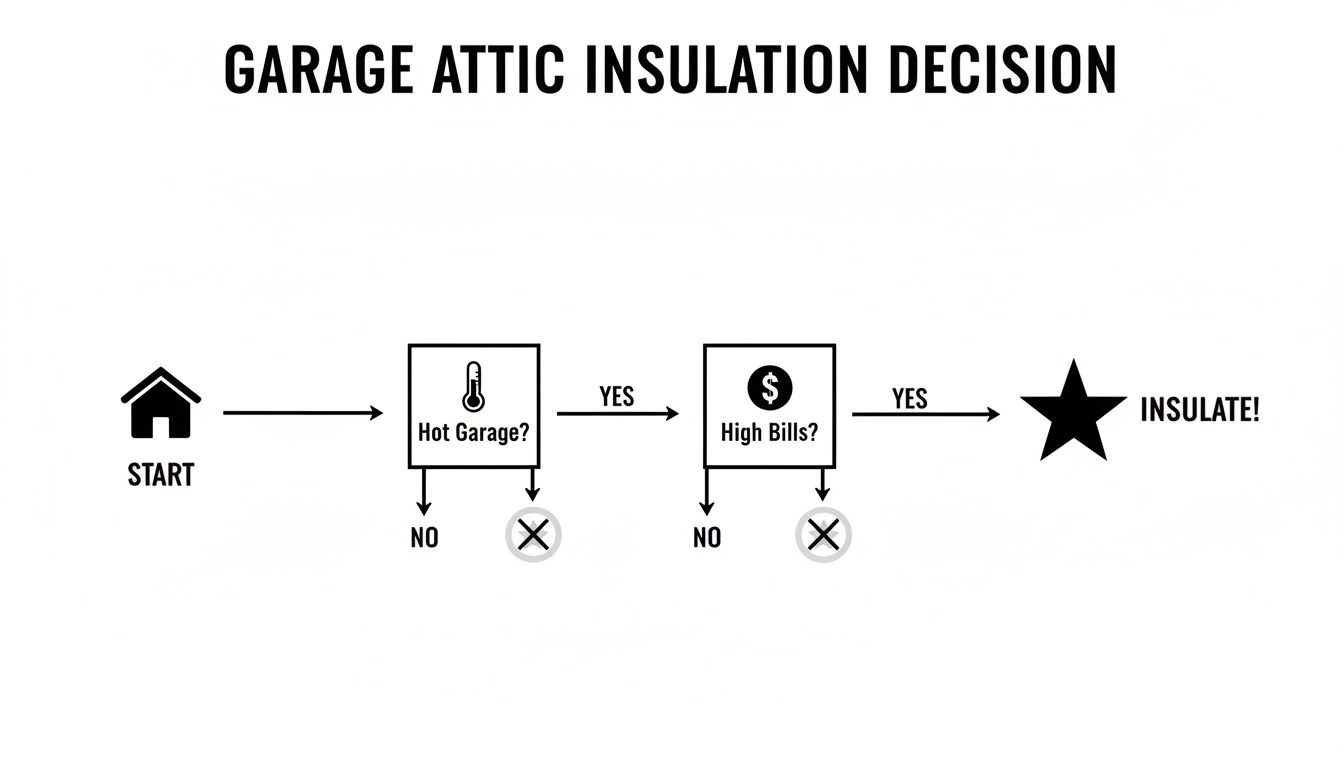
As you can see, if you're a South Florida homeowner battling a sweltering garage and sky-high FPL bills, all roads lead to getting that attic properly insulated.
Spray foam insulation is the undisputed king here because it does two jobs in one powerful application: it insulates against heat and creates a seamless, airtight, moisture-proof barrier. Forget traditional materials that just get stuffed into cavities. Spray foam expands on contact, filling every single crack, gap, and crevice.
The result is a solid, monolithic seal that stops both air and water vapor in their tracks.
For any homeowner from Stuart down to Palm Beach Gardens, that’s a game-changer. It means the humid summer air stays outside where it belongs, and your cool, conditioned air stays inside. This takes a massive load off your AC unit and prevents the condensation that inevitably leads to mold and wood rot.
To really understand the differences, it helps to see the materials side-by-side. We’ve found this is the best way for homeowners to grasp why we recommend what we do for our specific climate.
| Insulation Type | Best For | R-Value per Inch | Moisture Resistance | Cost |
|---|---|---|---|---|
| Closed-Cell Spray Foam | Maximum moisture control, air sealing, and thermal performance in humid climates. Adds structural rigidity. | 6.5 – 7.0 | Excellent (Vapor Barrier) | $$$ |
| Open-Cell Spray Foam | Excellent air sealing and sound dampening. Good for interior walls but less ideal for roofs in high humidity. | 3.5 – 3.8 | Fair (Vapor Permeable) | $$ |
| Fiberglass Batts | Budget-friendly projects in dry climates where air and moisture infiltration are not major concerns. | 3.1 – 4.3 | Poor (Absorbs Moisture) | $ |
| Blown-In Cellulose | Environmentally friendly option for dry climates. Very poor choice for humid garage attics. | 3.2 – 3.8 | Poor (Absorbs Moisture) | $ |
As the table shows, when moisture is the primary enemy—and in South Florida, it always is—closed-cell spray foam stands in a class of its own. Its ability to completely block water vapor makes it the only surefire solution for a long-lasting, effective garage attic insulation system.
Now, not all spray foam is created equal. The difference between open-cell and closed-cell is huge, and picking the right one is key to getting the results you want.
Open-Cell Spray Foam: Think of this as a dense sponge. It’s soft, flexible, and fantastic at blocking air and dampening sound. If you want to quiet down a noisy garage, it works wonders. But, it's vapor-permeable, which means moisture can pass through it. While it’s still an upgrade from fiberglass, it's not a true vapor barrier.
Closed-Cell Spray Foam: This is the heavyweight champion for fighting humidity. It’s dense, rigid, and cures into a hard plastic that actually adds structural integrity to your roof deck. More importantly, it is a true vapor barrier, completely shutting down any moisture trying to get through. This makes it the hands-down best choice for a garage attic in our region.
For a South Florida garage attic, closed-cell spray foam is what we recommend 99% of the time. Its power to create a complete thermal, air, and moisture barrier in one shot gives you unmatched protection against our climate's toughest challenges.
If you really want to get into the weeds on the building science, you can learn more about the differences between open-cell and closed-cell spray foam in our detailed breakdown.
I see it all the time. People try to save a buck with fiberglass batts or blown-in cellulose, and it almost always backfires in our damp climate. These materials work by trapping pockets of air, but they do absolutely nothing to stop air movement or moisture from getting in.
Think of fiberglass insulation like a wool sweater. It's warm, but wind and rain will go right through it. When our humid air blows through fiberglass in an attic, it hits the cooler interior surfaces and condenses. Over time, that moisture soaks the insulation, turning it into a heavy, compressed mat that has lost all its R-value and becomes a perfect breeding ground for mold.
Cellulose, which is basically shredded paper, is even worse. It acts like a sponge, absorbing a ton of water until it's just a clumpy, useless mess that can rot the wood around it.
The global home insulation market was valued at $58 billion in 2023 and is expected to climb to $95 billion by 2032, driven by the demand for high-performance materials. Here in South Florida, where our AC bills are insane and humidity often tops 80%, that trend is even more pronounced. Insulating a garage attic with closed-cell spray foam can deliver an R-value of 6.5 to 7.0 per inch, crushing fiberglass in both air sealing and moisture blocking. For builders we work with in West Palm Beach and Jupiter, this means new homes are achieving up to 20% better energy ratings right off the bat.
So you've decided to bring in the pros. Smart move. But knowing what a quality installation actually looks like helps you make sure you’re getting what you paid for. It's a lot more than just a guy with a hose spraying foam—it’s a precise process from start to finish.
A true professional crew doesn't just wing it. From the moment they arrive until the final walkthrough, everything should be about precision, safety, and getting you the best possible results. Let's break down what that process should look like.
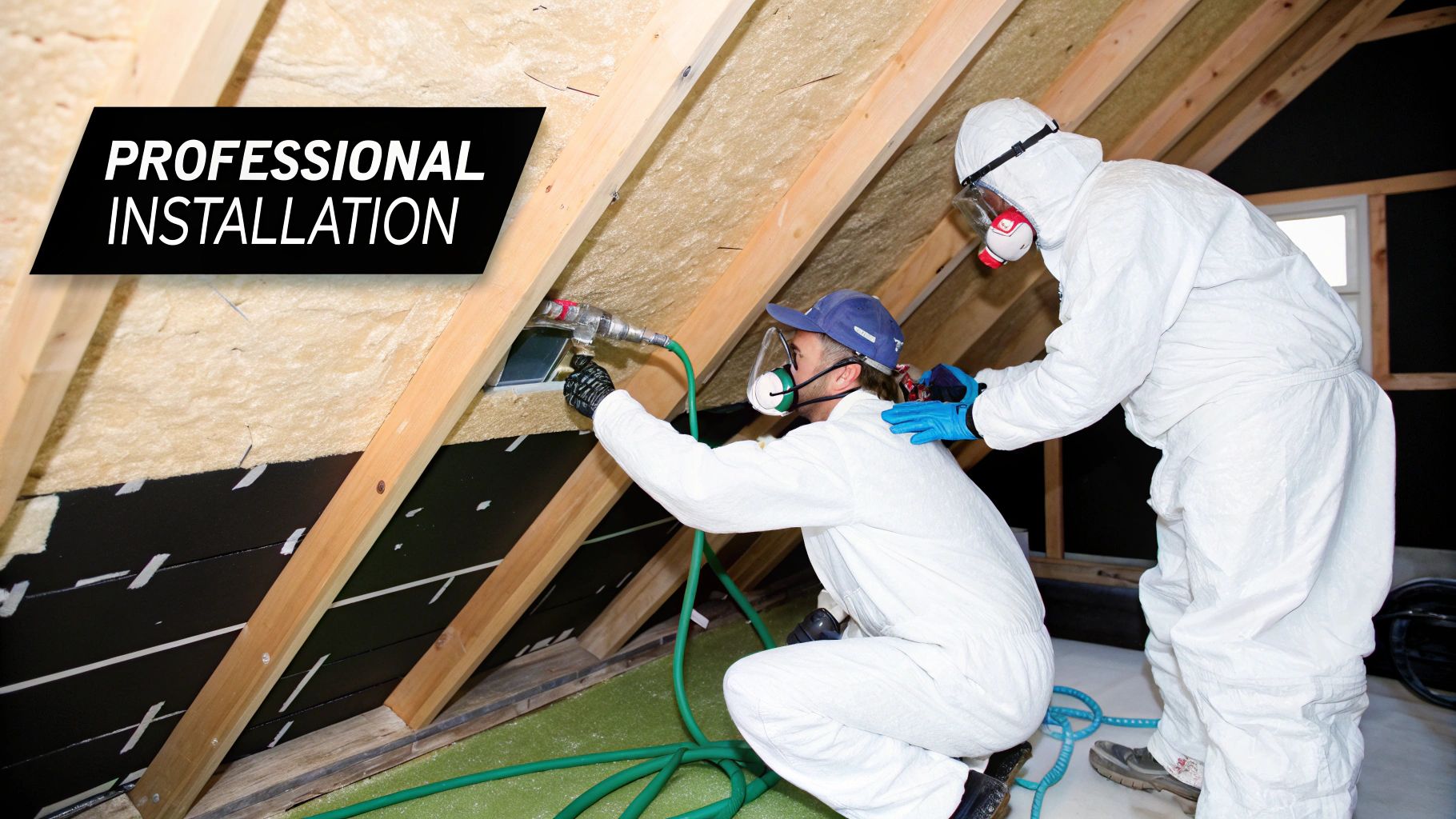
The whole process kicks off with a detailed consultation. A good technician isn't just there to measure your attic and give you a price. They’re there to diagnose the real problems causing that sweltering garage and high energy bills.
This on-site evaluation is where their expertise really shows. The specialist will get into the nitty-gritty:
After this deep dive, you should get a clear, itemized quote that spells out exactly what they're going to do and why. No surprises.
On installation day, the first thing a professional crew does is protect your stuff. They know spray foam is permanent, so preventing overspray is everything. Honestly, how a team preps the site tells you a lot about their standards.
They should meticulously cover everything that isn't being sprayed. We're talking:
They'll also set up powerful fans and ducting for ventilation. This keeps fresh air flowing, which is a non-negotiable safety step for managing fumes while the foam is applied and cures.
Pro Tip: A top-tier installation team spends a good chunk of their time on prep. If you see a crew rushing this part, it’s a massive red flag. The care they take to protect your home before they even start spraying says everything about the final quality of their work.
Once prep is done, the technicians will get into full personal protective equipment (PPE)—respirators, disposable suits, the whole deal. This isn't for show; it's essential for their safety.
Then the real magic begins. They’ll start applying the two-part liquid foam to the underside of the garage attic's roof deck. But this isn't a "point and spray" job. A skilled applicator works in thin, even layers, called "lifts," letting each one set up for a moment before applying the next. This controlled method ensures the foam expands properly, sticks tight, and hits the right thickness for your target R-value.
The goal is to create one solid, seamless barrier. They get into every nook and cranny, sealing around rafters and trusses to eliminate every possible air gap. This is what makes spray foam so incredibly effective at insulating a garage attic and locking out our brutal heat and humidity.
After the last pass is sprayed and the foam has cured, the crew shifts into cleanup mode. They’ll carefully pull down all the plastic sheeting and masking tape, making sure not a speck of overspray is left behind. Your garage should look just as clean as it did when they arrived, if not cleaner.
But the job isn’t done yet. The team lead should walk you through the finished attic, showing you the work and explaining what they did. This is your chance to ask questions and see the quality for yourself. A reputable company won't pack up until you’ve signed off, confirming you’re 100% happy with the result. That final handshake is what separates the real pros from everyone else.
Here in South Florida, the intense heat is only half the battle when you're insulating a garage attic. The real enemy is humidity. If you just slap some insulation up there without a solid plan for moisture, you're setting yourself up for failure. It's like wearing a raincoat but forgetting your shoes in a downpour. Understanding how to keep your attic dry is everything.
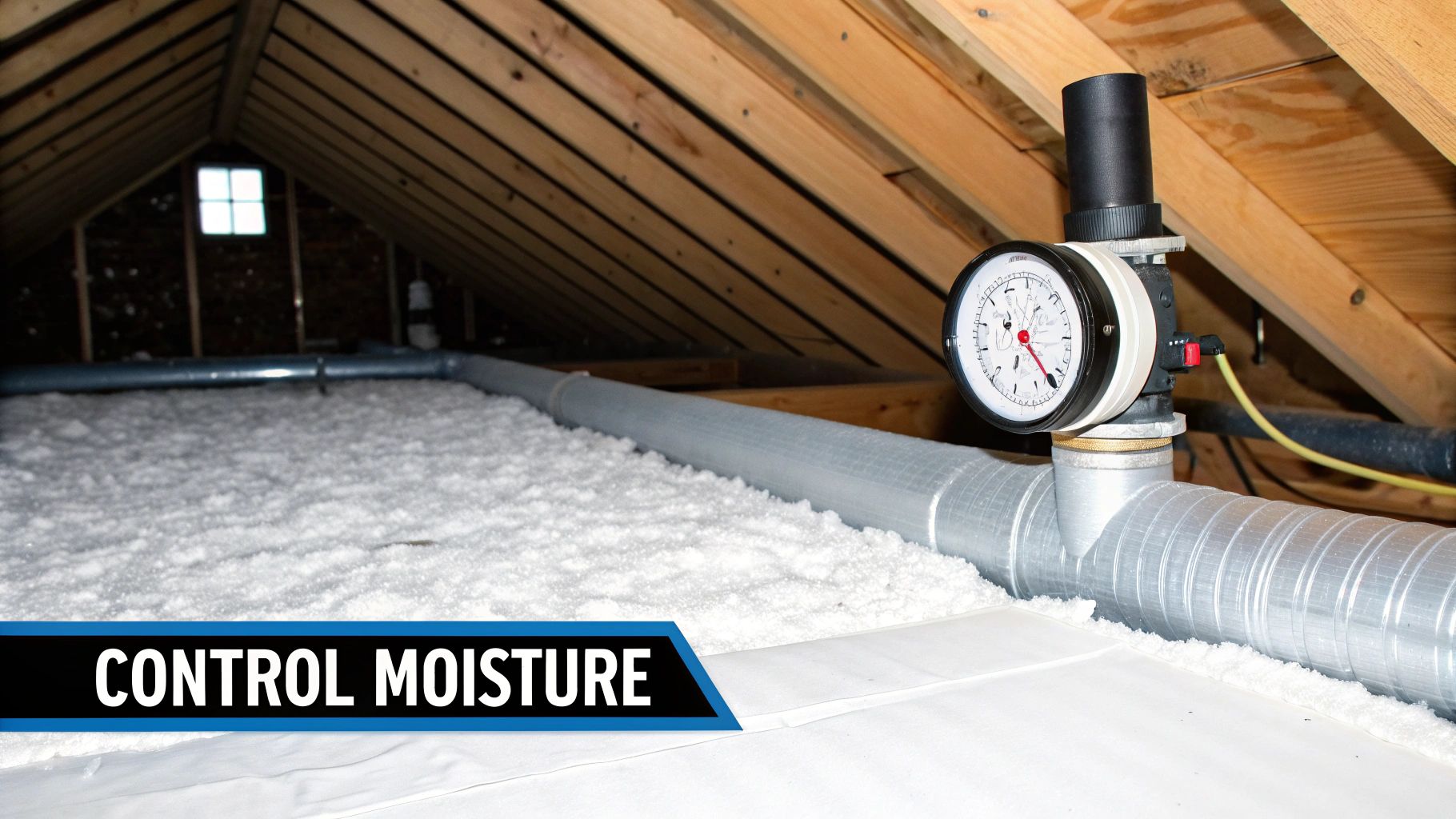
When that soupy, warm air from outside sneaks into a cooler attic, it immediately condenses on surfaces like the underside of your roof sheathing. That condensation—water vapor turning into liquid—is ground zero for mold, mildew, and wood rot. This is precisely why closed-cell spray foam is such a game-changer down here; it doubles as a powerful vapor barrier.
Think of traditional insulation like a sweater; air and moisture can pass right through it. Closed-cell spray foam, on the other hand, is like a wetsuit. It creates a seamless, impermeable barrier that physically blocks water vapor from ever getting into your attic space. It stops condensation before it even has a chance to form.
For any garage attic in our climate, this isn't just a nice feature—it's non-negotiable. By stopping moisture in its tracks, you're doing more than just making the space more comfortable. You're actively protecting the structural integrity of your home. If you really want to get into the nuts and bolts of it, our guide on the importance of vapor barriers in attics digs deeper into the building science.
This isn't just theory, either. We see it play out in tough commercial jobs all the time. Airtight's foams are the go-to solution for South Florida's metal buildings and warehouses specifically to fight off condensation and make the structures last longer. We've had property managers in Stuart tell us they saw 15-20% drops in cooling costs after we insulated, and with a lifespan of 25+ years, they're not worrying about re-doing the job anytime soon.
When we apply spray foam directly to the underside of your roof deck, it completely changes the dynamic of your attic. You're shifting from a traditional vented attic—which is basically outside, temperature-wise—to an unvented, "conditioned" attic. The attic now becomes part of your home's thermal boundary.
The payoff for this approach is huge:
This brings up a question I hear from homeowners all the time.
"Wait, if I seal my attic, won't it trap moisture inside?" It's a great question, but the answer is no—as long as the job is done right. A professional installation creates a complete air and vapor seal on the exterior-facing surfaces. There’s simply no way for outside moisture to get in and cause problems.
The system works because it attacks the source of the issue: humid air leaking in from the outside. Your home's HVAC system is already designed to handle the moisture created inside the house (from cooking, showers, etc.). By sealing the attic, you're making your AC's job easier by shielding it from South Florida's oppressive outdoor humidity. It's a complete system that delivers energy savings and a healthy, dry home. That's real peace of mind.

Looking at garage attic insulation as just another expense is missing the point entirely. It’s far better to see it as a direct investment in your home’s efficiency, your family’s comfort, and its long-term value.
Of course, the upfront cost is a factor. But the real story is how quickly that investment starts putting money back in your pocket.
There’s no single, flat price for insulating a garage attic. The final number depends on a few key things, but once you understand what moves the needle, you can budget effectively and see the true value when you get a professional quote.
A few different elements come together to determine the total cost of the job. Any good estimate will break this down for you, but it helps to know what to look for ahead of time.
It’s always tempting to go with the cheapest quote, but remember, the goal is a permanent solution. Paying a bit more for closed-cell spray foam in our climate is an investment in preventing thousands of dollars in mold and rot damage down the line.
This is where the math really starts to make sense. Insulating your garage attic isn't a sunk cost; it's an improvement that generates returns in several ways, often paying for itself much faster than people realize.
Your ROI really comes from three places:
When you add up the monthly savings on your power bill and the long-term protection against costly damage, the project's real value becomes crystal clear. For a more detailed breakdown, check out our guide on the cost of spray foam insulation. It's an investment that starts paying you back from day one.
Even with all the benefits laid out, it's natural for South Florida homeowners to have a few more questions. Insulating your garage attic is a big deal, and you need straight answers without the technical mumbo-jumbo. Let's tackle the common questions we hear every day.
We'll clear up any lingering doubts so you can feel completely confident about the decision you're making for your home.
This is usually the first thing people ask, and they’re often surprised by the answer. For most standard two-car garages, our crew can have the entire job wrapped up in just one day.
And when we say one day, we mean everything—from the careful prep work to protect your garage to the final spray foam application and cleanup. We pride ourselves on working efficiently to keep the disruption to your day at a minimum. For bigger or unusually complex attics, it might take a little longer, but you'll always get a clear, firm timeline from us upfront.
Your family’s safety is our number one concern, period. The foam itself gets hard and stable almost instantly, but we strongly recommend waiting a full 24 hours before you, your family, or your pets spend any significant time in the garage.
Think of it as a safety buffer. This 24-hour window lets any odors from the curing process completely air out and disappear. After that, the air is clear, and the foam has fully cured into a solid, inert plastic that's 100% safe for your home. It's a simple precaution for total peace of mind.
Yes, without a doubt. It’s one of the biggest and most immediate changes you'll feel. Right now, your uninsulated garage attic is like a giant radiator strapped to the side of your house, constantly blasting heat into your home through shared walls and ceilings.
When we install closed-cell spray foam, we create a powerful thermal shield that stops that heat transfer cold. The heat gets trapped in the attic and can't radiate into your living space. This takes a massive load off your AC unit, making your home feel noticeably cooler and more comfortable, especially in those rooms right next to the garage.
We hear it from customers all the time—they're shocked by the difference. That bedroom over the garage or the kitchen that shares a wall suddenly goes from being the hottest room to one of the most comfortable. That's how you know insulating a garage attic is truly a whole-home upgrade.
Absolutely. Modern spray foam is an incredibly safe and durable product, especially when it's installed by certified professionals like us. Once it has cured (after that 24-hour waiting period), it’s nothing more than a solid, stable, and completely inert plastic.
Here’s why it's a healthy choice for your home:
We only use modern, low-VOC formulas and follow strict safety rules during the application, so you can be sure the final result is a safe and permanent improvement to your home.
Ready to put a stop to the heat and start seeing real savings? The team at Airtight Spray Foam Insulation has helped hundreds of your South Florida neighbors turn their scorching garages into energy-saving shields. Get a free, no-obligation quote today and see how our expert installation can make your home cooler, cleaner, and more efficient.