Blog
Spray Foam vs Fiberglass Insulation Cost 2026 Homeowner’s Guide

When you’re looking at spray foam vs fiberglass insulation cost, there’s no getting around it: fiberglass has a much lower price tag upfront. But that initial quote doesn't tell the whole story. The real cost of insulation shows up over time, and that's where spray foam's long-term value in energy savings and durability really shines.
Answering Your Insulation Cost Questions
Choosing the right insulation for your South Florida home is a big decision, and it’s about more than just the sticker price. It's tempting to go with the cheaper fiberglass, but that’s only one piece of the puzzle. To really understand what you're paying for, you need to look at the installed price, the performance you get, and the long-term return on your investment (ROI).
Spray foam costs more to install, but in my experience, it’s almost always the smarter investment, especially with our relentless humidity here in South Florida.

A Direct Cost Comparison
Let's get into the numbers. To give you a clear picture of the upfront financial commitment, here are the typical installed costs per square foot you can expect in the South Florida market. These prices are for professional installation, which is non-negotiable if you want either material to perform correctly.
Fiberglass batts are the go-to for anyone focused on keeping initial project costs down. It's the most budget-friendly choice, but its performance is completely dependent on a perfect install. Even small gaps can drastically reduce its effectiveness.
Spray foam comes in two main types, each with its own price and performance characteristics:
- Open-Cell Spray Foam: This is the more affordable of the two foams. It’s a fantastic air barrier and does a great job with sound dampening, but it won't stop moisture.
- Closed-Cell Spray Foam: This is the top-tier option. You get a higher R-value per inch, it adds structural strength, and—most importantly for Florida—it creates a solid air and vapor barrier.
You’re not just buying insulation; you're investing in a complete system. Fiberglass is a basic thermal layer. Spray foam is an integrated air barrier (and with closed-cell, a moisture barrier) that completely seals your home's building envelope.
This is a critical distinction that impacts everything from your energy bills to the health of your home.
2026 Insulation Cost Comparison Per Square Foot
This table outlines typical price ranges for professionally installed insulation in South Florida, helping you compare upfront investment levels.
| Insulation Type | Cost Per Square Foot (Installed) | Best For |
|---|---|---|
| Fiberglass Batts | $0.40 – $1.50 | Budget-conscious projects and standard wall cavities without moisture concerns. |
| Open-Cell Spray Foam | $1.00 – $2.00 | Interior walls, soundproofing, and attics where moisture isn't the primary threat. |
| Closed-Cell Spray Foam | $1.50 – $3.50+ | Attics, crawl spaces, and areas requiring a strong moisture barrier and high R-value. |
While the table makes the initial spray foam vs fiberglass insulation cost difference clear, it's just the starting point. The real story is how the more expensive option per square foot can end up saving you more money and protecting your property in the long run.
Breaking Down Project Estimates and Upfront Costs
When you get an insulation quote, it’s easy to focus on just one number. But that final price is the result of a dozen different factors, from the size of your house to the type of insulation you’ve chosen. Getting a handle on what goes into that estimate is the first real step in comparing the spray foam vs fiberglass insulation cost.
The total price isn't pulled out of a hat. The complexity of the job—like navigating a cramped attic filled with ductwork—matters. The specific foam you choose, whether open-cell or closed-cell, will also shift the numbers, as will the required thickness needed to hit your target R-value.
Key Factors Shaping Your Insulation Quote
No two insulation jobs are the same. A brand-new build in Stuart is a completely different project than retrofitting an older home in Wellington. Here’s what really drives the cost:
- Total Square Footage: This one is simple. More space means more material and more time, which adds up.
- Location of Insulation: Attics, walls, and crawl spaces each have their own quirks. An open, unfinished attic is straightforward. Existing walls? That takes a lot more precision and labor to get right.
- Type of Insulation: As we've seen, fiberglass has the lowest upfront cost. Closed-cell spray foam is on the higher end, but you're paying for unmatched density, a higher R-value, and a true moisture barrier.
- Project Complexity: If we have to work around complex rooflines, HVAC equipment, and plumbing stacks, it takes more time to create that perfect, unbroken seal. That extra detail and labor will be reflected in the quote.
When you look at upfront cost, there’s no denying spray foam is a bigger investment. But that investment delivers performance fiberglass just can’t match, especially here in South Florida's humidity.
Based on 2024 industry averages, you can expect open-cell spray foam to run between $0.44 to $1.50 per square foot installed. For the ultimate moisture protection, closed-cell spray foam typically costs $1.00 to $3.00 per square foot. Fiberglass batts are much lower, coming in around $0.30 to $0.70 per square foot installed. For a deeper dive into these numbers, you can explore our detailed guide to the cost of spray foam insulation.
Real-World South Florida Cost Scenarios
Let's ground these numbers in reality with two typical projects we see in our area. These estimates show just how much the project size and insulation choice can change the final cost.
Example 1: 2,000 sq ft Home in Wellington
This homeowner needs to replace their old attic insulation to get a grip on summer cooling costs and humidity. It's a standard attic with some ductwork to work around.
- Fiberglass Batt (R-30): Approximately $2,400 – $4,200. It’s the cheapest option upfront, but it won’t create an air seal, leaving the home exposed to air and moisture intrusion.
- Open-Cell Spray Foam (5 inches): Approximately $7,000 – $10,000. This gives you a fantastic air seal, which will immediately improve your energy bills and overall comfort.
- Closed-Cell Spray Foam (3 inches): Approximately $9,000 – $14,000. This is the top-tier solution. It provides a complete air and vapor barrier, adds structural strength to the roof, and delivers the highest R-value per inch.
Example 2: 4,000 sq ft New Construction in Stuart
Here, a builder is working on a high-end home and needs to insulate the entire building envelope (attic and walls) for peak performance and longevity.
- Fiberglass Batt (Full Home): Approximately $8,000 – $14,000. This meets the basic building code but doesn't provide the high-performance air seal that’s expected in a modern luxury home.
- Closed-Cell Spray Foam (Full Home): Approximately $30,000 – $45,000+. This investment creates a solid, airtight shell. It drastically cuts down on energy use, defends against moisture, and even adds structural integrity that lasts the life of the home.
While the upfront cost for spray foam can be three to four times higher, it’s a one-time investment. Fiberglass may require adding more or replacing it entirely within 15-20 years, whereas spray foam is designed to last the lifetime of the structure.
This longevity is where the value equation really shifts. The higher sticker price for spray foam often leads to a lower total cost of ownership once you account for decades of energy savings, durability, and never having to pay for a replacement. It changes the conversation from a one-time expense to a long-term asset.
When you're looking at quotes, the spray foam vs fiberglass insulation cost difference is usually the first thing that jumps out. But those initial numbers don't tell you the whole story. The real value is in how these materials perform day-in and day-out, and that’s where they go down completely different paths. To see why a higher upfront investment in spray foam often makes sense, you have to look past the price tag and get into how each material actually functions inside your walls and attic.
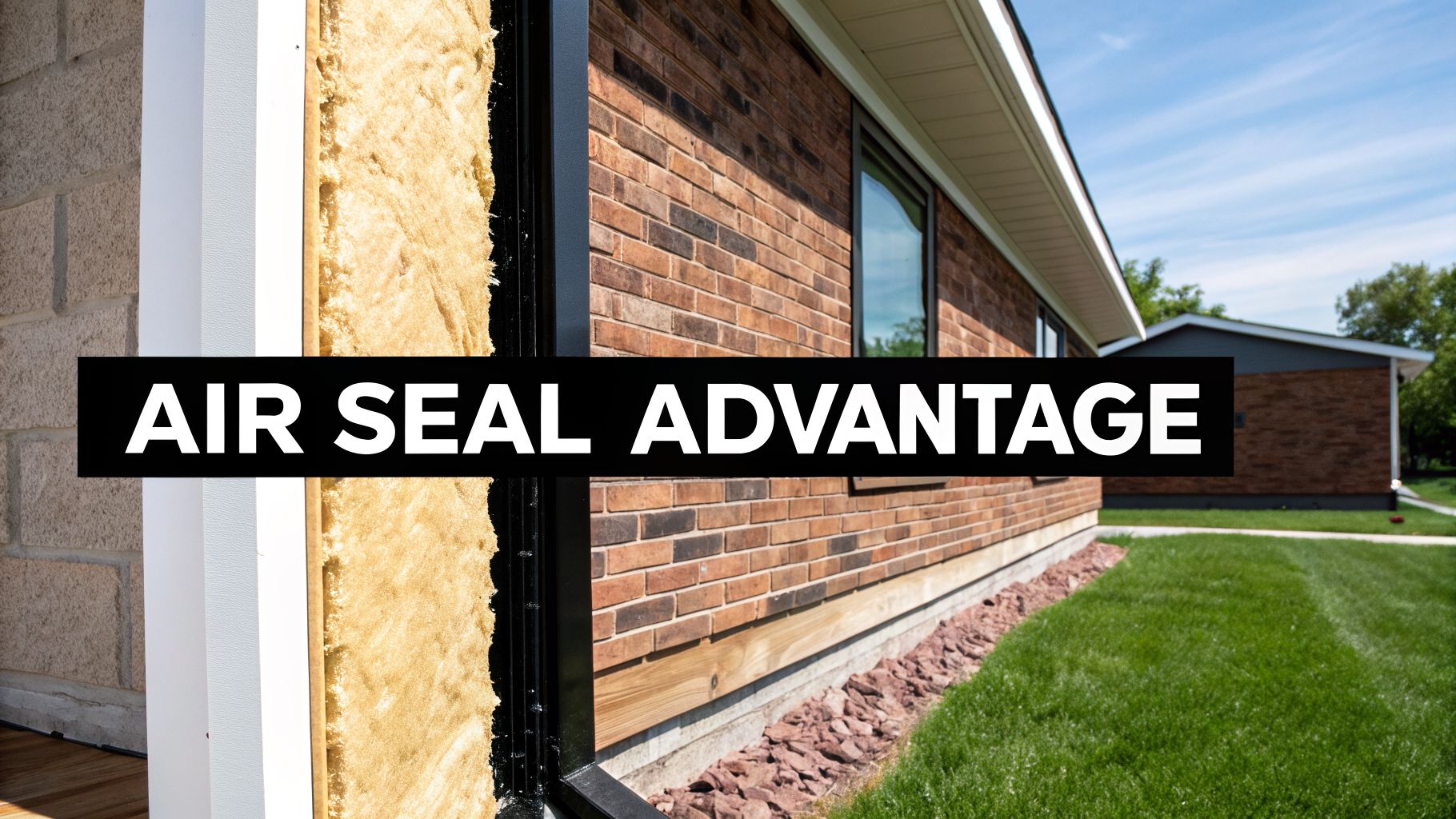
Most people start by comparing R-value, which is just a measure of how well insulation resists heat. On paper, spray foam already has a clear advantage here. It provides an R-value of R-3.5 to R-7 per inch, with the closed-cell versions hitting that higher number. Fiberglass, in contrast, comes in lower at R-3.1 to R-4.3 per inch. In a typical 2×4 wall, this means spray foam can easily deliver an R-13 rating or more, while fiberglass only hits R-13 if the installation is absolutely perfect—something we rarely see in the real world.
But honestly, R-value is only half the battle.
The Critical Role of the Air Seal
The single most important difference between spray foam and fiberglass isn't the R-value; it's the air seal. I always tell clients to think of fiberglass batts like a wool sweater. It’ll keep you warm on a calm day, but the second the wind kicks up, you feel the cold right through it. Fiberglass works exactly the same way. Air moves right through and around it.
That air movement, or convection, is one of the biggest reasons for energy loss in a home. We've seen studies showing that even tiny gaps and seams around pipes, outlets, and studs can completely undermine the performance of fiberglass. Those little openings become highways for air, letting your cool, conditioned air escape and pulling that oppressive Florida heat and humidity right inside.
Spray foam, on the other hand, is like a modern windbreaker jacket. When we install it, the foam expands to fill every single crack and gap, bonding directly to the studs and sheathing. This process creates a solid, airtight barrier that stops convection cold.
An R-13 fiberglass batt with just a 4% void area from gaps or compression can lose up to 50% of its effectiveness. Spray foam’s performance is built-in because it eliminates those voids from the start, guaranteeing you get the R-value you actually paid for.
This airtightness is what gives you consistent indoor temperatures and much lower energy bills. It makes sure your home breathes through the HVAC system the way it was designed to, not through random leaks in the walls.
Comparing Insulation Performance Metrics
To really make the right call, it helps to see a head-to-head comparison of how these materials work in a tough climate like South Florida.
| Performance Factor | Fiberglass Insulation | Spray Foam Insulation |
|---|---|---|
| Air Sealing | Poor. Needs separate, often incomplete, air sealing work. | Excellent. Creates a perfect air barrier as part of the installation. |
| Moisture Control | Acts like a sponge, absorbing moisture which can lead to mold and lost R-value. | Resists moisture (open-cell) or creates a full vapor barrier (closed-cell). |
| Longevity & Durability | Can sag, settle, and get damaged by pests over its 15-25 year lifespan. | Rigid and permanent, lasting for the life of the building (80+ years). |
| Consistent R-Value | Performance drops sharply with any gaps, compression, or moisture. | Holds its stated R-value because it forms a solid, gap-free layer. |
Deciding between open-cell and closed-cell foam adds another layer, with closed-cell offering the best moisture defense. You can check out our guide on the differences between closed-cell vs. open-cell spray foam to see which is right for your project. At the end of the day, the superior performance of spray foam gives you tangible benefits that fiberglass just can't match.
Calculating Your Long-Term ROI Through Energy Savings
The initial spray foam vs fiberglass insulation cost is a big number, and it's easy to get hung up on it. But focusing only on the installation quote is like judging a car by its paint job—it misses the whole story of performance and long-term value.
A smart homeowner or contractor knows to look beyond that first invoice. This is where spray foam's higher price tag stops looking like an expense and starts looking like a powerful, money-saving investment.
The most immediate return shows up on your monthly FPL bill. Because spray foam is an exceptional air sealant, it dramatically lightens the load on your HVAC system. In the face of South Florida’s relentless heat, that’s not just a small perk; it’s a total game-changer.
The energy savings aren't just a few bucks here and there. We're talking about substantial reductions, with many homeowners seeing their energy costs drop anywhere from 20% to as high as 50%. Spray foam creates a single, solid barrier that stops the constant air leaks that force your AC to run nonstop.
Projecting Your Payback Period
While the initial check you write is bigger, those aggressive energy savings mean spray foam starts paying you back from day one. The "payback period" is simply how long it takes for your accumulated energy savings to cover the initial cost difference between spray foam and a cheaper material like fiberglass.
Let's run the numbers for a typical South Florida home:
- Average Monthly Electric Bill (with old, leaky insulation): $350
- Energy Savings with Spray Foam (a conservative 30%): $105 per month
- Total Annual Savings: $1,260
If the upgrade from fiberglass to spray foam cost an extra $8,000, your payback period would be just over six years ($8,000 ÷ $1,260 per year). From that point forward, the insulation is literally putting money back in your pocket, month after month, for as long as you own the home.
The real value of spray foam isn't just in what you spend, but in what you save. Over a 30-year mortgage, those annual savings could total over $37,800—far outweighing the initial premium paid for a superior insulation system.
This simple math completely changes the spray foam vs fiberglass insulation cost conversation. It becomes a clear case of investing a bit more now to save a whole lot more down the road. For a deeper dive into the numbers, our guide can help you determine if is spray foam insulation worth it for your specific situation.
Unpacking the Non-Monetary Returns
The ROI for spray foam goes well beyond your bank account. These other benefits protect your home's health and durability, adding serious value that a simple price-per-square-foot comparison will always miss.
1. Reduced Strain on HVAC Systems
By creating an airtight seal, spray foam slashes your HVAC system's runtime. A unit that runs less and cycles on and off less often is a unit that lasts longer. This means fewer expensive emergency repair calls and can push a full system replacement back by years—a potential savings of thousands.
2. Enhanced Home Durability and Structural Integrity
This is something most people don't think about. Closed-cell spray foam, in particular, adds incredible structural strength. As it cures, it becomes a rigid, dense material that glues your home’s framing and sheathing together. This added rigidity helps your roof and walls stand up to the high winds we see all too often during South Florida's storm season.
3. Increased Property Resale Value
Today’s homebuyers are savvy about energy efficiency. A home with spray foam insulation is a huge selling point—it signals a modern, high-performance property with proof of lower utility bills. It makes your home stand out on the market and can directly increase its final sale price. It’s an upgrade that real estate agents love to see.
Protecting Your Home From Humidity, Mold, and Pests
In South Florida, our fight for a comfortable home isn’t just about the heat—it’s a constant battle against oppressive humidity. This is where the spray foam vs. fiberglass insulation cost discussion gets real, moving beyond energy savings and into long-term property protection. Your choice of insulation is one of the most critical decisions you'll make in defending your home against moisture, mold, and even pests.
Fiberglass insulation, with its soft, fibrous structure, essentially acts like a sponge. In a humid climate like ours, it can absorb water vapor right out of the air and hold it against your home's wood framing and drywall. This creates the perfect breeding ground for mold and mildew, which can cause serious health issues and literally rot your home from the inside out.
Once fiberglass gets wet, its R-value plummets and it almost never dries out completely. We’ve seen countless cases where it sags, pulling away from the studs and creating hidden pockets where damp air collects and mold flourishes completely unseen.
Sealing Out Moisture and Mold for Good
This is where spray foam, especially closed-cell spray foam, completely changes the game. Instead of absorbing moisture, closed-cell foam is a non-permeable material that flat-out blocks it. It cures into a rigid, solid plastic that doubles as a built-in vapor barrier, totally separating your indoor environment from the sticky outdoor humidity.
Because it adheres directly to the sheathing and studs, there are zero gaps or seams for moisture to sneak through. This seamless shield is your best defense against the intense humidity we deal with in Jupiter, Wellington, and across the region. It maintains its structural integrity and R-value no matter how much moisture it faces. Making the right insulation choice is a huge part of moisture control and learning how to avoid mold in your basement or attic.
In South Florida, insulation isn't just for thermal control; it's for moisture management. Fiberglass can unfortunately become part of the problem by holding moisture, whereas closed-cell spray foam is an active part of the solution by blocking it entirely.
This fundamental difference is crucial for your home's long-term health and for avoiding six-figure mold remediation bills down the road. It’s a key factor that adds tremendous long-term value to spray foam's higher upfront cost.
Creating an Impenetrable Barrier Against Pests
Beyond moisture, another constant headache for Florida homeowners is pests. Rodents, roaches, and termites can cause unbelievable damage and create an unsanitary home. Here again, the physical properties of your insulation play a massive role.
Fiberglass batts are practically a welcome mat for pests. They can easily tear it up for nesting material, and the gaps between the batts and framing create perfect, hidden highways for them to travel through your attic and walls. The material offers absolutely no resistance.
In stark contrast, spray foam insulation presents a formidable barrier.
- It's Inedible: Cured spray foam is a rigid plastic with zero nutritional value. Pests can't eat it.
- It's Impenetrable: By expanding to fill every last crack and crevice, it seals off the tiny entry points pests use to get inside. They simply can't tunnel through the dense, hard surface of closed-cell foam.
- It Eliminates Nesting Space: The solid, gap-free seal leaves no comfortable voids for rodents or insects to build nests and breed.
By turning your home's envelope into a solid, sealed structure, spray foam effectively puts up a "no vacancy" sign for unwanted critters. This is a preventative measure that protects not only your peace of mind but also the structural integrity of your property, adding another layer of value that goes far beyond the initial insulation quote.
Which Insulation Is Right for Your South Florida Property?
Picking between spray foam and fiberglass really boils down to your specific project, your budget, and what you want to achieve long-term. There's no single "best" choice for everyone; it all depends on the situation. We've already covered the differences in the spray foam vs fiberglass insulation cost, performance, and lifespan. Now, let's put that knowledge to work in real-world scenarios we see every day here in South Florida.
This decision tree cuts right to the chase, zeroing in on the biggest issue we face in our climate—humidity.
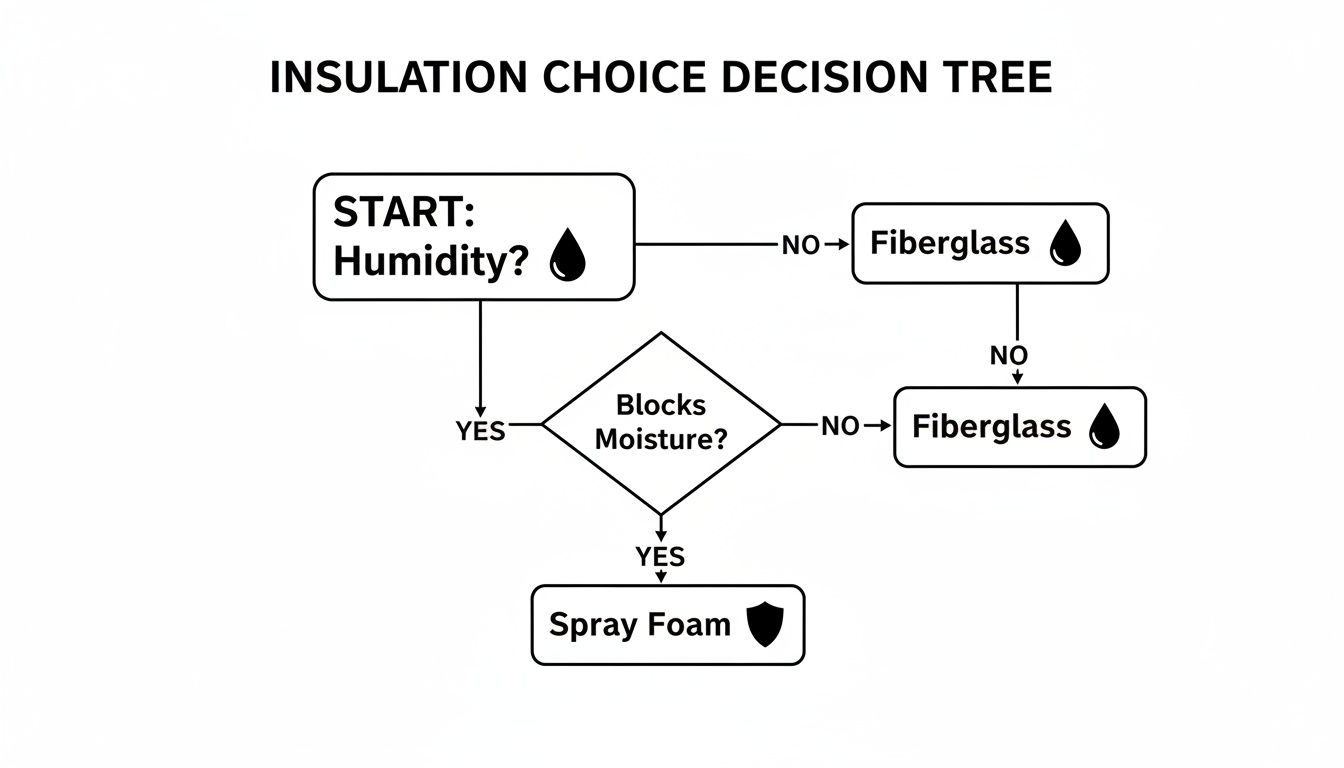
As you can see, when humidity is in the picture, the ability to block moisture isn't just a feature—it's the most critical factor. This is where closed-cell spray foam really separates itself as the best line of defense for your property.
A Practical Guide for Your Project
Your priorities will shift depending on whether you’re a homeowner, a builder, or a property manager. Here’s how I see the decision from each of those perspectives.
For the Homeowner Upgrading an Existing Attic
If you're a homeowner in Wellington who's tired of fighting high summer energy bills and that sticky indoor humidity, closed-cell spray foam on the underside of your roof deck is your best bet. Yes, the upfront cost is more than just rolling out new fiberglass, but it's a comprehensive solution. You’re creating an air and moisture seal, which dramatically cuts down on energy loss and adds real structural strength to your roof.
For the Contractor Building a New Custom Home
For builders in Jupiter or Stuart focused on high-performance new construction, closed-cell spray foam has become the new standard of quality. It provides the airtight seal and energy efficiency that today’s savvy clients demand. When you build a home with a completely sealed envelope from the start, you're not just meeting energy codes—you're guaranteeing performance and adding a powerful selling point that screams quality and durability.
The most expensive insulation job is the one you have to do twice. For new builds, installing a lifetime solution like spray foam from day one eliminates future headaches and ensures the home performs as designed for decades to come.
For the Property Manager Improving Multiple Units
If you're a property manager, you're playing a different game. Retrofitting an entire portfolio of rental units with spray foam might not be financially feasible. A hybrid approach is often the smartest move here. I’d recommend prioritizing closed-cell foam in crawl spaces or attics with a history of moisture and mold. For the other units, upgrading to a professionally installed, high-density fiberglass can be a solid budget-friendly improvement, but only if you also tackle air sealing separately and meticulously.
Your Final Decision Checklist
Before you make a final decision, run through these key questions. Your answers will point you in the right direction.
- Budget: Is minimizing the initial investment your number one goal, or can you invest more today for bigger savings down the road?
- Performance: Do you just need basic thermal resistance, or is a complete air and moisture barrier essential for your home?
- Longevity: Are you okay with an insulation that might need to be replaced in 15-25 years, or do you want a permanent, one-and-done solution?
- Home Health: How important is protecting your property from mold, moisture damage, and pests?
By weighing these factors honestly, the right path for your project will become much clearer. The spray foam vs fiberglass insulation cost isn't just a number on an estimate; it's an investment in your property's comfort, efficiency, and health for years to come.
If you’re ready to get a professional recommendation tailored to your South Florida property, our team at Airtight Spray Foam Insulation is here to help. Request your free, no-obligation quote today, and let's figure out the right solution for you.
Even after weighing the numbers, you probably have a few more questions rattling around. It's one thing to compare spray foam vs. fiberglass insulation cost on paper, but making the right call for your own South Florida home means digging into the practical details.
Let's clear up some of the most common questions we get from homeowners and contractors. These are the details that move you from confusion to a confident decision.
Is Open-Cell or Closed-Cell Better for a South Florida Attic?
This is a critical question, and in South Florida, the answer is almost always closed-cell spray foam.
Open-cell foam has its place—it’s a bit cheaper and its soft, spongy texture makes it easy to spot a roof leak. The problem? It doesn’t stop moisture, it just absorbs it. In our relentless humidity, that’s a recipe for trouble.
Closed-cell foam, on the other hand, is the workhorse we need here. It packs a higher R-value into every inch and, most importantly, cures into a rigid, non-permeable vapor barrier. Applying it directly to the underside of your roof deck is the single best way to shut out both oppressive heat and the moisture that breeds mold.
Here's something else to consider: In a hurricane zone, closed-cell foam acts like a structural glue, adding serious rigidity to your roof deck. This helps fight wind uplift during a storm—a huge benefit that open-cell simply can't offer.
How Long Does Spray Foam Insulation Last Compared to Fiberglass?
There’s no real contest here. Spray foam is a one-and-done investment that’s engineered to last for the life of your house—we're talking 80 years or more. Once it cures, it's a solid, stable material that won’t sag, shrink, or lose its insulating power.
Fiberglass just doesn't have that kind of staying power. Its effective lifespan is typically 10 to 25 years, at best. Over time, it slumps down, gets compacted, soaks up moisture from our humid air, and becomes a nesting ground for pests. Each of these problems tanks its R-value, eventually forcing you to tear it all out and start over. That "cheaper" upfront cost doesn't look so good when you have to pay for it twice.
Are There Rebates or Financing for Spray Foam Insulation?
Yes, and taking advantage of them can make a big impact on the overall cost. The Inflation Reduction Act of 2022 created some significant federal tax credits for homeowners who make energy-efficiency upgrades, and high-performance insulation definitely qualifies.
On top of that, many Florida utility companies offer their own local rebates for projects that cut down your energy use. These programs change, but they are absolutely worth looking into.
Getting these final details straight is the last step toward making a smart, long-term investment in your property. The team at Airtight Spray Foam Insulation has been navigating these choices in South Florida for years. We can help you pinpoint the right solution, find qualifying rebates, and even explore financing options that fit your budget.
Ready to see what a difference the right insulation can make? Request a free, no-obligation quote today.