You walk into a metal building early in the morning, and the roof is dripping. The first reaction is usually, “We've got a leak.” A lot of the time, you don't. You've got condensation.
That distinction matters. A roof leak gets patched. A moisture problem keeps coming back until the whole assembly is handling vapor, air leakage, and temperature correctly. In South Florida, that problem gets worse because the air is humid for long stretches of the year, and many buildings are cooled hard on the inside.
A proper metal building vapor barrier isn't a cosmetic upgrade. It's part of the building's life support system. Get it right, and you protect steel, insulation, contents, and energy performance. Get it wrong, and the building starts sweating, rusting, and costing you money.
The most common call starts with a simple complaint. Water is dripping off the underside of the roof panels, tools are getting wet, cardboard stock is soft, and the owner is convinced the roof installer missed something.
Sometimes the roof is fine.
What's happening is “indoor rain.” Warm, moisture-laden air reaches a colder metal surface, and that moisture turns into liquid water on the steel. In a metal building, that can happen fast because steel doesn't forgive mistakes in moisture control. It transfers temperature quickly, so the roof or wall panel becomes the surface where water shows up first.
In South Florida, this catches people off guard because they assume vapor always moves from inside to outside. That's not a safe assumption here. If the building is air conditioned and the outdoor air is hot and damp, moisture can drive inward toward the cooler interior side of the assembly. That changes what works and what fails.
A metal building rarely warns you with one dramatic failure. It usually starts with recurring dampness in places people try to ignore.
This is why a metal building vapor barrier matters so much. Its job is to keep moisture from reaching the surfaces where condensation forms. In practical terms, that means protecting the frame, preserving insulation performance, and preventing the kind of hidden moisture damage that gets expensive before it becomes obvious.
A lot of jobsite confusion starts with the words. People say vapor barrier when they mean air barrier. They say radiant barrier when they mean vapor retarder. Then they install the wrong layer in the wrong place and wonder why the building still sweats.
The easiest way to think about it is this. A vapor barrier is like a raincoat. It resists moisture vapor moving through material. An air barrier is like a windbreaker. It stops moving air, and with that moving air comes a lot of moisture.
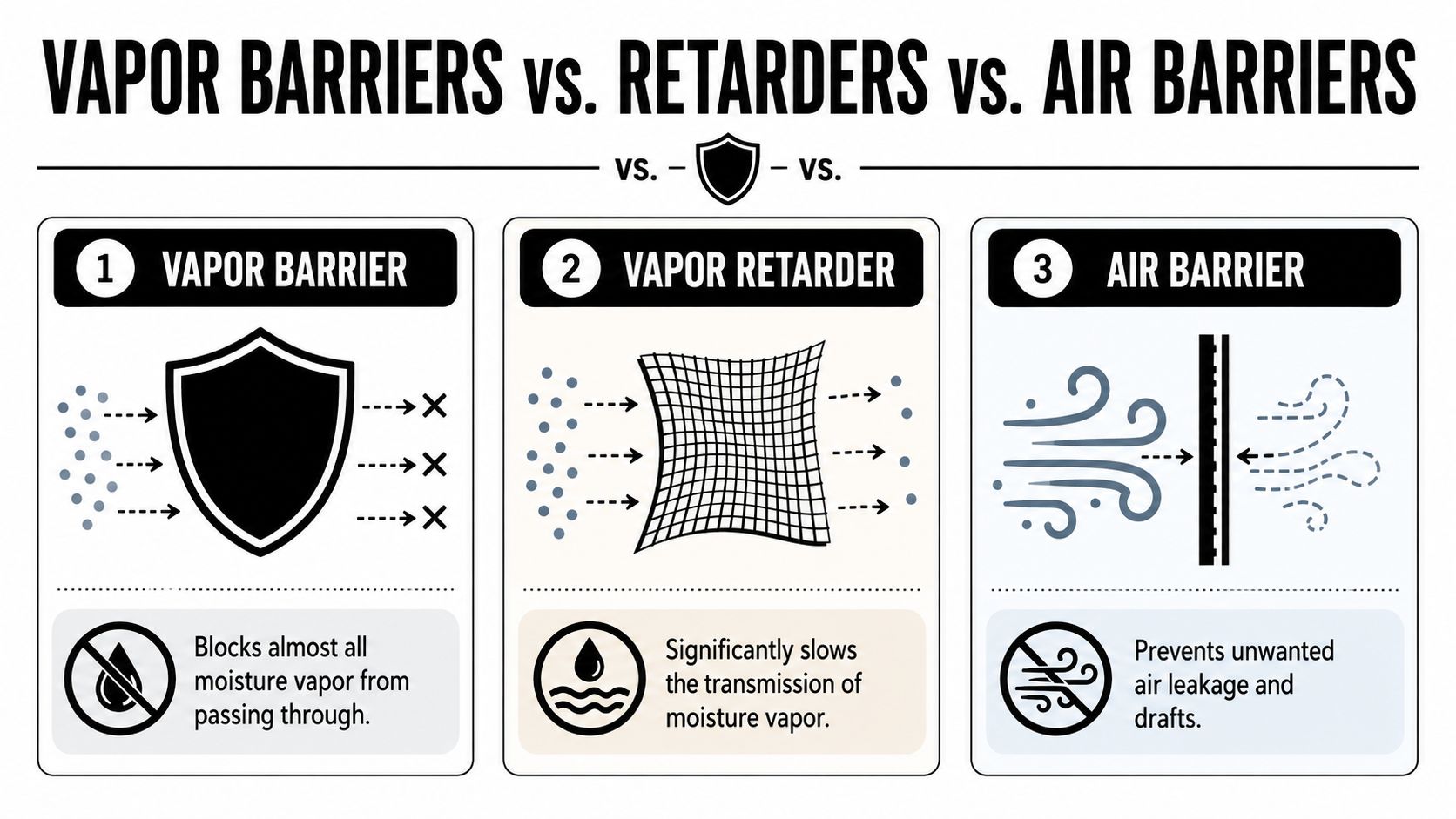
In metal buildings, a vapor barrier is technically defined as a material with a permeance rating of 0.1 perm or less under Class I criteria, according to Bay Insulation's overview of vapor retarders in metal buildings. Think of perm rating like the size of holes in a screen. The lower the number, the harder it is for water vapor to pass through.
In real-world trade language, many products called vapor barriers are vapor retarders. They don't stop every bit of vapor, but they slow it enough to control condensation when they're correctly selected and installed. In metal construction, that distinction matters because the assembly has to dry in the right direction for the climate.
An air barrier stops uncontrolled air leakage through the envelope. That's critical because air can carry moisture into cavities and onto cold surfaces far faster than vapor diffusion alone. Air barriers became mandatory in the IECC 2015/ASHRAE 90.1-2013 commercial energy code cycle, and the system must be continuous across all joints and assemblies according to Therm-All's guide to metal building insulation.
A vapor retarder can't do the whole job if air is leaking around laps, penetrations, and perimeter details. An air barrier can't do the whole job if the assembly still allows vapor to accumulate where it can condense. In a metal building, the best-performing systems treat these as connected layers, not separate afterthoughts.
Practical rule: If the assembly isn't continuous at seams, corners, fasteners, and penetrations, it isn't continuous at all.
That's especially true in commercial metal buildings where code compliance now expects the air barrier to be identified in the drawings and maintained across transitions.
A South Florida owner closes up a metal shop, adds air conditioning, and expects the space to get cleaner, cooler, and cheaper to run. Instead, the roof starts sweating before sunrise, the insulation facing goes limp, and rust shows up first at fasteners and laps. That is condensation doing what rainwater often gets blamed for.
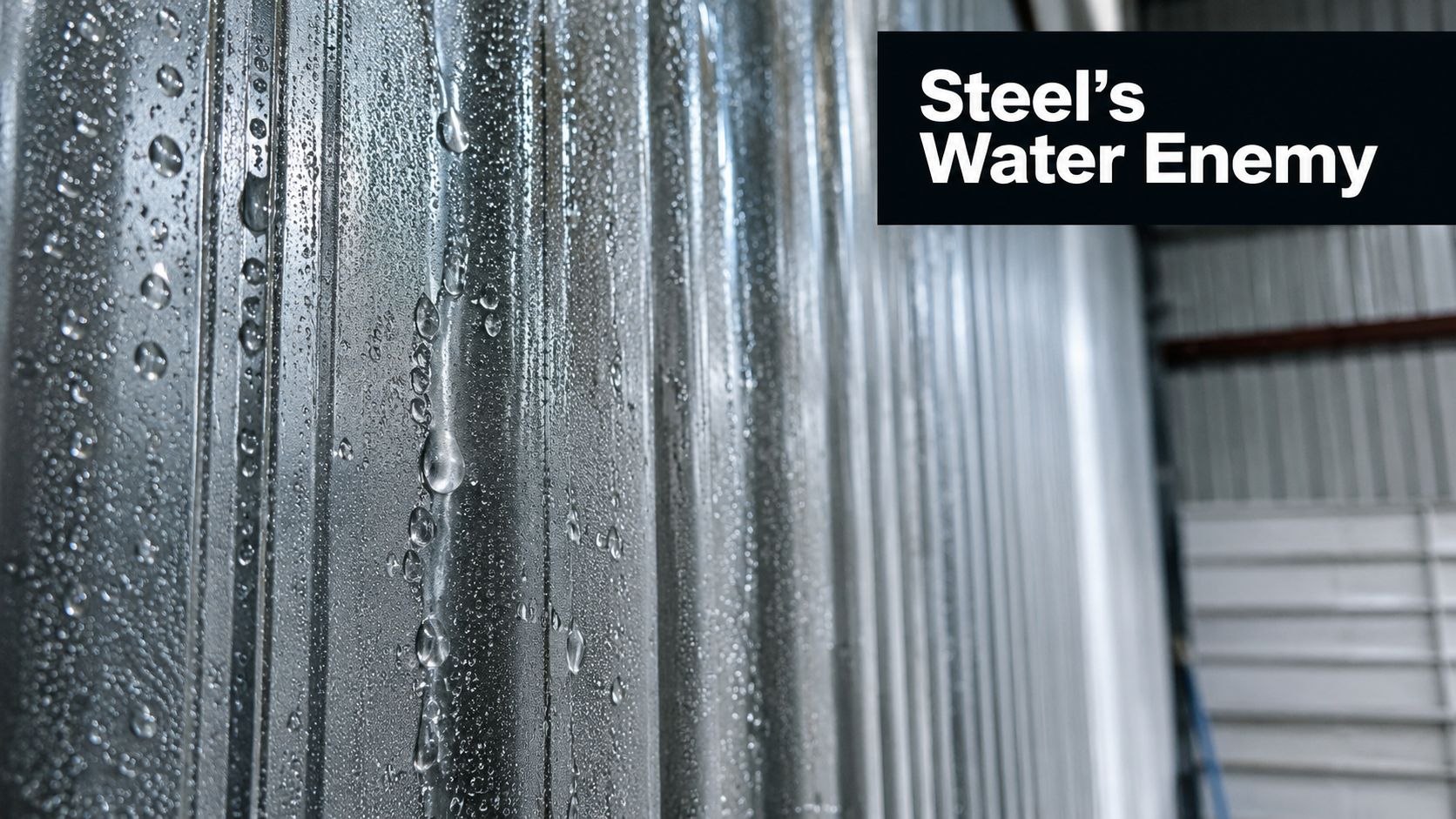
Steel gives moisture nowhere to hide. Once humid air reaches a surface that has dropped below the dew point, liquid water forms on panels, purlins, clips, and fasteners. In hot, humid climates, that can happen even when the building looks tight from the outside, because the underlying problem is often moisture moving from the wrong side of the assembly.
A lot of one-size-fits-all advice assumes vapor always pushes from inside to outside. South Florida does not play by that rule for much of the year. Outdoor heat and humidity often drive inward toward cooler interior surfaces, which is one reason metal buildings here fail in ways that surprise crews used to colder climates.
Rust rarely begins in the middle of a clean, dry panel. It shows up around fasteners, panel laps, cut edges, and framing connections where water can linger. Once those areas stay wet on a regular cycle, coatings break down and corrosion spreads.
Fiberglass insulates by holding dry, still air. Once it gets damp, its thermal performance drops and the facing can sag or separate. The U.S. Department of Energy notes that wet insulation can lose much of its effectiveness, which is why moisture control is tied directly to energy use, not just durability, in its guide to insulation and air sealing. If you want a side-by-side look at common vapor barrier materials for metal buildings, compare not just perm rating but how each product holds up when real jobsite humidity and penetrations enter the picture.
Perm rating matters here. It works like a throttle for water vapor. Lower perm materials slow vapor more. But the rating only helps if the layer stays continuous after the insulation crew, electrician, sprinkler contractor, and HVAC installer are done poking holes in it.
Steel does not feed mold, but the dust on it can. So can insulation facings, wood nailers, stored contents, and interior finishes added later. Once the assembly stays damp, the building starts smelling musty, staining surfaces, and holding humidity longer than it should.
That problem shows up often in conversions. Owners turning a shell into a conditioned shop, office, or living space usually learn fast that insulation alone is not a moisture plan. The same lesson comes up for people building a barndominium in Southern NC, but the risk is even sharper in South Florida because outside vapor drive is stronger and cooling seasons run longer.
The symptoms overlap. Water drips. Insulation gets wet. Staining appears. The pattern is what separates the two.
In my experience, crews waste a lot of time chasing sealant failures when the underlying issue is warm, wet air reaching cold steel day after day. That is why spray foam performs so well in hot, humid metal buildings. It insulates and air-seals in one layer, which reduces the chance of humid air reaching the steel in the first place. In this climate, that integrated approach often beats trying to piece together fiberglass, a separate facing, and field-detailed air control after the fact.
This walkthrough helps illustrate the issue in a way many owners recognize on sight.

If you treat condensation like a leak, you keep patching symptoms. If you control the vapor drive and keep humid air off the steel, you stop the cycle.
Not every sheet layer belongs in a metal building, and not every low-cost roll sold as a barrier is appropriate for hot, humid conditions. Material choice should follow building use, climate, and how the rest of the assembly is built.
In high-humidity environments, a vapor retarder should have a perm rating between 0.02 and 0.09 to effectively control condensation, and common facings such as PSF and VRP both achieve 0.02 perm, according to the North American Insulation Manufacturers Association metal building design guidance. That's why those reinforced facings show up so often in metal building packages.
The main question isn't just “Is it a barrier?” The better question is, “Will this stay continuous, survive installation, and make sense with the rest of the assembly?”
| Metal Building Vapor Barrier Material Comparison | Typical Perm Rating | Pros | Cons |
|---|---|---|---|
| Polyethylene film | Qualitatively low when properly specified for vapor control | Widely available, familiar to many crews | Tears easily, details poorly around framing and penetrations if handled carelessly |
| PSF facing | 0.02 perm | Strong moisture control, integrated with fiberglass systems, durable facing | Performance depends heavily on seam treatment and fit around purlins and edges |
| VRP facing | 0.02 perm | Good vapor resistance, common in metal building insulation systems, clean interior finish | Can be compromised by punctures, loose seams, or rough handling during install |
| Peel-and-stick membrane | Varies by product | Good adhesion at transitions and details, useful for complex areas | Product-specific installation requirements matter, and poor substrate prep causes failures |
| Liquid-applied membrane | Varies by product | Useful on irregular surfaces and hard-to-wrap details | Quality depends on thickness control, curing conditions, and installer discipline |
PSF and VRP are common because they combine insulation facing and vapor control in one system. That can simplify the assembly, but only if the laps are sealed and the facing stays intact. A slit, puncture, or loose edge can become the weak point for the whole run.
These are useful at transitions, penetrations, and retrofit conditions where a broad blanket system won't solve every detail. They can be excellent support materials, but they aren't a shortcut for a badly planned assembly.
These make sense where geometry is awkward. Pipes, embedded steel, odd corners, and patchwork retrofits sometimes favor a fluid-applied approach. The trade-off is that application discipline matters a lot.
Perm rating tells you how resistant a material is to vapor movement. Installation quality tells you whether that rating will mean anything on the building.
Radiant barriers and insulation facings often get mixed together in ways that create redundancy. If you're comparing options, it helps to review how different vapor barrier materials for building assemblies behave before choosing a system based on habit.
The cheap answer often costs more later. On metal buildings, durability at seams and compatibility with the rest of the envelope usually matter more than what the roll cost on delivery day.
South Florida changes the rules. Advice that works in a cold climate can create trouble here because the direction of vapor drive often flips.
In a heated northern building during winter, moisture tends to move from the warmer interior toward the colder exterior. In South Florida, a cooled metal building can pull the problem the other way. Hot, humid exterior air pushes inward toward cooler interior surfaces and assemblies. That's why a one-size-fits-all interior-side vapor barrier detail can miss the actual problem.
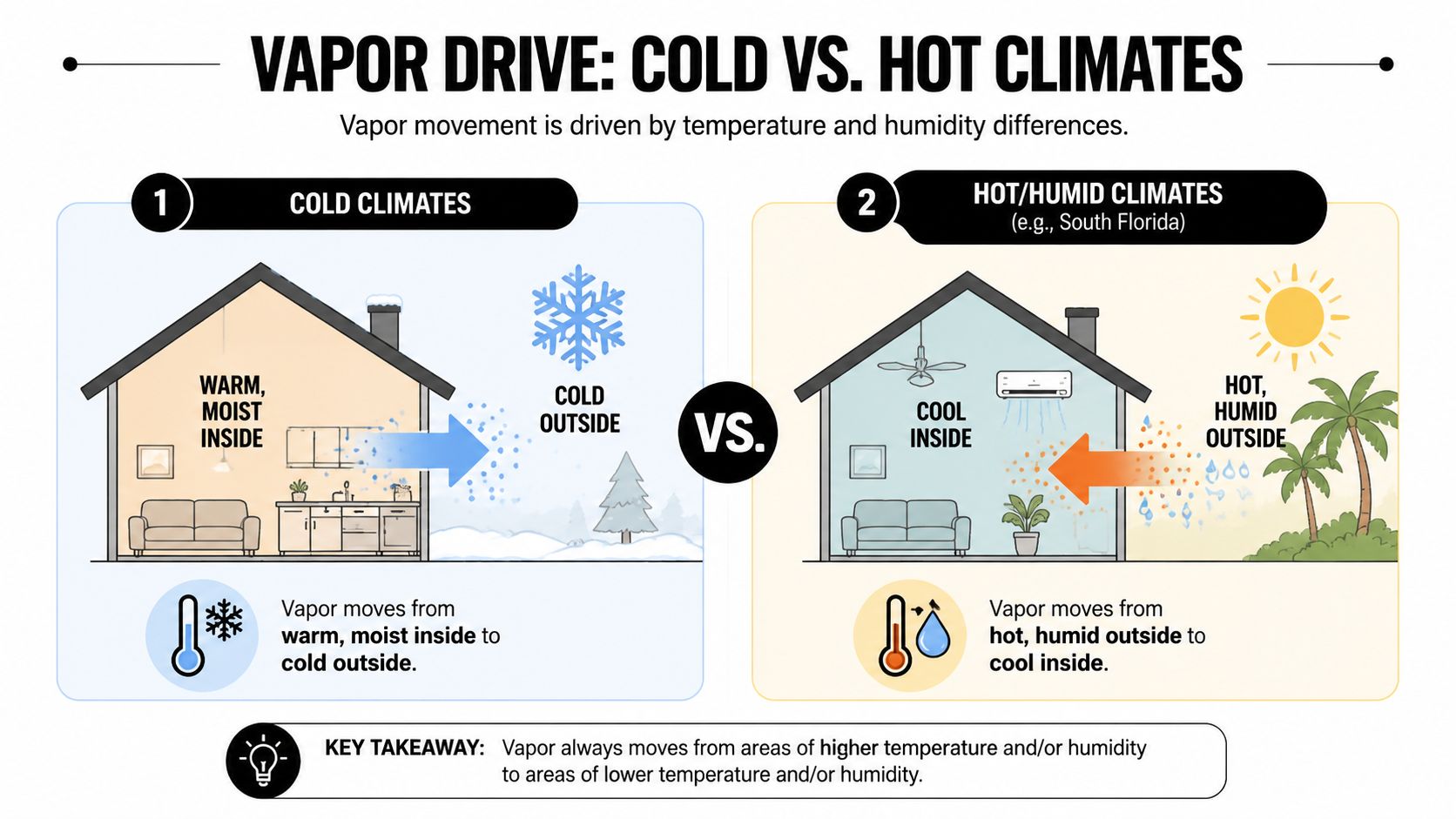
A lot of generic guidance assumes the inside is the moisture source and the outside is the cold condensing side. That's not reliable in an air-conditioned warehouse, workshop, gym, or storage building in coastal Florida.
If you put the wrong vapor-control layer in the wrong place, you can trap moisture instead of managing it. That's where many metal building retrofits go sideways. The building may feel cooler after the insulation goes in, but hidden dampness begins building behind the finish or against the steel.
Closed-cell spray foam becomes a strong integrated solution in hot, humid climates. When professionally applied to the interior side of the metal shell, it can reduce air leakage and provide vapor control in the same assembly. Instead of relying on multiple loose layers to line up perfectly over framing, you get a continuous adhered layer.
That matters in real buildings, not just diagrams.
For many South Florida buildings, that integrated approach is what matches the climate. If you want a broader look at how vapor barrier and insulation choices work together in humid climates, it helps to think in terms of assemblies, not single products.
Interior-applied spray foam in hot-humid climates like South Florida often requires a vapor barrier to prevent inward moisture drive, and when spray polyurethane foam is applied to the interior of a metal building, it must be covered with a 15-minute rated thermal barrier to comply with fire safety codes, according to the Spray Foam of Maine technical bulletin on insulating metal buildings.
The best insulation for a South Florida metal building is the one that respects inward vapor drive, not the one copied from a cold-climate detail sheet.
Spray foam isn't magic. It still has to be specified and installed correctly. But in this climate, it often solves multiple failure points at once.
A good product installed badly is still a bad assembly. Most metal building moisture failures happen at seams, penetrations, terminations, and transitions where crews get rushed or substitute materials.
The biggest mistake is thinking broad coverage matters more than continuity. It doesn't. A metal building vapor barrier only works when it stays unbroken across the whole controlled layer.
Use vapor-seal tape designed for the facing or membrane, not generic duct tape. Bay Insulation specifically notes that seams must be sealed with vapor-seal tape rather than standard duct tape to maintain continuity in metal building systems, as covered in the earlier technical discussion.
Purlins, perimeter edges, corners, overhead door frames, light penetrations, pipe penetrations, and service openings are where most failures start. If those aren't planned, crews start improvising.
The barrier has to connect from field area to edge detail to penetration detail. A good-looking center section doesn't matter if moisture bypasses the system at the perimeter.
One of the worst mistakes in hot climates is stacking vapor-impermeable layers without giving the assembly a safe drying path.
If your radiant barrier already includes a vapor barrier, unfaced insulation is optimal because adding faced insulation creates a redundant vapor layer that traps moisture, according to BlueTex guidance on radiant barriers and vapor barriers. That mistake shows up all the time when someone assumes “more barrier is better.”
It isn't.
Two strong vapor-control layers with moisture between them can create a trap. Once humid air or incidental moisture gets in, drying becomes difficult. In South Florida, that can turn into persistent dampness fast.
Jobsite reality: The failure usually isn't the material on the label. It's the unsealed joint, the ripped corner, or the extra facing somebody added without thinking through drying.
A metal building that stays dry performs better. That sounds simple, but it's the whole game.
The right vapor-control strategy protects steel from corrosion, keeps insulation from losing effectiveness, and lowers the chance of hidden mold and interior moisture problems. In South Florida, that strategy has to match hot, humid conditions and inward vapor drive. Generic advice from colder regions often misses that completely.
For many buildings, reinforced faced systems can work well when they're properly selected and meticulously sealed. For others, especially conditioned buildings in humid coastal conditions, a spray foam-based approach makes more sense because it tackles air leakage and vapor control together.
What matters most is choosing one coherent assembly and installing it like the details matter. Because they do.
A metal building vapor barrier isn't an accessory. It's protection for the structure, the contents, and the operating cost of the building for years to come.
If you're in Jupiter, Palm Beach Gardens, West Palm Beach, Wellington, or Stuart and want a real assessment of what your metal building needs, talk with Airtight Spray Foam Insulation. Their team understands how South Florida humidity, inward vapor drive, and metal building assemblies interact, and they can help you choose a system that's built to work the first time.