If you’re thinking about insulating your metal building, it’s not a step you can afford to skip. It’s absolutely essential for controlling the climate inside, stopping condensation in its tracks, and making sure the structure lasts for the long haul. Your best metal building insulation options range from high-performance spray foam—which gives you a nearly perfect air and moisture seal—to more traditional choices like fiberglass batts and rigid foam boards. Each one tackles the unique challenges that come with insulating steel.
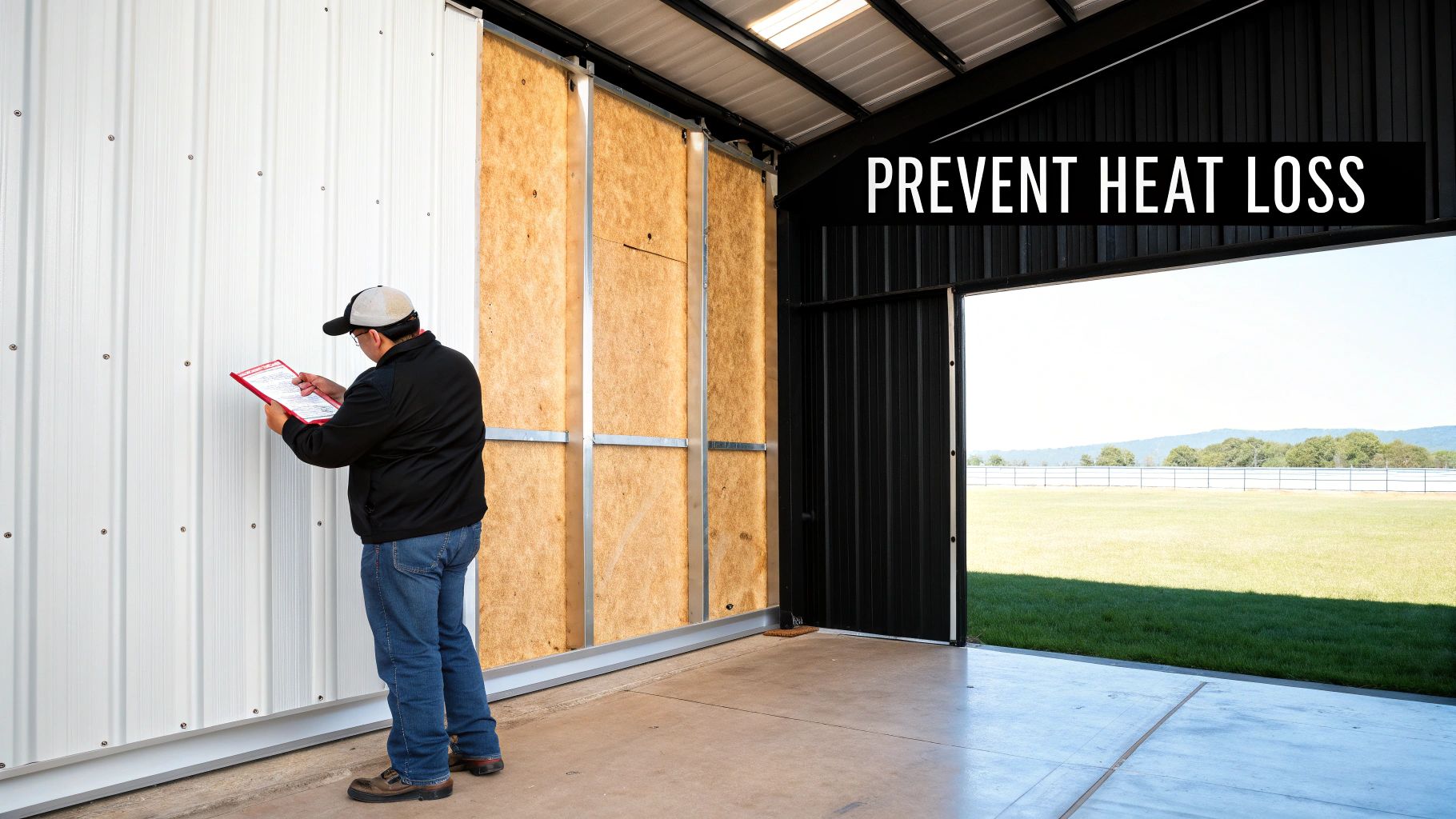
Picture an uninsulated metal building like a tin can sitting in the Florida sun. It gets scorching hot in minutes and cools down just as fast when a cloud rolls over. Steel is an amazing conductor, meaning it transfers heat with almost no resistance. That property makes an uninsulated building a slave to the weather, leaving you with a sweltering interior in the summer and a bone-chilling space in the winter.
This wild temperature swing isn’t just about comfort; it’s a direct hit to your wallet. Without a proper thermal barrier, your HVAC system has to run nonstop just to keep up, sending your energy bills through the roof.
Beyond the temperature battle, the biggest enemy of any metal building is moisture. When warm, humid air inside your building hits the cold surface of the steel panels, condensation forms instantly. You’ll often hear people call this “sweating,” and it’s the root cause of some major headaches.
Condensation is more than just a little dampness; it’s the primary fuel for rust and corrosion. Over time, that constant moisture will eat away at your steel panels and fasteners, leading to expensive repairs and seriously cutting down the lifespan of your building.
A properly installed insulation system creates a crucial barrier. It keeps the warm, moist interior air from ever touching the cold exterior metal, stopping condensation before it can even start.
When you invest in the right insulation, you get three core benefits that protect both your building and everything you keep inside it. This is a big deal in the construction world—the global building thermal insulation market was valued at USD 29.9 billion in 2024 and is expected to climb to USD 52.5 billion by 2034. You can dig deeper by reviewing the latest building thermal insulation market analysis.
Choosing from the available metal building insulation options is a critical decision. It directly impacts your operating costs, how long your building will last, and what you can do with it.
Before you can pick the right insulation for your metal building, you need to know how performance is actually measured. It’s easy to get fixated on a single number, but a truly effective system is about much more than just one rating. Learning the language of thermal performance helps you cut through the marketing fluff and see what really counts.
The first term everyone hears is R-value. Think of it as a simple score for an insulation’s ability to resist heat flow. A higher R-value means better insulating power, so a material rated at R-13 will block more heat than one rated at R-7. Pretty straightforward.
But here’s the catch: R-value only measures heat transfer through the material itself. In a real-world metal building, that’s only half the battle.
Heat doesn’t just move through insulation; it hitches a ride on air currents. This is called convective heat transfer, and it happens every time conditioned air leaks out and outside air sneaks in through the tiny gaps, seams, and cracks in your building.
This is why an insulation’s ability to create an air barrier is so critical. A true air barrier stops this uncontrolled air exchange cold. It doesn’t just save you a fortune on energy bills—it’s also your best defense against condensation. When you stop warm, moist air from touching cold steel, you stop moisture problems before they can start.
An insulation’s advertised R-value means almost nothing if it’s not paired with a good air seal. I’ve seen high R-value systems with tons of air leaks perform worse than lower R-value systems that are perfectly airtight.
Closely tied to air sealing is the idea of a vapor barrier (or vapor retarder). This is a layer designed specifically to stop water vapor from passing through your insulation and condensing into liquid on the cold steel panels. In a humid climate like South Florida, this is arguably the single most important job of your insulation system.
A material’s ability to block vapor is measured by its perm rating. The rule is simple: the lower the perm rating, the less moisture gets through. Materials fall into these general classes:
For nearly all metal building projects, you need an impermeable or semi-impermeable barrier to prevent the destructive cycle of condensation, rust, and rot.
Beyond keeping heat and moisture in check, a few other things separate a good insulation choice from a great one.
Fire Resistance: This isn’t optional. Building codes mandate specific fire performance ratings for insulation, measuring how quickly a flame spreads and how much smoke develops. Materials are given a classification (like Class A/Class 1) to ensure they meet modern safety standards.
Sound Dampening: Let’s be honest, metal buildings can be noisy. Rain sounds like a drum solo, and wind can howl. The right insulation can make a massive difference, absorbing sound and creating a much quieter, more comfortable space. This is measured with ratings like Sound Transmission Class (STC) and Noise Reduction Coefficient (NRC).
Once you understand these key performance metrics, you have a solid framework for comparing your options and making a smart decision.
Choosing the right insulation for your metal building isn’t just about picking a material—it’s a decision that impacts your building’s comfort, energy bills, and longevity for decades. Every option offers a different balance of thermal performance, moisture control, and cost. Getting it right means matching the product to your building’s use and, just as importantly, our South Florida climate.
This diagram hits on the three critical metrics you need to consider: R-value, air sealing, and moisture resistance. They aren’t separate features; they work together as a complete system.
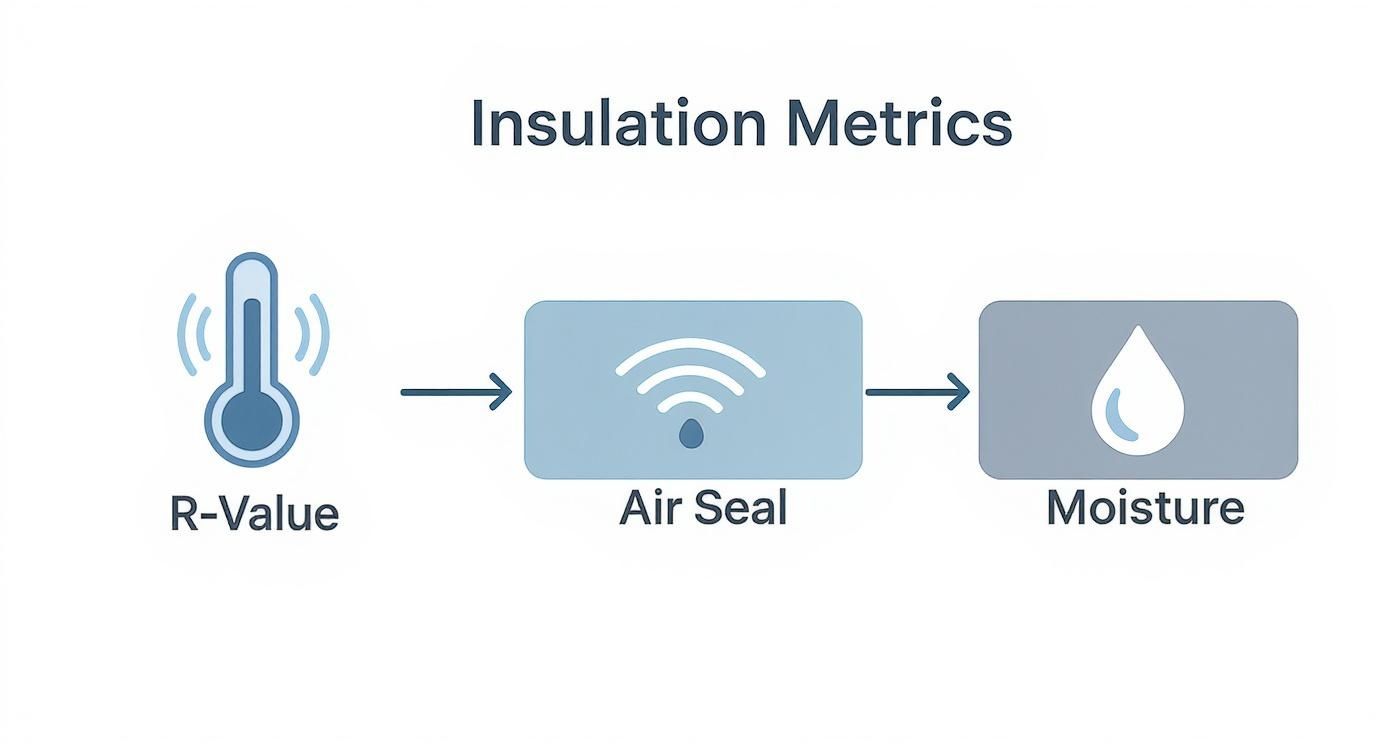
As you can see, R-value is only one piece of the puzzle. Without an effective air seal and moisture barrier, even the highest R-value insulation will fail to protect a metal structure.
Spray polyurethane foam (SPF) is in a league of its own because it’s both insulation and an air barrier in one shot. We apply it as a liquid that expands instantly, filling every single crack, seam, and gap. It creates a seamless, monolithic seal that’s physically impossible to replicate with pre-made materials.
That airtightness is its defining feature. By killing all uncontrolled air movement, spray foam directly stops the convective heat loss that plagues so many buildings and provides the best defense against condensation. You can see more real-world applications in our spray foam insulation guides.
When it comes to metal building insulation options, you’ll be choosing between two main types: open-cell and closed-cell.
Open-Cell Spray Foam
With a soft, sponge-like consistency, open-cell foam expands massively when applied. It gives you a great thermal barrier and an excellent air seal.
Closed-Cell Spray Foam
This stuff is completely different. Closed-cell foam is rigid, dense, and cures into a hard, structural material. Its cells are totally sealed, blocking both air and moisture from getting through.
The Game-Changing Differentiator: Closed-cell spray foam’s ability to create a seamless, waterproof, and airtight seal directly on the metal is its superpower. It completely eliminates thermal bridging through screws and framing, giving you the highest real-world performance you can get.
Fiberglass has been the default choice for decades, mostly because it’s cheap and you can find it anywhere. It comes in big rolls or pre-cut batts meant to be stuffed between wall studs or roof purlins.
It works by trapping air to slow heat transfer (conduction), but it does absolutely nothing to stop air movement (convection). In a metal building, that’s a fatal flaw. Without a perfectly installed, completely sealed vapor barrier, humid air will flow right through the fiberglass and condense on the cold steel panels.
Fiberglass Batts and Rolls
These usually have a paper or foil facing that’s supposed to act as a vapor retarder, but every single seam has to be meticulously taped and sealed.
Rigid foam boards are a solid middle-ground option, giving you good thermal resistance and moisture control in a DIY-friendly format. These boards come in standard sizes (usually 4’x8′) and are made from a few different materials.
The big plus for rigid foam is its consistency. Unlike fiberglass, its R-value is stable and won’t get ruined by compression. The downside? You still have to painstakingly tape every single seam between boards and seal all the edges to get a true air and vapor barrier. One missed spot and you’ve got a leak.
Unlike materials that slow heat transfer, a radiant barrier reflects it. It’s basically a highly reflective sheet, like aluminum foil, laminated onto another material like kraft paper.
It doesn’t have a meaningful R-value by itself. Its job is to block radiant heat from the sun, which makes it a really popular add-on in hot places like South Florida. For it to work, you absolutely must have an air gap of at least ¾ inch facing the reflective side.
Here’s a quick-glance table to help you compare the top contenders for your metal building. This breaks down the key attributes, costs, and where each one truly shines.
| Insulation Type | Typical R-Value (per inch) | Moisture & Air Barrier | Installation Complexity | Estimated Cost (per sq ft) | Best Use Case |
|---|---|---|---|---|---|
| Closed-Cell SPF | R-6.5 – R-7.0 | Excellent (Monolithic Air & Vapor Barrier) | Professional Only | $3.00 – $5.50+ | High-humidity climates; condensation prevention |
| Open-Cell SPF | R-3.5 – R-3.8 | Excellent Air Barrier; Not a Vapor Barrier | Professional Only | $2.00 – $3.50 | Conditioned spaces; sound dampening |
| Rigid Foam Board | R-4.0 – R-6.5 | Good (Requires Taping All Seams) | Moderate DIY | $2.00 – $4.00 | DIY projects; consistent R-value needed |
| Fiberglass (Batts/Rolls) | R-3.1 – R-3.7 | Poor (Relies Entirely on Separate Barrier) | Easy DIY | $1.25 – $2.50 | Low-budget projects in dry climates |
| Radiant Barrier | Minimal (Reflects Heat) | Good Vapor Barrier (When Taped) | Easy DIY | $0.50 – $1.25 | Supplementing other insulation in hot climates |
When it comes down to it, the best choice hangs on your priorities. If maximum performance and absolute moisture control are non-negotiable—especially here in Florida—then closed-cell spray foam is the undisputed winner. For projects where cost is the primary driver, fiberglass or rigid foam can work, but only if you install them with extreme attention to detail.
When you’re trying to insulate a metal building in a place like South Florida, the old rulebook gets tossed out the window. Down here, R-value isn’t the star of the show. Instead, your number one enemy is moisture—constant, aggressive, and relentless. The main job of your insulation isn’t just slowing down heat; it’s building a fortress against condensation.
Humid air is loaded with water vapor, and the second it touches a cooler metal panel, that vapor turns into liquid water. We call it “sweating,” and in our subtropical climate, it’s a huge problem. If you don’t stop it, you’re looking at rust, corrosion, mold, and eventually, the building itself starting to fail.
So, when you’re looking at metal building insulation options, you have to think differently. The single most important factor isn’t thermal resistance—it’s whether the material can create a perfect, seamless air and vapor barrier.

In this climate, your insulation absolutely must stop water vapor from getting through. A material’s ability to do this is measured by its perm rating—the lower, the better. Anything that lets vapor sneak past is a serious gamble.
This is exactly where traditional insulation like fiberglass falls short. Even if you install a separate plastic vapor barrier, every seam, staple, and tiny tear is a potential entry point for humid air to find its way to the cold metal. Once moisture gets trapped behind the insulation, it’s game over. You’ve created the perfect hidden environment for mold to thrive and corrosion to eat away at your building.
For a metal building in South Florida, your insulation is your first and last line of defense against moisture intrusion. A system that cannot guarantee a monolithic, joint-free vapor barrier is not a viable long-term solution. It’s a risk that simply isn’t worth taking.
This reality puts the spotlight squarely on spray foam, since it’s the only material that can create that truly seamless, monolithic seal. But picking between open-cell and closed-cell foam is a critical decision that comes down to the specific building and how it’s used.
Scenario 1: A Non-Conditioned Warehouse in Stuart
Scenario 2: An Air-Conditioned Workshop in Palm Beach Gardens
If you want to dive deeper into the different types, our article comparing spray foam versus blown-in insulation offers more detail. But for most metal buildings in our humid climate, the tough, waterproof protection of closed-cell foam is the clear winner for long-term durability and peace of mind.
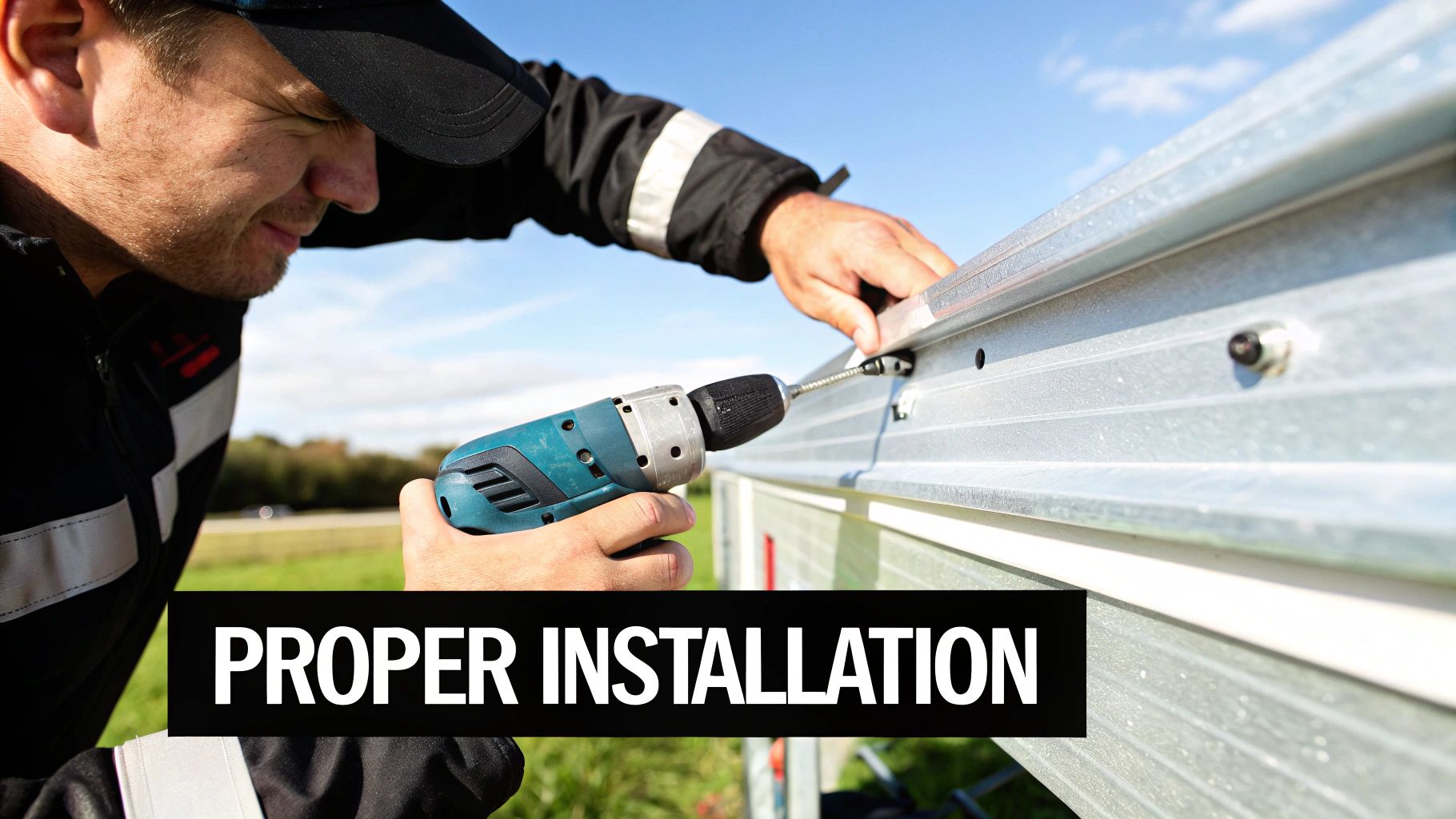
Picking the right insulation material is only half the battle. Even the highest-rated product will fail miserably if it’s installed the wrong way. The installation isn’t just a final step; it’s what makes the entire system work, dictating whether you actually get the performance you paid for. How the material is attached, sealed, and integrated with the building’s steel frame can make or break its effectiveness.
For any of the metal building insulation options to do their job, they have to form a complete, unbroken barrier against heat, air, and moisture. We call this a continuous thermal envelope. A single gap, a compressed section, or a poorly taped seam can undermine the whole setup, leading to wasted energy and a serious condensation problem.
Different insulation types demand their own specific installation methods, and each one has critical details that can’t be overlooked. Understanding these processes helps you see exactly where things can go wrong—and why calling a professional is almost always the right move.
Fiberglass Batt Installation
Fiberglass blankets are usually installed with a pin-and-cap system. Installers push long pins through the insulation, securing them to the metal purlins and girts. A cap goes on the end of the pin to hold everything in place.
Rigid Foam Board Installation
Rigid boards are typically friction-fit between the steel framing members. The idea is to cut each board to the perfect size so it fits snugly inside the cavity, leaving no gaps.
Spray Foam Direct Application
Spray foam is sprayed as a liquid directly onto the interior of the metal panels. It expands in seconds to fill every crack and crevice, creating a single, seamless layer that bonds permanently to the structure.
The real magic of professionally installed spray foam is its ability to create a perfect, monolithic seal around awkward shapes. It flows around wiring, plumbing, and structural beams, eliminating the tiny gaps that are nearly impossible to seal with pre-cut materials.
One of the biggest performance killers in a metal building is thermal bridging. This happens when heat finds a shortcut, bypassing the insulation by traveling through a more conductive material—in this case, the steel frame itself.
Steel is an excellent conductor of heat. Every screw, purlin, and girt that isn’t properly isolated becomes a thermal bridge, creating cold spots on the interior surface where condensation loves to form. A truly continuous insulation system is the only way to stop this from happening.
A related solution is insulated metal panels (IMPs), which are engineered composite panels that provide a built-in thermal break. The market for these advanced systems is growing fast, valued at USD 5.02 billion in 2025 and projected to hit USD 6.24 billion by 2032. These panels combine metal skins with an insulating core, offering great thermal performance in a lightweight package. You can explore detailed market analysis of insulated metal panels to get a better handle on this segment.
Ultimately, the quality of the install defines the real-world performance you get. A flawless installation ensures a true thermal envelope, protecting your investment by delivering the energy efficiency, moisture control, and comfort you expect from day one.
Once you start digging into the different insulation options for a metal building, the practical questions always follow. We hear them all the time—concerns about condensation, whether a DIY install is a good idea, and of course, the all-important bottom line.
Getting clear answers to these questions is what turns a plan into a confident decision. Here are the most common ones we tackle for building owners in South Florida.
Closed-cell spray foam is, without a doubt, the single most effective way to stop condensation in a metal building. It’s not even a fair fight.
By adhering directly to the metal sheathing, it creates a seamless, monolithic barrier. This completely eliminates the tiny gaps where warm, humid air hits the cold metal and sweats. That’s the root cause of condensation.
Its biggest advantage is its incredibly low permeance—water vapor simply can’t pass through it. While you can try to achieve a similar result with perfectly taped radiant barriers or a meticulously sealed fiberglass job, those methods are far more likely to fail over time. A single bad seam is all it takes.
Only closed-cell spray foam completely stops both the air movement and the moisture transfer that feed the destructive condensation cycle. It fixes the cause, not the symptom, making it the clear winner for our high-humidity climate.
Whether you can tackle the installation yourself really comes down to the material you choose. Some options are fairly forgiving for a skilled DIYer, but others are strictly for the pros.
A botched spray foam job is a nightmare to fix. Given that you need an absolutely perfect air and moisture seal, professional installation isn’t just a good idea—it’s a necessary investment to make sure the material actually does its job.
The cost to insulate a metal building can vary quite a bit depending on its size, the type of insulation, the R-value you’re aiming for, and local labor rates. But, we can give you a general ballpark to help with budgeting.
Here’s a rough breakdown of what you can expect to pay per square foot, including professional installation:
While closed-cell spray foam is the biggest upfront investment, its unmatched performance—especially in preventing moisture damage and even adding structural strength—often delivers a much better long-term return. In a demanding climate like ours, it’s money well spent.
Ready to put an end to condensation and create a comfortable, energy-efficient space? The experts at Airtight Spray Foam Insulation have over 25 years of experience delivering high-performance solutions for metal buildings across South Florida. Request your free, no-obligation quote today and discover the difference a professional installation makes.
Metal buildings in Wellington, FL—including barns, workshops, and storage units—require specialized insulation to control heat, humidity, and condensation. Airtight Spray Foam Insulation installs solutions that perform in Florida’s demanding climate.
???? Learn more about spray foam in Wellington:
https://yourwebsite.com/spray-foam-insulation-wellington/