Blog
Spray Foam vs Fiberglass Insulation in South Florida

When it comes to insulating a home in South Florida, the choice between spray foam and fiberglass isn’t just about keeping things cool—it’s about fighting a constant battle with oppressive humidity and corrosive salt air. While fiberglass has been the standard for years, spray foam creates a complete air and moisture barrier, making it a far more effective solution for our demanding coastal climate.
Choosing Your Insulation for South Florida’s Climate
Picking the right insulation is one of the most important decisions you can make for your home’s comfort, energy bills, and even its structural health. Down here, insulation works harder than just about anywhere else in the country, thanks to the intense sun and moisture-laden air. The decision isn’t just about R-value; it’s a long-term investment in preventing mold, keeping cooling costs in check, and maintaining healthy air inside your home.
For decades, fiberglass was the go-to insulation mainly because of its low upfront cost. The problem is, its performance tanks in South Florida’s humid environment. On the other hand, spray foam is a modern solution designed specifically to tackle these challenges head-on. It doesn’t just slow down heat transfer—it actively seals your home from air and moisture getting in.
That single difference is the key to understanding why one so often outperforms the other in local homes. Before we get into the nitty-gritty, let’s look at a quick overview.
A Quick Comparison
This infographic gets right to the point. It shows how spray foam actively creates a seal, while fiberglass just sits there, passively insulating and trapping moisture.
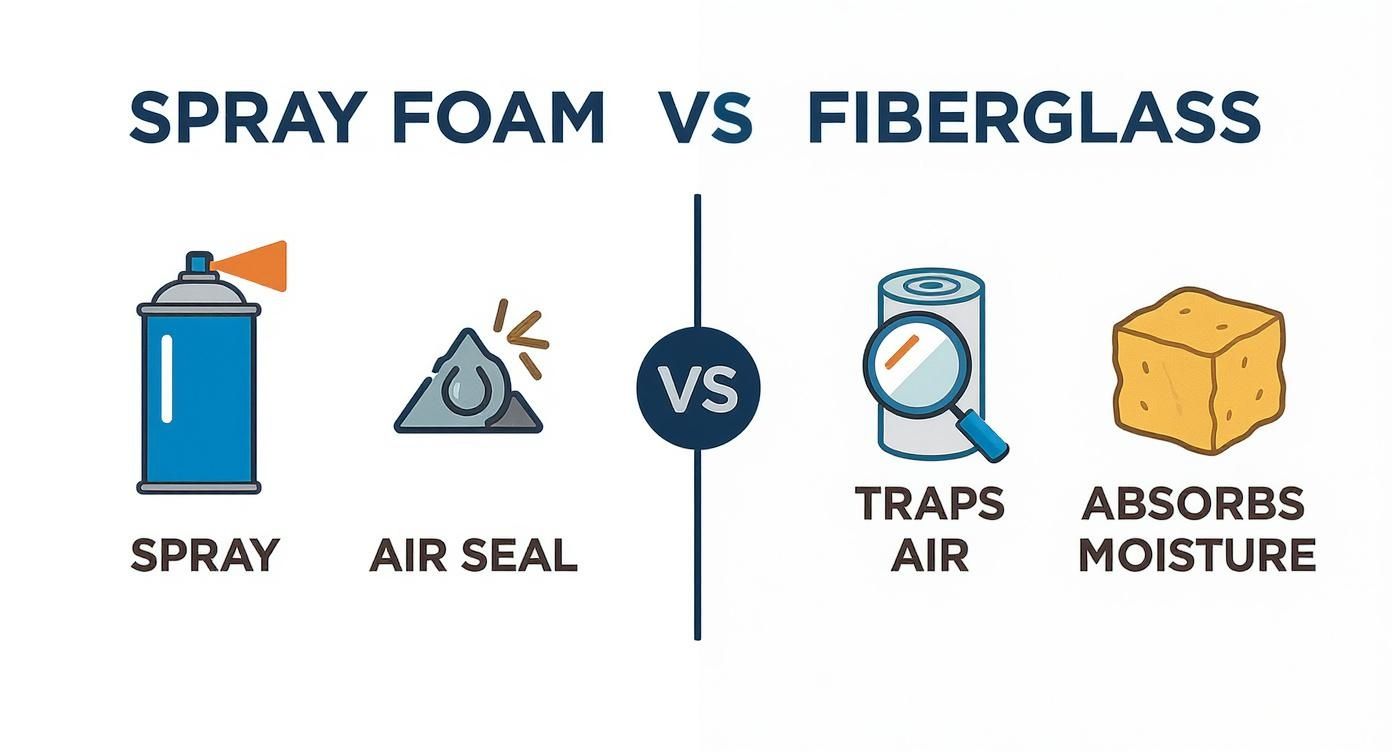
The takeaway here is simple: spray foam’s ability to block both air and moisture gives it a huge advantage against our climate. To make things even clearer, here’s a breakdown of the most important factors for South Florida homeowners.
Quick Comparison: Spray Foam vs Fiberglass for South Florida Homes
For homeowners weighing their options, this table cuts through the noise and compares the two materials on the factors that matter most in our region.
| Feature | Spray Foam Insulation | Fiberglass Insulation |
|---|---|---|
| Air Sealing | Excellent. Creates a monolithic, airtight barrier that stops leaks. | Poor. Air easily passes through and around batts, drastically reducing effectiveness. |
| Moisture Resistance | Excellent. Closed-cell foam is a vapor barrier that repels water. | Poor. Absorbs and holds moisture like a sponge, leading to mold and lower R-value. |
| Durability & Lifespan | Very High. Lasts 50+ years without sagging or degrading. | Moderate. Can sag, settle, and compact over time, often needing replacement. |
| Upfront Cost | Higher. A significant initial investment. | Lower. More budget-friendly for the initial installation. |
| Long-Term Value | High. Delivers major energy savings and prevents costly moisture repairs. | Lower. Savings are limited by air leakage and potential moisture damage. |
| Installation | Requires certified professional installation. | Can be installed by professionals or as a DIY project. |
While fiberglass might seem like a win on upfront cost, spray foam’s superior performance in air sealing, moisture resistance, and durability makes it the clear long-term winner for protecting a home in South Florida.
Why Air Sealing Matters More Than R-Value Alone
When people compare spray foam and fiberglass, the first thing they usually look at is the R-value. It’s the standard measure of how well insulation resists heat flow. But focusing only on R-value is like judging a raincoat by the thickness of its fabric without checking if the seams are sealed.
A high R-value means very little if hot, humid Florida air can just blow right through gaps and cracks in your walls.
This is where air sealing becomes the real game-changer for your home’s performance. Air leakage is one of the biggest sources of energy loss, period. It lets your cool, conditioned air escape and allows hot, sticky air to creep in, forcing your AC to run constantly.
The Problem with Gaps in Fiberglass
Fiberglass batts are notoriously difficult to install perfectly. No matter how carefully they’re cut and fitted, small gaps are almost always left around electrical boxes, plumbing lines, and wood framing. Each one of those tiny gaps becomes a highway for air movement.
Think of it like wearing a thick wool sweater on a windy day. The sweater itself is warm (that’s its R-value), but the wind cuts right through it, leaving you cold. Fiberglass works the same way—it can slow down heat, but it does almost nothing to stop air from moving through it.
A home’s thermal envelope is only as strong as its weakest point. Even with high R-value fiberglass, unsealed gaps and cracks can account for up to 40% of a home’s energy loss, effectively undermining the insulation’s purpose.
In South Florida, this constant air exchange is a recipe for disaster. It pulls humid, outside air into your attic and walls, creating the perfect environment for moisture damage and mold growth.
How Spray Foam Creates an Airtight Barrier
Spray foam insulation is a completely different animal. We apply it as a liquid that expands on contact, filling every single crack, crevice, and odd-shaped void in your attic or walls. As it cures, it creates a solid, seamless barrier that’s bonded directly to the structure itself.
This process doesn’t just insulate—it air seals your home in a single step. There are no gaps, no seams, and no pathways for air to sneak through. This completely stops convective heat transfer (air movement) in its tracks, which is something fiberglass just can’t do. The result is a far more effective thermal barrier where it actually counts: in the real world.
A Closer Look at R-Values and Real Performance
On paper, R-value numbers can be misleading if you don’t factor in air sealing. It’s critical to understand how these materials actually perform in a home, not just in a lab.
Here’s a quick breakdown of typical R-values per inch:
- Closed-Cell Spray Foam: R-6.5 to R-7
- Open-Cell Spray Foam: R-3.5 to R-4
- Fiberglass Batts: R-3.1 to R-3.4
Sure, a thick fiberglass batt might have a high total R-value, but its real-world performance is constantly being crippled by air leaks. On the other hand, spray foam’s superior air-sealing quality more than makes up for any difference in R-value.
This holistic approach is the foundation of a truly energy-efficient home and is central to our Airtight Comfort System. By stopping unwanted air movement, spray foam ensures your home stays consistently cool, dry, and comfortable.
How Each Insulation Holds Up to South Florida’s Humidity and Salt Air
South Florida’s climate is notoriously hard on building materials. It’s not just the heat; it’s the relentless combination of thick, year-round humidity and corrosive salt air that creates a brutal testing ground. When comparing spray foam to fiberglass here, it’s less about general R-value and more about survival and long-term performance in our unique coastal environment.
The air in our region is loaded with moisture. For any insulation to work effectively, it can’t just slow down heat—it has to win the daily war against water vapor.
Fiberglass and the “Sponge Effect”
Let’s be blunt: in a humid climate like ours, traditional fiberglass insulation acts like a sponge. Its fluffy, porous structure is great for trapping air in dry climates, but it becomes a massive liability in South Florida. It readily absorbs and holds onto moisture right out of the air.
Once those fiberglass batts get damp, a whole cascade of problems kicks off:
- Compression and Lost R-Value: Moisture is heavy. It weighs down the fibers, causing the batts to sag, compress, and lose their fluffiness. This compaction crushes the tiny air pockets that give the insulation its R-value, making it far less effective at keeping your home cool.
- Structural Damage: All that trapped moisture is now sitting directly against your home’s wood framing. This creates a constant state of dampness that can eventually lead to wood rot and compromise your home’s structural integrity.
- Mold and Mildew Growth: Damp, dark spaces are a paradise for mold. Wet fiberglass becomes an ideal breeding ground, and as mold flourishes inside your walls and attic, it releases spores into your living space, creating serious indoor air quality problems.
This built-in vulnerability makes fiberglass a poor long-term investment for coastal homes, where the fight against moisture never ends.
Spray Foam: Your Built-In Moisture Barrier
Closed-cell spray foam, on the other hand, is a completely different animal. It doesn’t just resist moisture; it’s fundamentally built to block it. When installed, it cures into a hard, non-porous plastic that is impermeable to water.
Think of it this way: closed-cell spray foam is a true vapor barrier. It literally stops water vapor from passing through, protecting your home’s structure from the inside out and preventing the condensation that fuels mold and rot.
This quality is an absolute game-changer for homes in high-humidity zones like ours. Spray foam forms a single, solid barrier that’s bonded directly to the sheathing and studs, leaving zero gaps for moisture to sneak in. It essentially waterproofs the entire insulated cavity, safeguarding your home’s structure for decades.
This is exactly why spray foam is the go-to solution for attics and walls in South Florida. It tackles the root cause of our moisture problems head-on.
Defending Against Corrosive Salt Air
Beyond humidity, our coastal homes face another invisible enemy: salt. The same salty air we love is also incredibly corrosive to metal components—think HVAC equipment, electrical connections, and even the nails and screws holding your house together.
Fiberglass batts, being permeable, do absolutely nothing to stop this corrosive air. Air moves freely through and around the insulation, carrying salt particles deep into your walls and attic where they can cause slow, silent damage over time.
This is where spray foam’s airtight seal becomes its superpower. By creating an impenetrable barrier, it stops airborne salt from ever entering your building envelope. This protects not just the wood framing but also all the critical systems running through your walls. It’s a level of protection you simply cannot get from a fibrous, porous insulation like fiberglass. In the spray foam vs. fiberglass matchup for coastal durability, this airtight defense makes spray foam the undisputed winner.
Analyzing Upfront Cost vs. Long-Term ROI
Let’s get right to it: the first thing everyone notices when comparing spray foam and fiberglass is the price tag. There’s no sugarcoating it—spray foam insulation is a bigger initial investment. For many homeowners on a tight budget, that upfront cost can feel like the deciding factor.
But framing the decision around the installation cost alone is a classic case of being penny-wise and pound-foolish, especially here in South Florida. The real story unfolds when you look at the long-term return on investment (ROI). Fiberglass is cheaper today, but spray foam is engineered to pay you back for decades.
The Initial Investment Breakdown
So, why the price difference? It boils down to the materials and the highly specialized installation process. Fiberglass batts are mass-produced and can be rolled out or stuffed into place relatively easily, which keeps labor costs in check. Spray foam, on the other hand, is a sophisticated chemical product applied as a liquid, requiring expensive equipment and certified technicians to ensure a safe, effective application.
- Fiberglass Cost: The lower material and labor costs make it the go-to budget option for the initial install.
- Spray Foam Cost: This is a premium building material that demands a professional application, leading to a higher upfront expense—often several times more than fiberglass for the same square footage.
While the numbers seem to favor fiberglass at first glance, this is where the simple cost comparison ends and the real value conversation begins. That higher upfront cost for spray foam isn’t just for insulation; it’s an investment in a high-performance, air-sealed building envelope that delivers tangible, measurable returns.
Quantifying Long-Term Savings and ROI
The true financial power of spray foam insulation reveals itself month after month, year after year. Its ability to create a near-perfect air seal directly translates into lower energy bills. When your cool, conditioned air stops leaking out and South Florida’s hot, humid air can’t get in, your HVAC system finally gets a break. It just doesn’t have to work as hard.
That reduced strain means more than just saving money on your cooling costs. It also extends the life of your expensive HVAC unit, pushing back costly repairs or a full system replacement. In a place like South Florida where the AC runs almost nonstop, these savings add up fast.
A properly sealed home insulated with spray foam can slash energy bills by up to 40% or more. Spread that over the 50+ year lifespan of the insulation, and those savings will dwarf the initial cost difference with fiberglass.
And don’t forget about “avoided costs.” Closed-cell spray foam doubles as a vapor barrier, stopping moisture in its tracks. This drastically lowers the risk of needing expensive mold remediation or repairs for rotted wood—two very common and very expensive problems we see with moisture-logged fiberglass in our climate. A single mold cleanup can cost thousands, completely wiping out any money you thought you saved on fiberglass.
A Growing Market Driven by Performance
Homeowners and builders are catching on. The significant financial benefits of spray foam are driving major growth in the market, largely because people are demanding smarter, more energy-efficient building materials that actually perform. As building codes continue to get stricter about energy efficiency, high-performance materials like spray foam are quickly becoming the new standard, not the exception. You can read more about the growth of the spray foam market and what’s behind its rapid expansion.
Ultimately, choosing between spray foam and fiberglass is a choice between a short-term fix and a long-term investment strategy. Fiberglass meets the immediate need for insulation at a lower price, but spray foam delivers a complete solution that boosts comfort, slashes operating costs, prevents future headaches, and adds real, lasting value to your property.
Best Applications for Attics, Walls, and Metal Buildings
Knowing the difference between spray foam and fiberglass on paper is one thing. Understanding where each one actually works in the real world—especially here in South Florida—is what really counts.
The right insulation depends entirely on the job. What works for an attic won’t necessarily be the best fit for walls or a big metal workshop. Let’s break down the practical applications to show you why spray foam is often the only choice for battling our intense heat, humidity, and condensation.
South Florida Attics: A Non-Negotiable Case for Spray Foam
Your attic is the frontline in the war against South Florida’s brutal heat. On a summer day, it can easily reach 150°F, baking your living space from above and forcing your AC to run nonstop just to keep up. This is exactly where spray foam is a game-changer.
When we apply closed-cell spray foam directly to the underside of the roof deck, we do more than just insulate; we create a completely sealed, semi-conditioned space. This strategy stops radiant heat dead in its tracks before it ever enters the attic, dramatically lowering the temperature and easing the burden on your entire home.
Fiberglass, on the other hand, is laid on the attic floor. This traditional method allows the attic itself to get dangerously hot. That intense heat then radiates downward, pushing through the fiberglass and putting constant strain on your HVAC system. It’s a losing battle.
By turning the attic from a sweltering heat chamber into a sealed and insulated part of your home, spray foam can drop attic temperatures by a massive 40-60 degrees. Fiberglass simply can’t compete with that level of performance in this application.
Walls: New Construction vs. Retrofit
When it comes to walls, the best approach often hinges on whether you’re building new or working with an existing structure.
- New Construction: In a new build or addition, spray foam is the undisputed champion. With open wall cavities, our technicians apply a seamless layer of foam that expands to fill every single nook and cranny around pipes, wires, and studs. This creates a monolithic air barrier that eliminates thermal bridging and drafts, resulting in a highly efficient wall right from the start.
- Existing Homes (Retrofit): Insulating closed, existing walls is a bigger challenge. Blown-in fiberglass is an option, but it’s notorious for settling over time, which creates gaps and compromises performance. While specialized injection foam exists, most homeowners get a better return on their investment by air sealing and properly insulating the attic first. For anyone with CBS construction, understanding the real insulation value of concrete block is crucial to making the right call.
Metal Buildings: The Ultimate Test
Metal buildings—so common for workshops, garages, and commercial spaces in South Florida—are a unique insulation nightmare. The problem? Condensation. Metal heats up and cools down fast, causing our humid air to condense on its surface, a phenomenon known as “sweating.” This constant moisture leads to rust, corrosion, and damaged property.
Fiberglass is a terrible choice for metal buildings. It’s a recipe for disaster. The batts trap condensation, getting soaked and heavy. The trapped moisture then rots the insulation, corrodes the metal panels, and creates a perfect breeding ground for mold.
Spray foam is the definitive solution. It bonds directly to the metal panels, creating a rigid, seamless barrier that accomplishes two critical things:
- It Stops Condensation: By insulating the metal from the interior air, spray foam keeps the surface temperature stable and above the dew point. Condensation never even gets a chance to form.
- It Adds Structural Strength: Closed-cell spray foam adds significant racking strength to the building, making it more resilient against high winds during hurricane season.
The global demand for spray foam is skyrocketing, largely because of its unmatched performance in challenging applications like these.
This trend isn’t just about insulation; it’s about recognizing that for structures like metal buildings, spray foam isn’t just a better option—it’s a necessity for long-term protection and performance.
Making Your Final Decision with Confidence
Choosing between spray foam and fiberglass is a big decision, but it gets a lot simpler when you factor in the realities of living in South Florida. The best choice isn’t just about the upfront price tag—it’s about long-term performance in our unique climate.
After looking at everything from R-value and air sealing to how each material handles moisture, one option consistently comes out on top for our homes.
Fiberglass is the familiar, budget-friendly choice that gets the job done on paper. The problem is, its real-world effectiveness gets hammered by our region’s relentless heat and humidity. Because it’s permeable, it allows hot, moist air to sneak right through, which means lower efficiency, a real risk of mold, and a much shorter useful life.
Spray foam, on the other hand, is engineered to create a solid, seamless barrier. It doesn’t just insulate; it completely air-seals your home, stopping that humid, super-heated air from ever infiltrating your attic and walls. It’s a comprehensive approach that translates to real energy savings and serious protection against moisture damage.
Your Decision-Making Checklist
To make the right call for your property, ask yourself these practical questions. The answers will quickly show you the difference between a temporary fix and a permanent solution.
- What’s Your Long-Term Goal? Are you looking for the cheapest initial cost, or are you prioritizing decades of lower energy bills and protecting your home’s structure?
- What Are Your Property’s Challenges? Do you have tricky rooflines and complex architecture? Or are you insulating a metal building where condensation is a guaranteed headache?
- What Performance Do You Actually Need? Is just meeting the bare minimum building code enough, or do you want an indoor environment that’s truly comfortable, dry, and efficient?
- How Do You View the Budget? Is this just another expense, or is it a strategic investment that will pay for itself through lower utility bills and higher property value?
For nearly every South Florida home, the evidence points overwhelmingly in one direction. Spray foam insulation is the superior long-term investment for maximizing comfort, minimizing energy costs, and safeguarding your home against our demanding coastal climate.
While fiberglass has its place, its vulnerabilities make it a compromised choice for our area. Those initial savings often get eaten up by higher cooling bills and the potential for expensive moisture-related repairs down the line.
If you’re ready to invest in a solution that truly solves South Florida’s unique insulation challenges once and for all, Airtight Spray Foam Insulation is here to help. Our team brings the expertise and professional-grade installation needed to create a properly protected and efficient home. Contact us today for a free, no-obligation quote and make the confident choice for your property.
Your Top Insulation Questions Answered
Even after weighing the pros and cons, it’s natural to have a few final questions before making a decision. When it comes to spray foam versus fiberglass, homeowners want to be sure about safety, long-term value, and what the installation process really looks like. Let’s clear up some of the most common concerns so you can move forward with confidence.
Is Spray Foam Safe?
This is probably the number one question we get, and the answer is simple: yes, once it’s cured. The installation itself is a chemical process. That’s why professional installers use full protective gear and ventilate the area, and why we require the home to be vacant for about 24 hours. This allows the foam to fully cure and any vapors (off-gassing) to completely clear out, leaving behind a stable, inert, and perfectly safe material.
Can I Just Install New Insulation Over the Old Stuff?
Technically, you can spray foam over old fiberglass, but in South Florida, that’s a bad idea. Over the years, that old pink stuff has been collecting dust, allergens, and—most importantly—moisture. Sealing it in with spray foam just traps those problems, creating a perfect environment for mold to thrive. The right way to do it is to remove the old, failing insulation completely. This lets the spray foam bond directly to your home’s structure, creating the perfect, airtight seal you’re paying for.
How Long Does This Stuff Actually Last?
This is where the two materials really show their differences.
Fiberglass insulation might last 15 to 30 years under ideal conditions. But here in Florida, humidity and gravity cause it to sag, compress, and lose its R-value much faster. On the other hand, closed-cell spray foam is a rigid, solid material that doesn’t absorb water, settle, or degrade. It has a functional lifespan of 50 years or more.
This incredible durability is what makes spray foam such a smart long-term investment. It keeps performing year after year, protecting your home and saving you money for decades. And as a bonus, that rigid, gap-free seal makes spray foam an excellent choice if you’re looking for an insulation that also acts as a sound barrier, adding a little peace and quiet to your home.
Ready to invest in a permanent solution for your South Florida home? The expert team at Airtight Spray Foam Insulation is here to provide a professional, safe, and effective installation that will protect your property for decades. Get your free, no-obligation quote today!
In West Palm Beach, FL, choosing the right insulation material can dramatically impact cooling costs and home comfort. Our team helps WPB homeowners understand the differences between spray foam and fiberglass so they can make the best choice for Florida’s heat and humidity.
👉 Explore spray foam services in West Palm Beach:
https://yourwebsite.com/spray-foam-insulation-west-palm-beach/