Blog
Open Cell Foam Insulation Cost A 2026 Homeowner’s Pricing Guide

Let's talk numbers. When you're trying to budget for an insulation project, the first and most important question is always, "How much is this going to cost?" For open-cell spray foam, you can plan on a 2026 price range of $1.00 to $1.50 per board foot for a professional installation. This is the figure that all our estimates are built on.
Understanding Your 2026 Open Cell Foam Insulation Cost
Before we can give you a real quote, you need to understand the basic unit of measurement we use in the insulation business: the board foot.
Think of it this way—it’s just a way to measure volume. It combines the area you want to insulate with the thickness of the foam.
A board foot is a 1-foot by 1-foot square area sprayed with 1 inch of foam insulation.
Once you get that, the math becomes pretty simple. If you know the square footage of your walls or attic and how many inches of foam we need to apply, you can figure out the total board feet and get a solid budget in mind.
How Thickness and Area Drive Your Price
The total cost really just comes down to simple multiplication. For instance, let's say you have a 1,000-square-foot attic that needs 5 inches of open-cell foam to properly air-seal it.
Here’s the breakdown:
- 1,000 sq. ft. (Area) x 5 inches (Depth) = 5,000 board feet (Total Volume)
Using our typical price range, a project this size would land somewhere between $5,000 and $7,500. This gives you a realistic starting point for what to expect for your home here in South Florida.
To give you an even clearer picture, here’s a quick-glance table breaking down the costs per square foot at common thicknesses we install.
2026 Open Cell Foam Insulation Cost at a Glance
| Metric | Typical Cost Range | Notes for Homeowners |
|---|---|---|
| Price per Board Foot | $1.00 – $1.50 | This is the base unit price for material and labor that your final project cost is built on. |
| Cost per Sq. Ft. (4" Depth) | $4.00 – $6.00 | A common depth for wall cavities. This gets you an R-value of about R-14. |
| Cost per Sq. Ft. (6" Depth) | $6.00 – $9.00 | We often use this in 2×6 walls or as a starting layer in attics for a bigger R-value boost. |
| Cost per Sq. Ft. (8" Depth) | $8.00 – $12.00 | This is a typical target for attics in hot, humid climates like ours to meet energy code. |
This table helps translate that industry "board foot" price into a more familiar cost per square foot based on the final thickness.
While we're focused on open-cell foam here, it's always smart to see how it stacks up against other options. This Attic Insulation Cost Pricing Guide is a good resource for comparing different materials and their costs.
Of course, these numbers are just the baseline. The next step is looking at the specific factors of your home that can shift that final price up or down.
What Really Drives Your Insulation Quote
The baseline price per board foot gives you a good ballpark number, but it’s just the beginning of the story. The final quote for your open-cell spray foam project is shaped by the unique realities of your home or building. Getting a handle on these variables helps you understand what goes into a professional job and why one quote can look so different from another.
Think of it like getting your house painted. The price isn't just for the gallons of paint; it's for the hours spent taping off windows, moving furniture, and getting the ladder set up just right to reach that tricky spot over the stairs. It’s the same with spray foam—the quote covers much more than just the material itself.
The Scope and Complexity of Your Project
The most straightforward factor is the size of the job. A big attic or a full set of exterior walls will naturally use more material and take more time than a small bonus room, and the price will reflect that. But the complexity of the space is just as important.
An empty, easy-to-access attic is one thing. A cramped crawlspace filled with plumbing lines or an old attic with a maze of trusses is a completely different ballgame.
- Project Size: The total square footage to be insulated and the required foam thickness (R-value) determine the total volume of material we’ll need.
- Accessibility: Tough-to-reach areas, like tight attic corners or low-clearance crawl spaces, mean our crew has to work more slowly and carefully. This adds to the labor cost.
- Obstructions: We have to meticulously spray around every pipe, wire, and HVAC unit to create a perfect seal. The more obstacles we have to navigate, the more time and precision it takes.
A new construction home in Palm Beach Gardens with wide-open wall cavities is about as simple as it gets. Compare that to a historic home in Wellington where we’re working around decades of existing construction—that’s a more complex project, and the quote will account for it.
The Cost of Preparation and Removal
Before a single drop of foam is sprayed, the surface has to be perfectly clean and ready. This is a non-negotiable step. If we don’t have a clean substrate, the foam won’t adhere properly, and you won’t get the air seal you’re paying for.
In older homes, this prep work can be a job in itself. If your attic is filled with old, contaminated, or sagging insulation—like dusty fiberglass batts or compacted cellulose—it has to go.
Important Note: Removing old insulation is a separate, specialized service. Depending on the type of material and how difficult it is to get out, the cost for removal typically ranges from $1.50 to $3.00 per square foot.
We handle this prep work to make sure we aren’t just spraying over old issues. We’re creating a fresh, stable surface so the new open-cell foam can perform its best for decades. For a deeper dive into how all these costs come together, our full guide on the spray foam insulation installation cost breaks it down even further.
R-Value Requirements and Local Climate
The final cost is also tied directly to how much insulation you need, which we measure in R-value. Here in South Florida, with our intense heat and humidity, hitting the right R-value is absolutely critical for keeping your home cool and your FPL bill in check.
A higher R-value means applying a thicker layer of foam, which naturally increases the material cost. But the investment pays off. Open-cell foam's popularity is booming for a reason—the global market was valued at $1.72 billion in 2024 and is projected to climb to $3.48 billion by 2033. This growth, detailed in reports from firms like MarketIntelo.com, is driven by its incredible value, especially since its price is often 20-30% lower than closed-cell foam. That makes it the go-to choice for homeowners in our humid climate.
HVAC and Ventilation Adjustments
When we install spray foam, we’re making your home exceptionally airtight. That’s a huge win for energy efficiency, but it also changes how your house "breathes." A super-sealed home may need some adjustments to ensure fresh, healthy air is still circulating properly.
This is especially true for older homes that unknowingly relied on drafts and air leaks for ventilation. Once we seal those leaks, we might need to introduce a controlled ventilation strategy to manage indoor air quality and humidity. It’s not always necessary, but it’s a potential factor a true professional will assess during your consultation to ensure your home is not just efficient, but also healthy and comfortable for your family.
Open Cell vs Closed Cell: A Practical Cost Comparison
Deciding between open-cell and closed-cell spray foam is one of the most common questions we get from homeowners. You see one is quite a bit cheaper, but does that mean it’s the right call for your house? Let's break down the real-world differences so you can feel confident in your choice, especially here in South Florida.
The first thing everyone notices is the upfront open cell foam insulation cost. There’s no ambiguity here—open-cell is the more wallet-friendly option right out of the gate. That initial savings is a huge reason it’s become so popular for a lot of residential projects.
You don't have to take our word for it; the numbers tell the same story. A professional open-cell installation typically runs between $1.00 to $1.50 per board foot. Compare that to closed-cell, which is almost always in the $2.00 to $3.00 range. This cost-effectiveness has driven the open-cell market to an estimated $1.7 billion in 2023, with experts projecting a 6.3% annual growth. It all comes down to its lower density, which simply requires less material. You can read more about these global spray foam market trends and see how US energy incentives are pushing things forward.
This quick guide shows how we figure out a quote—it’s more than just the foam itself. The size of the job, how tough it is to get to, and the R-value you need all play a part.
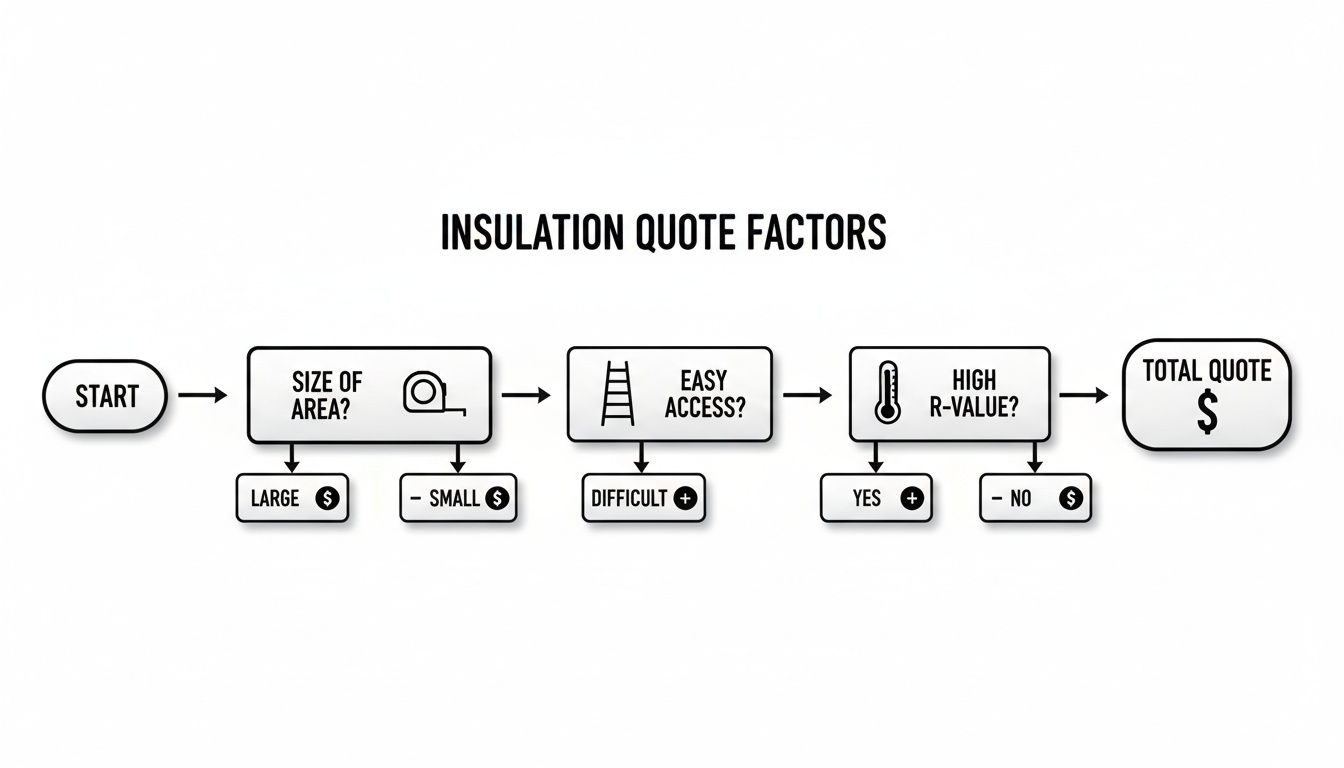
As you can see, a professional quote is a careful calculation based on the unique details of your home.
Open Cell vs Closed Cell Foam: Which Is Right for You?
While the price tag is a major part of the conversation, the performance differences are where you really see why one might be better for a specific job than the other. This table lays out the core distinctions to help you decide.
| Feature | Open Cell Foam | Closed Cell Foam |
|---|---|---|
| Cost | $1.00 – $1.50 per board foot. More budget-friendly. | $2.00 – $3.00 per board foot. A premium investment. |
| R-Value | Around R-3.7 per inch. Requires more thickness for the same R-value. | Around R-6 to R-7 per inch. Higher insulating power in less space. |
| Moisture | Vapor-permeable ("breathable"). Allows moisture to pass through and dry out. | Vapor-impermeable (waterproof). Acts as a true vapor barrier. |
| Structure | Soft, flexible, and spongy. Excellent for sound dampening. | Rigid and dense. Adds structural strength to walls and roofs. |
| Expansion | Expands significantly (up to 100x), filling every gap. | Expands less (around 30-40x) but cures much harder. |
| Best For | Attics, interior walls, and areas where sound reduction is desired. | Basements, crawl spaces, metal buildings, and flood-prone areas. |
Ultimately, it’s about using the right material for the right application. Both are fantastic products when installed correctly in the proper location.
The Trade-Off: R-Value and Thickness
Performance is where you start to see the give-and-take. Closed-cell foam packs a bigger punch, with a high R-value of around R-6 to R-7 per inch. Open-cell foam comes in at about R-3.7 per inch.
So, what does that mean in practice? To get the same total insulation value, you just need a thicker layer of open-cell foam. In a standard 2×4 wall, you're limited on space, so the higher R-value of closed-cell is a clear winner. But in a wide-open attic? We can easily spray 8-10 inches of open-cell, giving you a massive thermal barrier that's incredibly effective and affordable.
Handling Humidity in Florida’s Climate
Down here, moisture is the enemy. How each foam handles water and humidity is probably the most critical factor for a South Florida home.
- Closed-cell foam is essentially waterproof. Its cells are sealed tight, forming a rigid barrier that blocks water. This is why building codes mandate it for flood zones or anywhere that might see direct water.
- Open-cell foam, on the other hand, is vapor-permeable. It won't stop liquid water, but it lets water vapor pass right through. This breathability is a huge plus in our attics and walls because it means moisture can dry out instead of getting trapped, which can lead to rot and mold.
Think about it this way: if you get a small roof leak, water will seep through the open-cell foam and leave a stain on your ceiling, letting you know you have a problem. With closed-cell, that water could get trapped between the foam and your roof deck for years, causing serious damage before you ever notice.
Open-cell lets your house breathe and dry out. Closed-cell creates a complete seal. For most of the house above ground—like attics and walls—that ability to manage vapor is a massive advantage in our climate.
The Right Tool for the Right Job
At the end of the day, one foam isn't just "better." They're different tools designed for different tasks.
We find that open-cell foam is the smarter, more economical choice for:
- Attics and roof decks where you have plenty of room to build thickness.
- Interior walls, where its fantastic sound-dampening ability makes your home noticeably quieter.
- Any project where getting the best performance for your budget is the main goal.
The premium price for closed-cell foam becomes a necessary investment for:
- Crawl spaces or basements that deal with ground moisture.
- Any wall or roof that needs extra structural reinforcement—its rigidity adds real strength.
- Applications in flood-prone areas where it's required by building codes.
By understanding these practical differences, you can see where the lower open cell foam insulation cost delivers incredible value and when the specific strengths of closed-cell are worth the extra investment for your home in Palm Beach Gardens, Jupiter, or Wellington.
Real Project Costs for South Florida Homes
The price per board foot gives you a starting point, but what really matters is how that translates to your actual project. So, let's get down to brass tacks and look at what the open cell foam insulation cost looks like for real homes right here in South Florida.
Running through these common scenarios will help you see how the numbers add up and get a much clearer picture for your own budget. We see these projects every single week in neighborhoods from Jupiter to Wellington.
For every estimate, the math starts with a simple formula:
Area (sq. ft.) x Foam Thickness (inches) = Total Board Feet
This is the core of any honest quote. When you're weighing your options, it's also helpful to see how an insulation project compares to other major upgrades, like what you’d see in a home addition cost estimator. It gives you a sense of the value you're getting for your investment in our local market.
Attic Insulation for a Jupiter Home
Hands down, the single biggest impact you can make against the brutal Florida heat is insulating your attic. For a pretty standard 1,500 sq. ft. attic in a Jupiter home, we create what's called a "conditioned" attic by spraying the foam directly to the underside of the roof deck. This is the modern, high-performance approach.
To hit the R-30 thermal barrier required by today's energy codes—and to deliver the cooling savings you expect—we apply 8 inches of open-cell foam.
- Calculation: 1,500 sq. ft. x 8 inches = 12,000 board feet
- Projected 2026 Cost: $12,000 – $18,000
This isn't just insulation; it's a complete transformation. Your attic goes from a 140-degree oven to a buffer zone that drastically cuts the heat load on your home. Your AC finally gets a break. And because open-cell foam is breathable, it allows any moisture from a small roof leak to dry out instead of getting trapped—a critical feature here.
Walls of a New West Palm Beach Construction
If you're building a new home in West Palm Beach, getting foam in the walls before the drywall goes up is one of the smartest decisions you can make. Let’s say the house has 2,000 sq. ft. of exterior wall cavities framed with standard 2x4s. That gives us a natural depth of 3.5 inches to fill.
Open-cell foam is perfect here. It expands to fill every single void, creating a monolithic air seal around studs, outlets, and pipes that fiberglass batts just can't match.
- Calculation: 2,000 sq. ft. x 3.5 inches = 7,000 board feet
- Projected 2026 Cost: $7,000 – $10,500
The R-13 value is solid, but the real game-changer is the air-sealing and sound-dampening. You'll immediately notice how much quieter the home is. Traffic, lawnmowers, and neighborhood noise just fade away. Managing moisture is also key, and you can learn more about how we ensure open-cell spray foam insulation performs in humid climates in our guide.
Climate-Controlled Garage in Wellington
So many people in Wellington want to reclaim their garage from the oppressive heat. Turning that hot box into a workshop, home gym, or just safe storage is a project we do all the time. For a typical two-car garage with 600 sq. ft. of walls and a 400 sq. ft. ceiling, the goal is a complete thermal and air seal.
Here, we'd spray the walls to 3.5 inches and thicken the application on the ceiling to 5.5 inches to fight the direct sun.
- Wall Calculation: 600 sq. ft. x 3.5 inches = 2,100 board feet
- Ceiling Calculation: 400 sq. ft. x 5.5 inches = 2,200 board feet
- Total Board Feet: 4,300
- Projected 2026 Cost: $4,300 – $6,450
The difference is immediate. We consistently see garage temperatures drop by 20-30 degrees. It stops feeling like you’re walking into a blast furnace and becomes a genuinely usable part of your home.
Metal Workshop in Stuart
Metal buildings are basically ovens in the sun. For a 1,200 sq. ft. workshop out in Stuart, insulation isn't a luxury—it's a necessity to even use the space in the summer. Since these buildings don't have traditional wall cavities, we apply the foam directly to the interior of the metal panels.
We recommend a solid 4 inches of open-cell foam on the walls and roof. This not only insulates but also completely stops condensation, which is a huge problem that causes "sweating" and rust in metal structures.
- Calculation: 1,200 sq. ft. x 4 inches = 4,800 board feet
- Projected 2026 Cost: $4,800 – $7,200
The foam bonds tightly to the metal, forming a seamless, quiet shell. The drumming sound from heavy rain is gone. Most importantly, the interior temperature becomes stable, comfortable, and dry, no matter what the weather is doing outside.
Calculating Your Return on Investment
It’s easy to look at the initial open cell foam insulation cost as just another line item in a home improvement budget. But that's not the right way to think about it. Open-cell spray foam is an investment, and it's one that starts working for you the day it's installed.
The most obvious payback, of course, comes straight from your monthly FPL bill. A home that’s properly insulated and air-sealed simply doesn't have to work as hard to stay cool. For most homeowners, that translates to energy savings between 15% and 40%.
The Financial Payback Period
Your return on investment (ROI) literally begins the second our crew packs up. Those energy savings immediately start chipping away at the upfront project cost. In fact, large-scale studies show U.S. homes with open-cell foam see an average drop of 24% in heating and cooling bills.
Here in South Florida, that can easily mean saving $300 to $1,200 every year. You can dig into the market data yourself over at gminsights.com.
The financial return on open-cell foam is twofold: it cuts your monthly expenses while boosting your home's resale value. Today’s homebuyers are smart—an energy-efficient home with documented low utility bills is a serious advantage in the market.
Let's run some simple numbers. Say a full attic insulation job costs $12,000. If you're saving an average of $80 a month (or $960 a year), the payback period is just over 12 years. That calculation doesn't even factor in rising energy costs, which would only shorten that timeline.
Returns You Can't Put on a Spreadsheet
While the financial return is easy to track, some of the best benefits of open-cell foam are the ones you feel every day.
The first thing people notice is the quiet. The soft, expansive nature of open-cell foam makes it an incredible sound absorber.
- Quieter Rooms: It deadens noise traveling between rooms and floors, making bedrooms, nurseries, and home offices truly peaceful.
- Less Outdoor Noise: The sounds of traffic, landscaping crews, and our famous Florida thunderstorms get muffled, creating a much calmer home.
Another huge return is the improvement in your indoor air quality. By creating a near-perfect air barrier, open-cell foam drastically cuts down on the pollen, dust, and other allergens that sneak into your house. For anyone with allergies or asthma, this isn't a small perk—it's a whole new level of healthy living. If you want to get the most out of these performance benefits, take a look at our guide on how to choose the right R-value for spray foam.
Speeding Up Your ROI with Incentives
You don't have to wait years to see a full return on your investment. Federal and local programs are in place to help you shorten that payback period significantly.
For starters, the Energy Efficient Home Improvement Credit offers a federal tax credit for a portion of the cost of qualified insulation upgrades. On top of that, many Florida utility companies offer their own rebates for projects that prove they lower energy use. When you stack these incentives, you can take thousands of dollars off the net cost of your project, making spray foam one of the smartest upgrades you can give your home.
How We Deliver a Perfect Insulation Job
Getting a handle on the cost of open-cell spray foam is one thing, but making sure that money is well-spent comes down to one person: the installer. At Airtight Spray Foam Insulation, we know a flawless application is everything. We’ve built our entire process around the heat and humidity challenges that are just a fact of life here in South Florida.
It all begins with a straightforward conversation. We’ll come out, take a look at your home, listen to what you’re trying to achieve, and give you a clear, detailed quote—completely free. We want you to be confident in your decision, so we'll walk you through our recommendations and answer every last question.
The Airtight Comfort System
After more than 25 years in this business, we’ve dialed in a process we call the ‘Airtight Comfort System.’ This isn’t some cookie-cutter checklist. It’s our promise to you, a step-by-step method for getting the job done right for your specific home, whether you're in Jupiter, West Palm Beach, or Wellington.
- Thorough Site Preparation: First things first, we protect your home. We meticulously mask off windows, floors, fixtures—anything that isn't getting sprayed. We also make sure every surface is perfectly clean and dry, which is critical for getting the foam to adhere properly.
- Precision Application: Our certified technicians use top-of-the-line equipment to apply a premium, low-VOC open-cell foam. We know how to work around tricky trusses, wiring, and plumbing to create a single, unbroken air seal with zero gaps or weak spots.
- Meticulous Cleanup: We respect your property. Once the foam is in, our crew does a full-scale cleanup. We aim to leave your home even cleaner than we found it.
Your Local Experts in Jupiter and Palm Beach
When it comes down to it, our process is our reputation. We’re not a national chain; we’re South Florida specialists who have spent decades making homes quieter, healthier, and way more efficient.
From the moment you call for a free quote to the final walkthrough, our entire team is focused on one thing: giving you a professional, stress-free experience. We pair the best materials on the market with true craftsmanship to deliver comfort and real energy savings that last.
Ready to see how the Airtight Comfort System can transform your home? We’re here to help you navigate your project with confidence and get the best possible results for your budget.
Frequently Asked Questions About Open Cell Foam
Even after you’ve got a handle on the numbers, it’s natural to have questions about what the installation process actually looks like. We get it. Here are some of the most common things homeowners ask us when we’re out on a job.
One of the first questions is always about safety: “Is this foam safe to have in my house with my family and pets?” Absolutely—once it’s cured. We only use premium, low-VOC (Volatile Organic Compound) materials. While we’re spraying, we make sure the area is fully ventilated. Within 24 hours, the foam hardens into a completely inert, stable plastic that doesn’t release any fumes, so you can be confident in your home’s air quality.
Installation Timeline and DIY Feasibility
People also want to know how long their home will be a work zone. “How long does a typical installation take?” For most residential projects, like insulating an attic, we’re in and out in just 1-2 days. The first day is usually for prep work and clearing out any old, failing insulation. Day two is for the main event: spraying, trimming, and a thorough cleanup.
That quick timeline often leads to the next question: “Can’t I just do this myself?” You’ll see DIY spray foam kits at the big box stores, but honestly, we’ve seen the aftermath of those projects too many times. We strongly recommend leaving this job to the pros.
A professional rig costs tens of thousands of dollars for a reason. It heats and mixes the two-part chemical formula perfectly every time. If that ratio is even slightly off, or if it's applied incorrectly, the foam might not cure properly, leaving you with a sticky, ineffective mess that can even damage your home’s structure.
Hiring an expert isn’t just about convenience; it’s about guaranteeing the performance you’re paying for. You get a perfect air seal and the full energy savings, without the enormous risk that comes with a DIY attempt. It’s about getting the job done right the first time.
Ready to make your home more comfortable and efficient? Airtight Spray Foam Insulation is here to provide a professional, seamless experience from start to finish. Request your free, no-obligation quote today!