Blog
Expert Insulation Installation Services in South Florida

Tired of your AC running nonstop while your house still feels warm and sticky? It’s a classic South Florida story. You’re paying a fortune in cooling bills, but that refreshing, cold air seems to vanish the second the air conditioner clicks off. Professional insulation installation services are the answer, creating a true air seal that finally puts a stop to wasted energy and brings lasting comfort.
Your Guide to an Airtight Home and Lower Energy Bills
Here in South Florida, we lean on our air conditioners nearly every day of the year. But what most people don't realize is how much of that cooled—and expensive—air is leaking right out of their homes. For homeowners everywhere from Jupiter to Wellington, older insulation methods just aren't cut out for our relentless heat and humidity, leaving you with an inefficient home.
A professional installation, especially with a modern material like spray foam, gets to the root of the problem. We’re not just rolling out some fiberglass batts. The goal is to create a seamless, custom-fitted barrier that molds to every single gap and crevice in your home's structure.
More Than Just Stuffing Walls
Think of old-school insulation as a loose, oversized jacket. It provides a little warmth, but wind and cold still find their way in. Spray foam, on the other hand, is like a diver's wetsuit—it clings perfectly to your home's frame, creating an unbroken seal that completely stops air and moisture from getting through.
An airtight seal is the single most important factor in a home's energy efficiency. When you stop uncontrolled air leakage, you allow your HVAC system to finally work smarter, not harder. That means less runtime and a real drop in your energy bills.
This expert approach delivers a whole lot more than just a cooler house. The benefits are clear:
- Slash Your Energy Bills: It’s not uncommon for homeowners to see their cooling costs drop by up to 20% or even more after a professional spray foam install.
- Breathe Cleaner Air: Sealing up those tiny cracks and holes effectively blocks dust, pollen, and other outside pollutants from getting into your living space.
- Stop Moisture and Mold: This is a huge deal in Florida. A proper air seal also functions as a vapor barrier, stopping the moisture intrusion that leads to dangerous mold and mildew growth.
- Enjoy Total Comfort: No more hot spots or rooms that just won't cool down. An airtight home holds a steady, comfortable temperature from one room to the next.
Ultimately, investing in professional insulation installation isn't just an expense—it's a direct investment in your property's health, its long-term value, and the daily comfort of your family.
The table below gives you a quick snapshot of the key advantages you can expect.
Why Professional Spray Foam Installation Pays for Itself
| Benefit | Impact for Your South Florida Property |
|---|---|
| Lower Energy Costs | Your AC runs less often and more efficiently, saving you up to 20% or more on monthly cooling bills. |
| Superior Comfort | Eliminates drafts and hot spots, creating a consistently cool and comfortable environment throughout your home. |
| Moisture & Mold Block | Creates a vapor barrier that is critical for preventing humidity buildup and mold growth in our climate. |
| Improved Air Quality | Seals out dust, pollen, and allergens, leading to cleaner, healthier indoor air for your family. |
| Increased Home Value | An energy-efficient home is a major selling point, adding tangible value and appeal to your property. |
As you can see, the return on this investment goes far beyond just the dollar savings on your FPL bill each month. It's about creating a healthier, more durable, and more comfortable home for the long haul.
Choosing The Right Spray Foam For Your Home
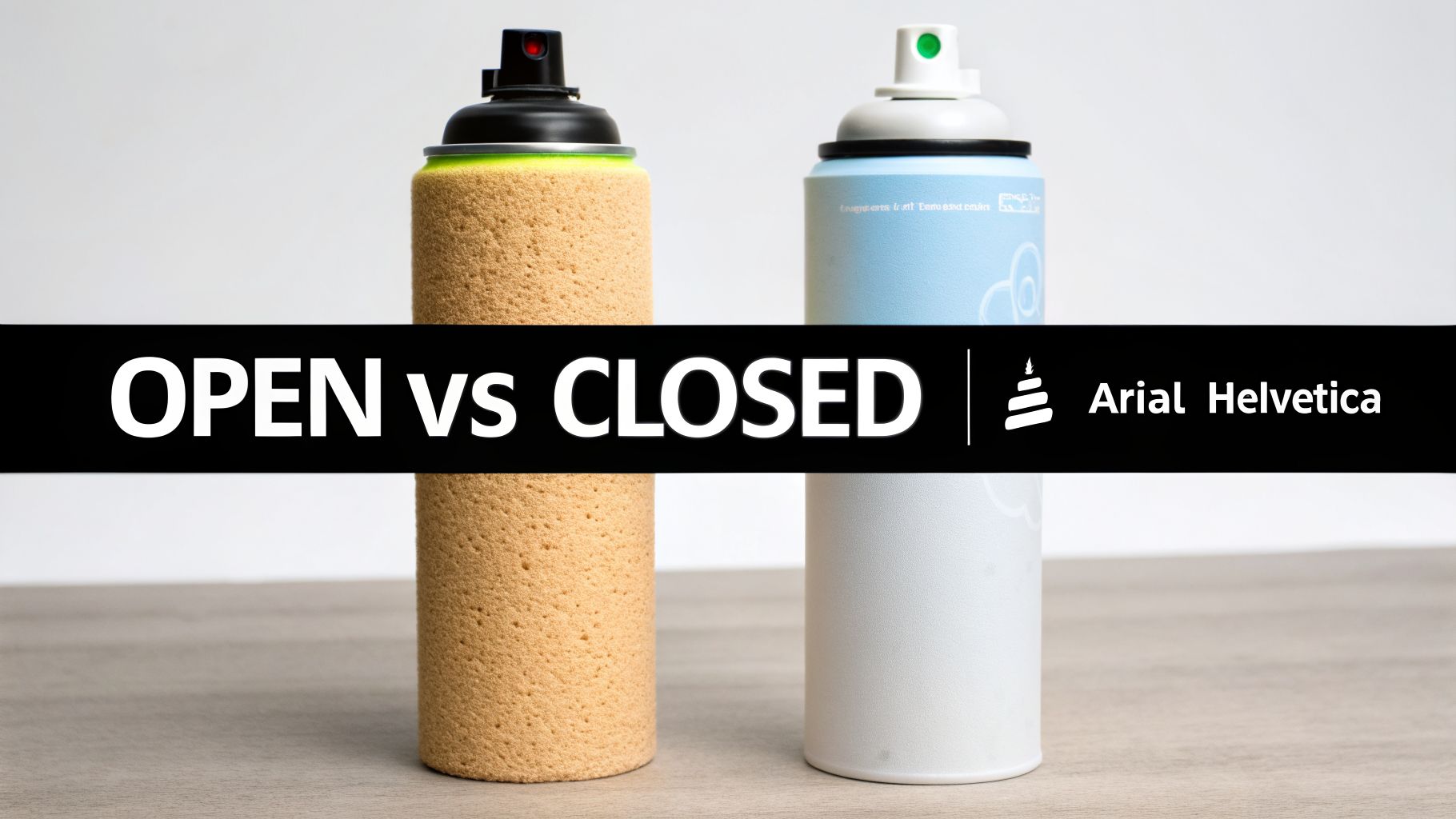
When you start looking into spray foam, you’ll see it’s not a one-size-fits-all product. Getting the results you want—especially when you’re up against South Florida's brutal heat and humidity—comes down to picking the right type of foam. The two main players are open-cell and closed-cell spray foam.
Think of them as two different tools for two very different jobs. One is light and expansive, while the other is dense, rigid, and incredibly strong. The choice you make here affects everything from your energy bills to how well your home handles moisture, and even its structural stability.
Open-Cell Spray Foam: The Sound-Absorbing Sponge
Open-cell foam is the softer, more flexible option. Its structure is made of tiny cells that aren't completely sealed, giving it a sponge-like quality. When applied, it expands in a big way, filling every little gap and crack with ease.
This makes it fantastic for dampening sound. If you're trying to quiet a home office or cut down on noise between floors, open-cell is a great pick for interior walls. But that sponge-like texture means it can also soak up water, making it a risky choice for attics or crawl spaces in our climate without a very specific ventilation plan.
Closed-Cell Spray Foam: The Rigid Moisture Shield
Now, think of closed-cell foam as a solid, waterproof barrier. Its cells are completely sealed and packed tightly together, forming a dense and rigid material. Air and—more importantly for us—moisture can’t get through. It’s a true vapor barrier.
This is the workhorse for South Florida homes. Its water resistance makes it the go-to solution for attics, crawl spaces, and exterior walls where humidity is always trying to get in. It also adds serious structural muscle to your home, acting like a glue that reinforces framing and makes the entire structure more resilient against high winds. That’s a huge benefit come hurricane season.
The ability of insulation to resist heat is measured by its R-value. A higher R-value means better insulation. Closed-cell foam delivers a much higher R-value per inch (around R-6 to R-7) compared to open-cell (around R-3.5), giving you more insulating power in less space.
That higher thermal resistance means your A/C runs less, which translates directly to lower FPL bills. For a deeper look at the science and specific applications, check out our detailed guide on open-cell vs. closed-cell foam.
Open-Cell vs. Closed-Cell Spray Foam at a Glance
So, which one is right for your project? This quick side-by-side comparison should help you decide, whether you're insulating an attic in Jupiter or a new metal building in Stuart.
| Feature | Open-Cell Spray Foam | Closed-Cell Spray Foam |
|---|---|---|
| Structure | Soft, flexible, and sponge-like | Rigid, dense, and solid |
| R-Value/Inch | ~R-3.5 | ~R-6.0 to R-7.0 |
| Vapor Barrier | No, it is vapor-permeable and can hold moisture | Yes, it forms an excellent air and moisture barrier |
| Best For | Sound dampening, interior walls, protected spaces | Attics, exterior walls, crawl spaces, metal buildings |
| Structural Aid | No, it is not a structural material | Yes, it adds significant strength and rigidity |
For most jobs here in South Florida, the benefits are clear. Closed-cell foam is simply the better choice for maximizing energy efficiency and protecting your home from moisture damage.
It's no surprise that demand for professional insulation installation services is climbing. The industry is projected to hit $13.6 billion in revenue by 2026, thanks in part to new energy-efficiency tax credits. Homeowners are seeing the value, driving insulation demand to 5.7 billion pounds in 2024 and achieving savings of up to 20% on energy costs.
Where Spray Foam Insulation Makes the Biggest Impact
Knowing what spray foam is is one thing. But knowing exactly where to apply it for the biggest impact—that's the real game-changer for your home and your energy bills. You can technically apply spray foam almost anywhere, but focusing on the primary battlegrounds against South Florida's punishing heat and humidity delivers the best return on your investment.
Think of your home as a boat in a hot, humid sea. You can have a solid hull, but if you have a few critical leaks, you're constantly bailing water. Our job is to find those leaks and seal them for good. For homeowners from Jupiter to West Palm Beach, these weak points are almost always the same: attics, exterior walls, and garages.
The Attic: The Ultimate Heat Shield
In any Florida home, the attic is ground zero. On a typical sunny afternoon, your roof shingles can easily hit 150°F or hotter. All that heat radiates straight down, turning your attic into a massive oven that sits directly on top of your living space.
Old-school insulation like fiberglass just slows down that heat. Spray foam changes the entire dynamic. By applying closed-cell spray foam directly to the underside of the roof deck, we create what’s known as an unvented (or conditioned) attic.
This strategy is a complete game-changer:
- Stops Radiant Heat at the Source: The foam blocks intense heat right at the roof deck, preventing your attic from ever turning into an oven in the first place.
- Moves Your Home’s Thermal Boundary: Your home's protective thermal envelope now extends to the roofline instead of the attic floor. This brings your AC unit and ductwork inside the conditioned space, allowing them to run far more efficiently instead of fighting to cool air in a 130°F environment.
- Forms a Powerful Moisture Barrier: Closed-cell foam creates a seamless, solid barrier against vapor. This is absolutely critical for stopping our humid air from condensing inside your roof structure, which is a leading cause of mold and wood rot.
A properly insulated attic does more than just lower your FPL bill. It creates a stable, protective buffer zone over your head, drastically improving your home's comfort and the quality of the air you breathe.
Exterior Walls: A Seamless Air Barrier
Your walls make up the single largest surface area of your home, and in most existing homes, they're a huge source of energy loss. Over the years, traditional fiberglass batts slump, tear, and create gaps, letting conditioned air leak out and humid, pollen-filled air seep in.
This is where spray foam really shines. When we inject foam into wall cavities, it expands to fill every last crack and crevice, creating a perfect mold around wiring, plumbing, and wood studs.
The result is a single, solid, airtight wall assembly. It’s the difference between a leaky wooden fence and a solid concrete wall. It completely stops air and moisture from passing through—something batt insulation can never truly accomplish.
For new homes being built in communities like Wellington or Palm Beach Gardens, spraying the walls is quickly becoming the gold standard for high-performance construction. In an older home, it’s one of the most powerful retrofits you can make to improve comfort and slash energy waste.
Garages and Metal Buildings: Taming Unconditioned Spaces
We often forget about the garage, but when it's attached to the house and baking in the afternoon sun, it becomes a massive radiator, pushing heat directly into your home. A professional installation transforms it from a stifling hotbox into a more comfortable, usable space. Simply insulating the garage ceiling or the shared walls can make a significant difference.
This same logic applies even more dramatically to metal buildings. Whether it's a workshop, storage unit, or a "barndominium," a bare metal structure offers virtually zero defense against our climate.
For metal structures, the benefits are huge:
- Stops Condensation Cold: Spray foam bonds directly to the metal panels, preventing warm, moist air from hitting the cooler metal and condensing. This completely stops the "rafter rain" that causes rust and water damage.
- Adds Serious Strength: The rigid, dense structure of closed-cell foam actually reinforces the metal panels, making them stronger and reducing noise from wind and rain.
- Makes Climate Control Possible: With spray foam, you can finally heat or cool the building efficiently, turning a simple metal shell into a true, year-round functional space.
From a sweltering attic in Stuart to a new metal workshop going up, strategically applying spray foam insulation solves the core problems our South Florida climate throws at us, delivering real comfort and efficiency where you need it most.
What to Expect on Installation Day: Our 4-Step Process
When you hire a professional insulation team, you should know exactly what’s going to happen at your property. We believe in total transparency, because a quality installation is about so much more than just spraying foam. It’s a precise, four-step process that hinges on meticulous preparation, expert application, and leaving your space better than we found it.
This process starts long before our spray rig ever shows up. It begins with a thorough on-site assessment. We don’t do ballpark quotes over the phone—we come to your property, whether it's an attic in Palm Beach Gardens or a new metal building in Stuart. We get our eyes on the job, measure everything, and identify any unique challenges to create a bulletproof plan.
Step 1: Protecting Your Property
Once the plan is locked in, our crew shifts into the most critical and often overlooked phase: preparation. This is what truly separates a professional job from an amateur one. Think of it like a master painter taping off a room—the final result is only as good as the prep work.
Our team is obsessive about protecting your home or business. We carefully:
- Cover everything: Floors, furniture, windows, and fixtures near the work area are completely shielded with heavy-duty plastic sheeting.
- Isolate the work zone: We seal off the application area to contain overspray and ensure the rest of your property remains untouched.
- Manage the air: This is non-negotiable for safety. We set up powerful ventilation systems to pull fumes directly outside as the foam cures, keeping the air inside clean.
This level of detailed prep means the job is clean, safe, and causes minimal disruption to your home or business.
Our entire workflow is designed to be systematic, ensuring nothing is left to chance.
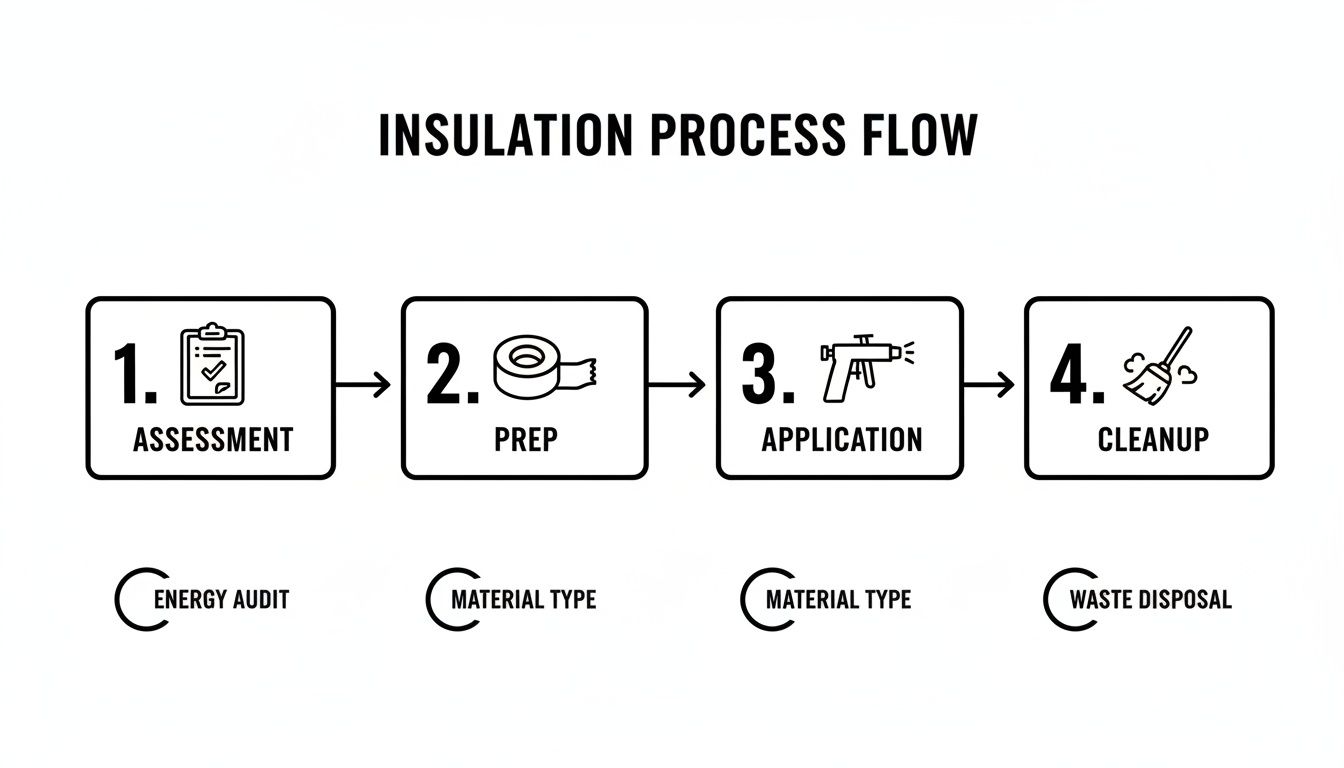
Each step logically follows the last, creating a repeatable process for a perfect, airtight seal every single time.
Step 2, 3, & 4: Application, Quality Control, and Cleanup
With the site fully prepped, our certified technicians get to work. This is where real-world experience makes all the difference. Using specialized equipment, they apply the foam in smooth, even passes. They’re not just pulling a trigger; they are constantly "reading" the foam as it expands to fill every crack and crevice, creating that all-important monolithic air barrier.
We're checking our work in real-time. This means monitoring the foam's temperature and depth to ensure we hit the target R-value and achieve a seamless finish.
A professional spray foam technician knows how to adapt. They adjust their technique on the fly based on the day's temperature and humidity, guaranteeing the foam cures perfectly for maximum performance. That's a skill you can't learn from a manual.
Once the foam has cured (usually within 24 hours), we move to the final steps. Our crew removes all the protective coverings and performs a deep clean of the work area, hauling away all materials and debris. We’re not finished until the site is cleaner than when we arrived.
The project wraps up with a final walkthrough where we inspect the work with you and answer any questions. It’s this start-to-finish accountability that defines a professional job. To see what sets a qualified team apart, learn more about what to look for when choosing spray foam insulation contractors in the South Florida market.
Understanding the Cost and Return on Your Investment
Let's get right to it: the cost. It’s usually the first thing homeowners and contractors ask about, and for good reason. A professional spray foam application is definitely a bigger upfront commitment than throwing in some fiberglass batts, but looking at it as just another expense is the wrong way to think about it.
This is a serious, long-term investment in your property’s performance, comfort, and even its structural health. The final price tag really comes down to a few key things: the type of foam we use (closed-cell costs a bit more), the total square footage we’re covering, and how thick we need to apply it to hit the right R-value for our South Florida climate. A cut-up attic with lots of nooks and crannies will also take more time and care than a wide-open wall.
The Immediate Payback on Your FPL Bill
Where you'll feel the return first is on your FPL bill. It's the most tangible, immediate reward. By creating a nearly perfect air seal, spray foam puts a stop to that constant, losing battle your AC fights every day—where cool air leaks out and punishing heat seeps in. Your air conditioner can finally take a breath instead of running nonstop.
We consistently hear from clients who see their cooling costs drop by 20-30%, and sometimes even more. For a typical home in our area, that’s not pocket change. We're talking hundreds, sometimes thousands, of dollars in real savings every single year.
Think of it this way: you’re already paying for good insulation. You’re just paying for it through an inflated FPL bill every month. By upgrading, you redirect that money back into your own pocket and your property's value.
For a detailed breakdown of what goes into the final price, you can learn more about our spray foam insulation installation cost.
Beyond Energy Savings: The Long-Term ROI
The financial upside doesn't end with a lower utility bill. An energy-efficient home is a huge selling point for today's buyers, which means a professionally insulated property simply has a higher value. To really see how insulation stacks up, it helps to view it within the wider context of home renovation return on investment projects available to property owners here in Palm Beach County.
More than that, you're making a proactive investment in protecting the building itself. Here’s what I mean from years of experience:
- Avoiding Costly Moisture Damage: Closed-cell foam is a beast when it comes to blocking vapor. It stops that relentless humidity from getting into your walls, which is what leads to wood rot, structural decay, and the mold we all dread.
- Preventing Expensive Mold Remediation: If you stop the moisture, you take away the one thing mold needs to grow. This alone can save you from a five-figure remediation bill and a massive headache down the road.
- Increasing Structural Integrity: This is something a lot of people overlook. The rigid structure of cured closed-cell foam literally adds strength to your wall assemblies and roof deck, giving your home an extra layer of resilience against high winds during hurricane season.
The demand for these benefits is undeniable. The drywall and insulation installation market is a massive industry, projected to hit $122.2 billion by 2026. This growth is driven by a large, skilled workforce, which means homeowners have access to qualified and competitive installers. Investing in quality insulation isn’t just some passing trend; it’s a smart financial move backed by a strong and growing industry.
How to Choose the Right Installer in South Florida
Let's be blunt: the quality of your spray foam is only half the equation. The installation itself is the other, more critical half. The best material in the world is useless if it’s put in by the wrong crew. A top-notch application is what gets you those energy savings and that crucial moisture barrier. A bad job? That’s a recipe for expensive problems down the road.
Finding the right contractor in South Florida isn't just about getting a few quotes and picking the cheapest. It's about finding a real partner who understands our unique climate, protects your home as if it were their own, and will be around to stand by their work for years to come. Think of it less like hiring a handyman and more like selecting a surgeon for your home. You need to check their credentials.
Verifying Licenses and Insurance
This is your first, non-negotiable step. Don’t even have a conversation with a contractor who can’t immediately prove they are licensed and insured. In Florida, any contractor worth their salt must be licensed by the state. You can and should ask for their license number and check it yourself on the Florida Department of Business and Professional Regulation (DBPR) website. It's a simple search that tells you they’ve met the state’s minimum standards.
Insurance is just as critical. They need both General Liability and Workers' Comp.
- General Liability Insurance is what protects your home. If a sprayer hose breaks and damages your drywall, or an accident happens on-site, their policy covers it—not your homeowner's insurance.
- Workers' Compensation protects you if one of their team members gets hurt on your property. Without it, you could be on the hook for their medical bills.
Don’t just take their word for it. Ask for the insurance certificates. A professional, legitimate company will have them ready and will never hesitate to send them over. This is your first line of defense against risk.
Experience and Local Expertise
South Florida isn't like the rest of the country. Our combination of relentless heat and suffocating humidity is a unique challenge. An installer from up north simply won't have the hands-on experience to understand what our homes go through. You need a team that lives and breathes South Florida building science.
A truly qualified local installer knows our climate is the enemy. They’ve spent years learning exactly how to apply spray foam to create a perfect, seamless air and vapor barrier—the kind that stops condensation and mold before it can even start in homes from Jupiter to Wellington.
When you're talking to potential contractors, get specific. Ask them about their work on homes just like yours in Palm Beach Gardens, West Palm Beach, or Stuart. Their answers will tell you everything you need to know about their local expertise. It’s the difference between a job done, and a job done right for our area.
Checking References and Warranties
Finally, do your homework on their history. A good contractor will have a long list of happy customers. Ask for recent, local references that you can actually call. Talking to a real person about their experience gives you the kind of unfiltered feedback you can’t find in a slick brochure.
Then, talk about the warranty. There are two parts to this: the material warranty (which usually comes from the foam manufacturer) and the workmanship warranty. A contractor who offers a clear, comprehensive labor warranty is showing you they're confident in their skills and plan to be in business long enough to back it up. That's peace of mind.
The U.S. insulation industry is massive, supporting a skilled workforce of over 527,000 installers. That includes 246,695 specialized contractors dedicated to this trade. It’s a big industry, and you can explore more economic contributions of insulation to see its full impact. With so many options out there, using this checklist will help you cut through the noise and find a true professional.
Frequently Asked Questions About Spray Foam Insulation
Even after you’re sold on the benefits, it’s completely normal to have a few more questions before committing. Digging into the practical details is what gives you the confidence to make the right call. Here are some honest, straightforward answers to the questions we hear most from homeowners around Palm Beach County.
How Long Does Spray Foam Insulation Last?
Think of it as a one-and-done investment. When spray foam is installed the right way by a certified professional, it’s engineered to last for the entire life of your building.
Unlike traditional insulation like fiberglass that can sag, settle, and lose its effectiveness over the years, spray foam is different. It’s an inert, rigid polymer. That means it won’t compress, break down, or absorb moisture, so it holds its shape, R-value, and air-sealing power for good.
Is Spray Foam Insulation Safe for My Family?
Absolutely—once it has fully cured. During the application itself, our crews follow strict safety protocols. We use powerful ventilation systems and full personal protective equipment (PPE), and we require the area to be vacant.
Once the foam has cured, which usually takes about 24 hours, it becomes a stable, inert plastic. It's completely non-toxic and doesn't "off-gas," making it perfectly safe for your family, kids, and pets.
The real key to safety is professional installation. Curing is a chemical reaction that has to be managed perfectly. Our certified technicians make sure the foam is mixed at the precise ratio and temperature to guarantee a complete, stable, and safe cure.
When you're vetting a pro, take a look at how they present themselves. A company that invests in clear communication and transparent business practices, like some of the ideas in these contractor marketing tips, is often a sign of a reputable business that’s serious about its work and its customers.
Can I Just Install Spray Foam Myself?
While you can find small DIY spray foam kits for tiny jobs like sealing around a single pipe, they are absolutely not meant for insulating an entire attic, wall cavity, or garage. Professional installation isn't just a recommendation; it's critical.
Here’s why:
- Specialized Equipment: We use high-pressure machinery that heats and mixes the two chemical components at a precise ratio. DIY kits can't come close to this, which often leads to the foam not curing properly.
- Technique and Experience: Our technicians are trained to apply the foam to achieve a perfectly consistent thickness for the target R-value. This creates a complete air seal without overfilling cavities, which can cause its own set of problems.
- Safety Risks: A botched DIY job can lead to poor performance, lingering chemical smells, and even structural damage to your home if the foam expands incorrectly and warps drywall or framing.
At Airtight Spray Foam Insulation, we stand by doing the job right the first time, every time. Our experienced team brings the expertise and professional-grade equipment needed to ensure your home is sealed safely and effectively for decades of comfort and savings.
Ready to see how our Airtight Comfort System can transform your property? Request your free, no-obligation quote today!