Blog
Foam Versus Cellulose Insulation A South Florida Guide

When you're fighting South Florida's relentless heat and humidity, the old debate of foam versus cellulose insulation isn't much of a debate at all. From my years in the field, I can tell you there's a clear winner when it comes to sheer performance. While both materials insulate, spray foam’s ability to create a complete air seal and block moisture puts it in a different league for our climate. This isn't just about comfort; it's about protecting your home and your wallet.
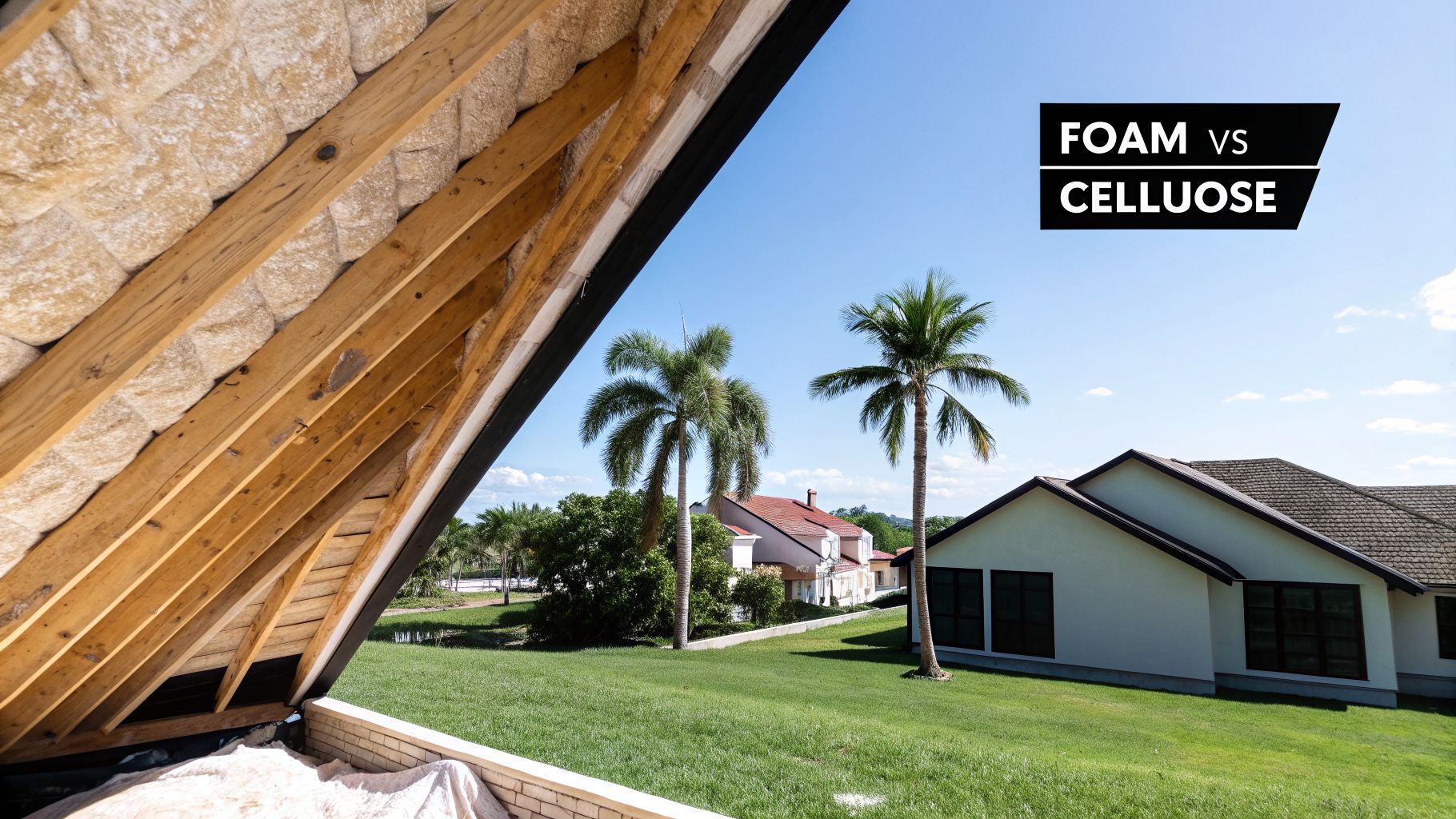
Choosing The Best Insulation For Your South Florida Home
Picking the right insulation isn't just about comparing R-values on a spec sheet. It's about choosing a complete system that can stand up to our unique challenges. Here in South Florida, where humidity is a constant battle and every bit of energy efficiency counts, the choice you make for your attic, walls, and roof is foundational. It directly impacts your home's comfort and its long-term health.
The market trends back this up. The foam insulation sector, valued at USD 31.81 billion in 2026, is on track to hit USD 40.39 billion by 2031. It’s no surprise that polyurethane foams—which is what spray foam is—accounted for a massive 40.74% market share back in 2025. The reason is simple: you get high R-values and a superior application that seals everything up tight.
Understanding the best insulation for southern climates is the key to creating an effective thermal and moisture barrier. It’s about more than just keeping the heat out; it’s about managing the air and moisture that come with it.
Quick Look Foam Vs Cellulose At A Glance
To get a quick sense of the key differences, this table gives you a snapshot of how spray foam and cellulose really compare on the features that matter most. Think of this as the high-level summary before we dive deeper.
| Feature | Spray Foam Insulation | Cellulose Insulation |
|---|---|---|
| Air Sealing | Excellent (creates a monolithic air barrier) | Poor (requires separate air sealing) |
| Moisture Control | Excellent (closed-cell is a vapor barrier) | Poor (absorbs moisture) |
| Structural Support | Yes (closed-cell adds rigidity) | No (provides no structural benefit) |
| Longevity | 50+ years (does not settle or degrade) | 20-30 years (can settle and compact) |
This quick comparison sets the stage for a much deeper conversation. For homeowners and builders from Jupiter to West Palm Beach, these differences are what determine long-term value and protection.
Analyzing Real-World Performance Metrics
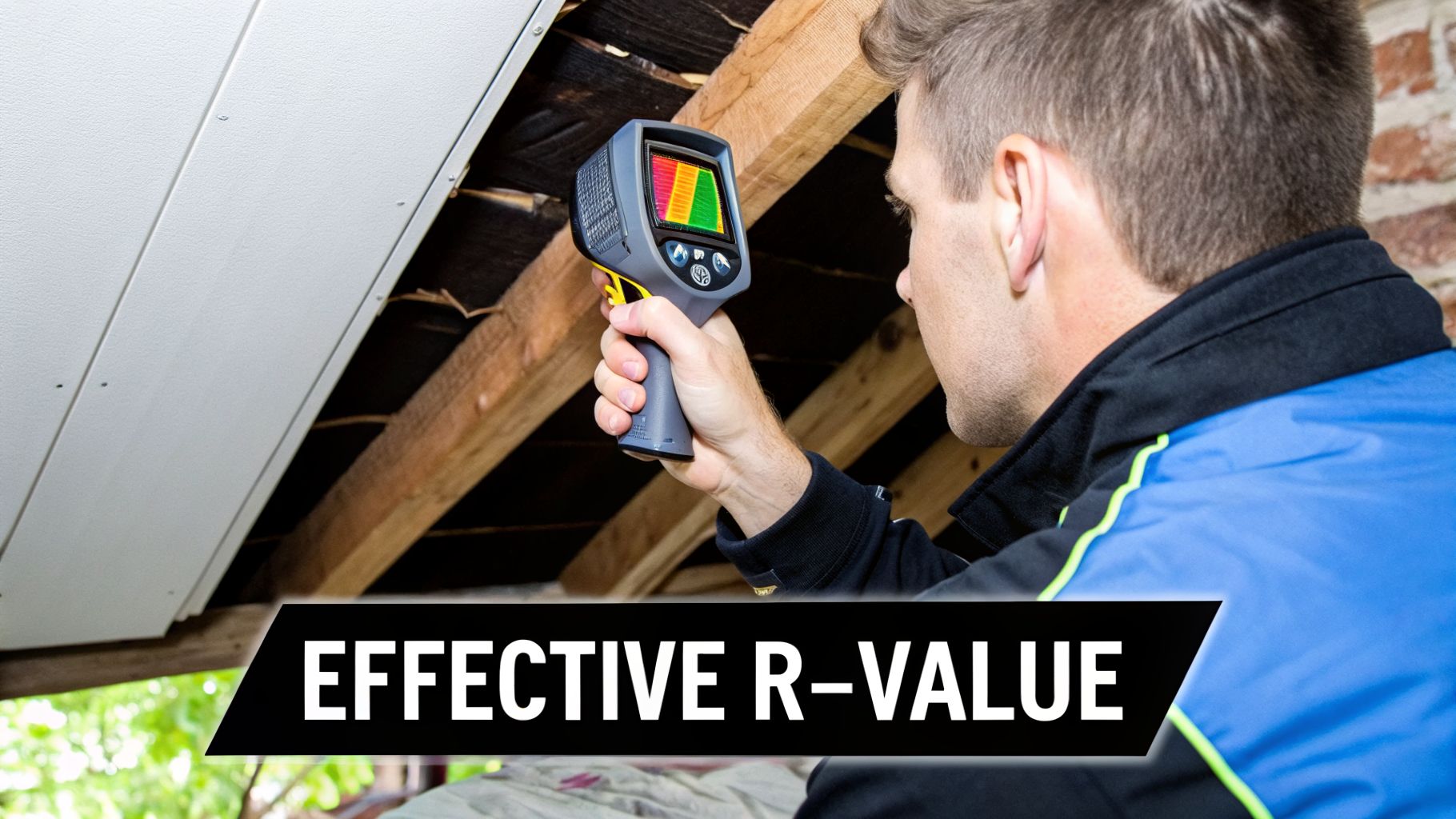
When you're looking at insulation, the numbers on a product sheet only tell you part of the story. In a real-world setting like a South Florida attic, the true performance metrics change dramatically based on how a material handles our oppressive heat, air movement, and humidity. This is where we need to talk about effective R-value.
A lab can measure thermal resistance in a perfectly controlled box, but your home is anything but. Air leaks, moisture, and tiny installation gaps can gut an insulation's stated R-value. This is a weakness I see all the time in cellulose jobs, and it often goes unnoticed until the homeowner is staring at a sky-high FPL bill.
Effective R-Value And The Power Of An Air Seal
Spray foam’s biggest advantage, hands down, is its ability to create a seamless, monolithic air seal. When we spray it, the foam expands to fill every single crack, seam, and penetration. It completely stops air from moving through your building envelope. This continuous barrier shuts down thermal bridging—where heat sneaks past insulation through the wood studs—and stops convective loops dead in their tracks.
Cellulose, because it’s a loose-fill material, simply can't do this on its own. It settles into the cavities but doesn't actually stick to the surfaces, leaving microscopic gaps around every pipe, wire, and stud. Conditioned air bleeds out, and hot, humid outdoor air pushes its way in, forcing your AC to run constantly.
Key Differentiator: Spray foam is your insulation and your air barrier in one application. Cellulose only insulates. To get it to perform anywhere near foam, you need a separate, painstaking air-sealing job, which adds significant cost and complexity.
This two-in-one function is what gives spray foam its superior effective R-value. Even when the per-inch numbers look similar on paper, foam’s ability to stop air leakage means it works far better in the real world—especially in our windy and brutally humid climate.
Moisture Management: The Critical Test In South Florida
Down here, humidity tests insulation just as much as heat does. This is where the performance gap between foam and cellulose becomes a chasm.
Closed-cell spray foam is a non-permeable vapor barrier. It flat-out rejects bulk water and resists moisture vapor, stopping it from passing through your roof deck or walls. This is absolutely critical for preventing the kind of condensation that leads to rot and mold inside your home's structure.
Open-cell foam, while not a full vapor barrier, is what we call vapor-permeable. It lets moisture vapor pass through it instead of trapping it. If you get a roof leak, water will move through the foam and show you where the problem is. Once the leak is fixed, the foam dries out completely and keeps its insulating power.
Cellulose, on the other hand, is hygroscopic. It’s made from paper, so it naturally absorbs moisture right out of the air. In a place that’s always humid like South Florida, cellulose can get heavy with water vapor. This makes it compact and lose its loft, which kills its R-value and creates uninsulated voids at the top of wall cavities. Our guide to dense pack cellulose R-value gets into the weeds on this exact problem.
A Head-To-Head Performance Comparison
When you dig into the data on energy savings, the numbers clearly favor spray foam. A recent analysis shows spray foam delivers R-3.5 to R-7 per inch—open-cell is on the lower end of that range, while closed-cell hits the top. By comparison, cellulose usually sits between R-3.2 and R-3.8 per inch.
But the real story is its air-sealing power, which can slash heating and cooling costs by 25-40%. That blows away the 10-20% savings you might see with a typical cellulose installation. To see how that translates to your own bills, it helps to know how to calculate home energy consumption and pinpoint where your energy dollars are going.
To make it even clearer, this matrix breaks down how each material really stands up to real-world conditions.
Foam vs Cellulose Detailed Performance Matrix
| Performance Metric | Spray Foam (Closed-Cell) | Spray Foam (Open-Cell) | Blown-In Cellulose |
|---|---|---|---|
| Effective R-Value | Highest; air sealing maximizes thermal performance. | High; air sealing provides excellent results. | Moderate to Low; compromised by air leakage and settling. |
| Moisture Resistance | Excellent; acts as a full vapor barrier. | Good; allows material to dry out if wet. | Poor; absorbs and holds ambient humidity. |
| Sound Deadening | Good; rigid structure blocks sound transmission. | Excellent; soft, open structure absorbs sound waves. | Very Good; dense packing dampens noise effectively. |
| Longevity | Excellent; rigid and inert, does not degrade. | Excellent; flexible and stable, does not settle. | Fair; prone to settling and compaction over time. |
At the end of the day, when you analyze the foam versus cellulose debate for a South Florida home, the data and real-world results all point to spray foam. Its unique ability to create a seamless air and moisture barrier gives you a level of performance that cellulose just can’t touch in our demanding climate.
Understanding the Installation and Structural Benefits
You can have the best insulation material in the world, but if it’s installed incorrectly, it just won’t perform. The application process is everything—it dictates the final performance, how long the insulation lasts, and can even impact the structural integrity of your home. When you put foam and cellulose side-by-side, their installation methods reveal just how fundamentally different they are.
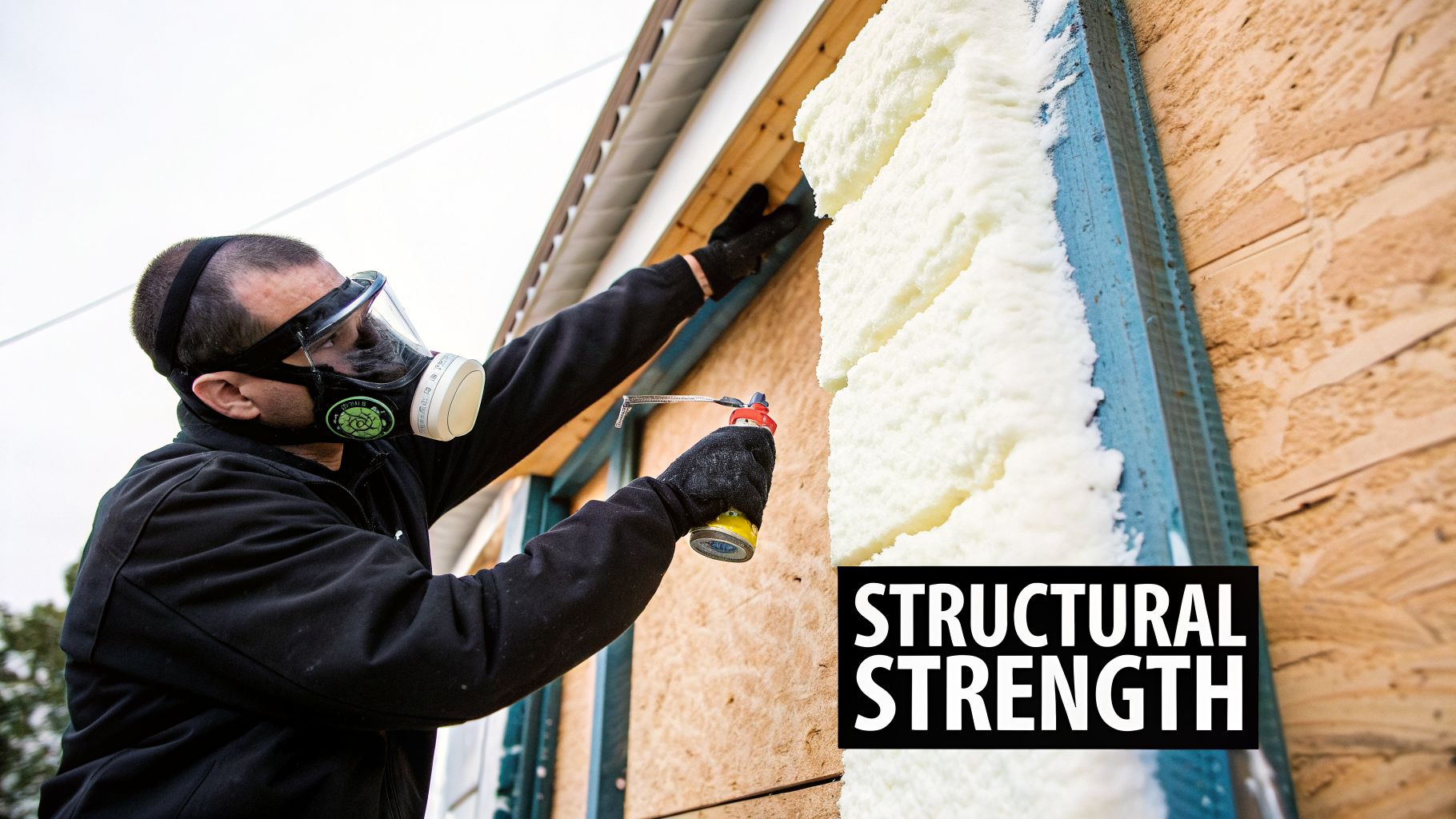
Applying spray foam is a highly technical job that requires certified professionals. It's not a DIY weekend project. The process starts with meticulous prep work, masking off any surfaces to protect them from overspray. Our technicians suit up in full personal protective equipment (PPE) to apply the two-part liquid polymer, which expands in an instant when it hits a surface, filling every single crack, crevice, and seam.
It’s this rapid expansion that gives spray foam its edge. It creates a seamless, monolithic barrier that bonds directly to the substrate—becoming one solid unit with your walls or roof deck. This isn’t just about filling a space; it’s about creating a perfect, custom-fit seal that requires real expertise to get the thickness and consistency just right.
The Cellulose Installation Method
Cellulose, on the other hand, is a loose-fill material. Think of it like shredded paper, which is basically what it is. A crew uses a large hose to blow these recycled paper fibers into an open attic or attempts to "dense-pack" them into enclosed wall cavities. While it's a common method for filling up big, open spaces, it comes with some serious drawbacks we see all the time.
For one, the installation can get incredibly dusty as fine particles of the treated paper go airborne. But the bigger issue is achieving a perfectly uniform density. It’s a real challenge. If the cellulose isn’t packed in tightly enough, it’s guaranteed to settle over time.
Here's the critical takeaway for homeowners: even a small amount of settling—as little as 10-20% over its lifespan—creates huge thermal gaps at the tops of your walls. These gaps become superhighways for heat, completely undermining the insulation's purpose and erasing any energy savings you hoped for.
This settling problem is a common point of failure for cellulose, and fixing it means paying someone to come back and "top off" the insulation. Spray foam, because it cures into a rigid or semi-rigid solid, will never settle, sag, or compact. The performance you get on day one is the same performance you'll have decades from now.
Structural Reinforcement: A Key Benefit for South Florida
Beyond just keeping your house cool, the physical properties of these materials offer very different benefits—especially here in South Florida, where hurricane-readiness is non-negotiable.
Cellulose is simply a cavity filler. It adds a lot of weight to your structure but offers absolutely zero structural reinforcement. It just sits there passively inside the framing, doing nothing to help your home stand up to the powerful forces of high winds.
Closed-cell spray foam, however, is a different story. Its dense, rigid structure and powerful adhesive qualities do something remarkable. When applied to the underside of a roof deck or inside wall cavities, it essentially glues the sheathing, studs, and joists together into a single, solid component.
This bonding action dramatically increases the structure's racking strength—its ability to resist the twisting, lateral forces from hurricane-force winds. In fact, studies have shown closed-cell spray foam can boost a wall assembly’s racking strength by as much as 300%. It turns your walls and roof into a stronger, more resilient unit, giving you an extra layer of protection when it matters most. This same property also makes it a fantastic moisture barrier insulation, locking out wind-driven rain.
When comparing foam versus cellulose, this structural enhancement is a true game-changer for any Florida property owner. It’s an integrated benefit that cellulose simply can't provide, making closed-cell foam the superior choice for both energy efficiency and storm resilience.
Calculating Your Long-Term Return on Investment
When you're comparing quotes for foam versus cellulose, it's easy to get fixated on the upfront price. I see it all the time. But looking at that initial number is like comparing two cars based only on their sticker price, completely ignoring fuel efficiency, maintenance, or resale value. A smart investment goes deeper than that—it’s about the total cost of ownership and your long-term return.
The price tag for spray foam isn't just for insulation material. It’s a comprehensive package. When we install spray foam, you’re getting your thermal barrier, your air barrier, and—with closed-cell foam—your vapor barrier, all in one shot. With cellulose, each of those is a separate line item. You have to pay for the cellulose itself, then add a whole separate, labor-intensive air-sealing process just to get in the same ballpark as foam's performance.
Beyond The Initial Quote: Total Cost Of Ownership
The real financial picture isn’t on the initial invoice; it's something you see unfold over years. Spray foam’s superior performance translates directly into lower monthly bills and a healthier, more durable home. Because it creates an almost perfect air seal, your HVAC system doesn't have to fight a losing battle to keep your home comfortable.
This efficiency delivers two huge financial wins:
- Lower Monthly Energy Bills: By stopping that precious conditioned air from leaking out and preventing hot, humid air from creeping in, spray foam can slash your heating and cooling costs by 25-40%. That’s a real, recurring savings you'll see on every single FPL bill.
- Reduced HVAC Wear and Tear: In a leaky, poorly sealed house, the AC runs almost nonstop. That constant strain leads to more breakdowns and a shorter lifespan for your equipment. By cutting that workload, spray foam helps your expensive system last longer, pushing those costly replacement and repair bills far down the road.
On top of that, closed-cell spray foam’s ability to block moisture prevents the kind of hidden rot and mold that can cost thousands to fix. Cellulose, being an absorbent material, simply carries a much higher risk of moisture-related problems here in our climate.
The investment in spray foam is an investment in your home’s operational efficiency and structural health. The monthly energy savings don't just offset the initial cost; they create a positive cash flow over the life of the home.
Calculating The Payback Period: A Wellington Home Example
Let's break this down with a real-world scenario. Take a typical 2,000 sq. ft. single-family home in Wellington, Florida. The owner's average FPL bill is $350 a month, and the attic insulation is old and has settled badly.
He gets two quotes to upgrade his attic:
- Cellulose Insulation: The upfront cost is $3,000. Based on typical performance with some air sealing, this is projected to cut his energy bill by about 15%.
- Closed-Cell Spray Foam: The upfront cost is $7,000. Because it delivers superior air sealing and R-value, this is projected to cut his energy bill by 30%.
Let's look at the monthly savings and payback for each option.
Cellulose Financials:
- Monthly Savings: $350 x 15% = $52.50
- Payback Period: $3,000 / $52.50 per month = ~57 months (4.8 years)
Spray Foam Financials:
- Monthly Savings: $350 x 30% = $105.00
- Payback Period: $7,000 / $105.00 per month = ~67 months (5.6 years)
At first glance, it looks like cellulose pays for itself faster. But that simple math misses the most important long-term factors. The savings from spray foam are locked in for the life of the house; the material doesn't degrade, settle, or lose performance. That cellulose, however, will almost certainly settle over the next decade, reducing its effectiveness and either extending its true payback period or forcing a costly "top-off" job.
Plus, the closed-cell foam adds structural strength to the roof deck and provides robust moisture protection that increases the home's resale value and resilience—financial benefits that don't show up in a simple payback calculation. When you look at the whole picture—energy savings, HVAC longevity, moisture protection, and property value—the higher initial cost of spray foam reveals itself as the smarter long-term investment.
Health, Environment, and Pests: What's Really in Your Walls?
When you’re choosing insulation, you’re not just thinking about R-value; you’re thinking about the health of your home and your family. I’ve been in countless attics and crawl spaces over the years, and I’ve seen firsthand how insulation choices impact air quality and even pest problems. People ask me all the time about the chemicals in foam versus the "natural" quality of cellulose. Let's break it down based on what we actually see in South Florida homes.
There’s a lot of chatter online about spray foam and chemicals. The truth is, modern spray foams are a world away from the formulas used decades ago. We exclusively use low-VOC (Volatile Organic Compound) spray polyurethane foam (SPF). The key is professional installation. When we apply it, we follow strict ventilation protocols. Once the foam cures—usually within a few hours—it becomes a solid, inert plastic. It’s stable, it doesn’t off-gas, and it’s completely non-toxic, giving you clean indoor air for the long haul.
Air Quality and Material Breakdown
Cellulose gets a lot of points for being made from roughly 85% recycled paper, which is great from a recycling perspective. However, what I've seen in the field raises some real health considerations. The installation process kicks up a massive amount of dust—a mix of fine paper particles and the borate chemicals used for fire and pest treatment. This isn't just messy; it can be a real issue for respiratory health, and that dust has a knack for finding its way into your living space.
More importantly for us here in Florida, cellulose is just paper. If a roof leak develops or high humidity sets in, that cellulose will act like a sponge. A wet, paper-based material packed into a dark attic is the perfect recipe for mold and mildew, which can seriously tank your home’s air quality.
I’ve seen it happen time and time again: a small, undetected leak turns a cellulose-filled attic into a major mold remediation project. While cellulose starts out "green," cured spray foam delivers healthier long-term air. It’s an inert material that won't absorb moisture, grow mold, or break down into dust.
A Head-to-Head on Pests and Fire
In South Florida, keeping pests out is a constant battle. This is one area where the difference between these two materials is night and day.
- Cellulose: It’s treated with boric acid, which does a decent job of deterring insects like roaches and termites that try to eat or nest in it. But here’s the thing: it’s just loose material. It doesn't actually stop them from getting in. I've seen rodents plow right through it, creating tunnels and displacing the insulation.
- Spray Foam: This is where foam really shines. Once cured, it’s a hard, dense plastic that offers zero food value to any pest. More critically, it forms a complete air seal, filling the tiny gaps and cracks that bugs and rodents use as their superhighways into your home. It creates a solid, impassable barrier they can't chew through, nest in, or get past.
When it comes to fire safety, both materials are required by code to be safe. Cellulose is treated with borates to make it char instead of burn. Spray foam contains fire retardants and is installed behind a thermal barrier (like drywall), creating a fire-resistant assembly. When a professional does the job right, neither material is a fire hazard.
Matching the Right Insulation to Your Project
The whole "foam versus cellulose" debate can feel abstract until you start looking at a real job site. The advice you find online often doesn't cut it when you're standing in a West Palm Beach attic or planning a new build in Stuart. The truth is, the right choice comes down to the specific application, your budget, and what you expect from your home in the long run.
Forget generic feature lists. Making the right call means thinking in terms of real-world scenarios. The best insulation for a historic home is rarely the same as for a new build, and what works in a standard attic can be a disaster in a metal building. Let's walk through the most common projects we tackle and pair them with the insulation that actually gets the job done.
Unvented Attics and Roof Decks
For unvented attics in our hot, humid climate, there's one clear winner: closed-cell spray foam. When we apply it directly to the underside of the roof deck, we move the home's entire thermal and air boundary up to the roofline. This simple change brings your attic into the conditioned space, slashing attic temperatures and stopping that oppressive radiant heat from penetrating your living areas.
Cellulose just isn't an option here. It would soak up condensation from the roof deck like a sponge, quickly leading to mold, rot, and complete insulation failure. While open-cell foam can be used, we almost always recommend closed-cell for its added structural strength and its unmatched ability to block moisture—making it the gold standard for a resilient, high-performance roof.
Soundproofing Interior Walls
If your main goal is creating a quiet home office or deadening the noise between the kids' playroom and the living room, the conversation changes. This is where open-cell spray foam really shines.
Its soft, flexible consistency is incredible at absorbing airborne sound waves, making rooms noticeably quieter. We dive deeper into this specific benefit in our guide to open-cell vs closed-cell insulation. While dense-pack cellulose also offers decent sound dampening, open-cell foam gives you excellent sound control and a perfect air seal inside the wall, something cellulose simply can't match.
Decision Point for Homeowners: Are you primarily solving a thermal and moisture problem, or is sound control your top priority? For South Florida's climate challenges, closed-cell foam is usually the answer. For interior peace and quiet, open-cell foam is a fantastic upgrade.
When Is Cellulose Even a Consideration?
Honestly, in South Florida, the use cases for cellulose are few and far between. The only time it might come up is for a low-cost "top-up" in an existing vented attic that already has a layer of old fiberglass or cellulose. In that very specific case, blowing in more cellulose is a cheap way to add a bit of R-value.
But this approach comes with major compromises. You aren't fixing any air leaks, which are a huge source of energy waste. You're also adding more material that's a magnet for moisture, will compact over time, and can attract pests. For most people, it's a temporary patch, not a genuine long-term solution.
This decision tree can help you think through the health and environmental factors when choosing your insulation.
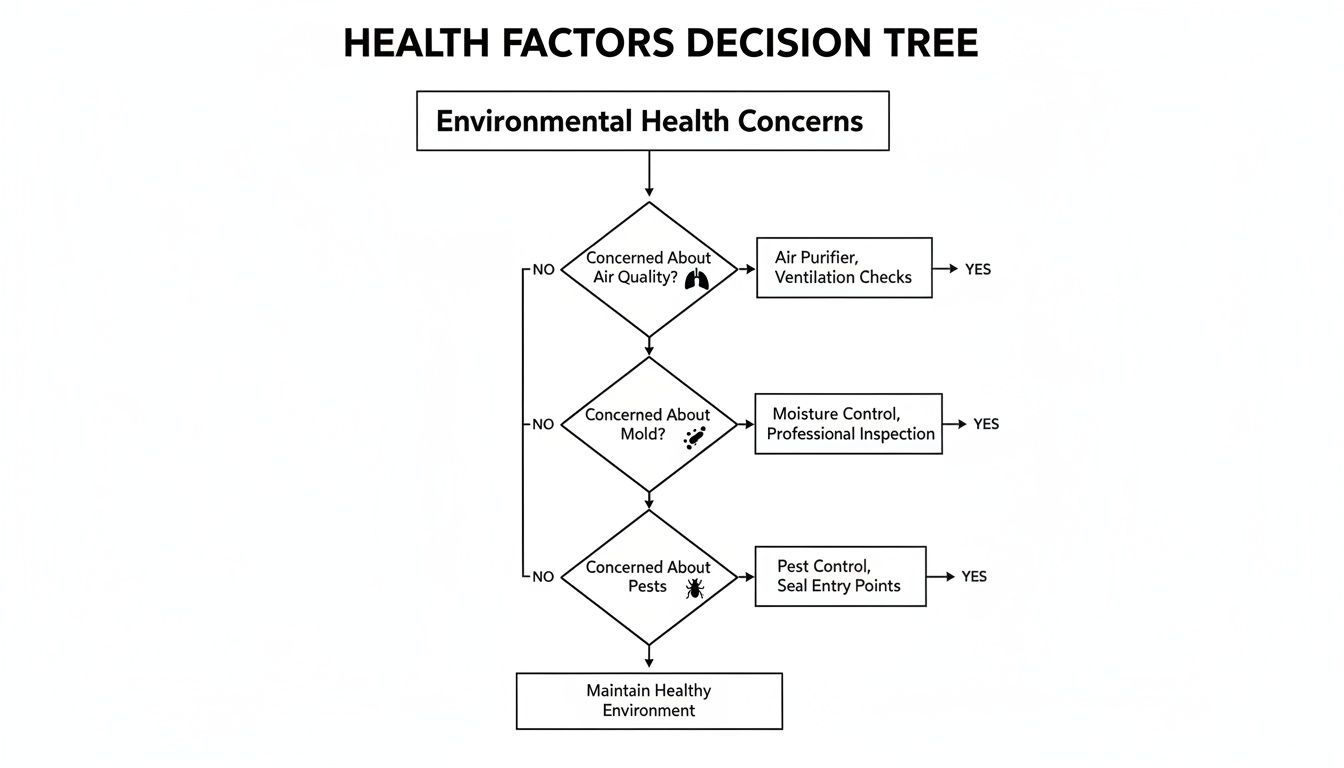
As you can see, when it comes to preventing issues with air quality, mold, and pests, spray foam consistently provides a stronger, more permanent solution.
Project-Based Insulation Checklist
To make it even simpler, here’s a quick checklist that matches the right material to the most common projects we see around South Florida.
- New Custom Home: Go with closed-cell foam for the roof deck and exterior walls. It's the premium choice for top-tier energy efficiency, added structural strength, and total moisture control.
- Existing Home Attic Upgrade: Closed-cell spray foam on the roof deck to create an unvented attic will give you the best performance and return on investment.
- Commercial Metal Building: Closed-cell spray foam is non-negotiable. It stops condensation dead in its tracks, creates an airtight seal, and bonds perfectly to the metal panels.
- Historic Home Retrofit: This can sometimes require a hybrid approach. Use spray foam in attics and crawl spaces where you can, but be thoughtful about wall cavities to preserve original materials.
At the end of the day, when you compare foam to cellulose for almost any project in our region, spray foam's ability to act as a thermal, air, and moisture barrier all in one application makes it the far superior long-term investment.
Common Questions We Hear From Homeowners
Even after comparing spray foam and cellulose side-by-side, you probably still have a few questions. That’s normal. Here are some of the most common ones we get from homeowners across South Florida, with straight answers based on our years of experience in the field.
Can You Install Spray Foam in an Existing Home with Drywall?
Yes, we do it all the time. While it’s certainly simplest in new construction when the walls are open, retrofitting spray foam into an existing home is very common.
For accessible areas like attics and crawl spaces, the application is straightforward. When it comes to finished walls, we have proven methods—like a "drill-and-fill" technique or carefully removing and replacing small sections of drywall—to get a complete, airtight seal without tearing your home apart.
Does Cellulose Insulation Really Settle Over Time?
It absolutely does, and this is one of the biggest long-term drawbacks we see with cellulose. Over the years, it can compact by as much as 20%, especially when installed in vertical wall cavities.
This settling creates significant gaps at the top of your walls, leaving a thermal highway for Florida’s brutal heat to stream right into your home. While a "dense-pack" installation can help reduce the issue, it can't eliminate the risk entirely. You're left with a product that degrades in performance over time.
Once spray foam cures, it’s not going anywhere. It forms a solid, rigid structure that will never sag, settle, or lose its shape. The R-value and air seal you get on day one are the same ones you’ll have decades from now.
Which Insulation Is Better for Soundproofing?
Both materials offer some sound reduction, but from our experience, open-cell spray foam is the clear winner for creating truly quiet spaces.
Its soft, pliable structure is fantastic at absorbing and deadening airborne noises—like conversations, TVs, or traffic. This makes it the ideal choice for insulating interior walls around home offices, media rooms, or bedrooms where you want to block out noise from the rest of the house.
Is the Higher Cost of Spray Foam Really Worth It in Florida?
For homeowners in South Florida, the answer we see day in and day out is a resounding yes. Thinking of the higher upfront price as just a "cost" is the wrong way to look at it; it’s an investment that pays for itself.
The superior air sealing and moisture control you get with spray foam translate into massive energy savings, prevent expensive mold and rot repairs, and make your home drastically more comfortable. It’s a long-term solution that delivers a powerful return on investment by solving the exact problems our climate throws at us.
Ready to stop fighting the Florida heat and humidity? The experts at Airtight Spray Foam Insulation are here to help you create a more comfortable, energy-efficient home. Request a free, no-obligation quote today.